On a clear day

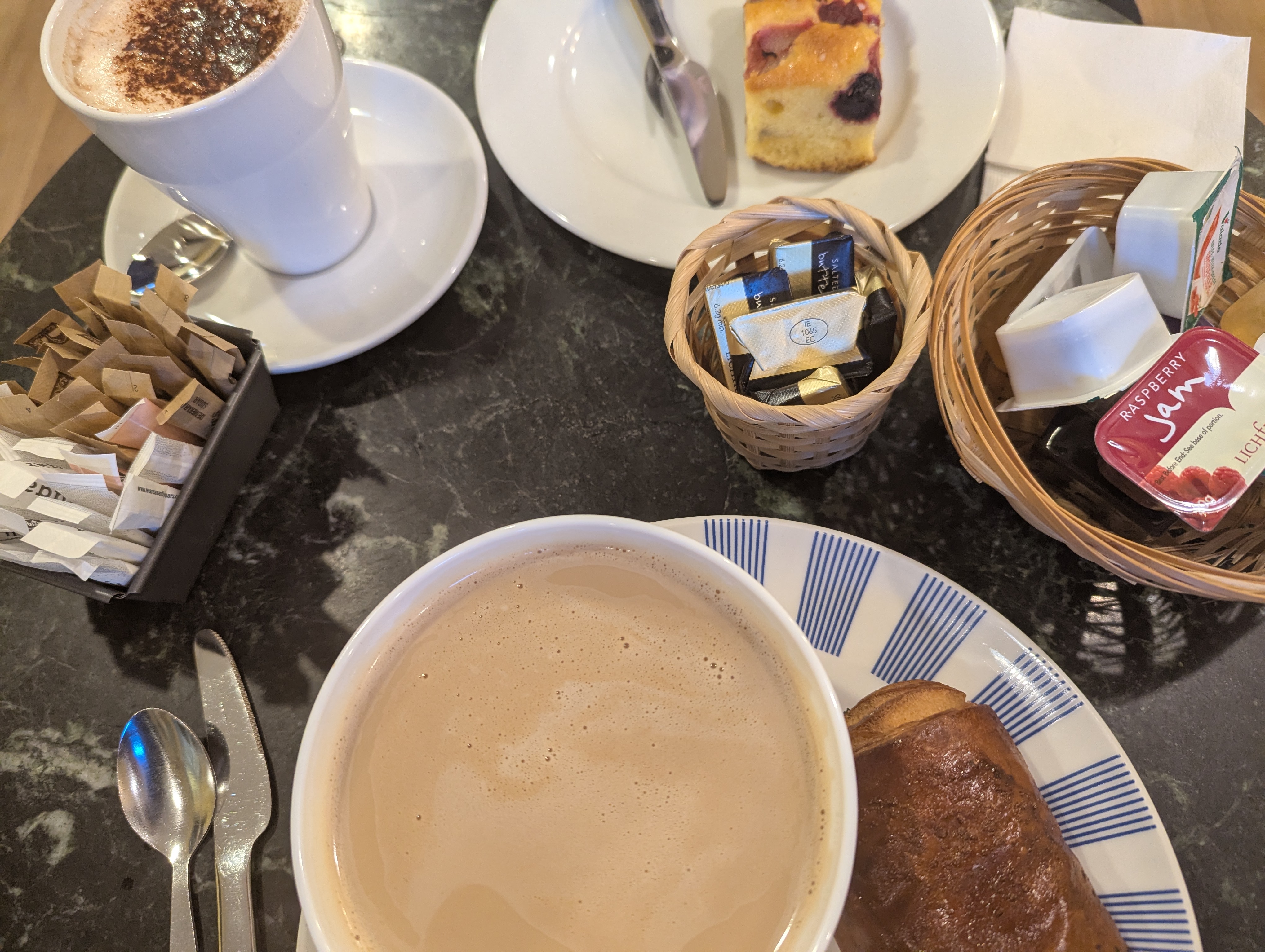
With the rain in the rear view window, we woke early and visited Cafe St. Pierre for breakfast. I had the “French breakfast” which was the croissant of your choice, a baguette with butter and jam, and a “bowl” of coffee. I thought maybe they just meant a large cup, but they really did mean a bowl. I had to lift it up and slurp it like a cat. (I hope that is what I was meant to do.) Lot of carbs in that breakfast but we had an active day planned.
Shower Report for the day: After the hotel invested a bit of time evaluating and fixing the prior day, water heat was by now a bit of a lottery. My husband won the warm shower and I won the lukewarm one. Steps in the right direction.
We took the train from Canterbury’s other station, Canterbury East, to Dover. It was quite a beautiful ride through cute towns and forests on a nearly empty train.

You should probably never judge a town by the appearance around its train station, but Dover seemed surprisingly gritty. We searched out a Welcome Center, which turned out to be associated with the Dover Museum and Bronze Age Boat Gallery. My husband was familiar with the bronze-age boat on display and asked about it in the Welcome area. They invited us to head up and see it on the top floor of the museum.

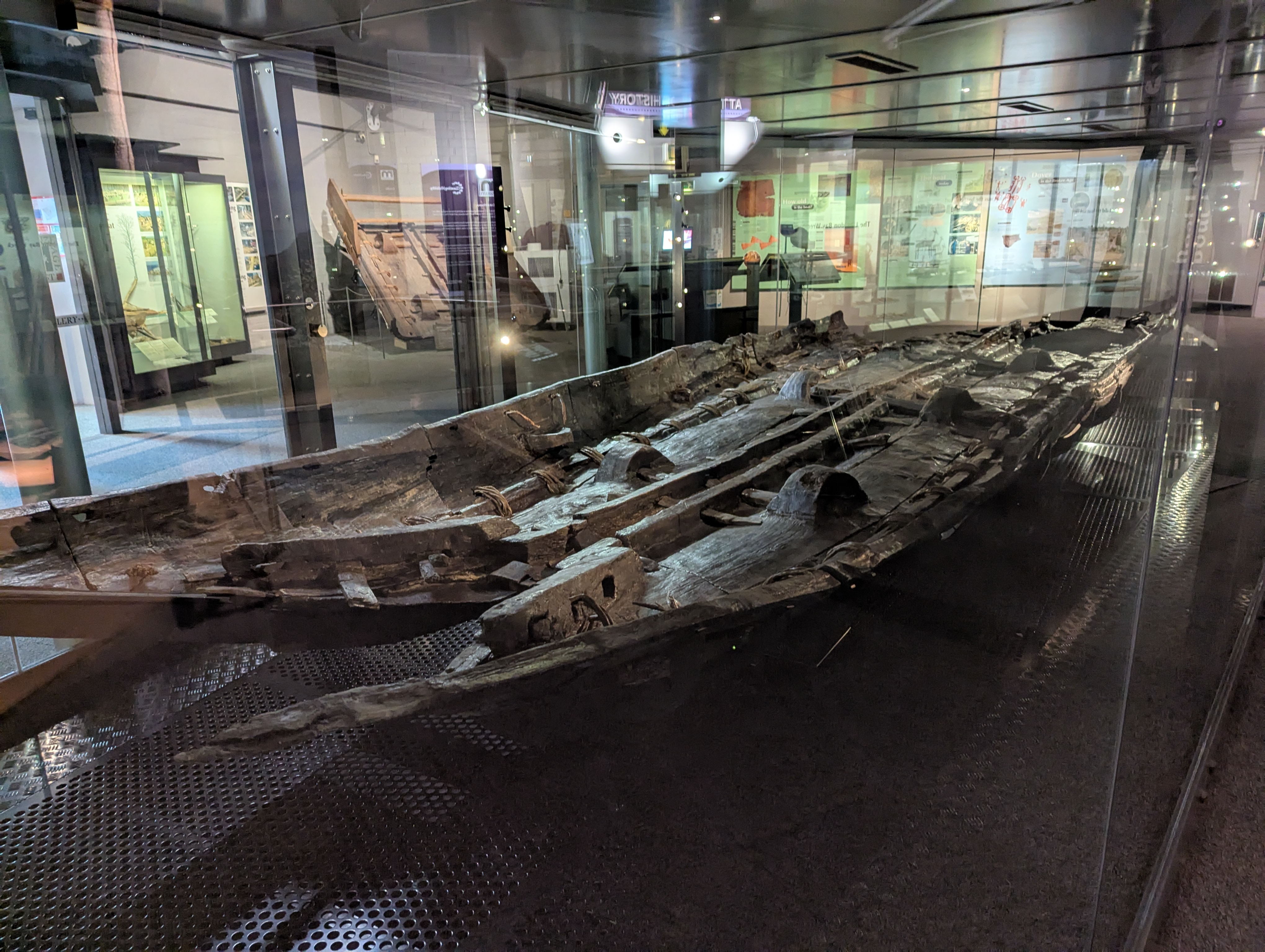
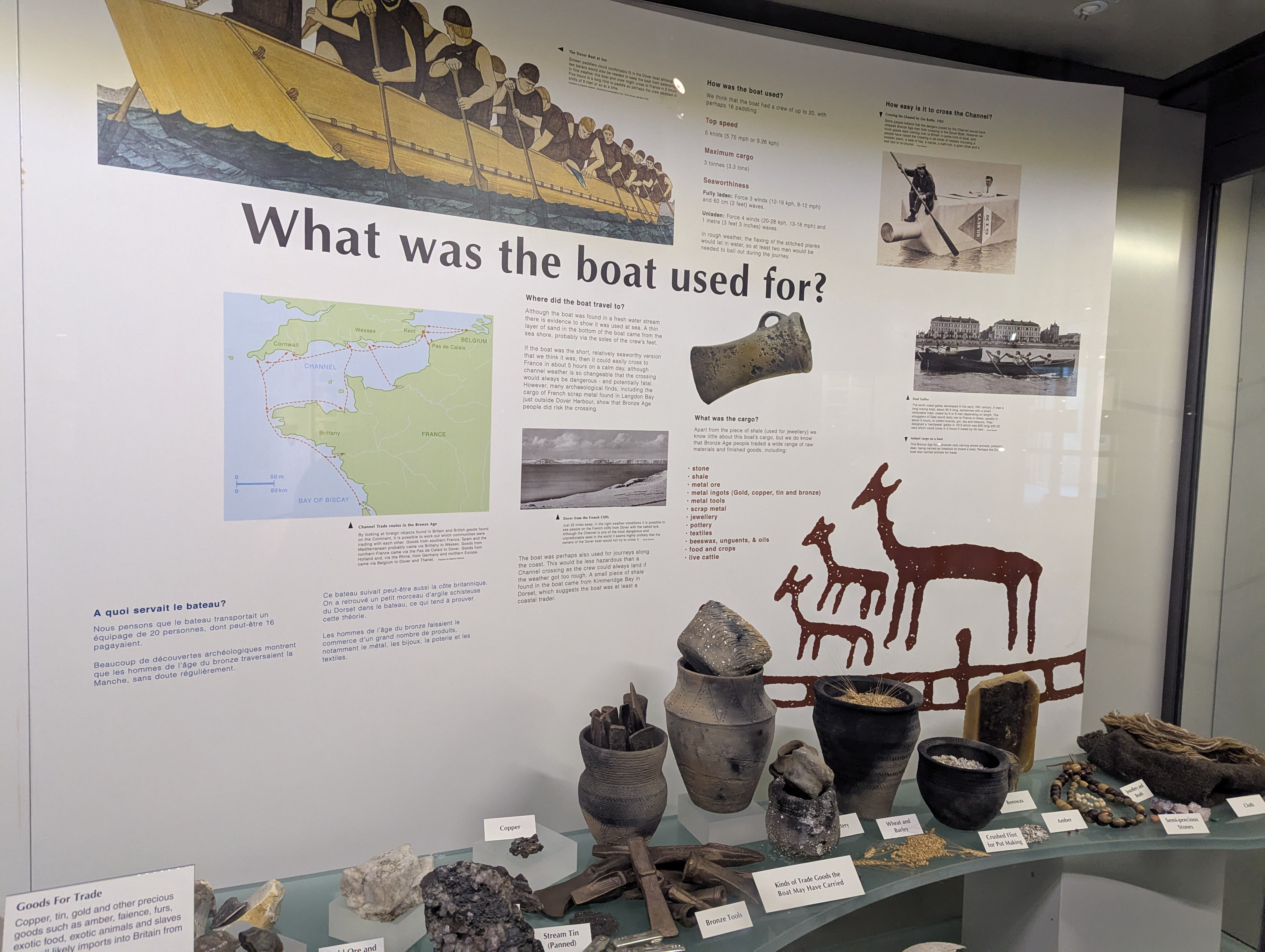
The boat was found near Dover in some sludge in 1992 during a construction project. Later evaluation determined it to be about 3,500 years old, the oldest boat ever found in the world. The original boat is displayed in a giant glass case. It’s in unbelievably good condition. As with many archeological finds, the discovery of this boat adds to our understanding of how humans lived many years ago and what they were capable of.
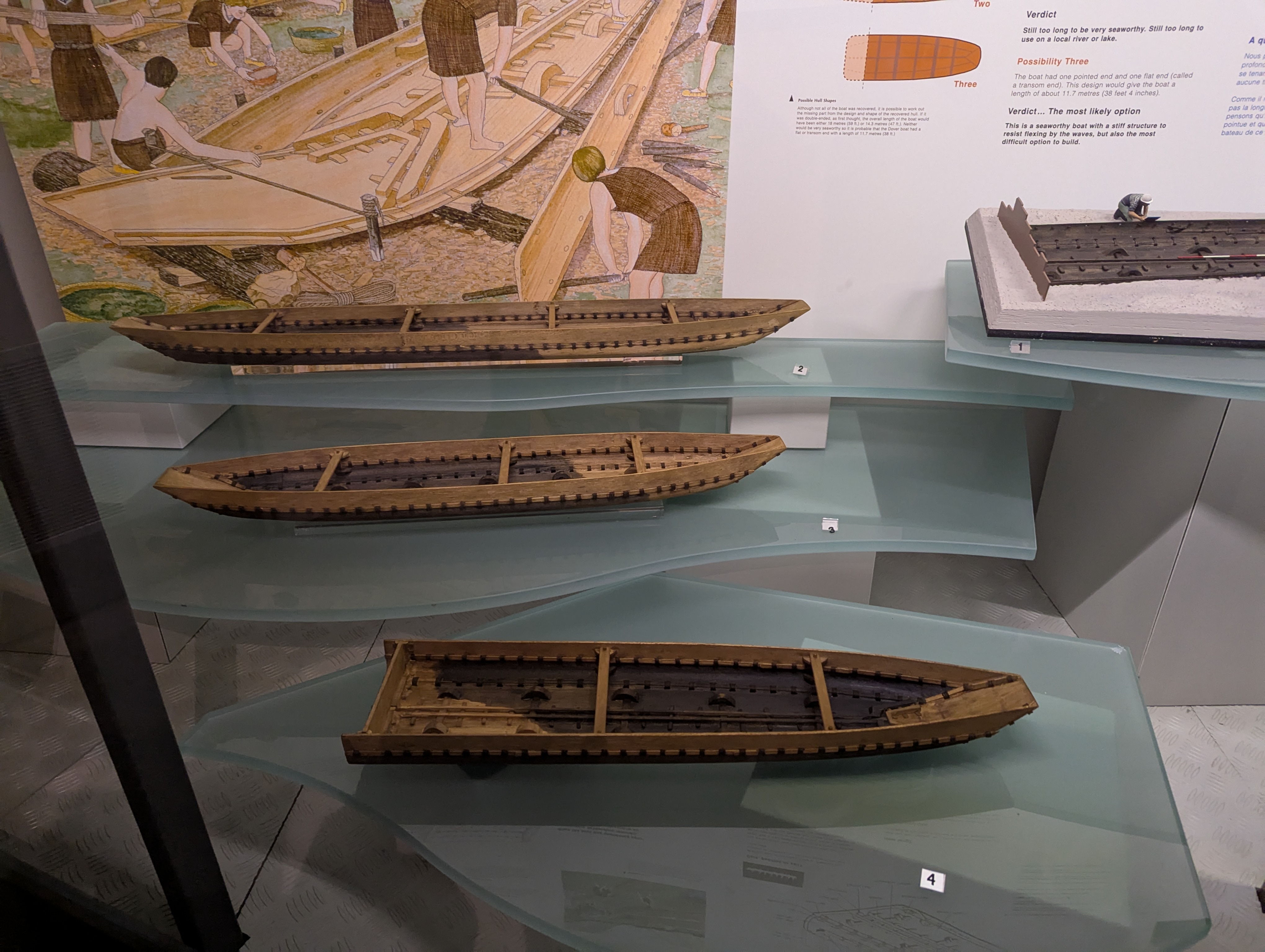
The exhibit included displays of bronze-age tools such as may have been used to build the boat. Because the boat was missing the back end, it also included an exhibit on how archeologists have built theories for what the back of the boat may have been like. I thought that was super interesting. Interesting to experience the thought process of curious and knowledgeable people.

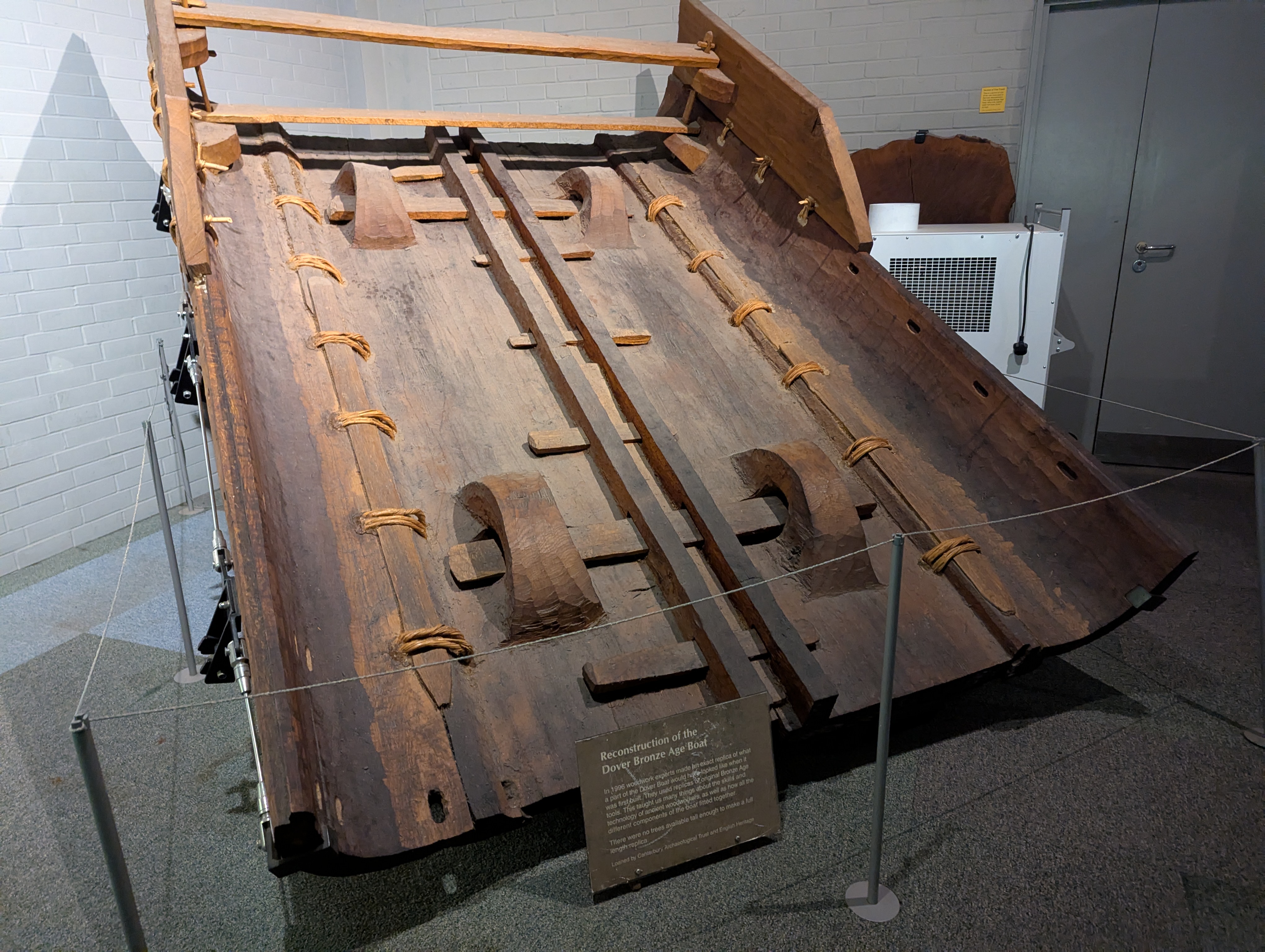
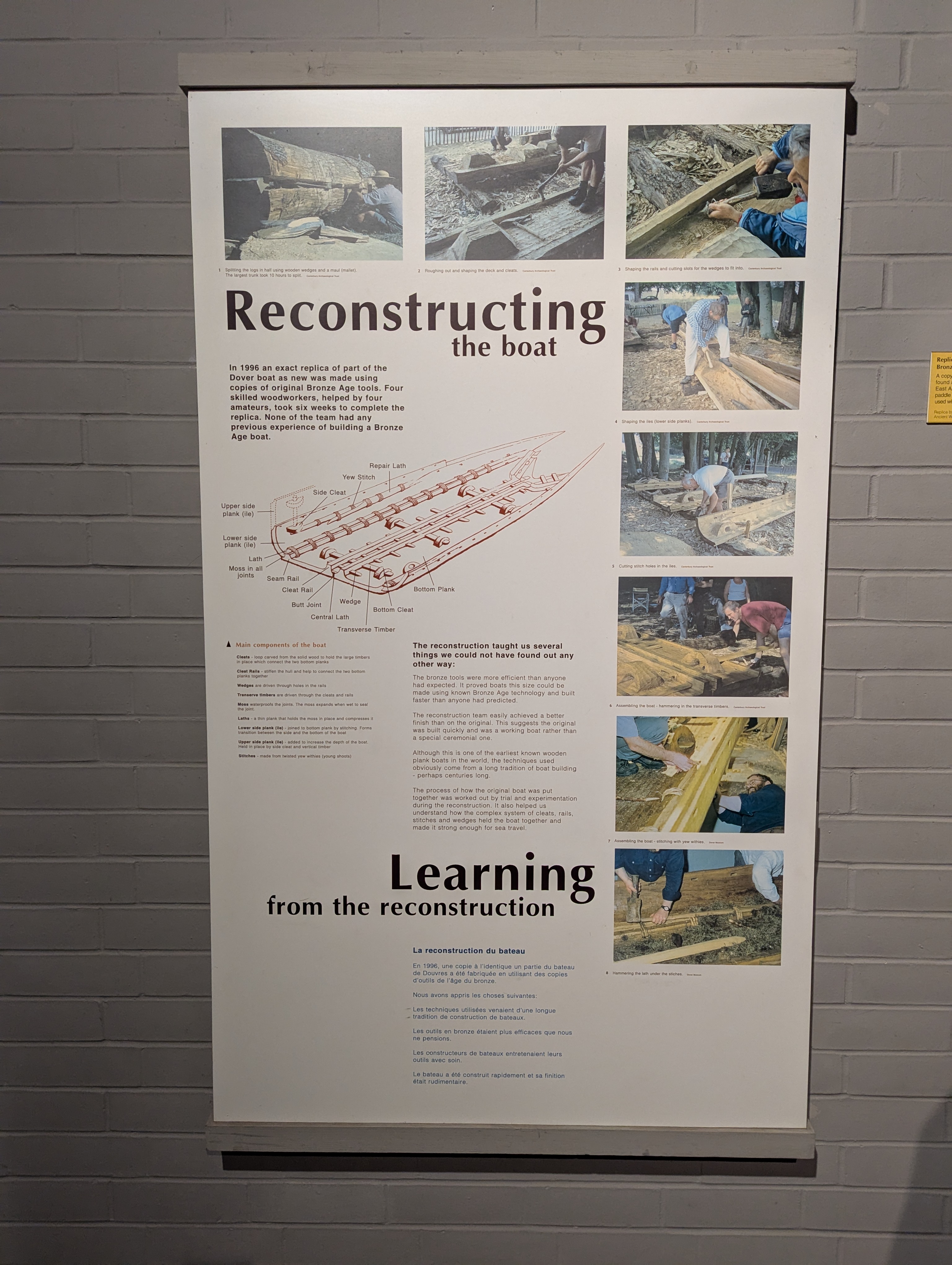
My favorite exhibit walked through an exercise that had been completed after the boat was found. A modern team attempted to replicate how the boat was built using bronze-age tools. They were able to build a replica of the boat (part of which is in the museum) in 6 weeks. In theory, the original builders probably were more familiar with the tools and boat building and could have completed it more quickly. But, in a bit of shade thrown by the people replicating the process, they concluded that, in part, it took them the long 6 weeks also because they also tried to provide beautiful finishes which the original team had not. That also provided clues as to the use of the boat. It was utilitarian and probably not ceremonial. But it certainly stood the test of time.

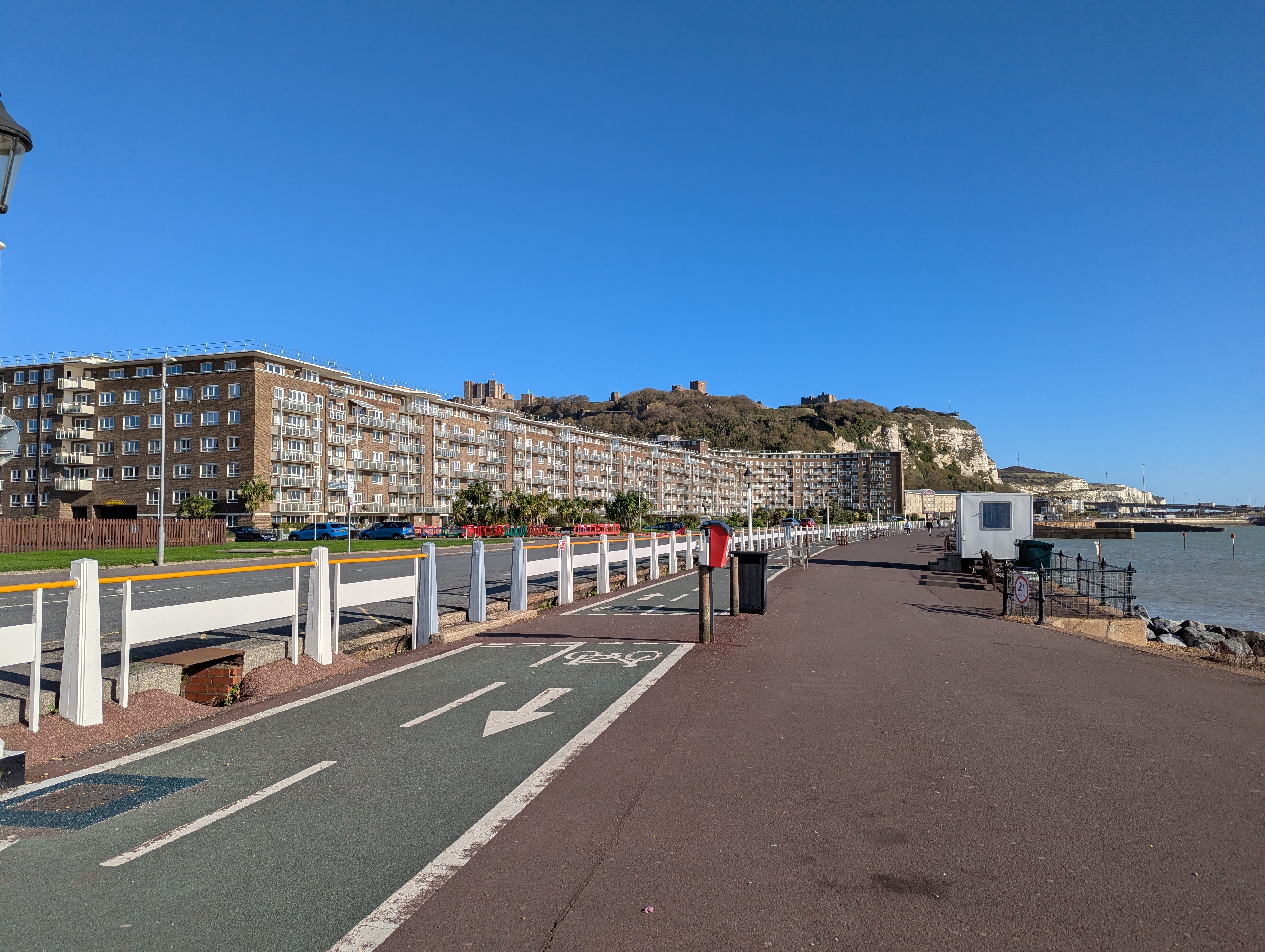
From the Welcome Center we walked over to the harbor and up the shore until we reached where the path is accessed to go up on the famous cliffs. The harbor is a functional harbor from which a number of huge ferries left or returned from trips over to France. It is not a beautiful stretch and sits right next to an extremely busy road. There are some cute cottages as you seek the path but they do not have a pretty view.

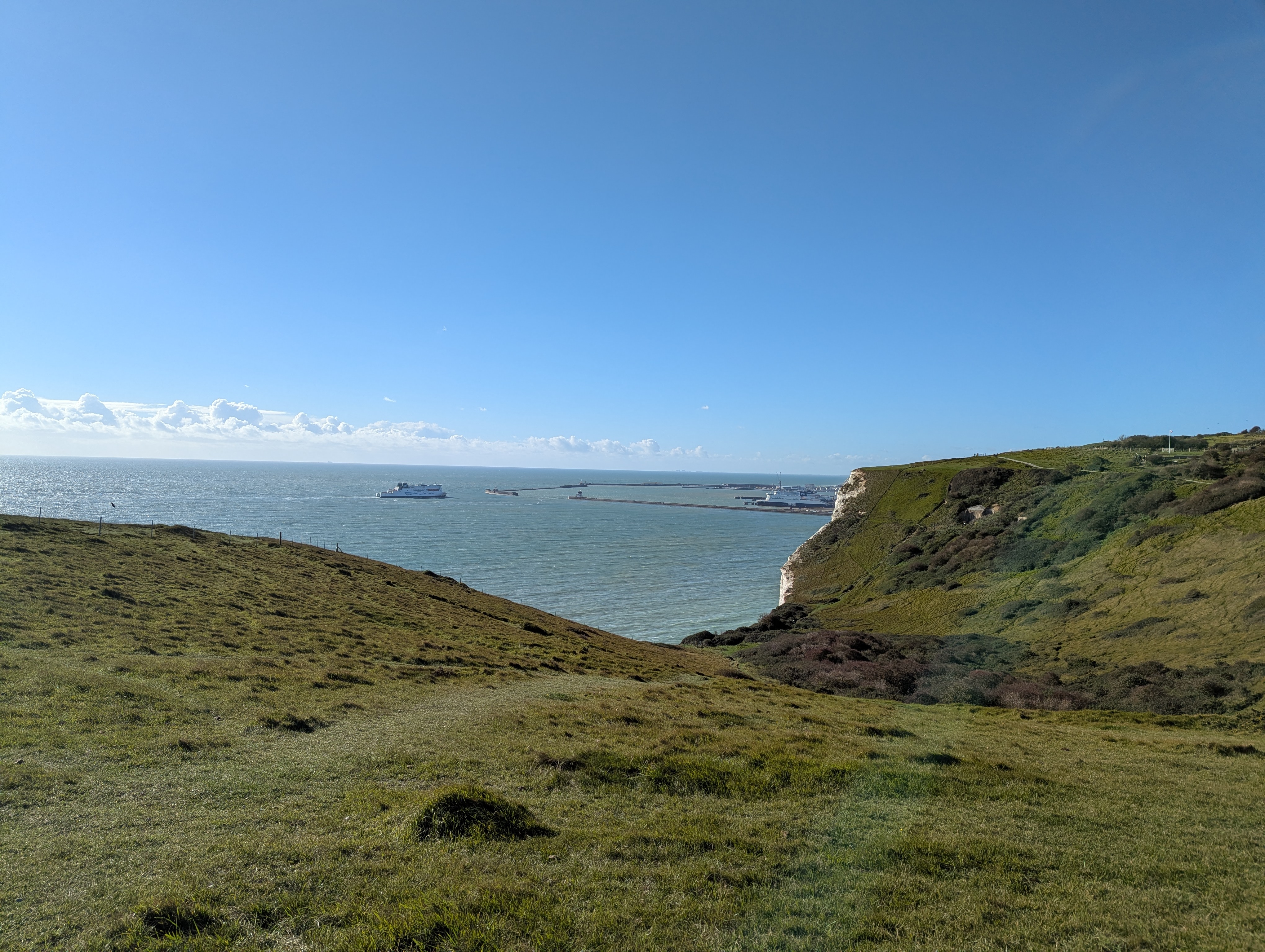
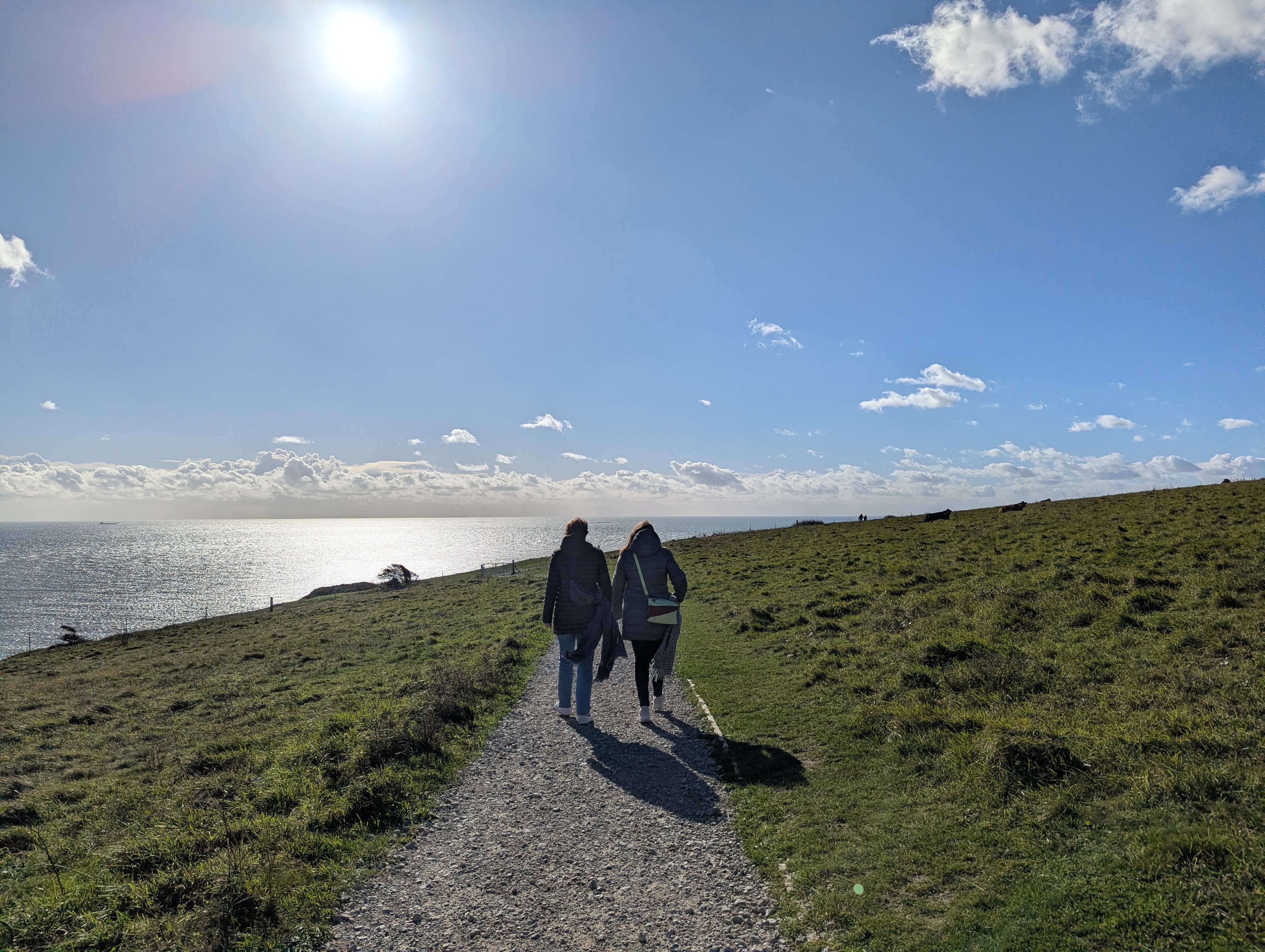
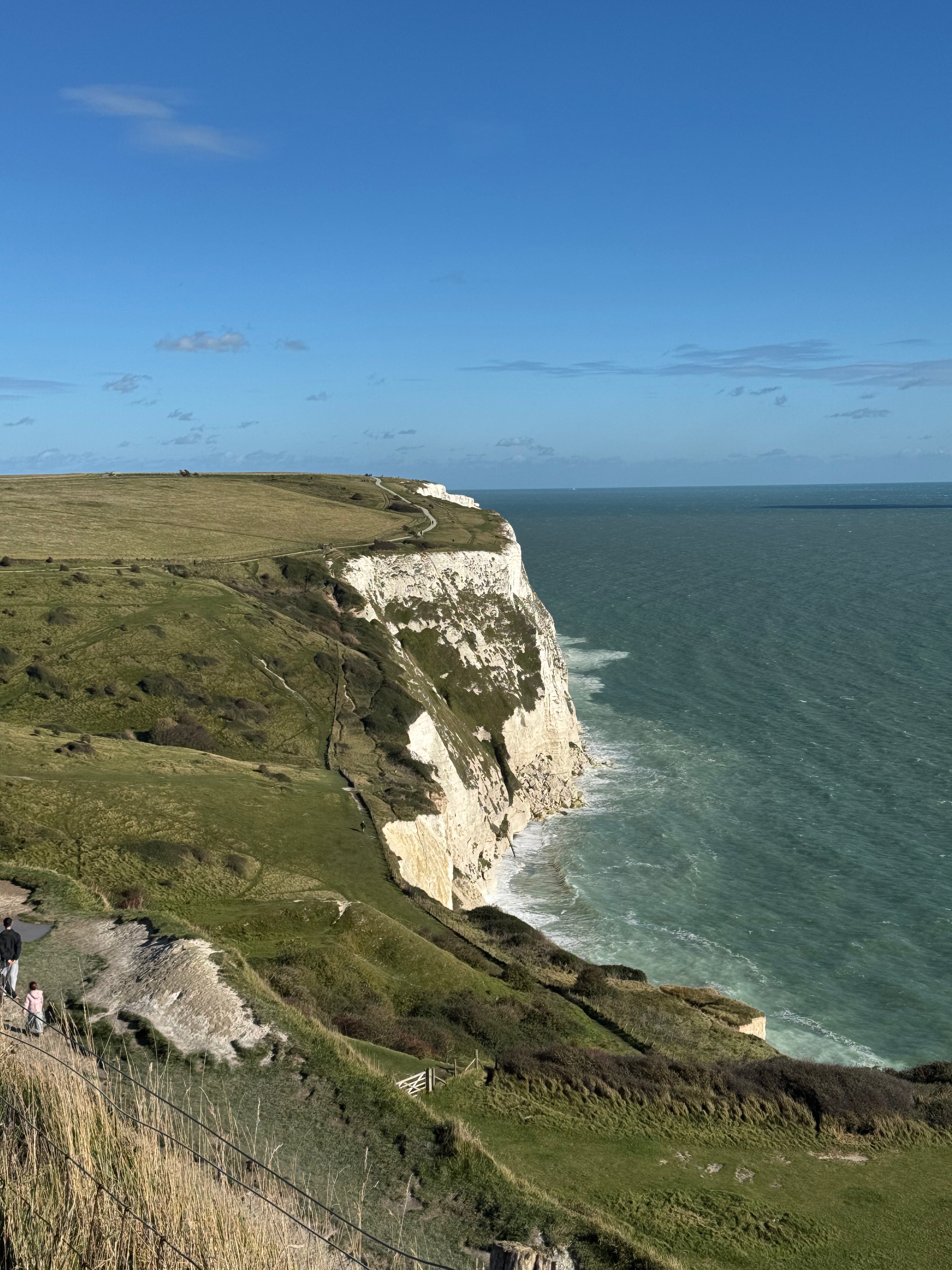
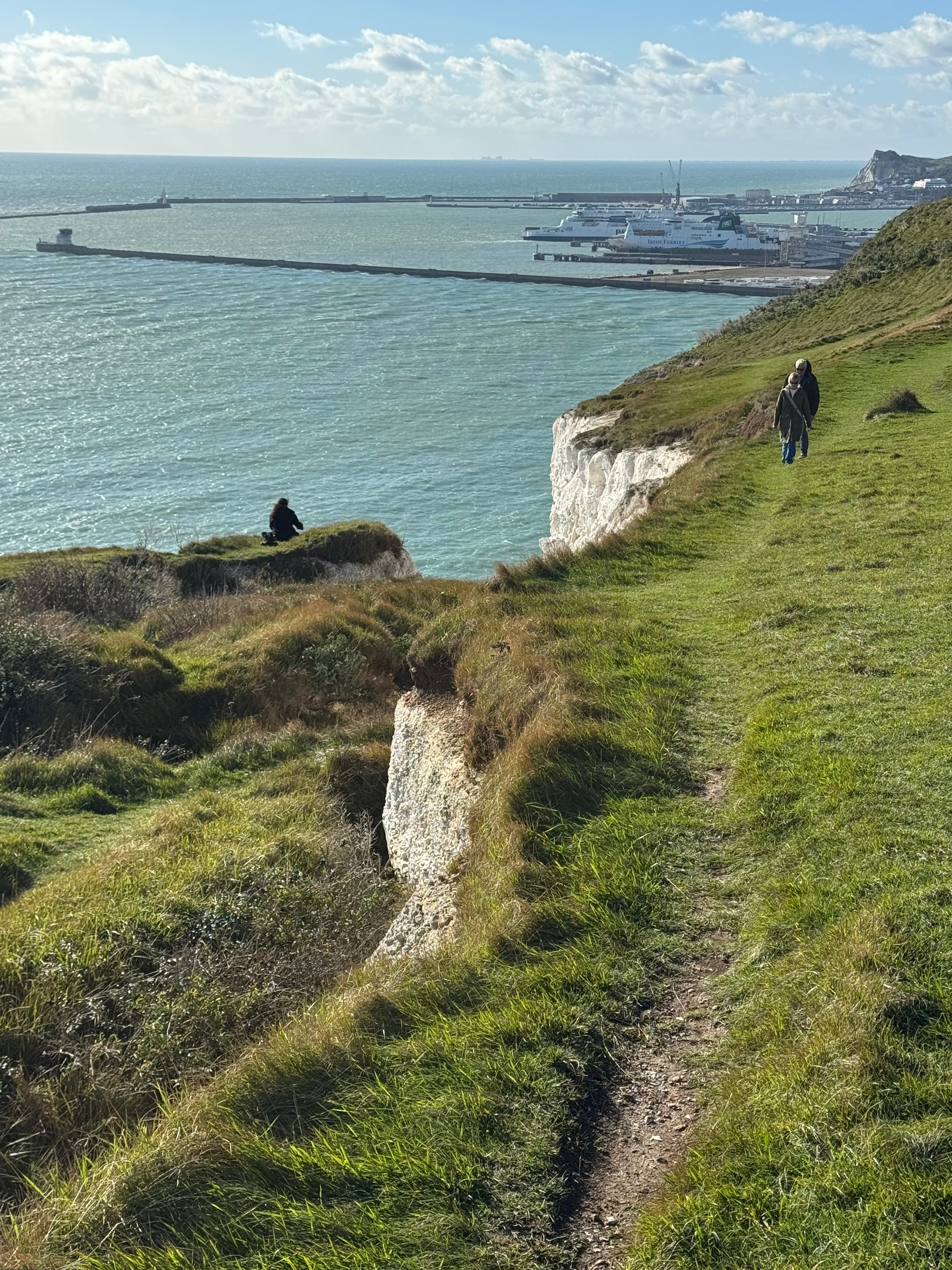
We climbed up and up the path. The wind was whipping but with the steepness of the path I became overheated pretty quickly. I stopped to remove my raincoat to finish the rest of the climb. On a clear day it’s possible to see France across the channel and we could make out the outline in the distance. In fact, we were close enough to France from the cliffs of Dover that T-Mobile sent me a text welcoming me to France and explaining the rates for texts and calls.

We were starting to be in a space that was far more beautiful than gritty. We could see the beautiful white cliffs, rolling hills, grazing sheep, the Dover castle. Even the harbor, which had seemed so industrial near the bottom, was pretty as we got higher on the cliffs.

At some point we had to make a decision about taking the high road or the low road. Our choice lead us very close to the edge of the cliffs. Although I’ve done a lot of Colorado hiking and skiing in my life, I’m not super comfortable with heights and I sensed my husband was also not so comfortable near the edge. We did all right and ultimately came to the part of the path that’s not so “out there.”

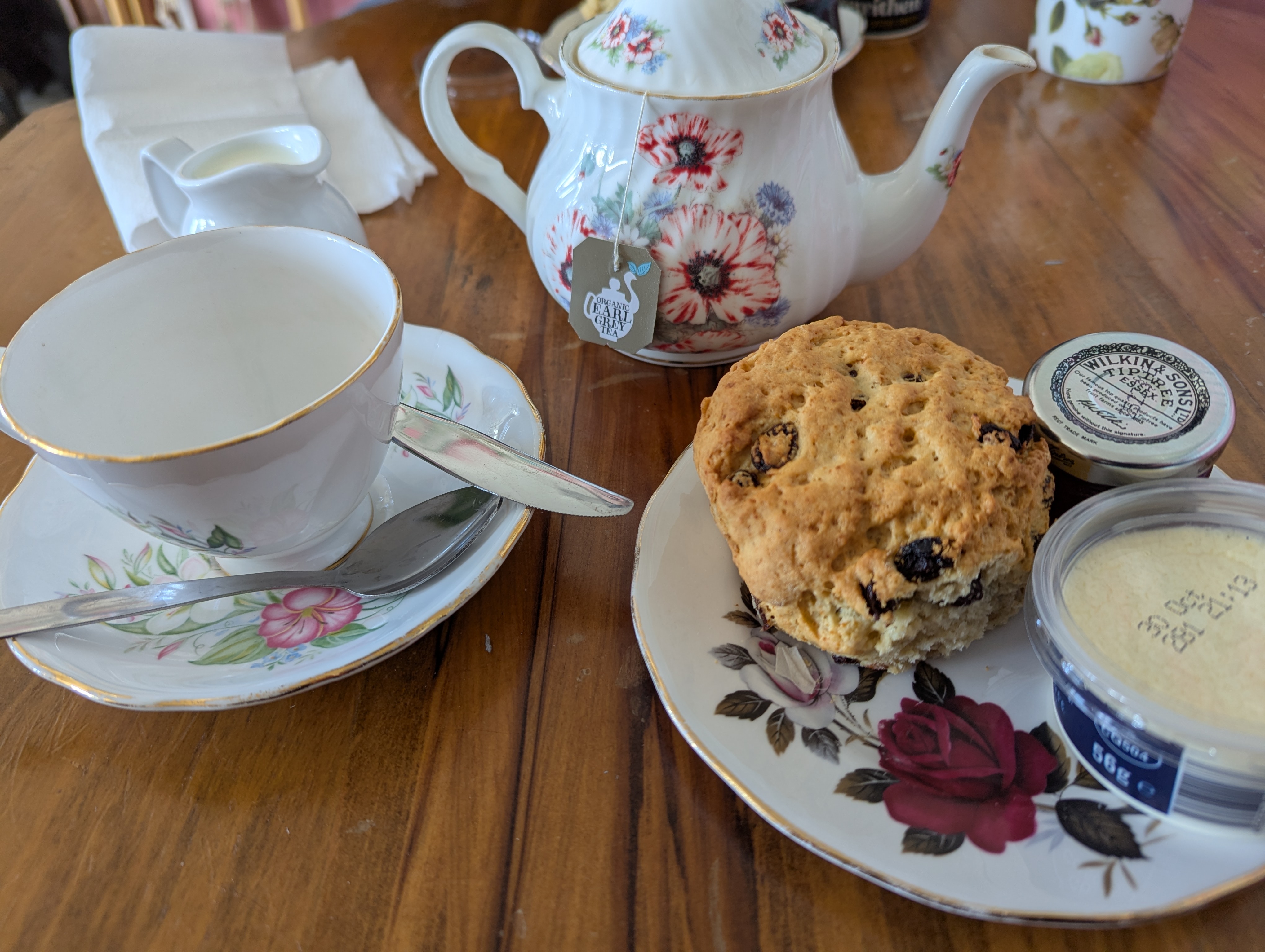
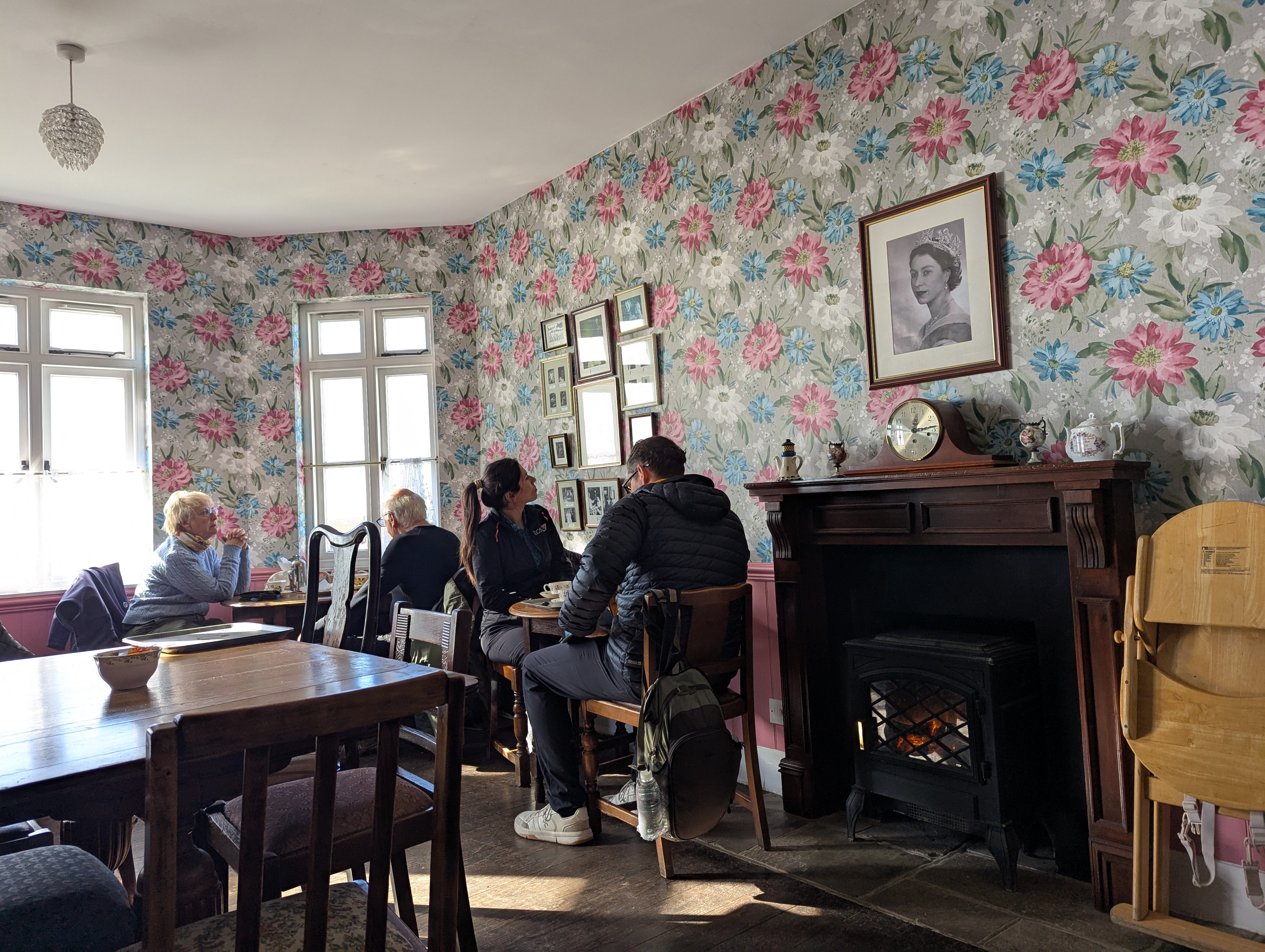
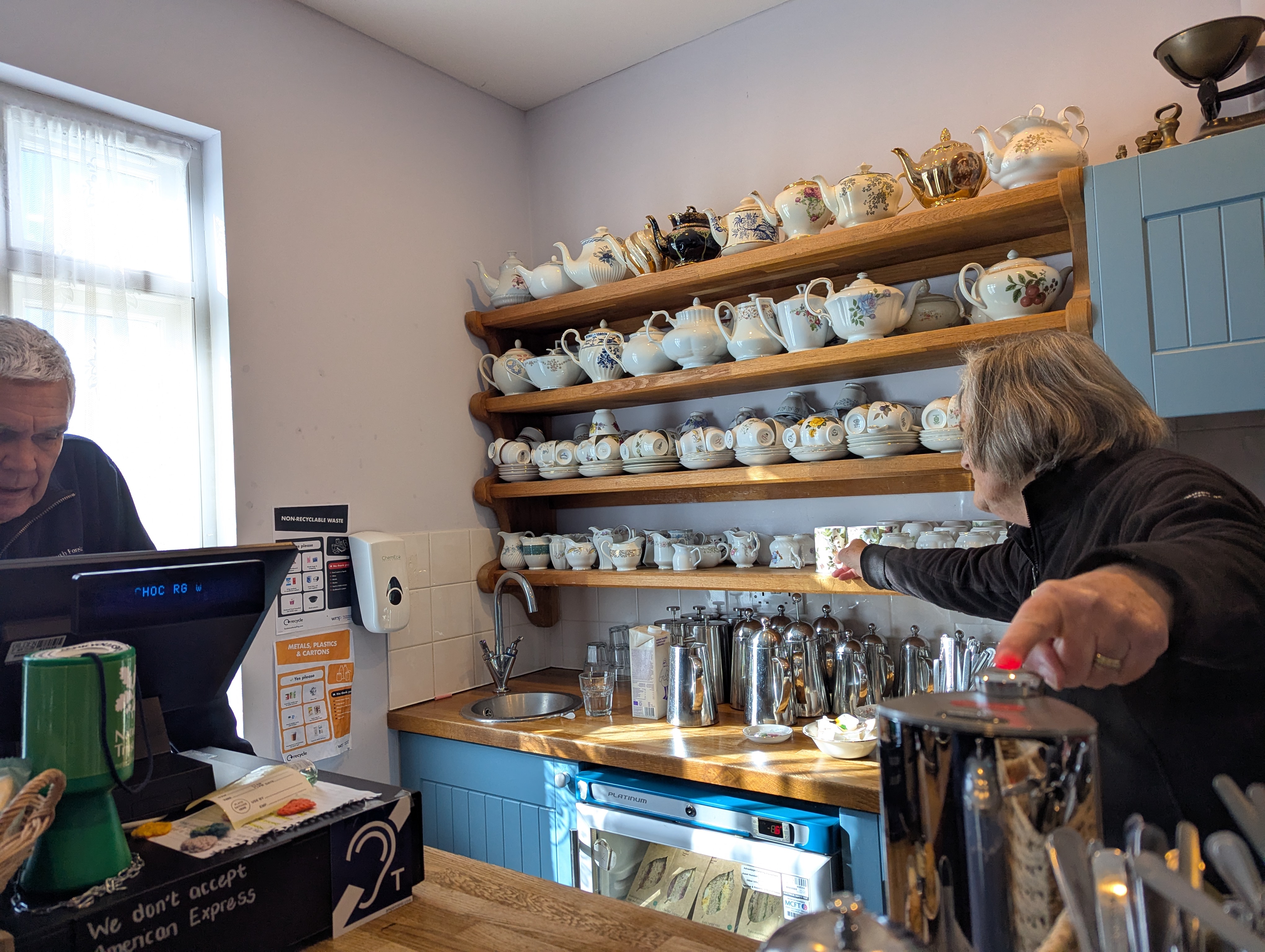
Our destination on the trail was the South Foreland Lighthouse. To reach it you go through a field of giant cattle. On the first floor of the lighthouse there is a cute little tea shop called Mrs. Knott’s Tearoom. It has a limited selection of items but who cares? It has cream team, which as we know means scones and clotted cream. It was served in lovely china in a beautiful room. It was a delicious way to celebrate the mid point of our hike.

We intended to go to Dover castle after our hike and, while we could see the castle from the cliffs, there is really no way to get to it without leaving the cliffs. So we hiked back down and then walked up a different hill, more or less in town, to get up to the castle.

If you may remember, my husband hurt his back on our last trip to England and it was not healed for this trip. He was able to do most things, but I tried to help with his luggage on stairs from airport to tube to hotel and carrying our shared backpack on our trips around Kent to try to preserve his ability to tour. He was still using heating belts to keep his back limber.

We had already walked more than 16,000 steps and 111 floors (so says Apple) and I felt maybe we could admit a small defeat and take a cab up to Dover castle. My husband would not hear of it. I’ll admit I was cursing his not-good-at-that-moment name as we climbed up the new hill. The fact is, we won’t always be able to do what we used to be able to do in the way we could do it. I hope over time we’ll be able to adjust our travel to fit our bodily realities and not have to stop travelling just because we can’t do it the way we used to. i.e., we may not always be able to hoist our luggage up and down stairs of stations on the Piccadilly line. Admittedly the cab in this case was for me as much as it was for him. I was pretty tired.

Now I’ve exposed you to the key conflicts in our household at the start of my retirement. My husband worries about spending too much money and I worry about losing our health while pushing to do things our bodies may be on the verge of no longer being able to do. My husband, the one with the sore back, seems to feel that he is not getting any older physically. In fact, this morning (a few weeks after this trip) he told me my feelings about aging are “a self-fulfilling prophesy.” I’m pretty sure our bodies will themselves fulfill my prophesy and, you know, “My Body, My Self,” so I can’t argue with his statement even though I suspect it will go down a bit differently than he intended with that turn of phrase.

But–this time–we made it to the top and made some quick calculations of what we’d be able to do at the castle. We were running out of time and it turned out there was a lot more to see and do at the castle than I had realized. This was not just another medieval castle (although it also was that), this area was used to protect England during modern wars also. Assuming it is ok to consider the World Wars as “modern.” There was also an very old church on the site. I think it would be easy to spend a full day at Dover castle.

We decided to hit the church and the medieval castle and skip the “modern” wartime tunnels, fire command post, underground hospital, etc. It was a tough call because those things looked very interesting.

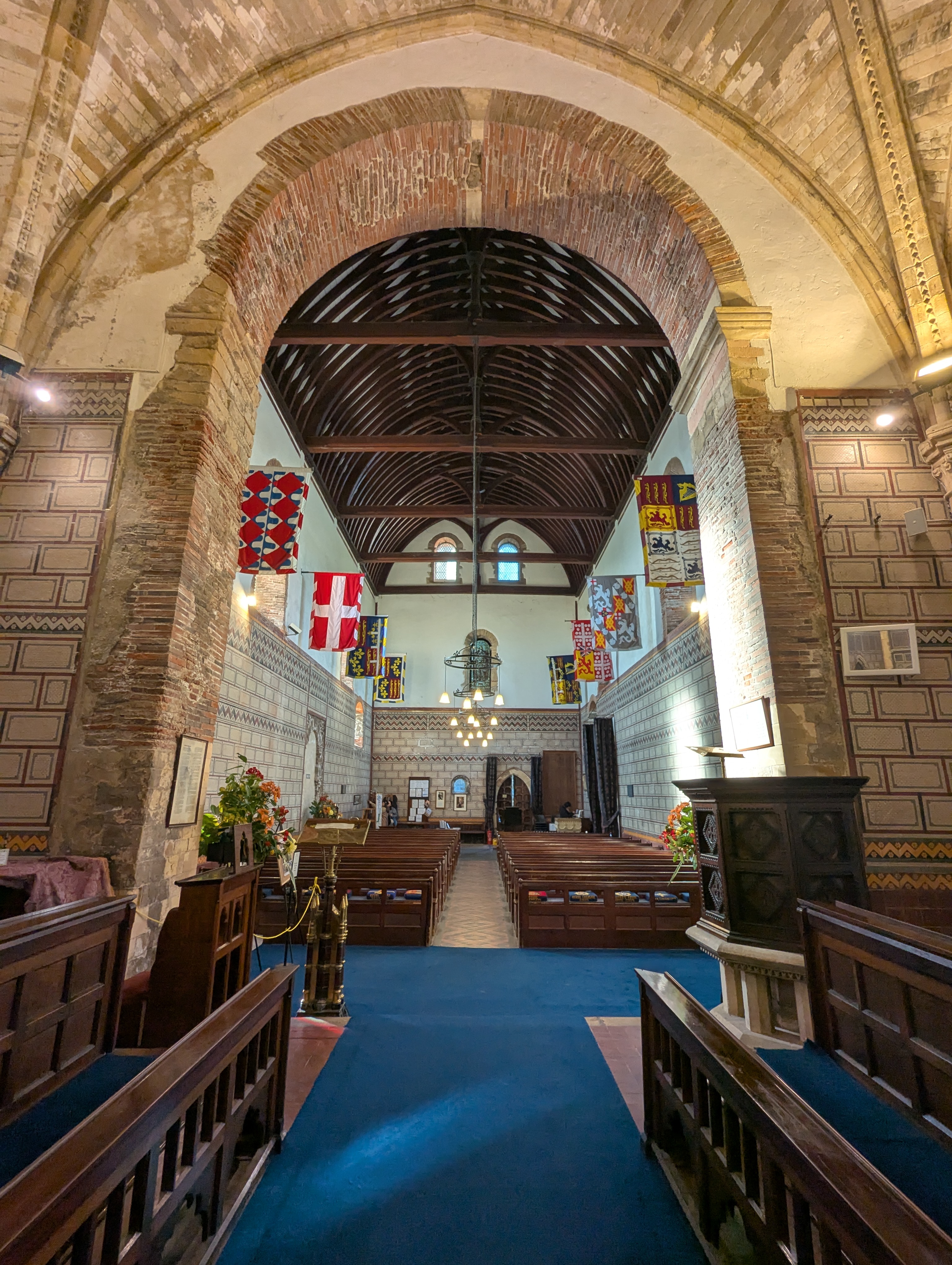
The St. Mary in Castro church was built around 1500 years ago, probably on the site of a much earlier church. It apparently was a building that was not affected like other churches by the boring people coming in and demanding that color be removed. It had beautiful, colorful tiles in walls and ceilings, in addition to lovely windows. It’s a functional church. We had very little information about it as we toured, but it was lovely to be in. Next to the church sits a Roman lighthouse that’s been converted into a bell tower. Pretty cool.

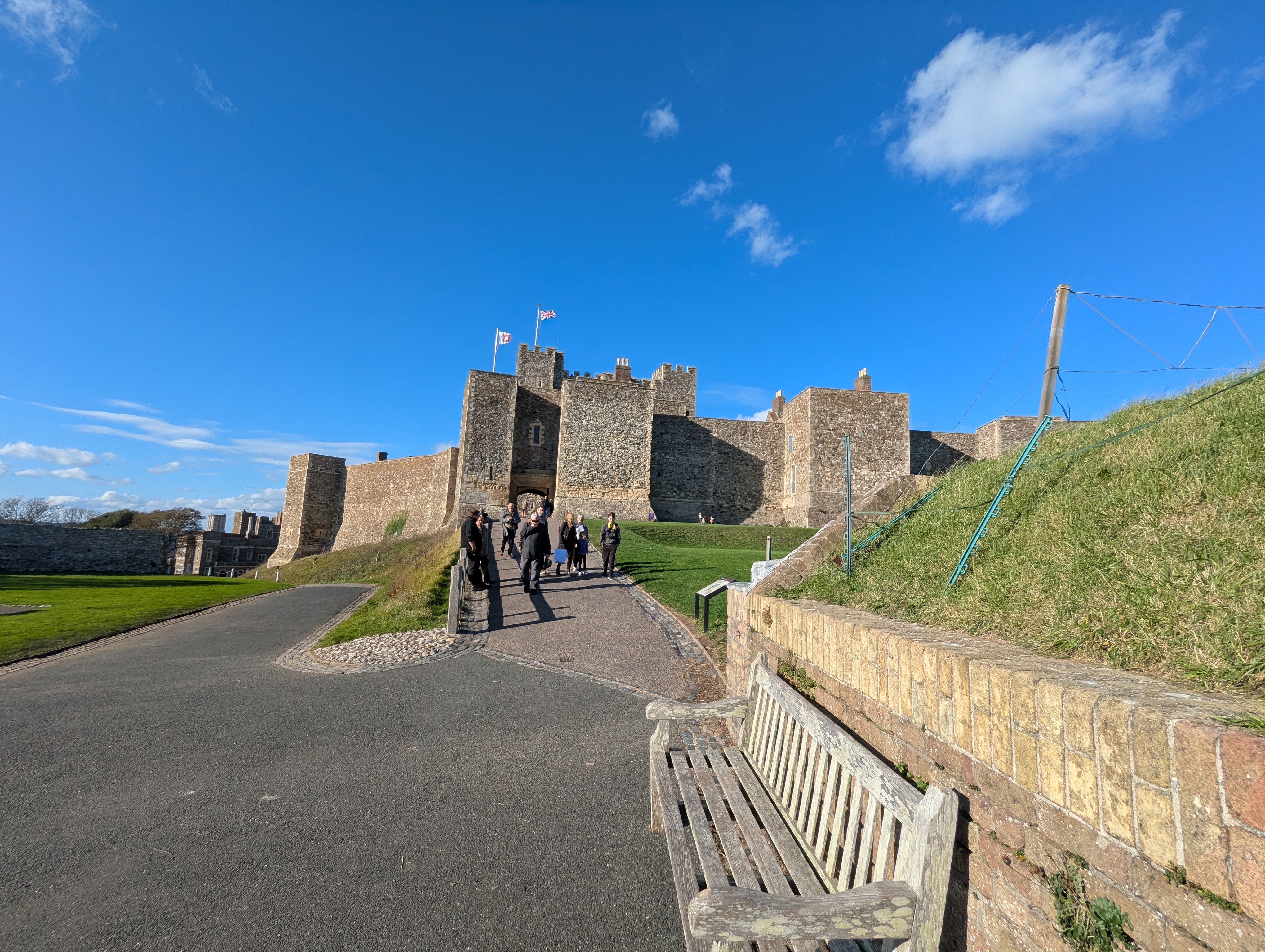
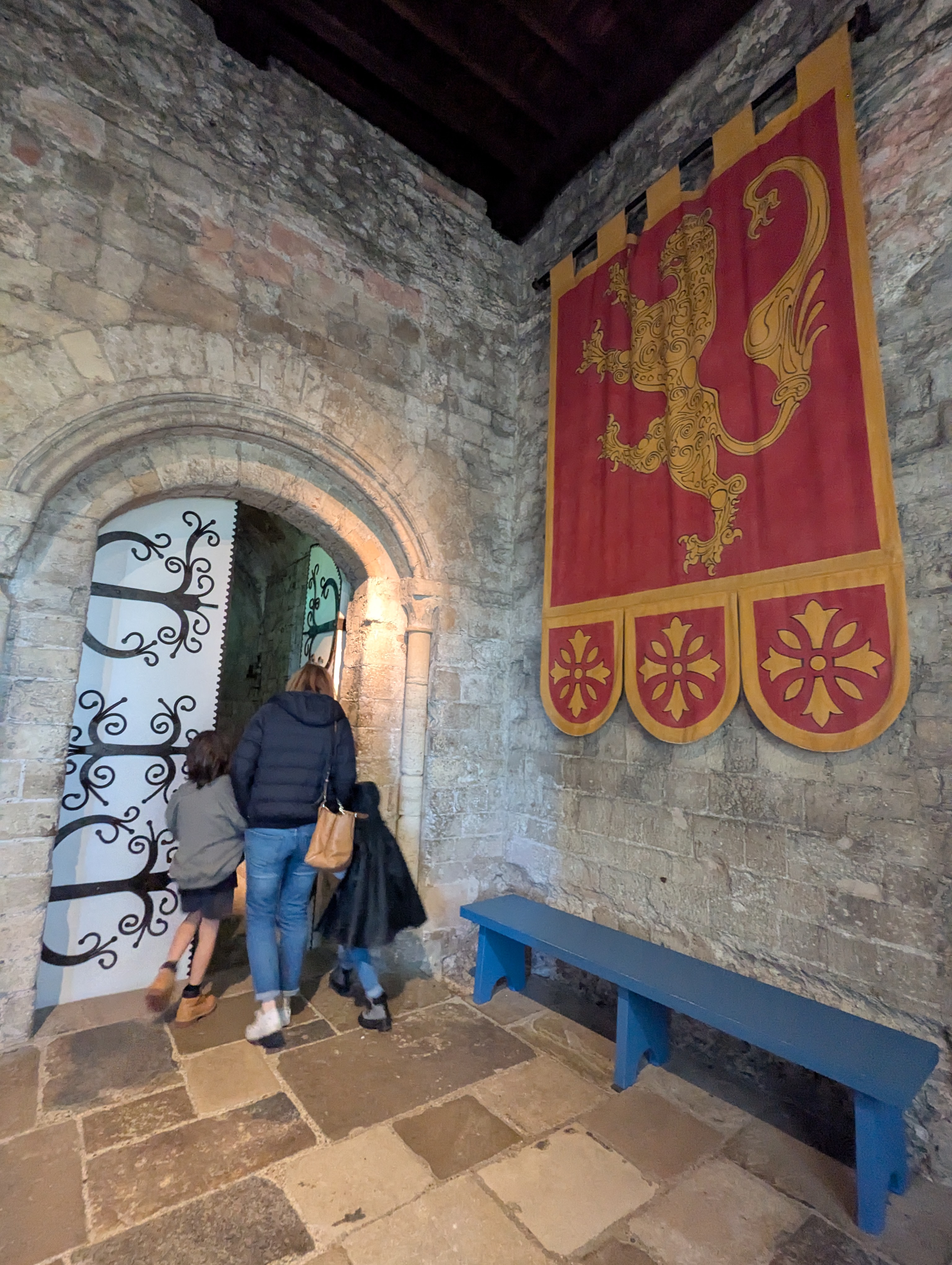
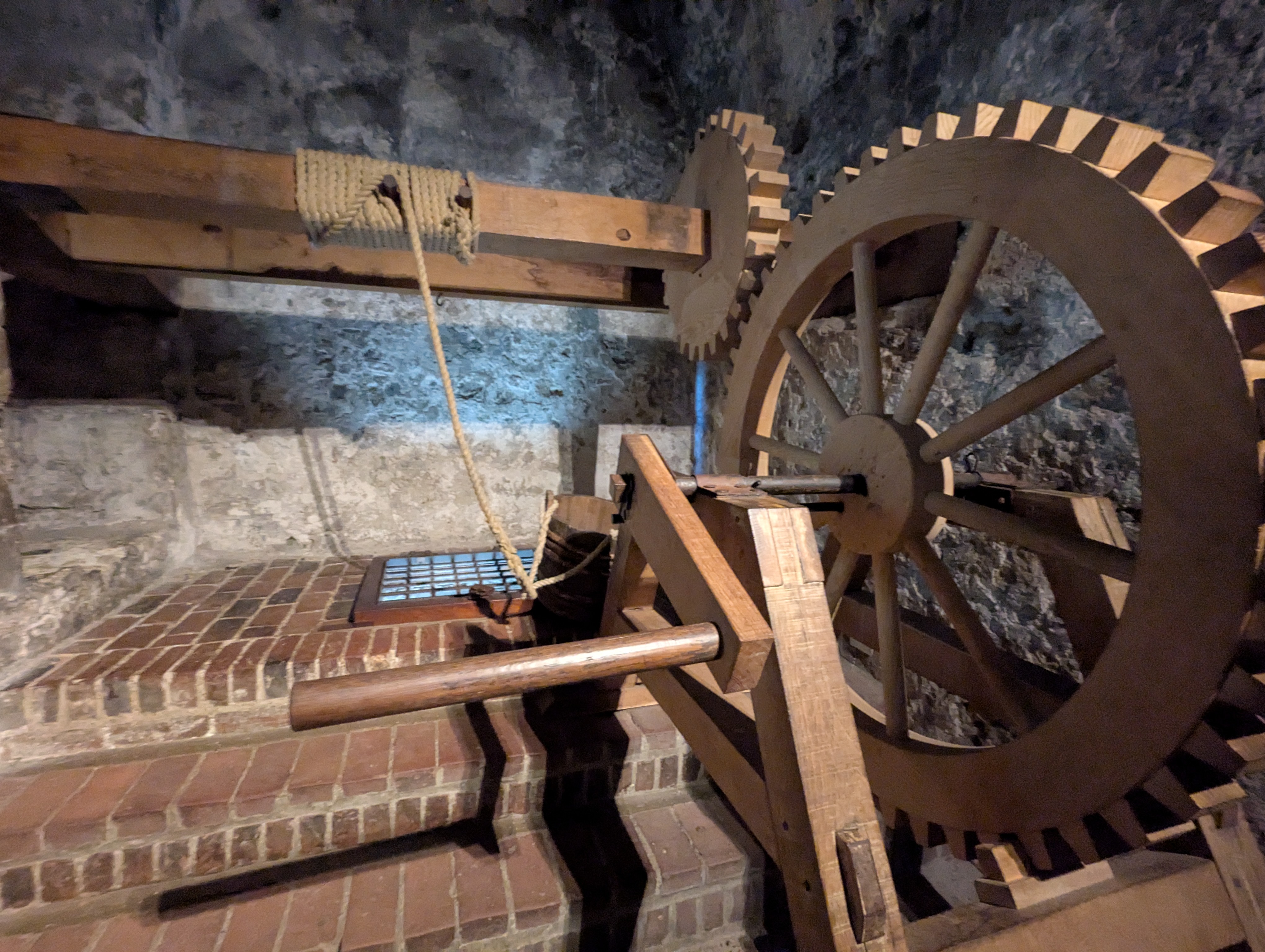
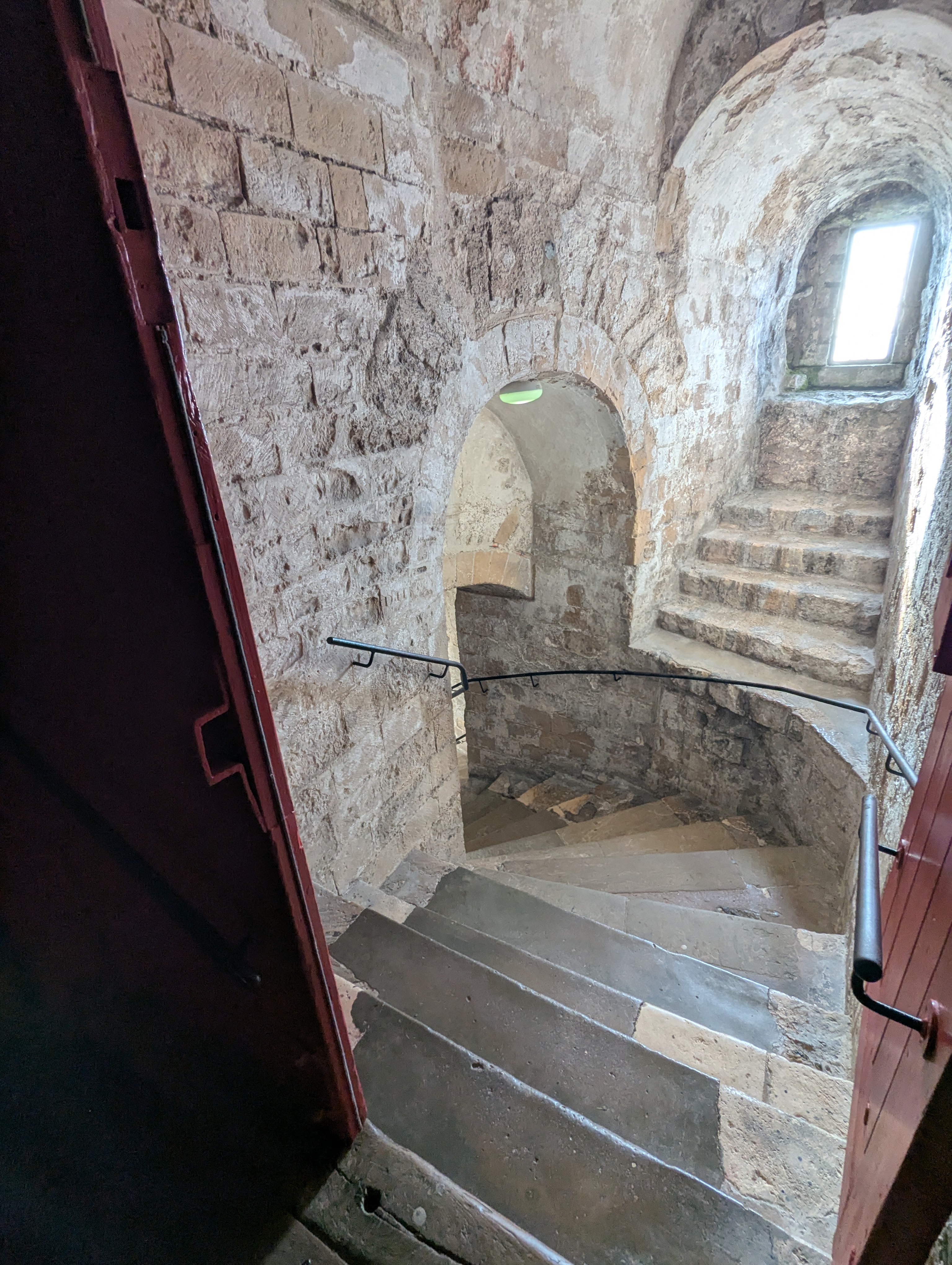
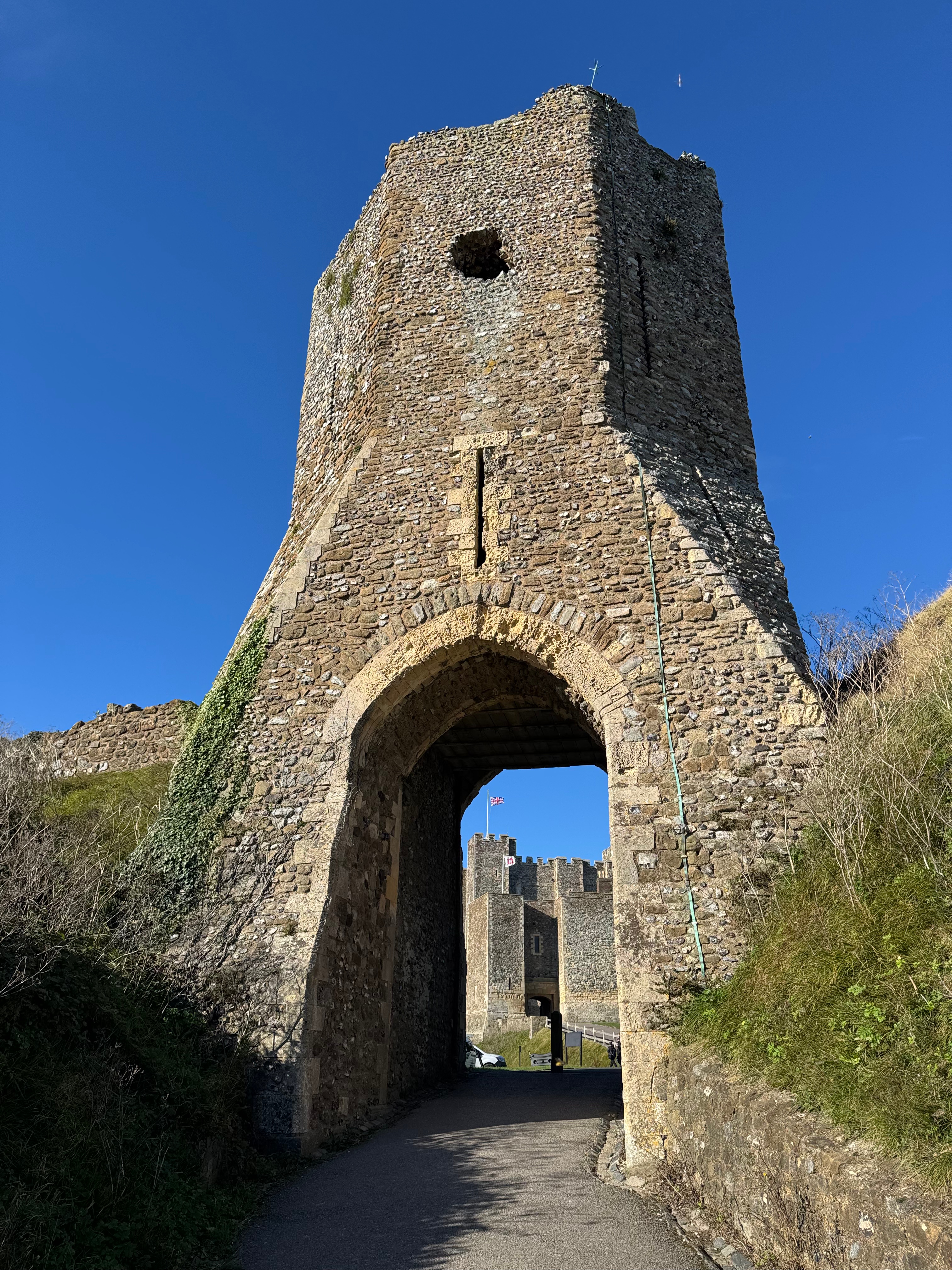
We explored the castle proper. Although a building of some sort was in place during the Roman occupation and was damaged and rebuilt following the Norman invasion, the medieval castle as it exists now formed under Henry II, who we met yesterday as the person responsible–accidentally or intentionally– for Thomas Becket’s death. We walked through the external walls and the grassy enclosure and then through the keep. It was quite large with several floors to explore.

The way the castle was exhibited with representative but somewhat cartoonish furnishings was quite a lot like the castle at Norwich we toured last month. Similar set-up geared well for kids to explore. This castle was in much better shape, though. Because it was before Halloween, what the kids seemed most interested in in the castle was a worker dressed up for Halloween like a witch.

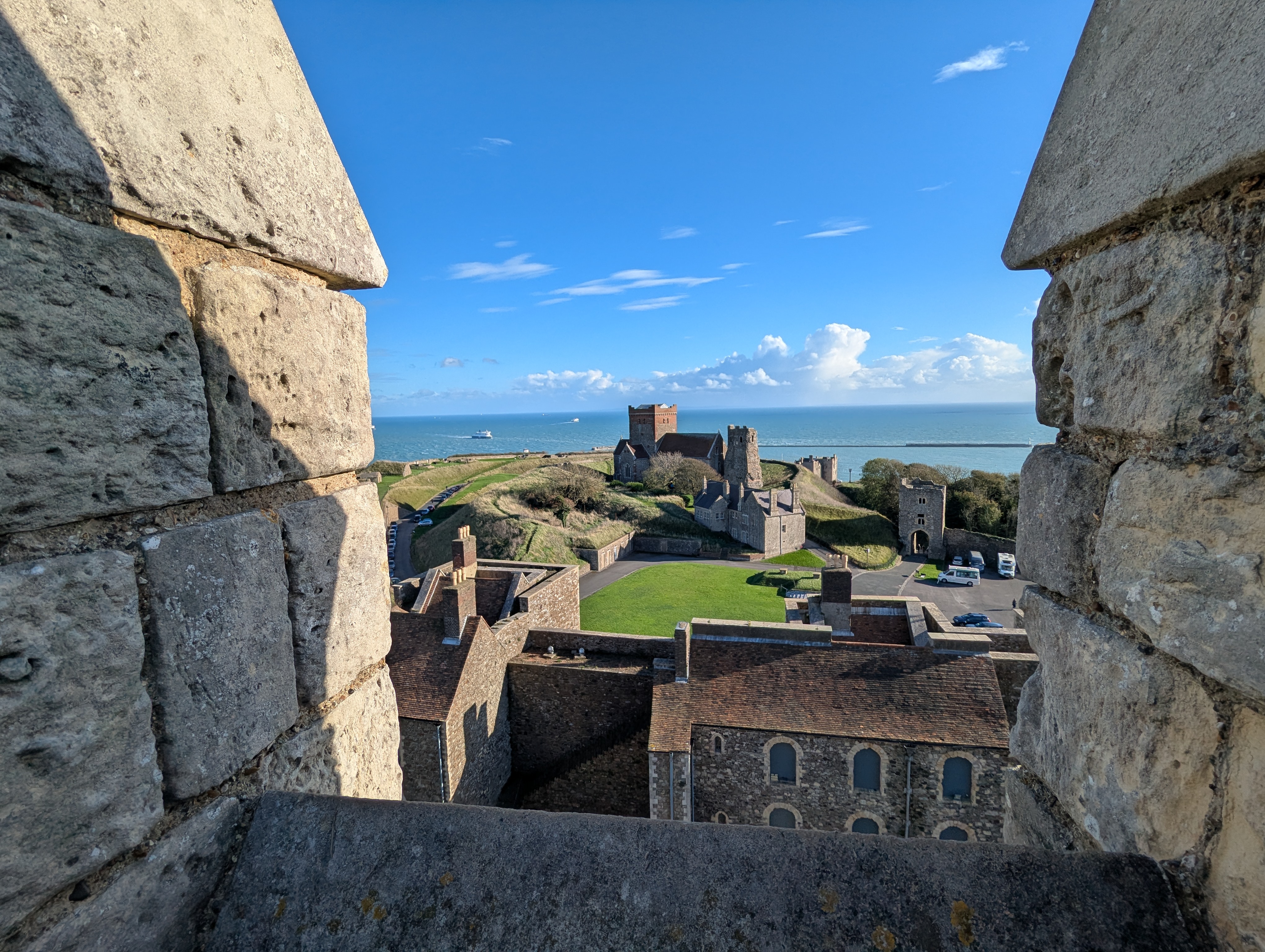
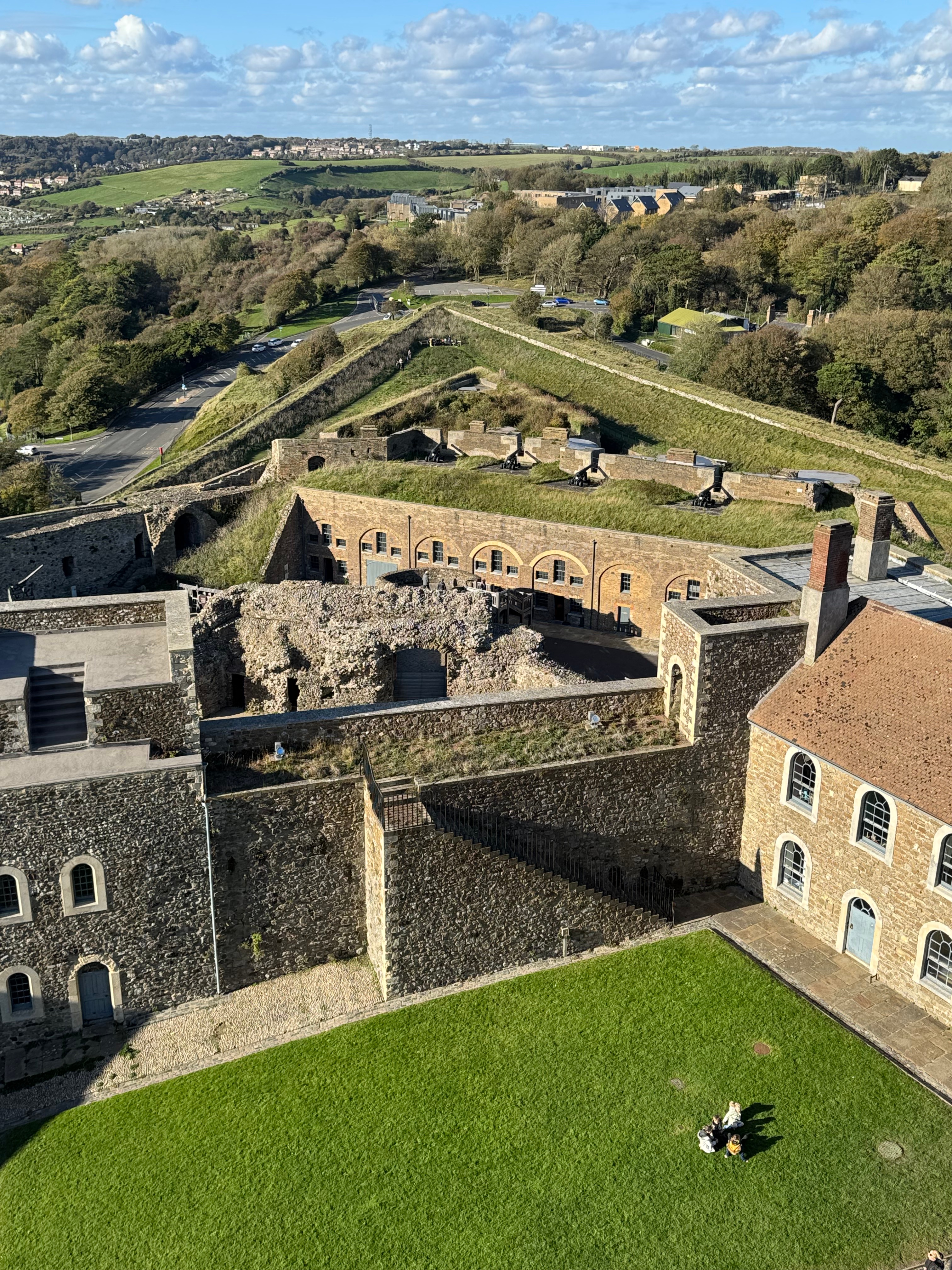
My favorite part of the castle was he views from the roof. It was unbelievably windy up there but you could see all over town, out on the country side, over to the cliffs. Beautiful.

We made our way down the hill again with sheep visible grazing in the moat of the castle. Our next destination was the rail station. We had decided to take the train to Deal, which we had not been able to visit as planned on our recent trip to Sandwich. The plan was to see Deal and have dinner before heading back to Canterbury where my husband was hoping to join his Italian language class online.

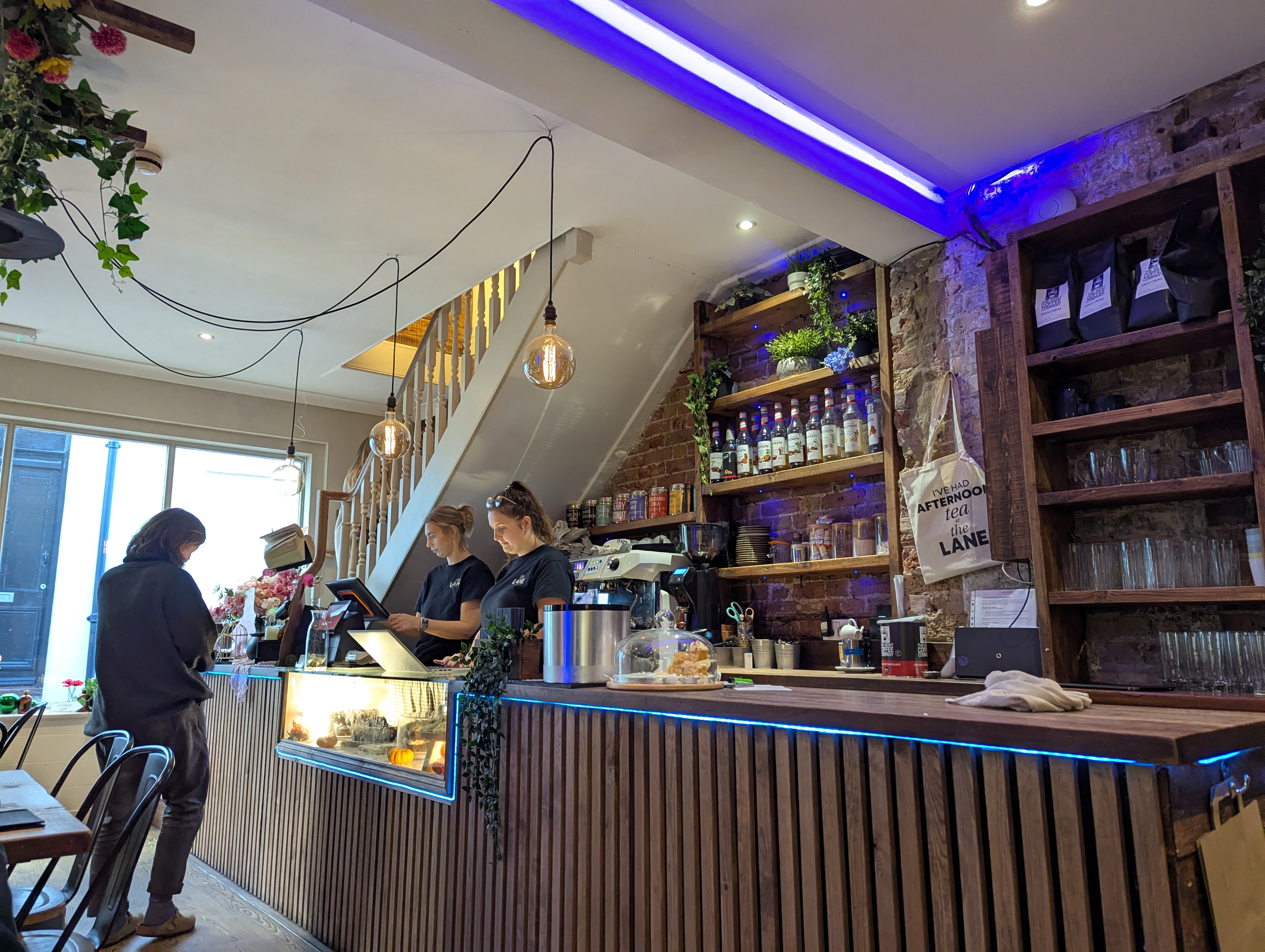
However, by the time we arrived in Deal we had new learnings about the train schedule and our time was going to be much shorter than we had originally understood. I had found a restaurant close to the station with acceptable ratings that also looked like it might make for a quick dinner, The Lane. It was early for dinner and there were very few people in the restaurant. Upstairs there was a Wicked-themed birthday party going on and the sound system in the restaurant was playing “For good.”

You may have noticed from my recent reports of what I’ve eaten in various places, except for breakfast, I’ve been leaning toward soups and salads. It was that point of traveling when your body demands vegetables. But when I sat down at the table at The Lane and reviewed the menu, my body demanded, of all things, a hot dog. And chips.

As you know, I live in the suburbs of Chicago, and what Chicago is known for, in addition to deep-dish pizza, is hot dogs. And I love a hot dog with everything that a Chicago dog normally comes with, except sport peppers. Tomatoes, relish, celery salt, a dill pickle spear, onions, mustard. Never ketchup. If you ask for ketchup in Chicago you will be abused. Sport peppers are a little too spicy for me and I’m in danger of having a sneezing fit when I eat them. Then it just becomes a Whole Thing. I remember ordering hot dogs in the Chicago Loop at lunchtime when I was working downtown. I would always say “Dog with everything except sport peppers.” And the worker would always repeat back my order, “Dog with everything, extra sport peppers.”

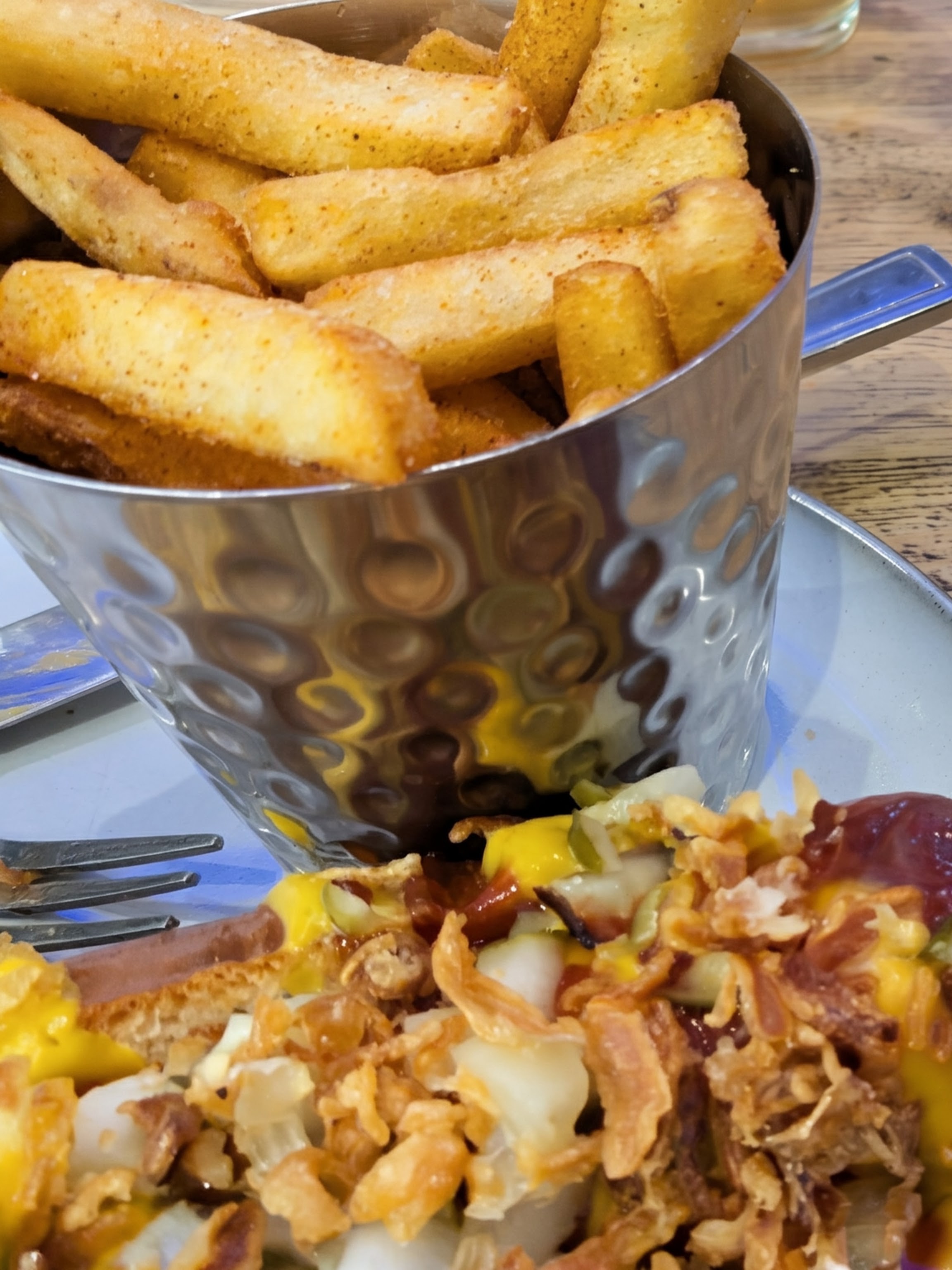
I digress, big time. The “classic” hot dog I ordered at The Lane was not a Chicago hot dog, but instead had on it ketchup, mustard, pickles, and “crispy onions.” As it arrived at my table I noticed it was HUGE. I figured I could manage about half that. I didn’t take a picture of it because it was just a hot dog. Then I took a bite. It was messy but the most amazing and yummy thing I’ve eaten for a while (this on a day I had scones and clotted cream). Maybe it was the crispy onions that made it so good? Maybe it was just a better quality hot dog? Maybe I was just really hungry after so much walking? I changed my mind and took a picture of part of it. My husband seemed to enjoy his tacos as much as I did the hot dog. And I did eat the whole thing.

As we were leaving, we asked the server if she had suggestions about what we should do if we had only 20 minutes in Deal. The thing she could think of was a local bar with a two-for-one drink special. I know she had just witnessed us eating our meal in a hurry and that may have made an impression, but I don’t think I could do two drinks in 20 minutes. In any case, we were not up for the challenge.

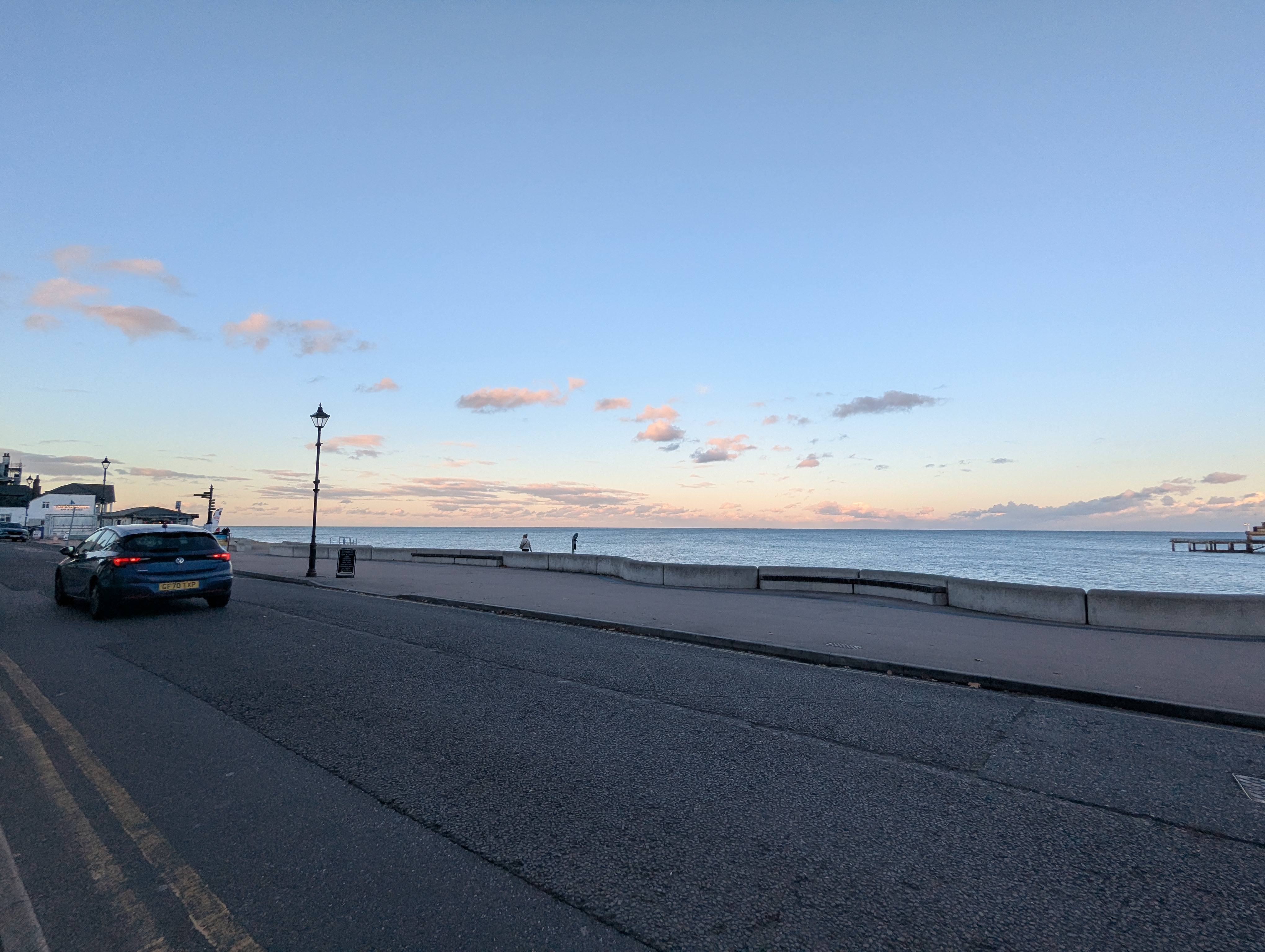
We thanked her and walked 5 minutes to the shore, took in the shops along the street next to the shore and the pier.

Deal is a cute little town, worthy of more than a 20-minute tour some day. But we had a train to catch and an Italian class to attend back at our temporary home in Canterbury.

Canterbury Tales

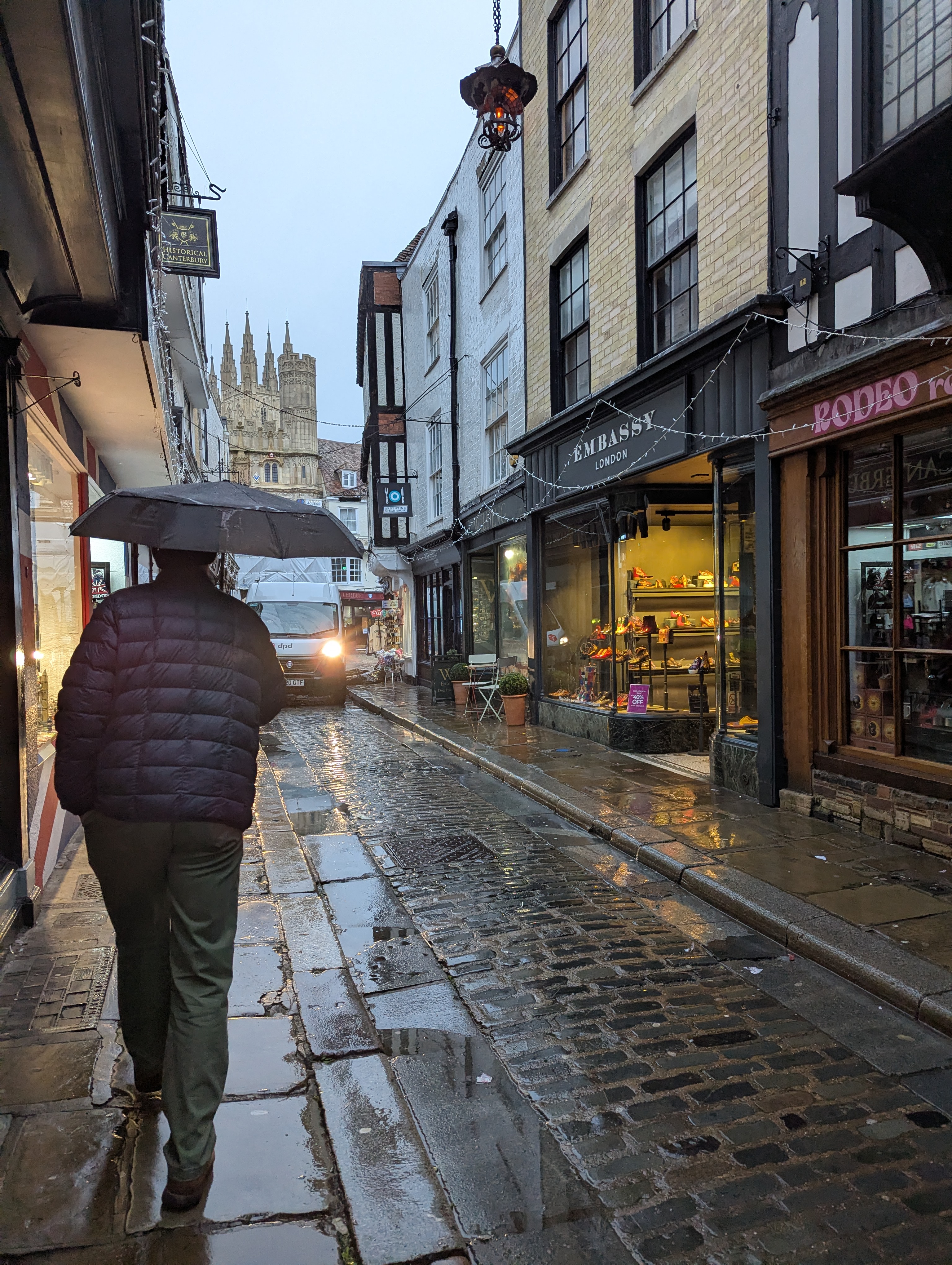
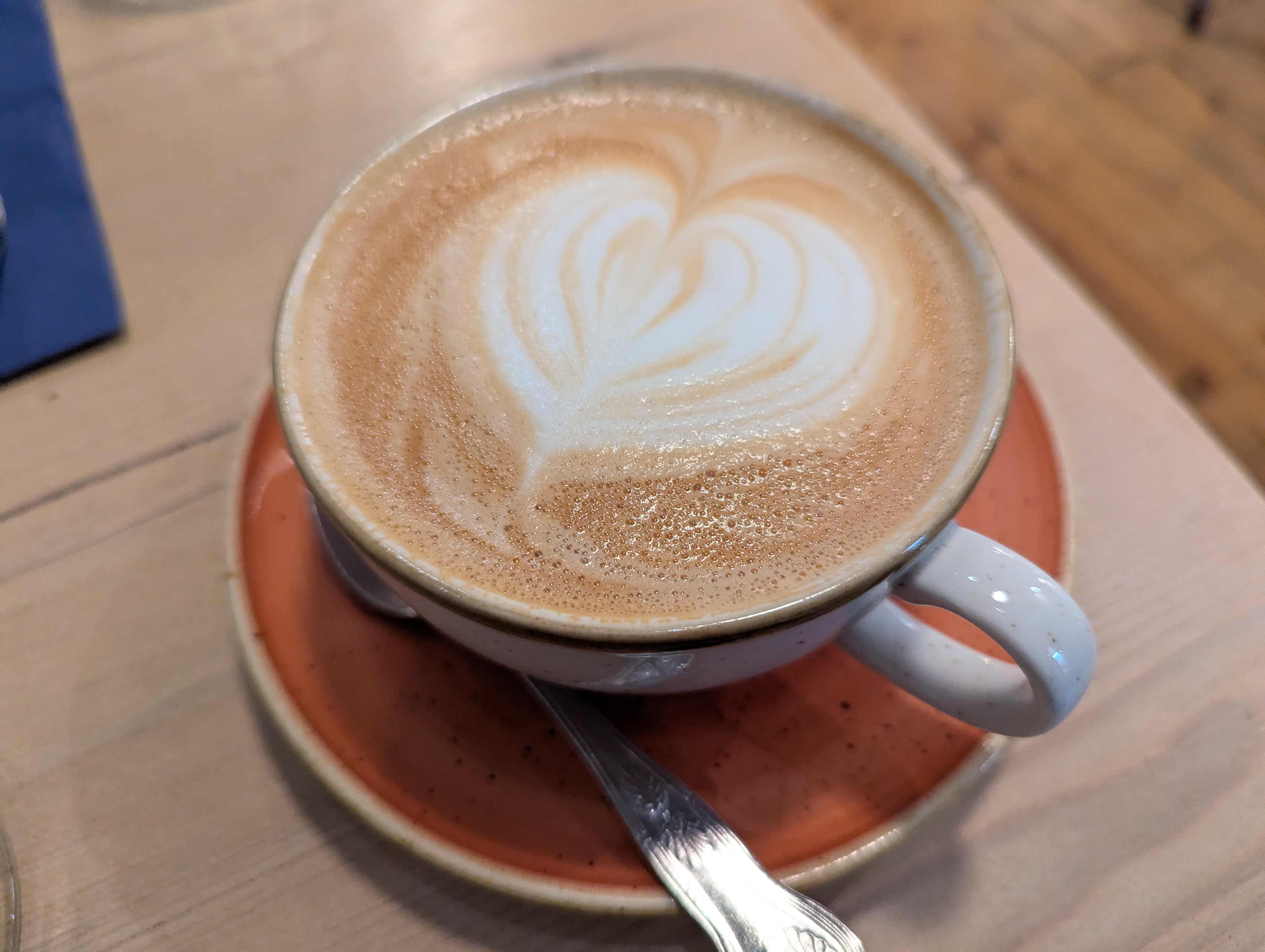
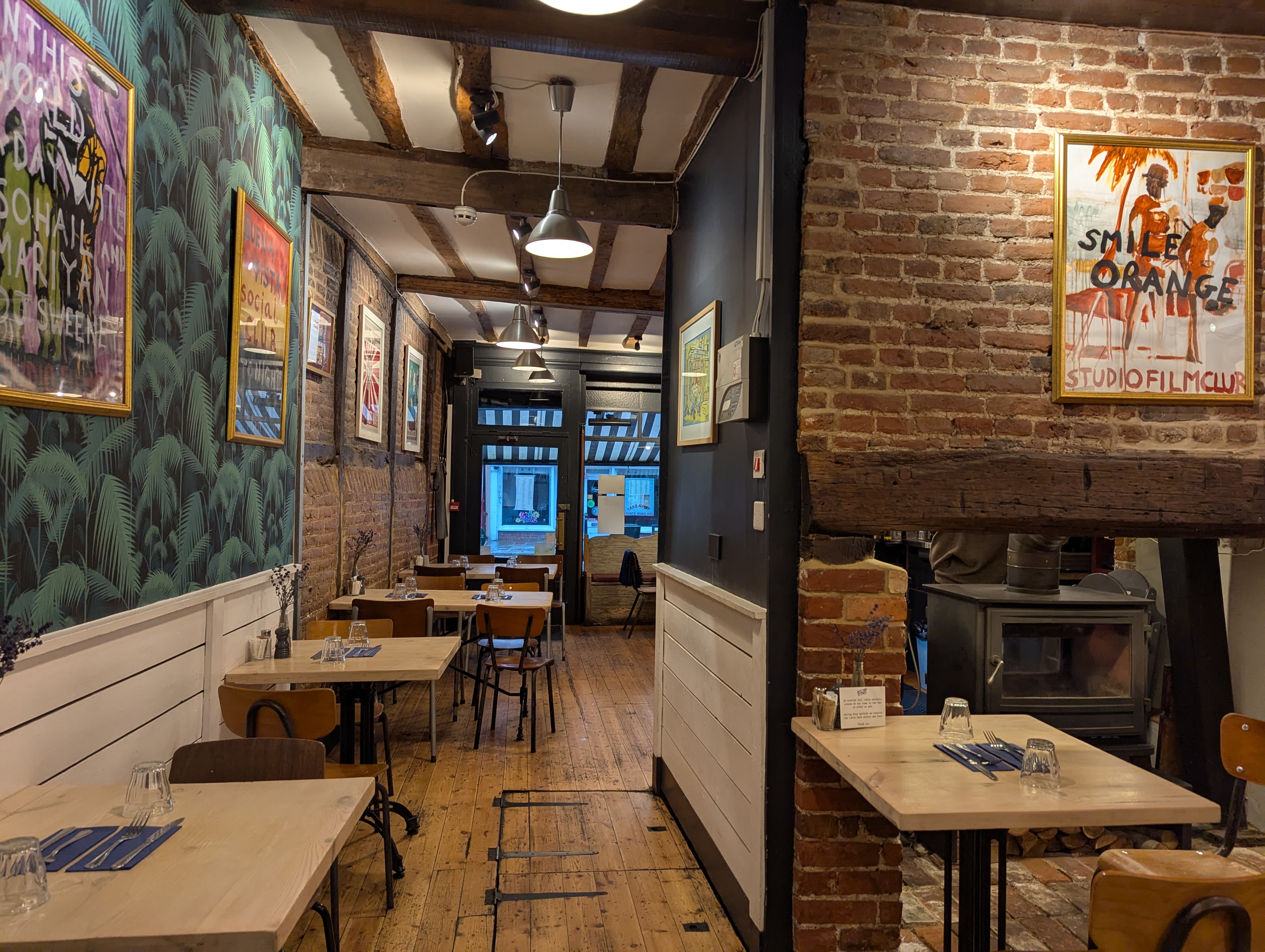
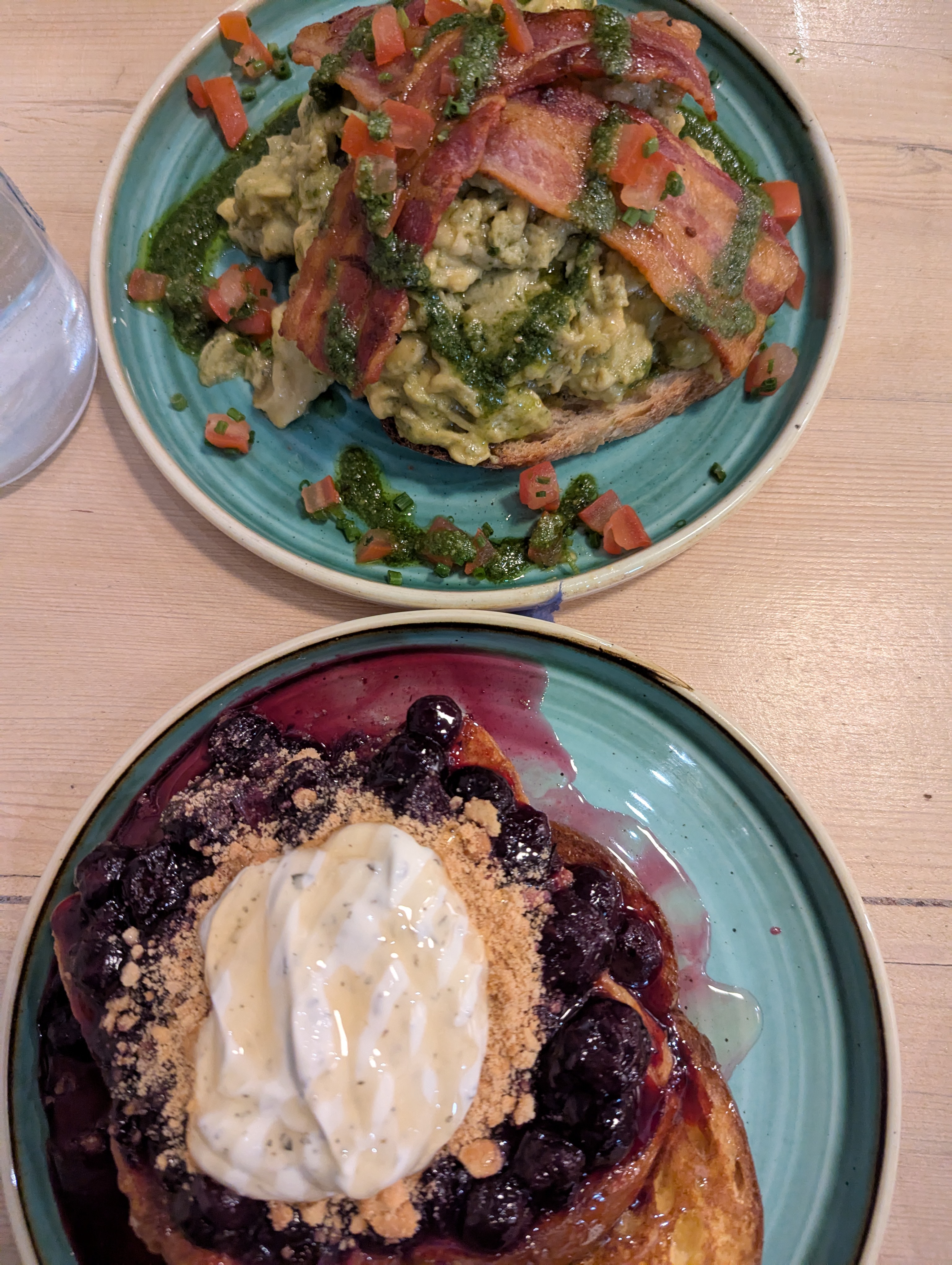
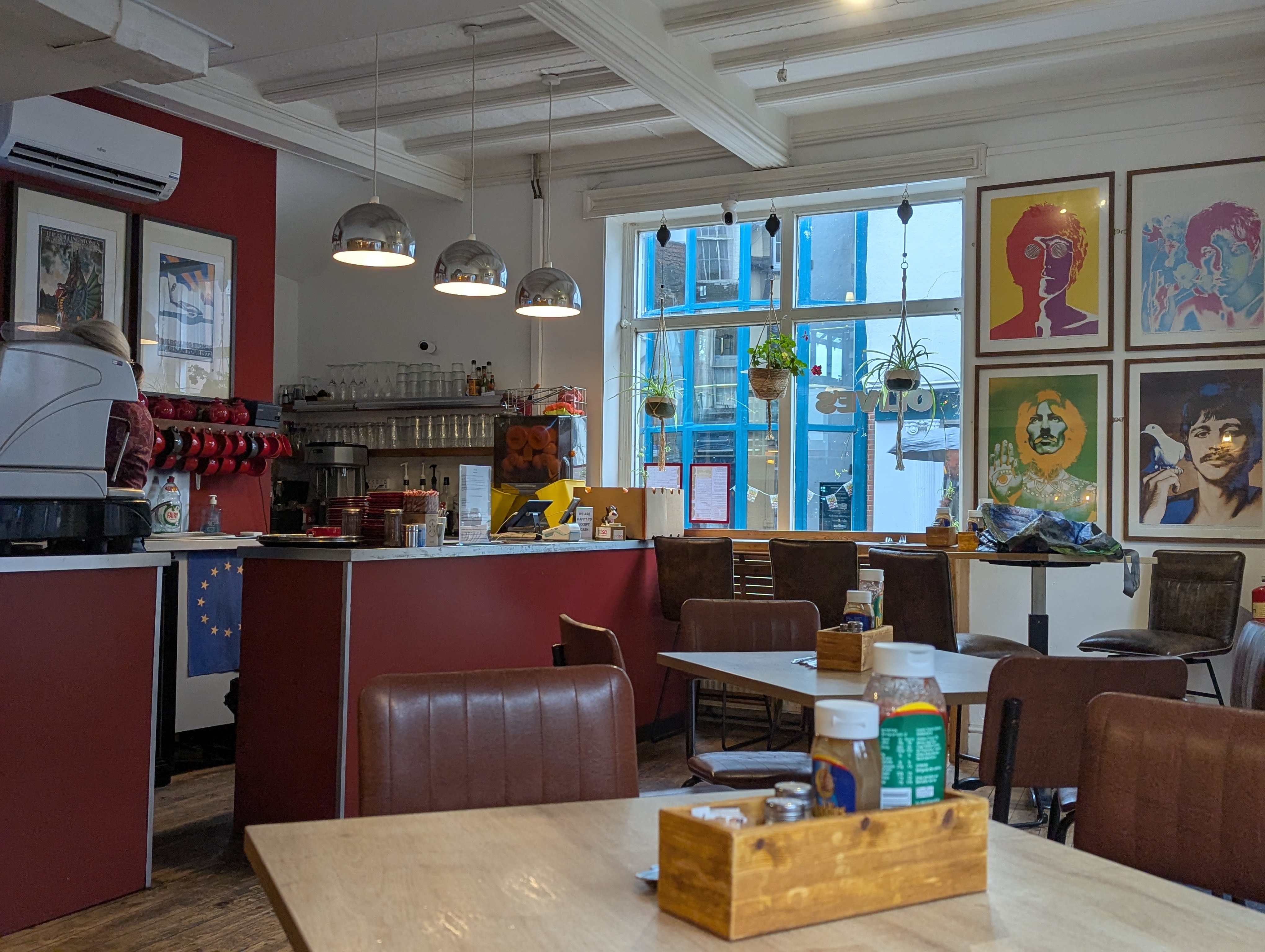
We woke to a raw, wet day, endured the cold showers I mentioned in my last post, and then walked several blocks to the highly recommended Refectory Kitchen for breakfast. We made a point to sit far from the door and were quickly served a much-needed warm drink. My husband had a dish called “Green eggs and ham” (green because of pesto) and I had a French toast with blueberry compote. Great way to start the day.

We steeled ourselves and walked through the rain in our practical footwear over to the Canterbury Cathedral. We’ve seen a lot of Cathedrals lately and I know that, to some people, they start to be all alike. While it may be true that many parts of the physical cathedral are similar to others, what I usually find so interesting is the unique history of the people connected with the Cathedral. The Cathedral at Canterbury has a notably colorful history. We used the audio tour available and found it interesting and useful.

Canterbury Tales by Geoffrey Chaucer includes imagined stories of pilgrims who traveled to Canterbury Cathedral. I read parts of it either in high school or college and, although I’ve forgotten so much from many books I’ve read, the details in some of those stories are still fresh in my mind.

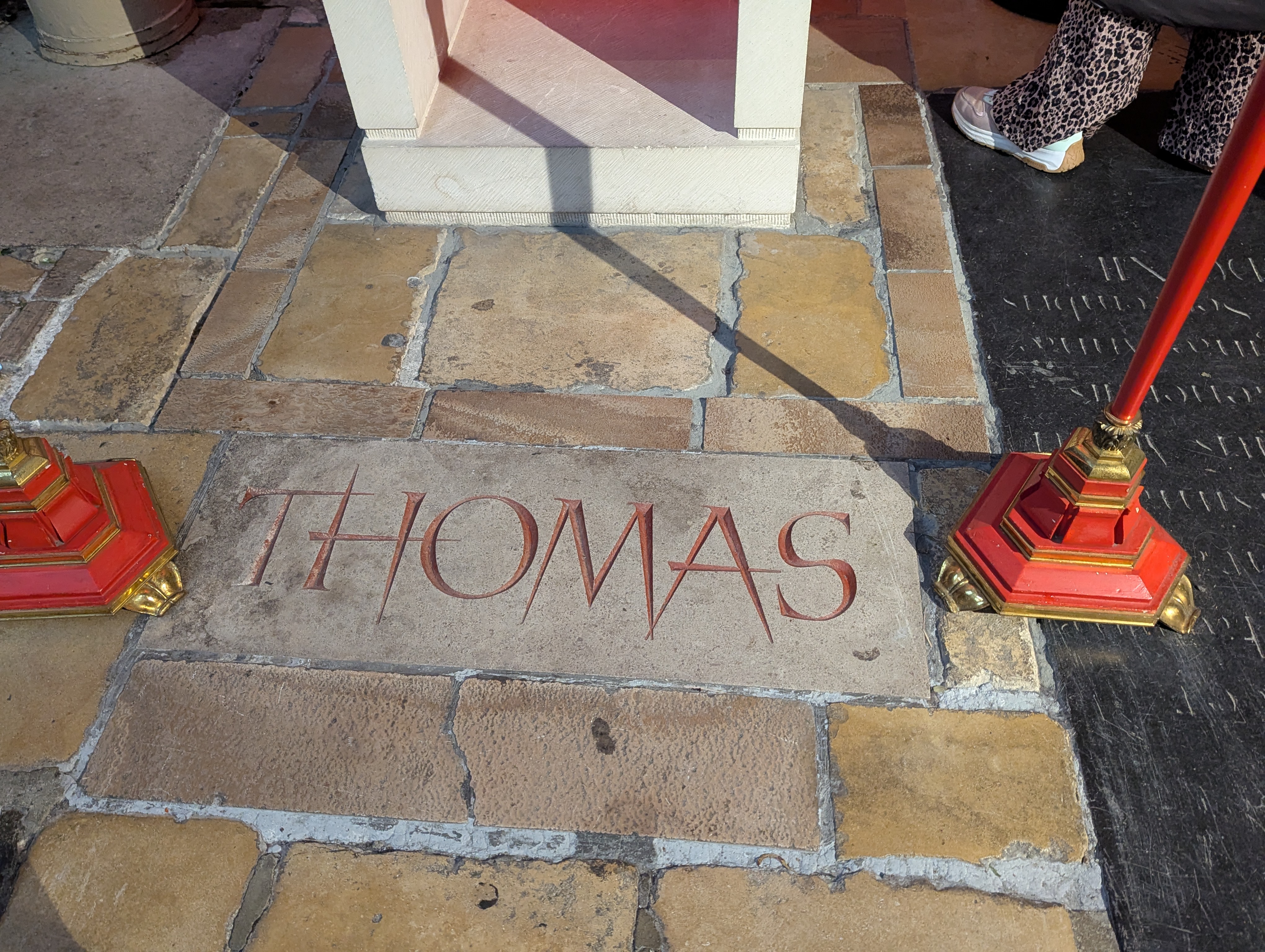
People made the pilgrimage to Canterbury in homage to Thomas Becket. Thomas Becket had been a nobleman and friend of King Henry II who was made Archbishop Of Canterbury. Kings and archbishops had great power over the subjects and King Henry II had reason to believe that by installing the like-minded Becket he would be able to exert more influence on the church. But as soon as Becket was made Archbishop, he began to go his own way to the great frustration of the king.

What happened ultimately is in dispute. Henry II either A) sent soldiers to kill Becket or B) said something innocuous that made the soldiers incorrectly believe they were being sent to kill Becket. Regardless of Henry II’s actual intent, the soldiers went to Canterbury and killed Becket inside the Cathedral.

Now martyred, he was named a saint by the Pope. And although pilgrims previously trickled to Canterbury Cathedral, Becket’s martyrdom and subsequent canonization turned that trickle into a deluge. Becket’s remains are buried in the cathedral and formerly could be viewed by visitors who were willing to pay for the privilege. I believe that is not possible today. (Maybe I should have displayed my crypto.)

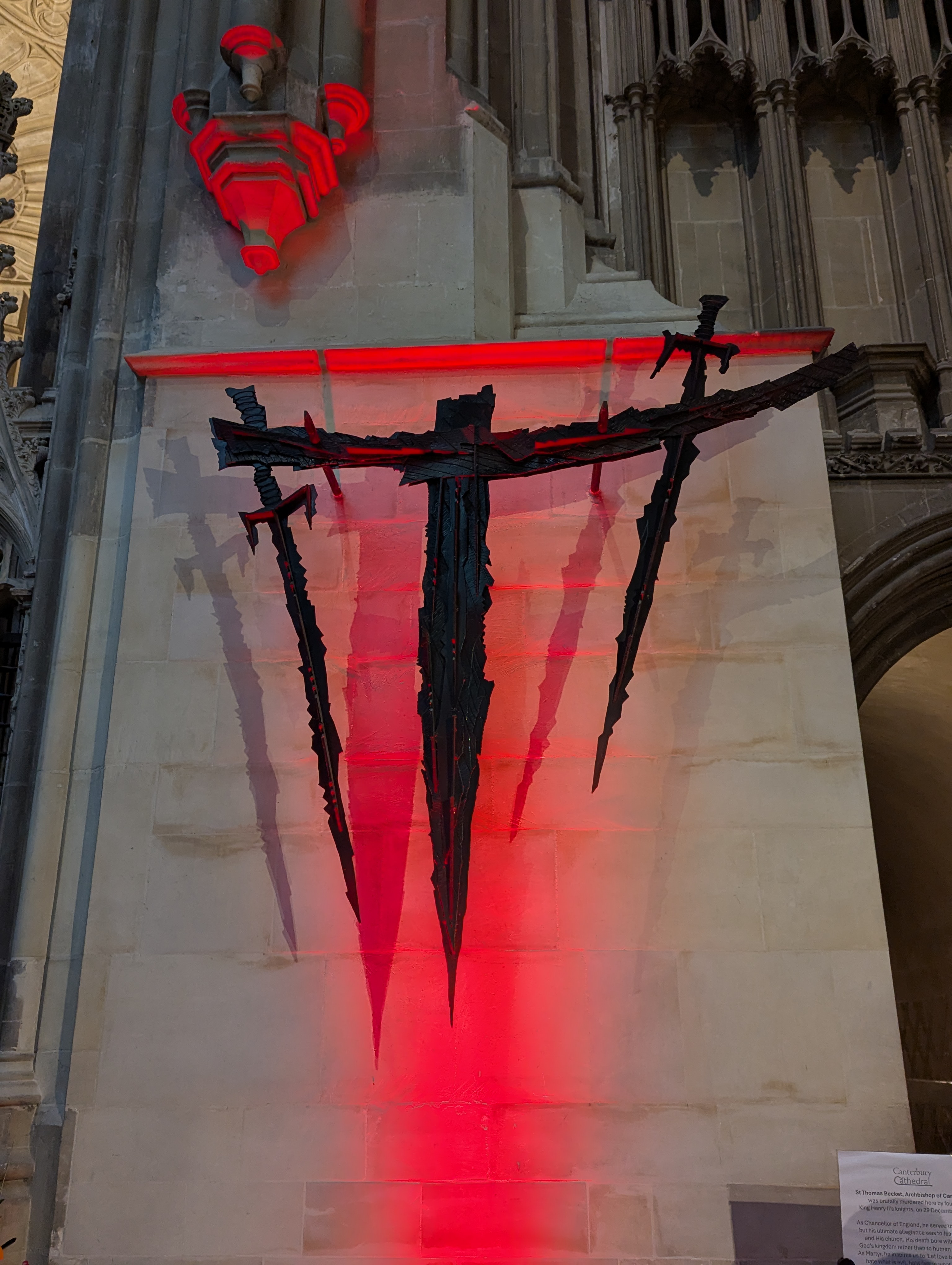
The site where Becket was murdered is commemorated with some art that includes representations of the swords of the soldiers.

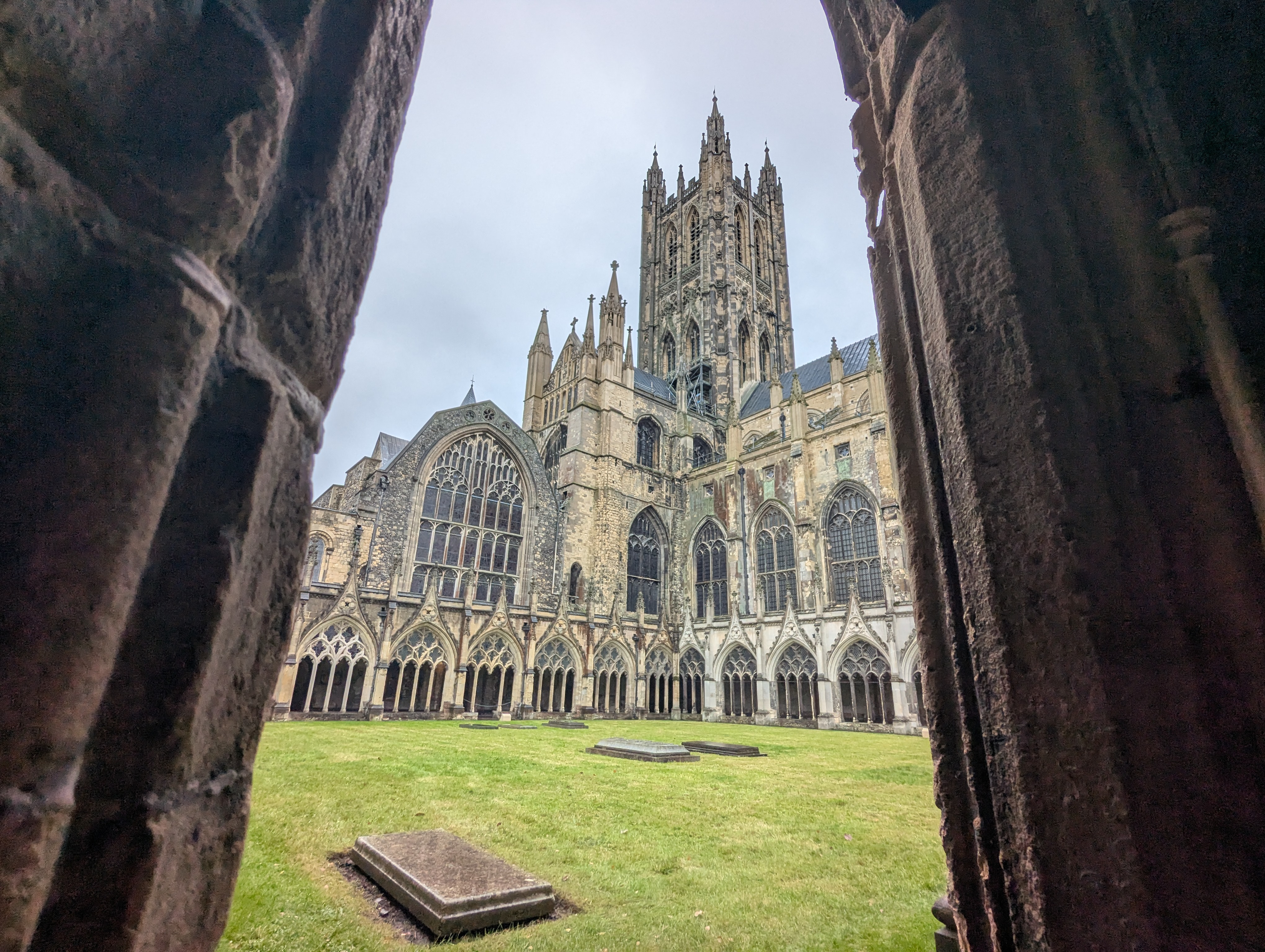
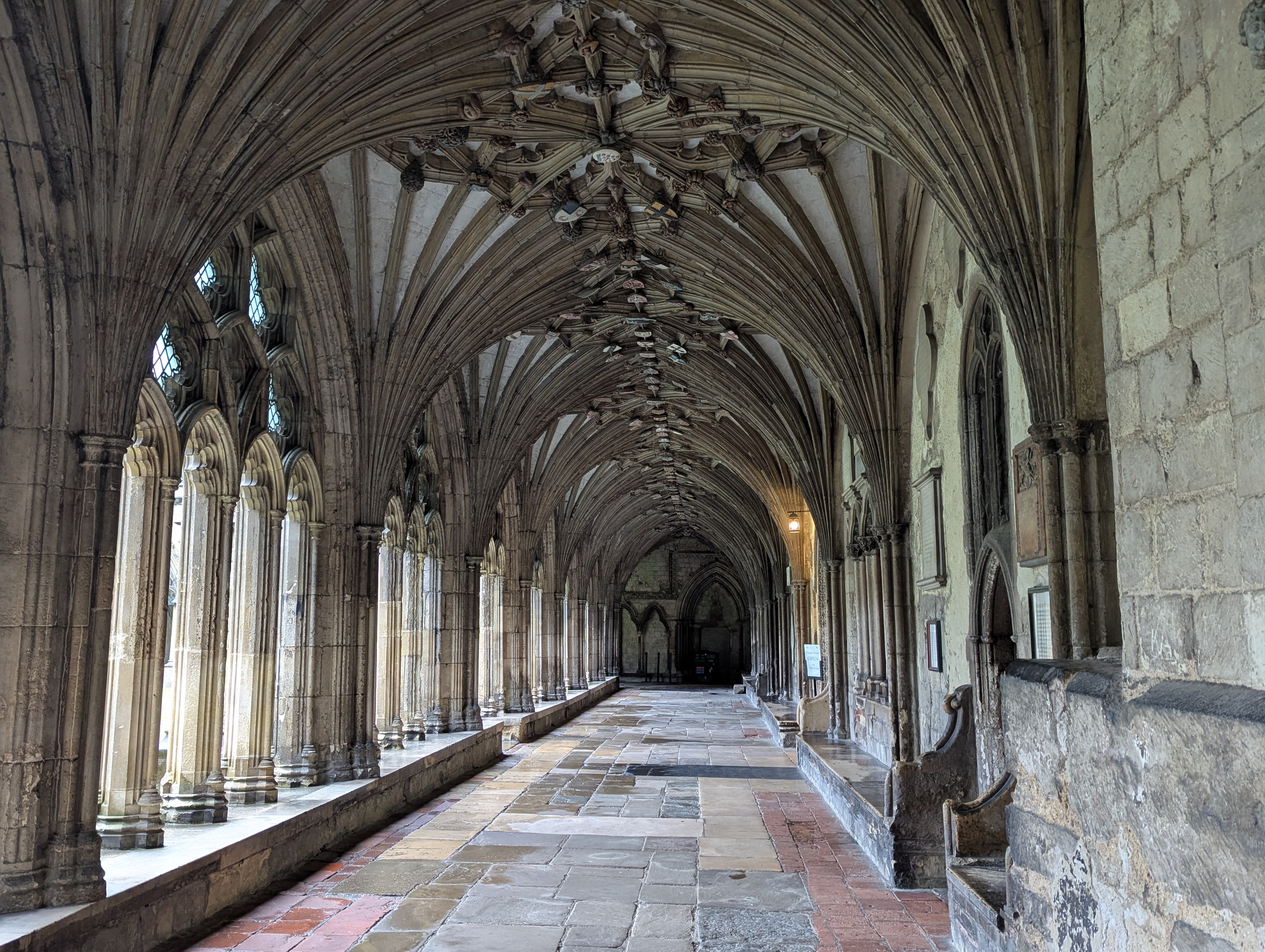
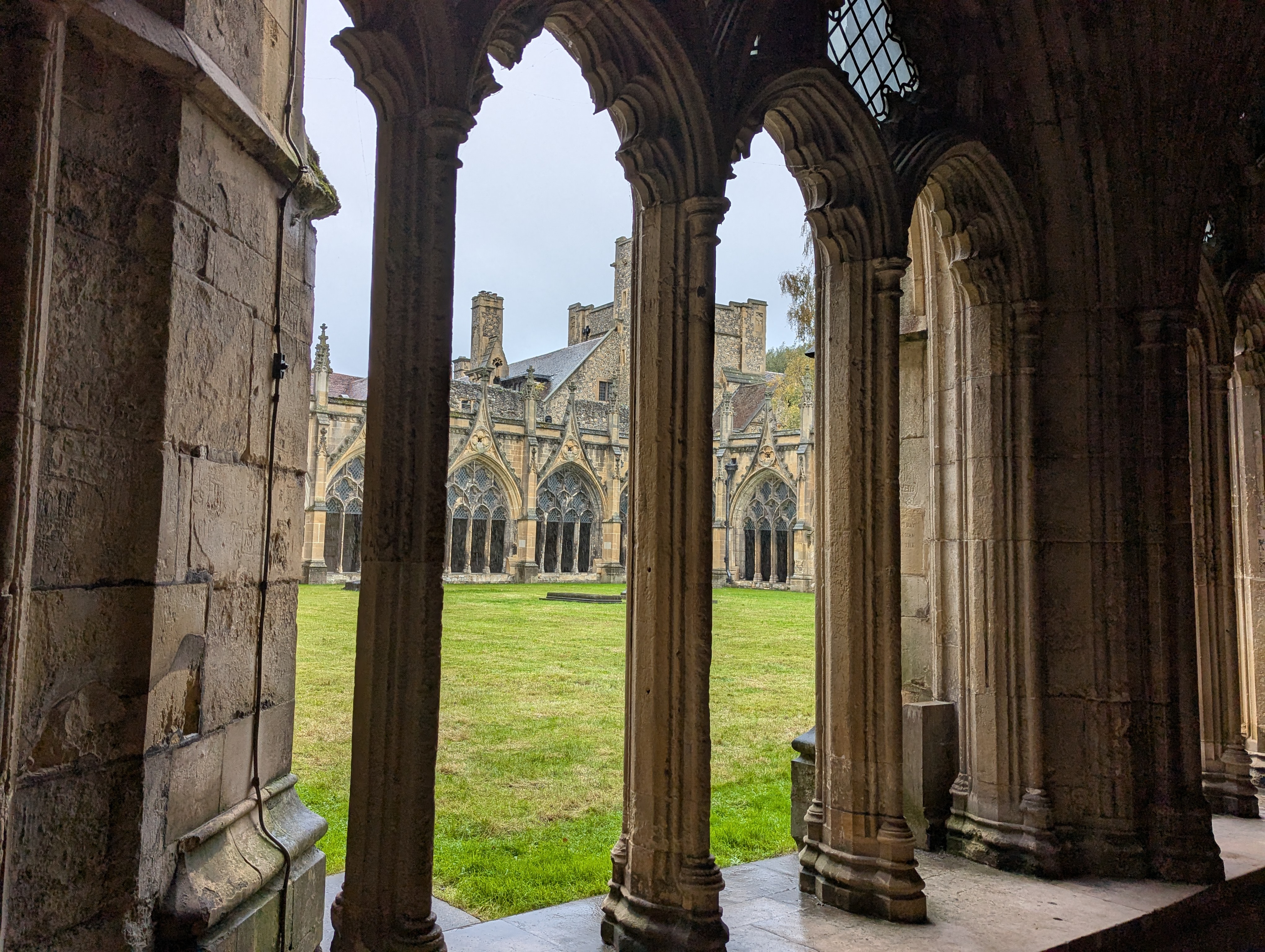
I’m a sucker for the cloisters in a Cathedral. It was still dark and rainy when I stepped out and took these photos which I think made them feel even more alive. You can just picture hundreds of years of monks coming and going.

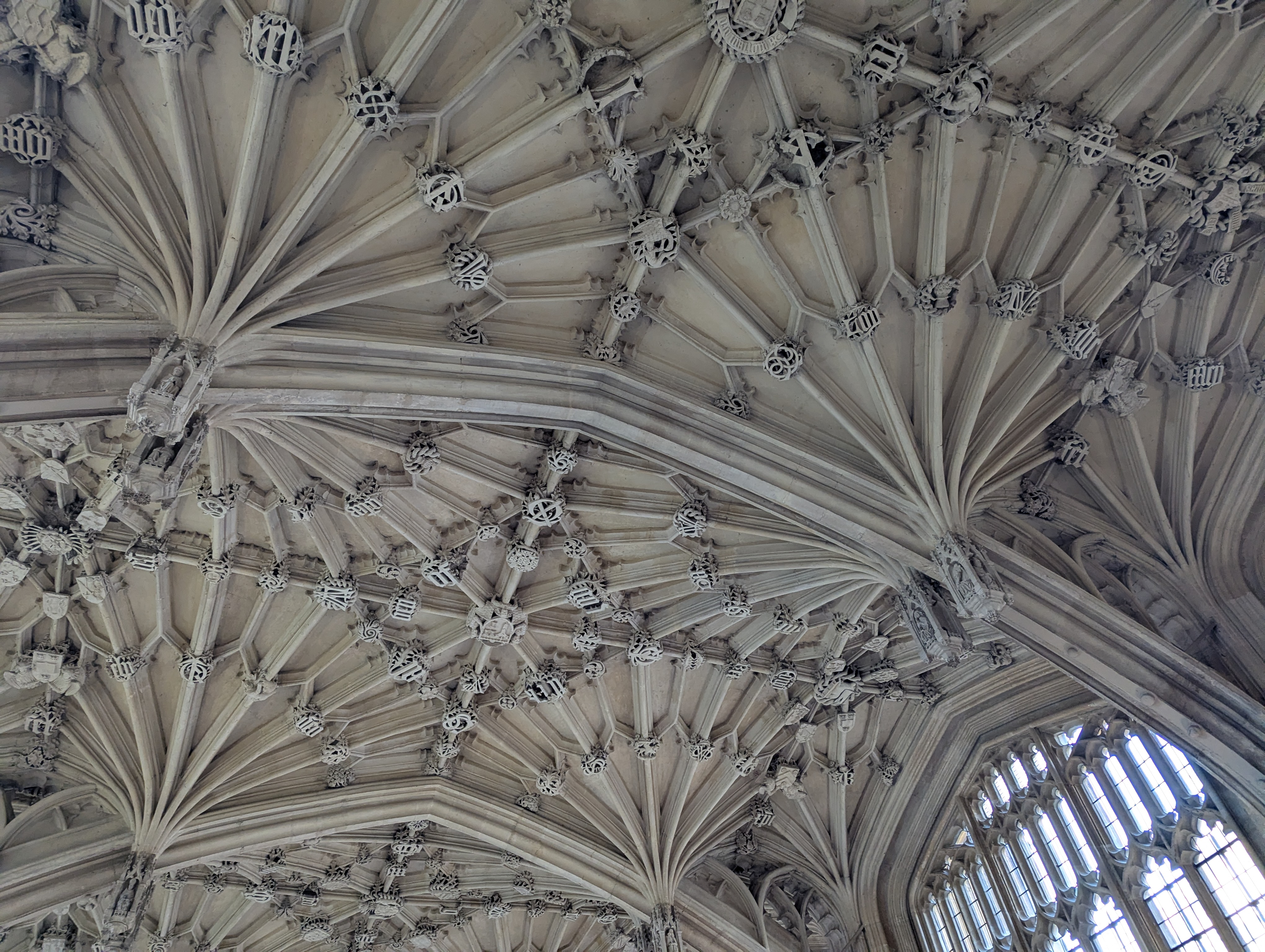
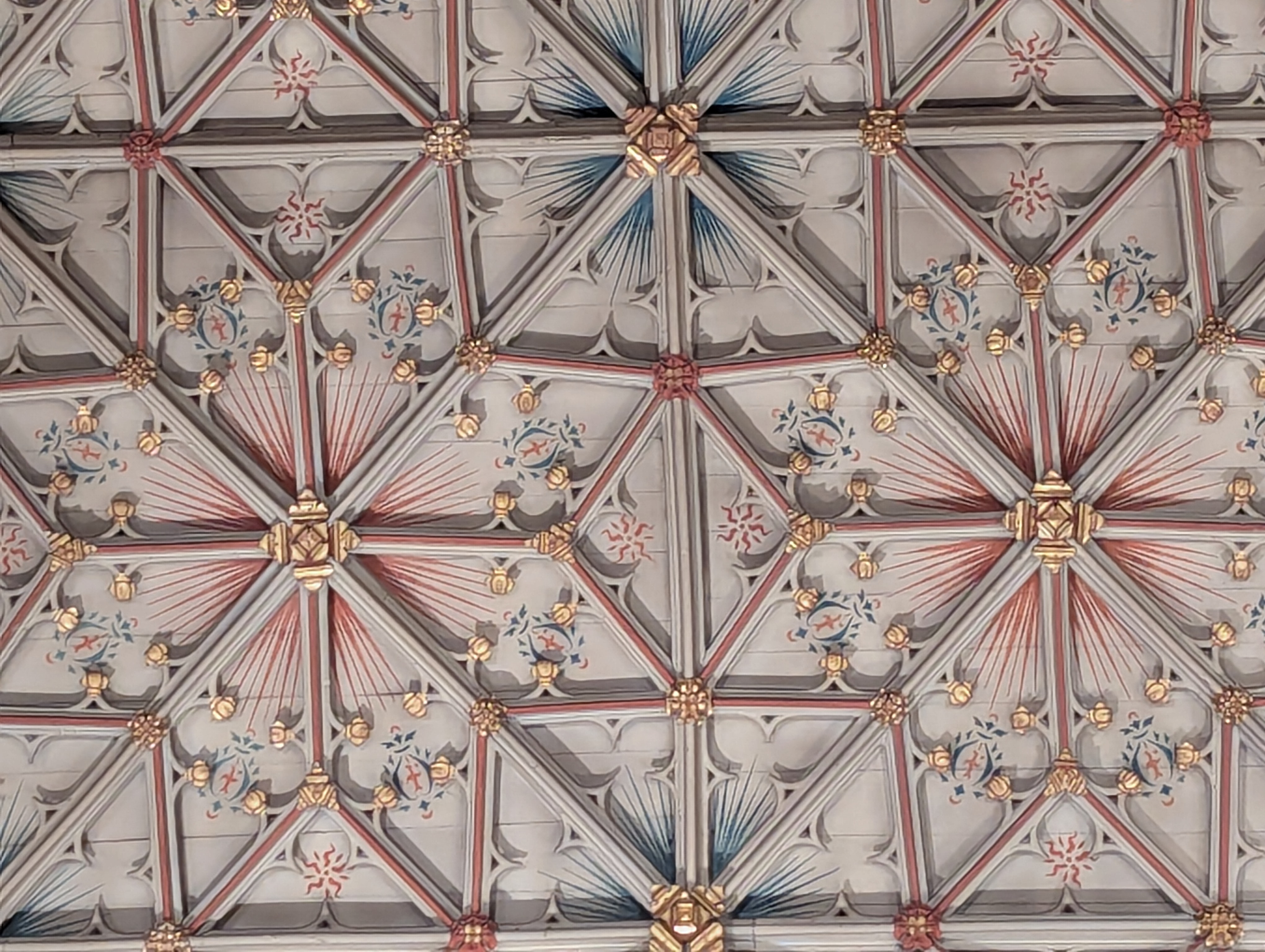
My husband and I also loved the area called the Chapter House, which served as a place where monks learned the rules of the order. The carvings in the ceiling are gorgeous.

In the crypts, the sculpture called Transport is especially interesting. Created by British artist Antony Gormley, it’s made of nails from the Cathedral formed in the shape and size of a typical human body. It hangs from the ceiling using wires or strings. Photos aren’t allowed in the crypt but I found a picture of the sculpture online here. My husband enjoyed the display in the Water Tower that described how ink was made back in the day and also included a pocket sundial.

There is only one monarch entombed in the Cathedral, Henry IV. His uncle Edward, referred to as the Black Prince, is entombed close by. The Black Prince has an inscription on his tomb: “Such as thou art, sometimes was I, Such as I am such thou shalt be.” There is a lot more gory detail in the inscription, but that’s a good summary. You’re no different from me. The end is coming and you can’t avoid it.

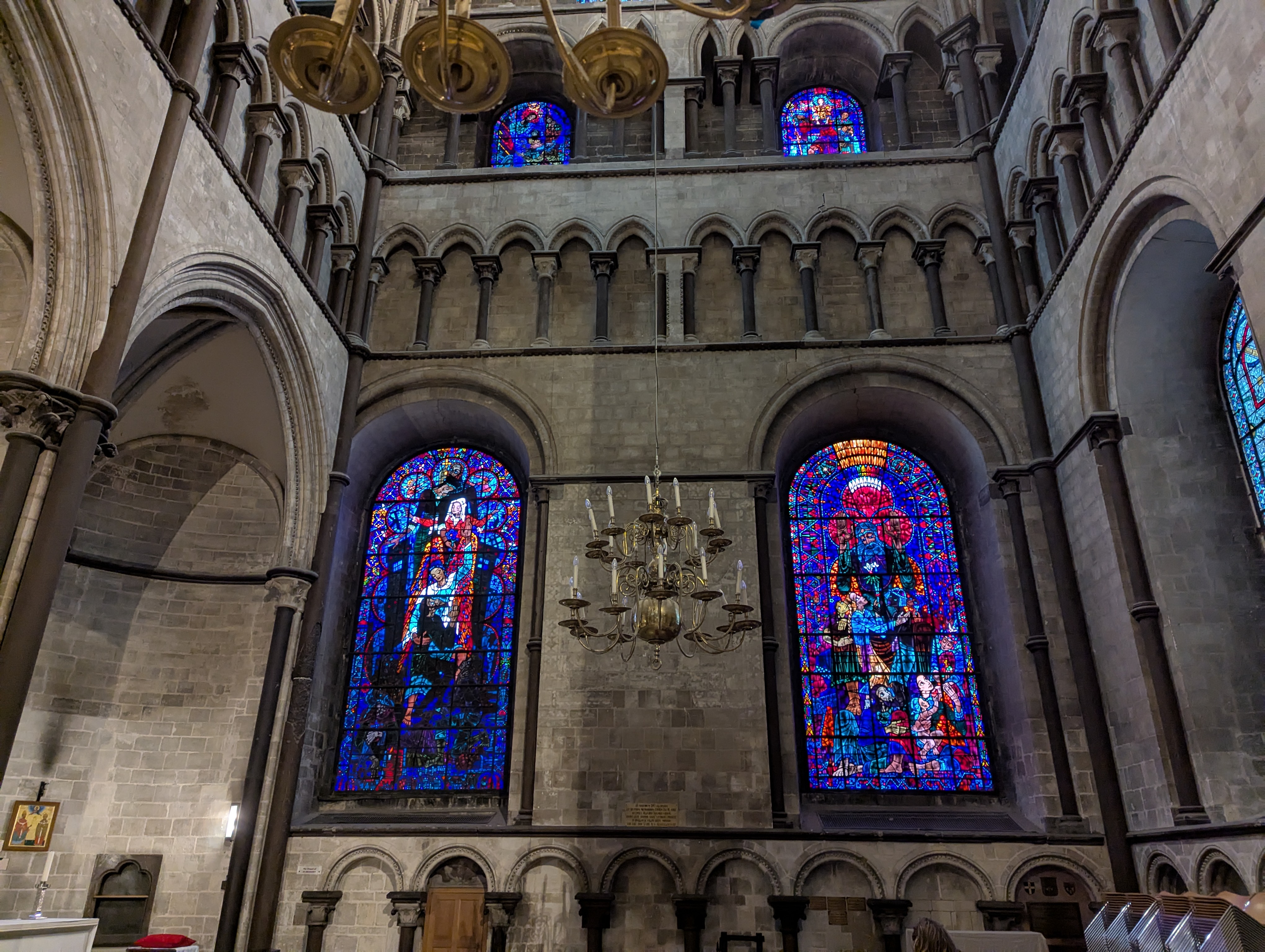
As with all Cathedrals, there are some beautiful stained glass windows as well as some very plain windows that were forced into place during periods in history in which the powers that be disliked color in church and got rid of it. Or that had been removed to protect them from bombing in World War II and then had to be painstakingly reinstalled. Or that had not been removed and had been bombed and replaced. I particularly enjoyed the windows created by the Hungarian artist Ervin Bossanyi that were installed in 1960 and commemorate themes around World War II, salvation and peace.

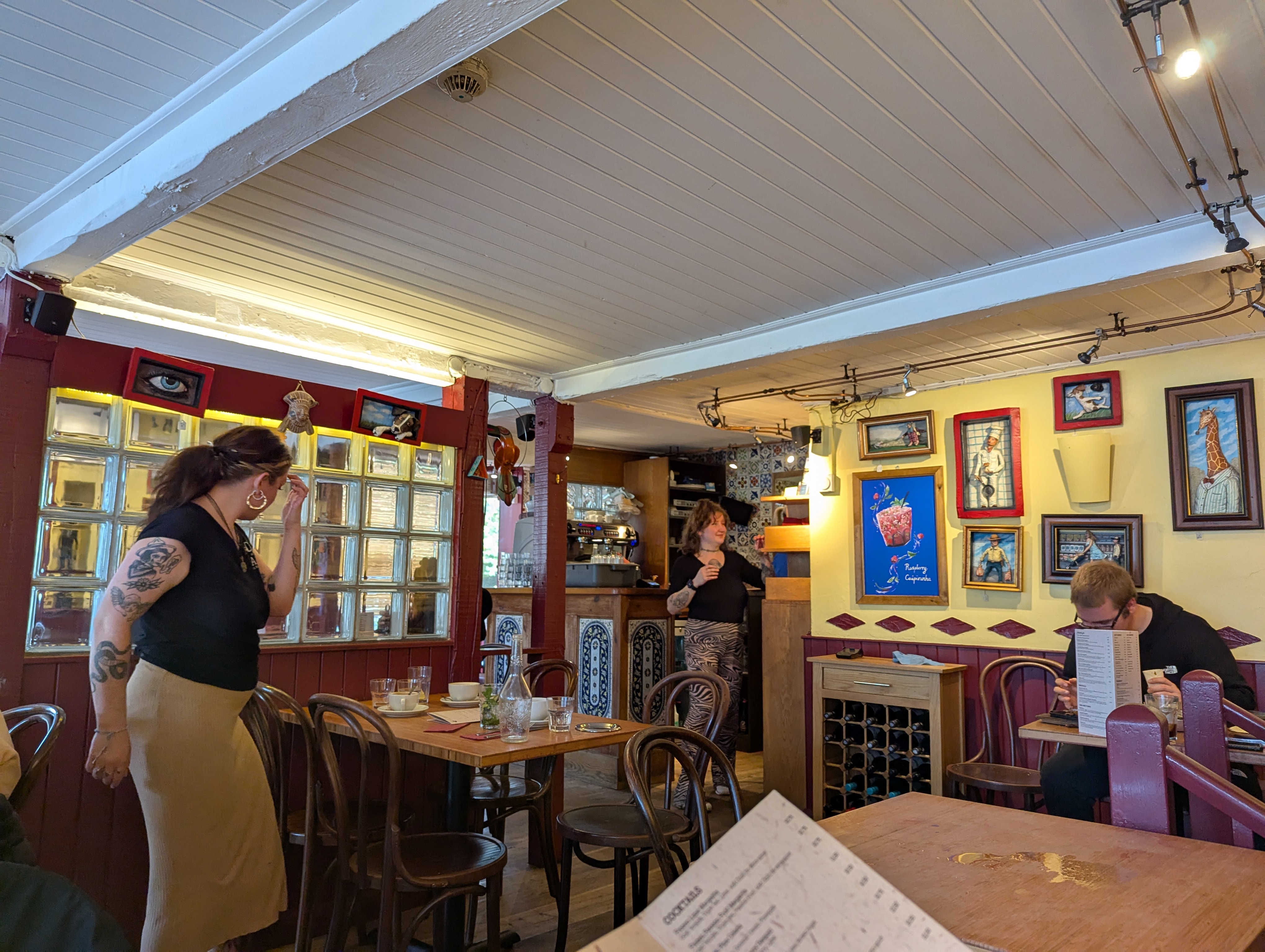
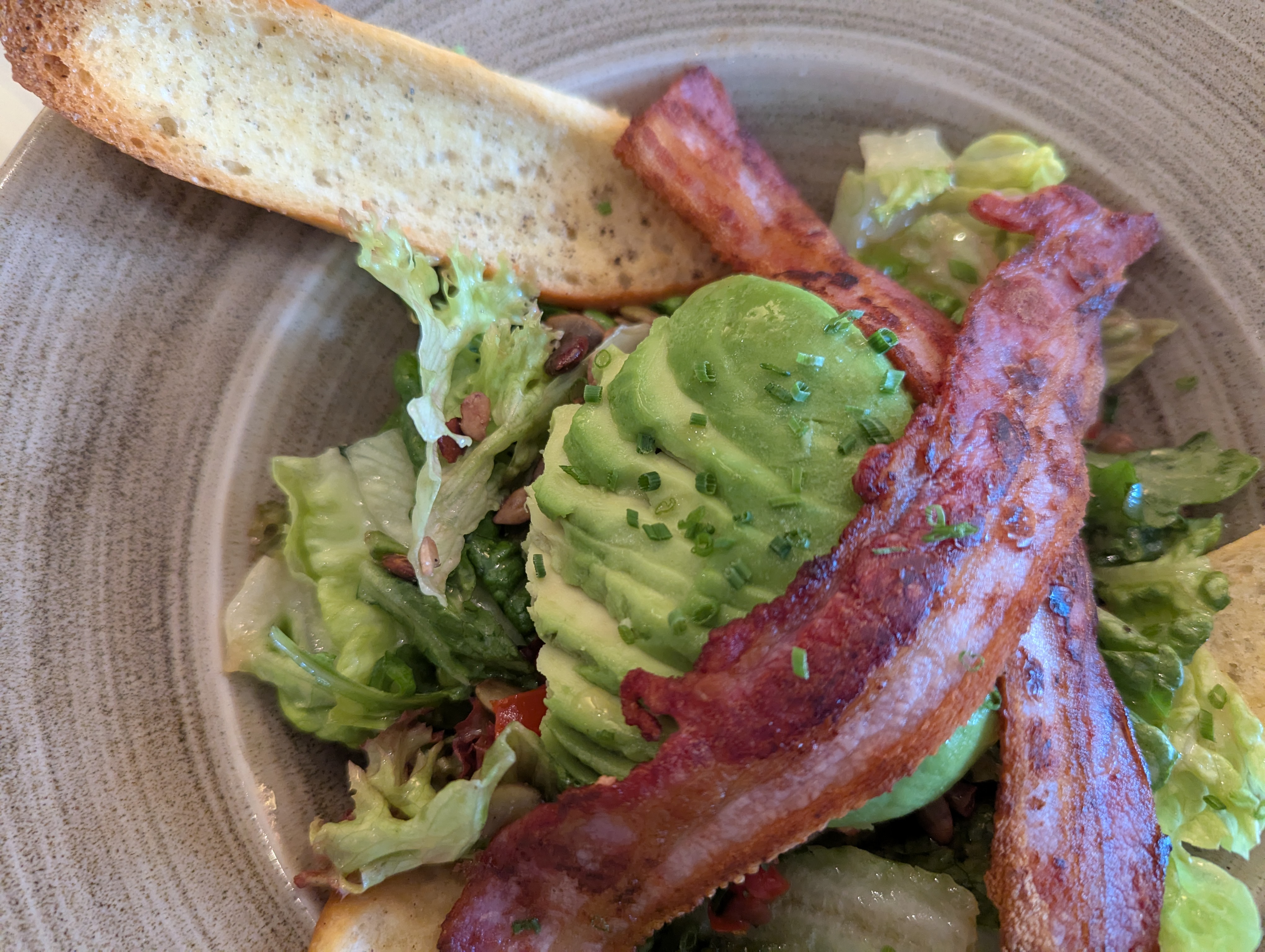
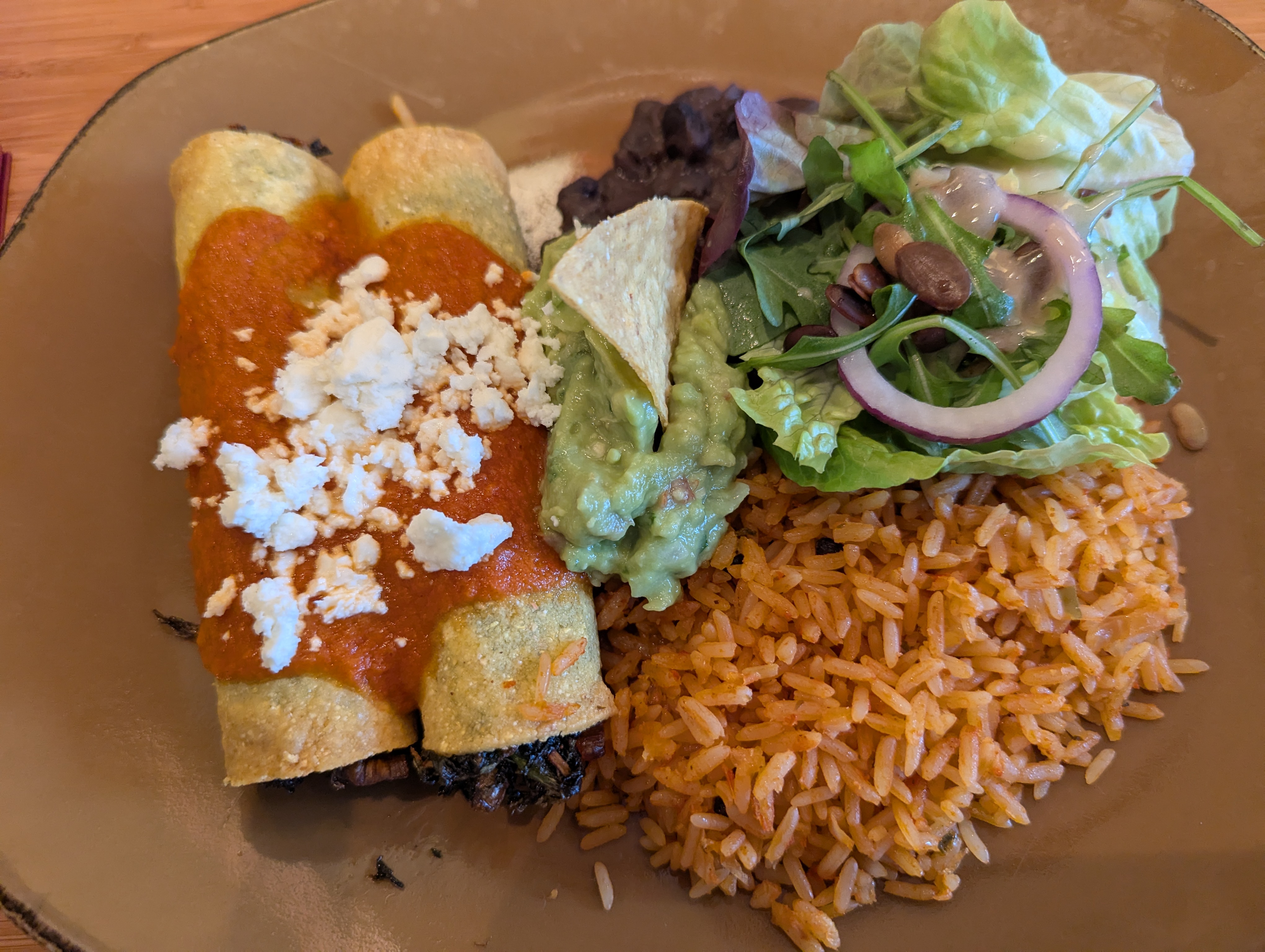
We took a lunch break at a cute Mexican restaurant called Cafe des Amis du Mexique. I had a salad that was so yummy I’ve tried to recreate it at home. Don’t quite have it right as of this writing. I really enjoyed the papier mache art on the walls by Total Pap, which was available for sale.

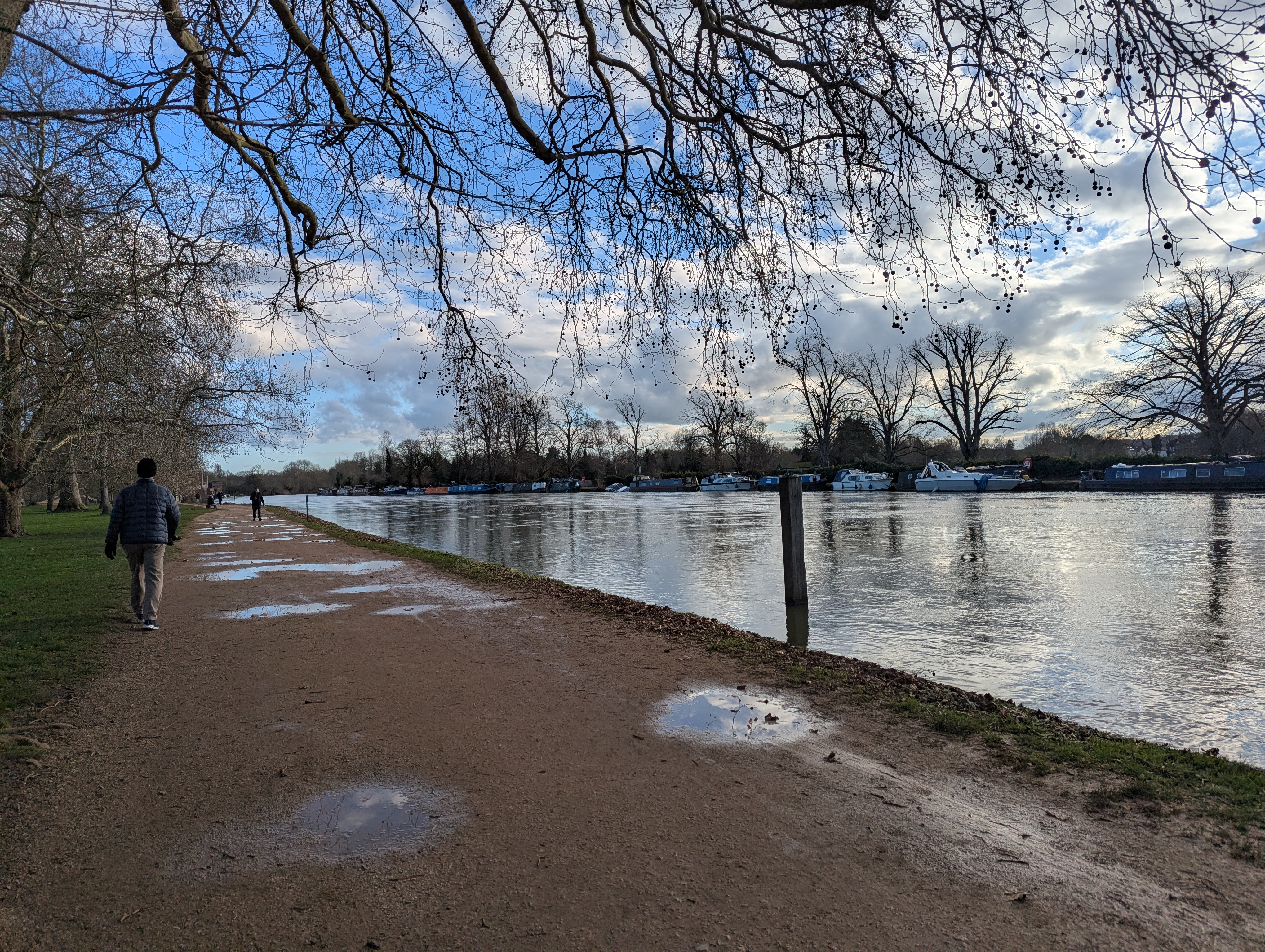
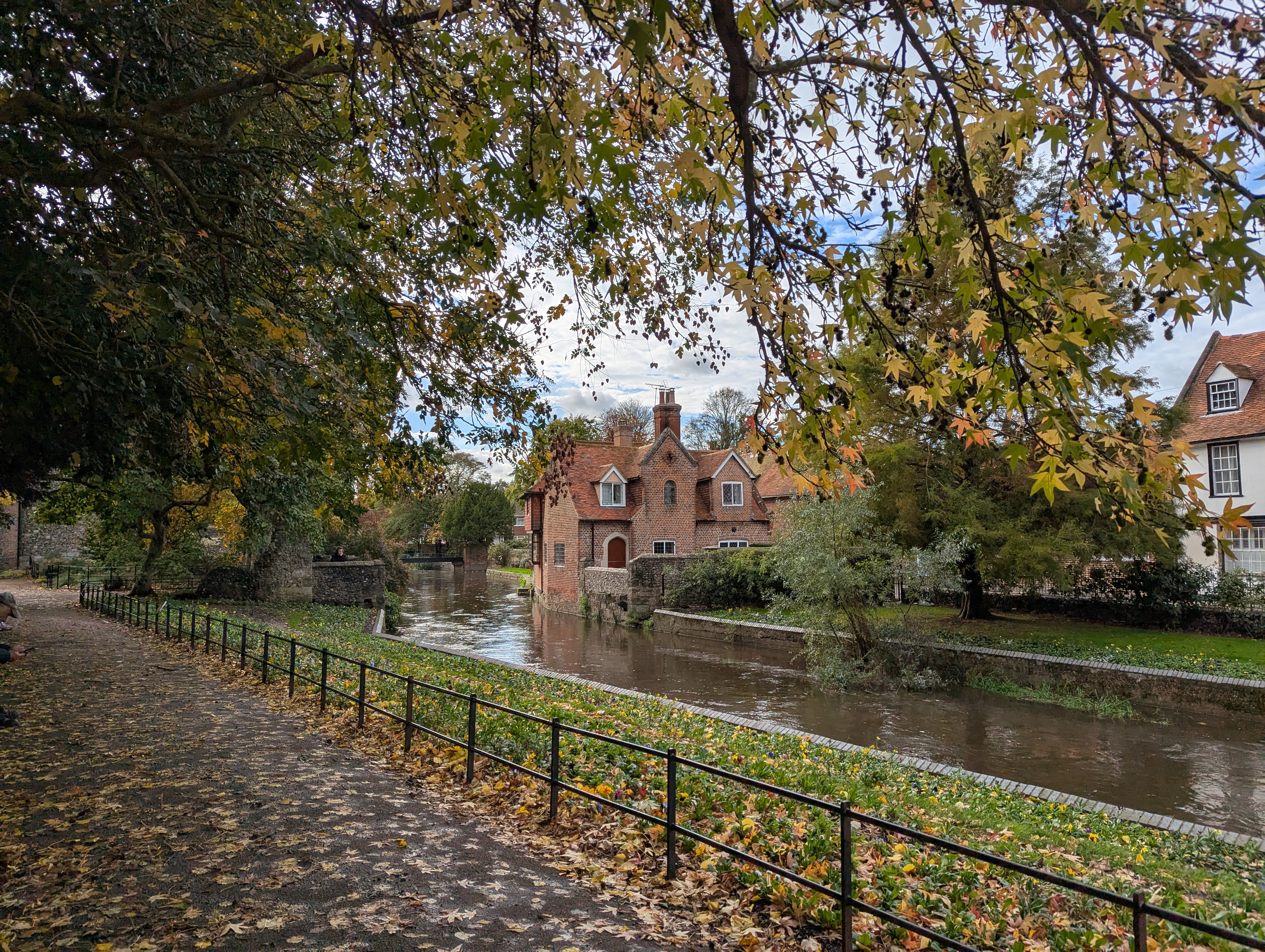
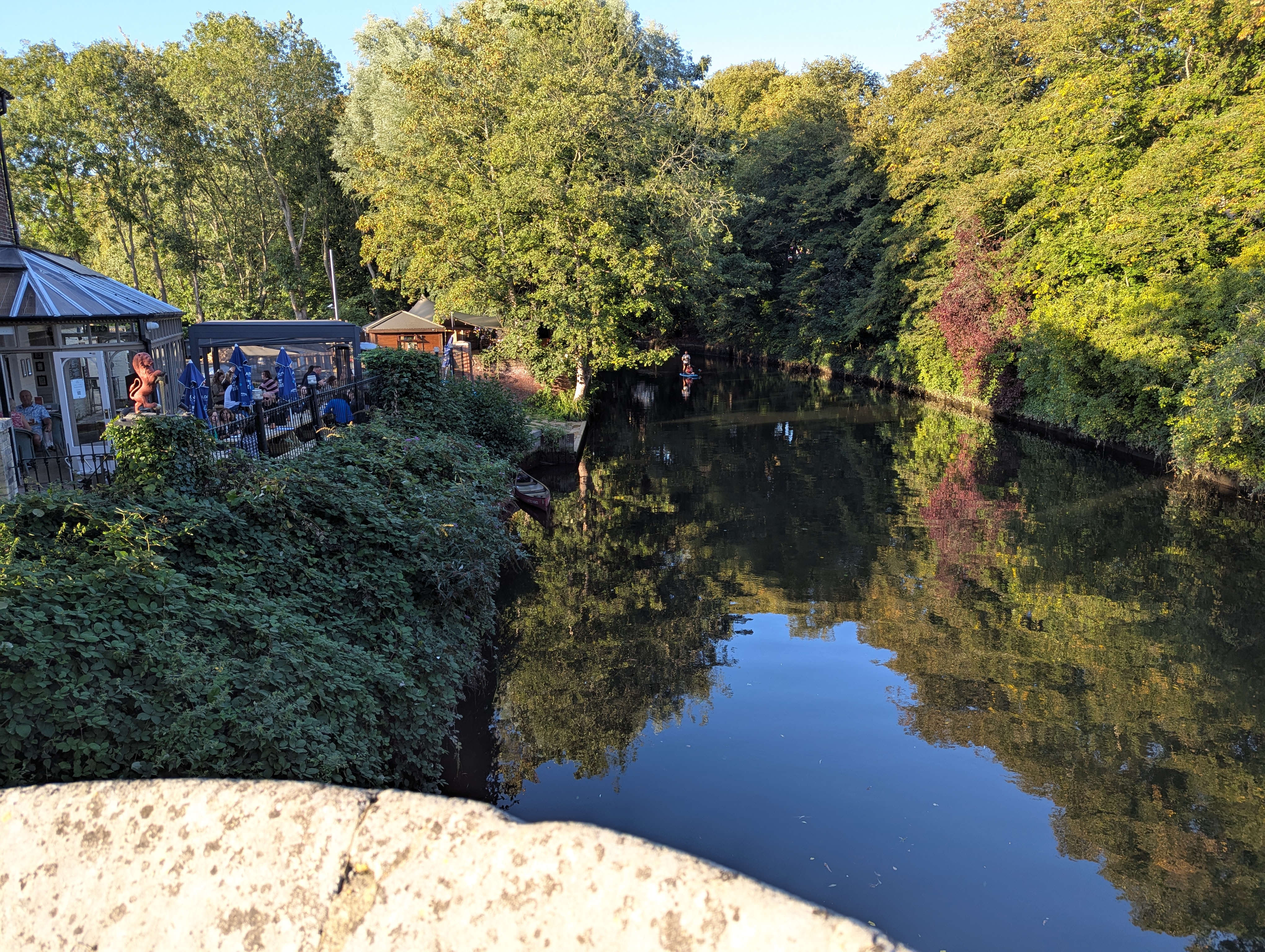
With the rain now stopped, we took a short walk along the River Stour.

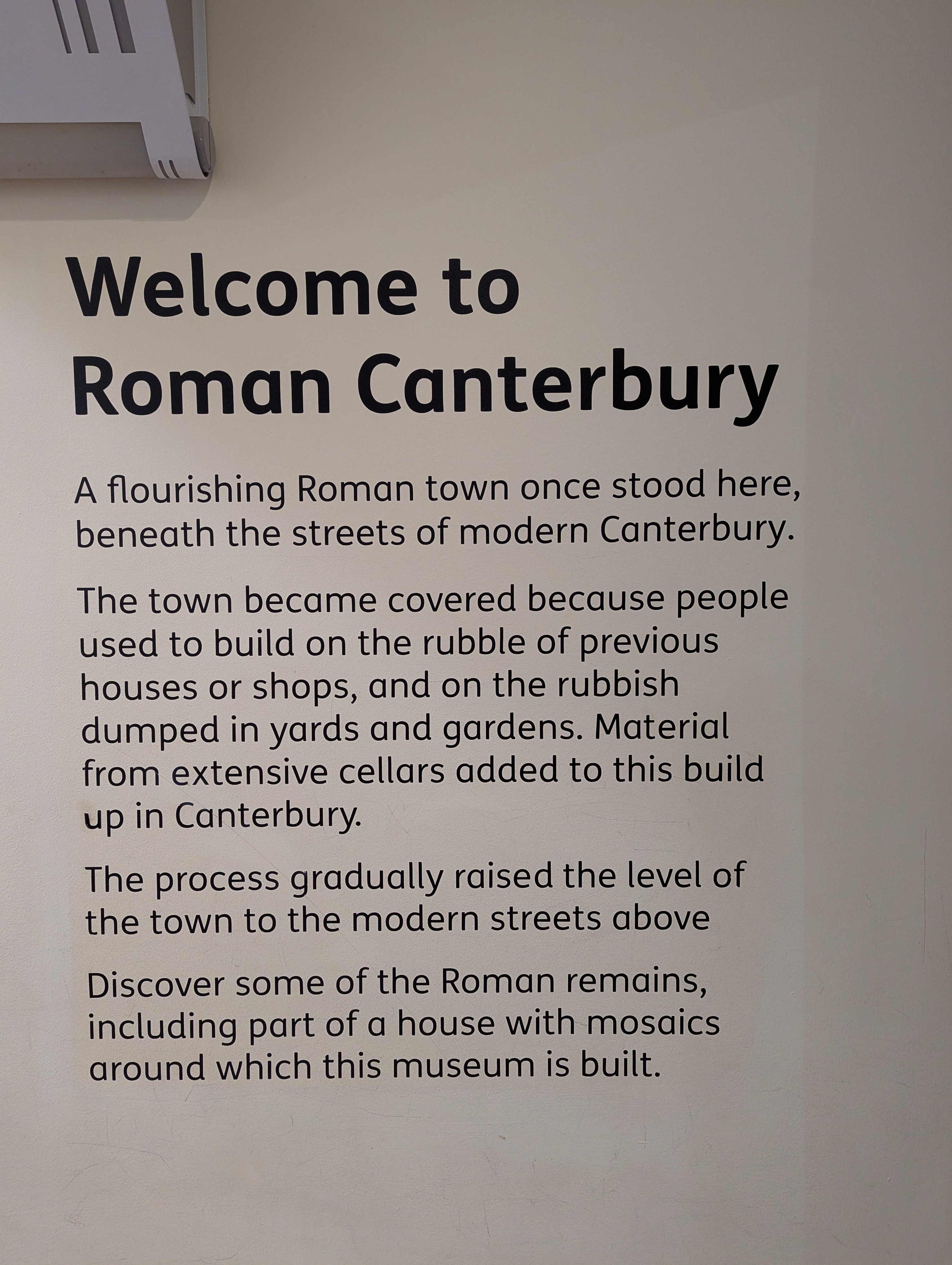
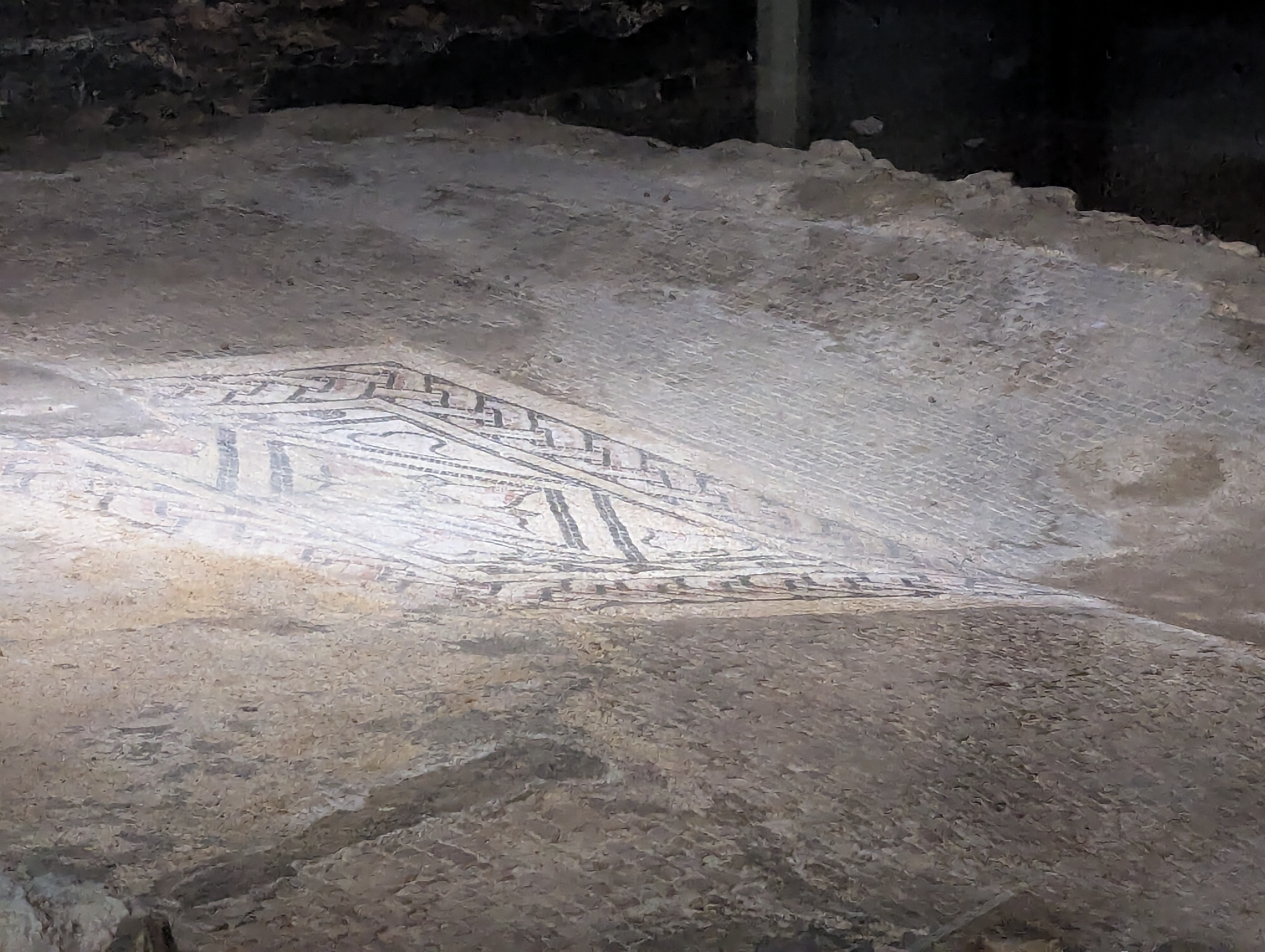
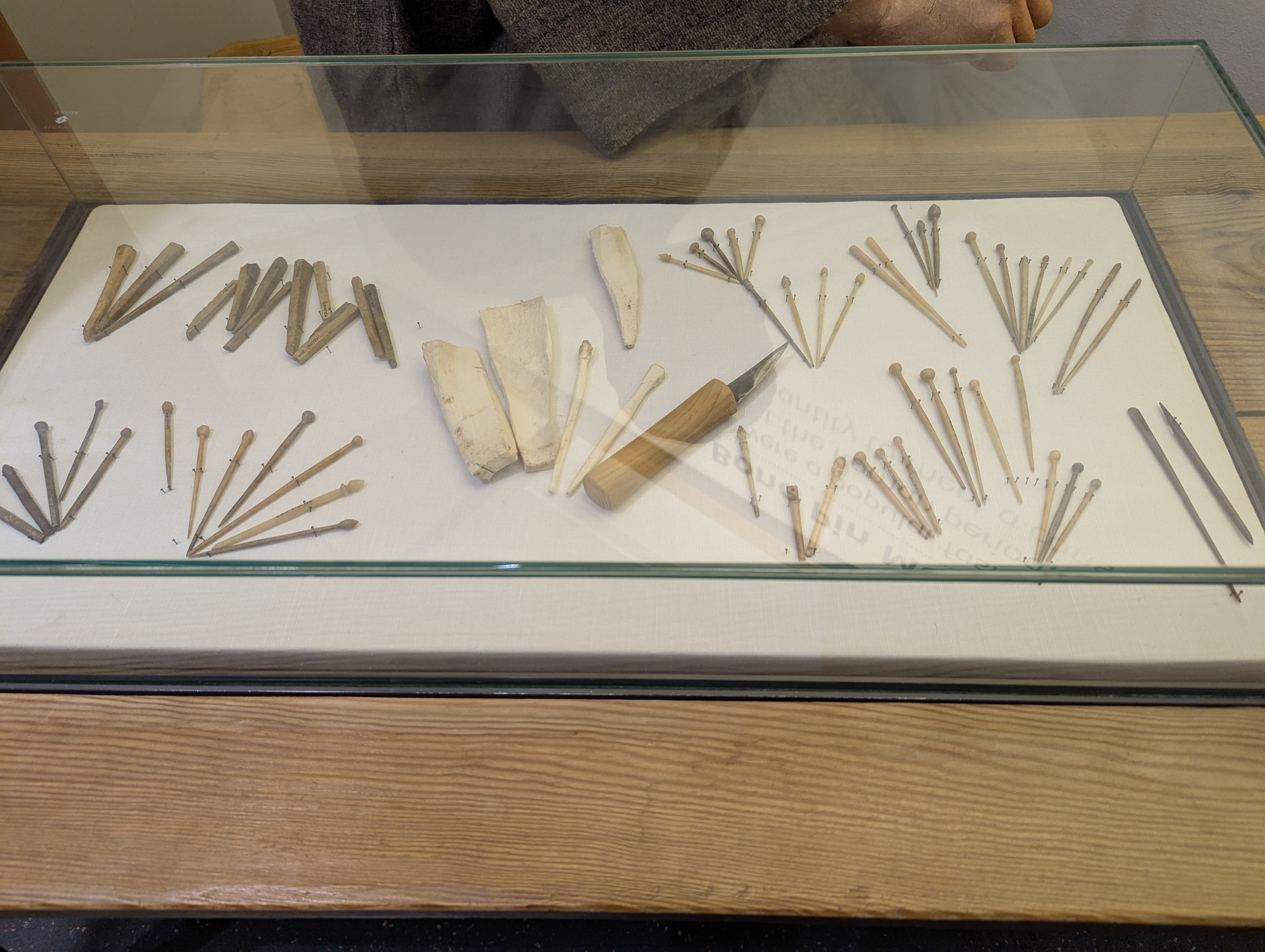
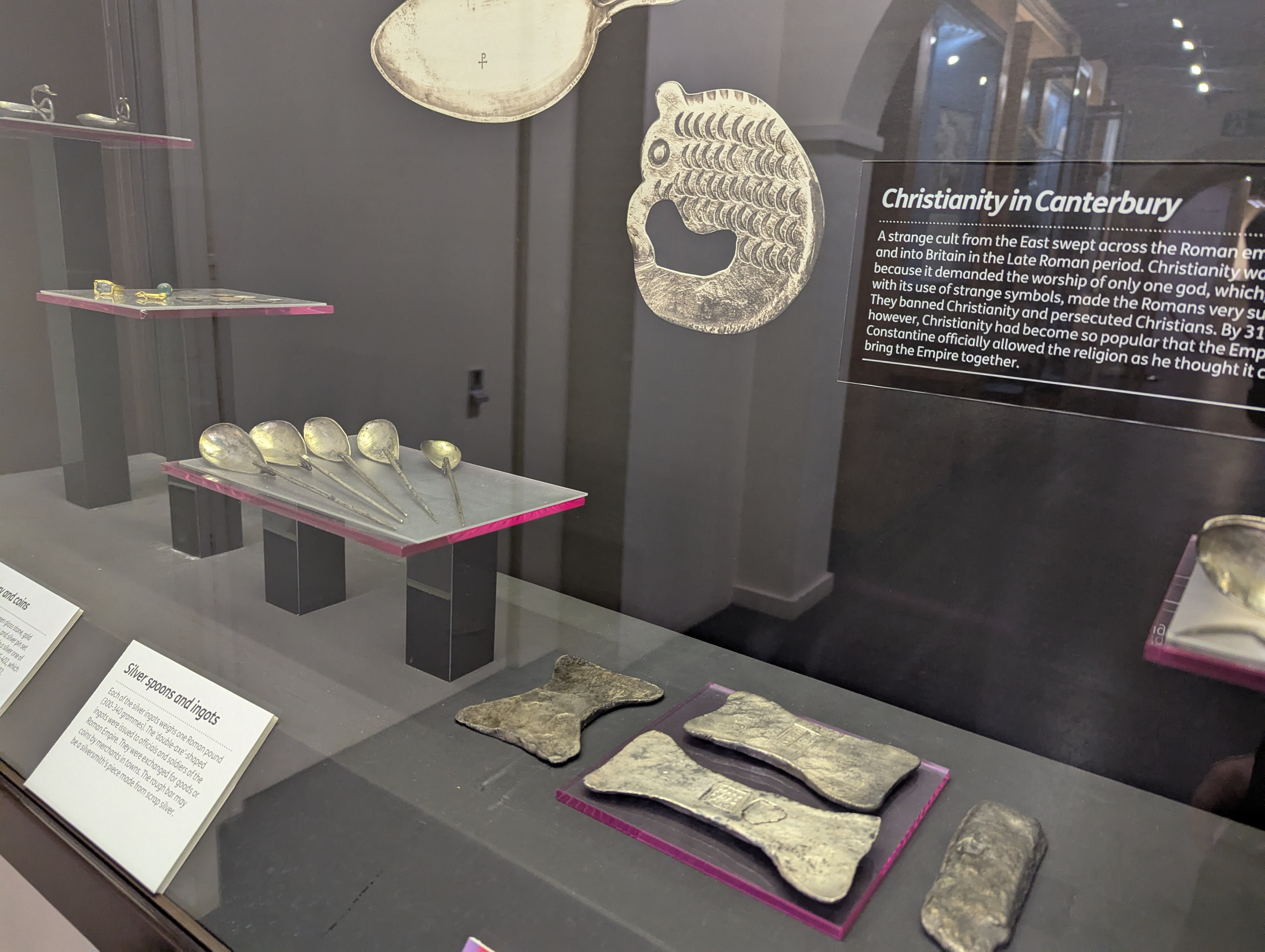
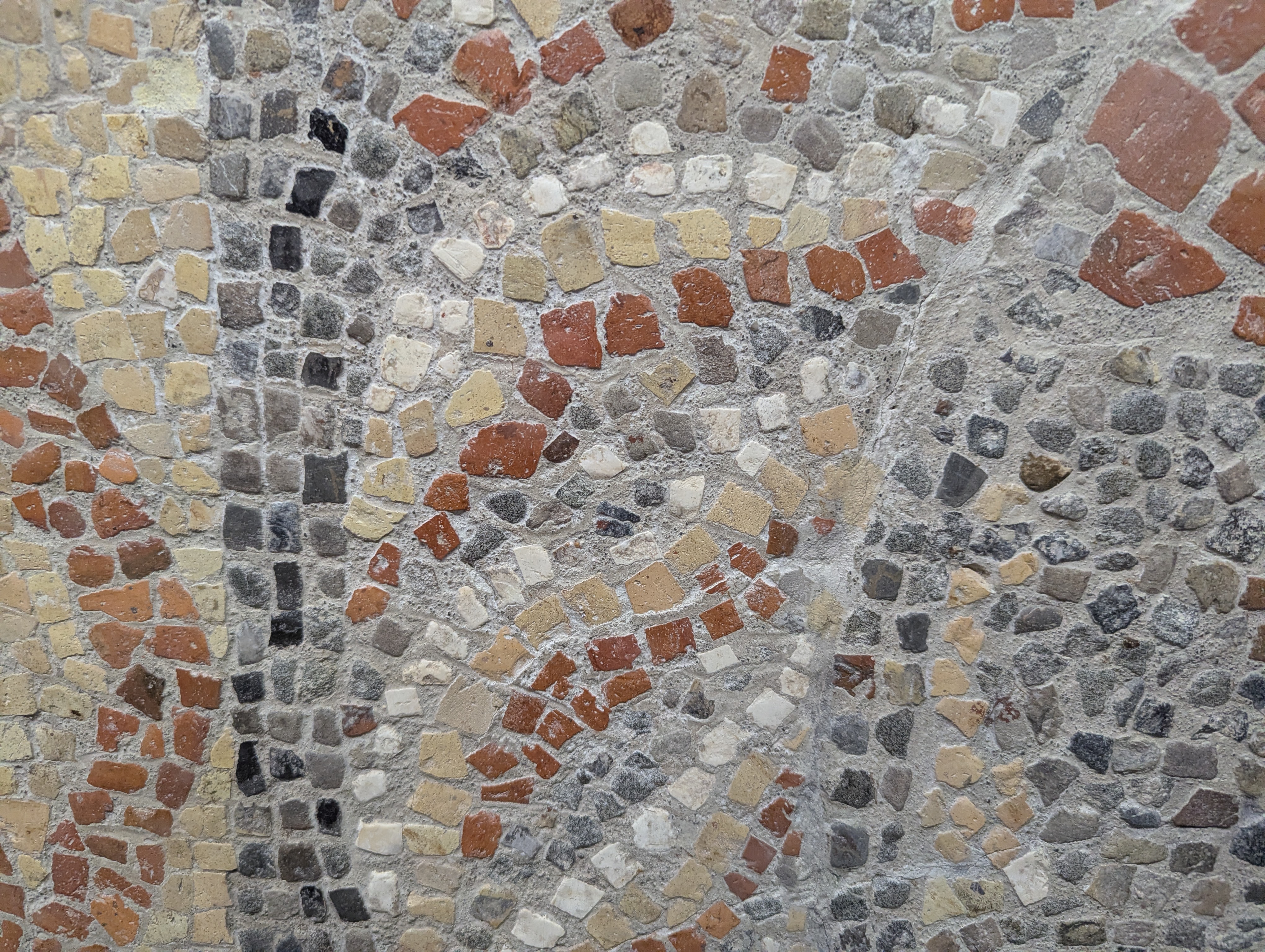
Our final serious destination for the afternoon was the Canterbury Roman museum.

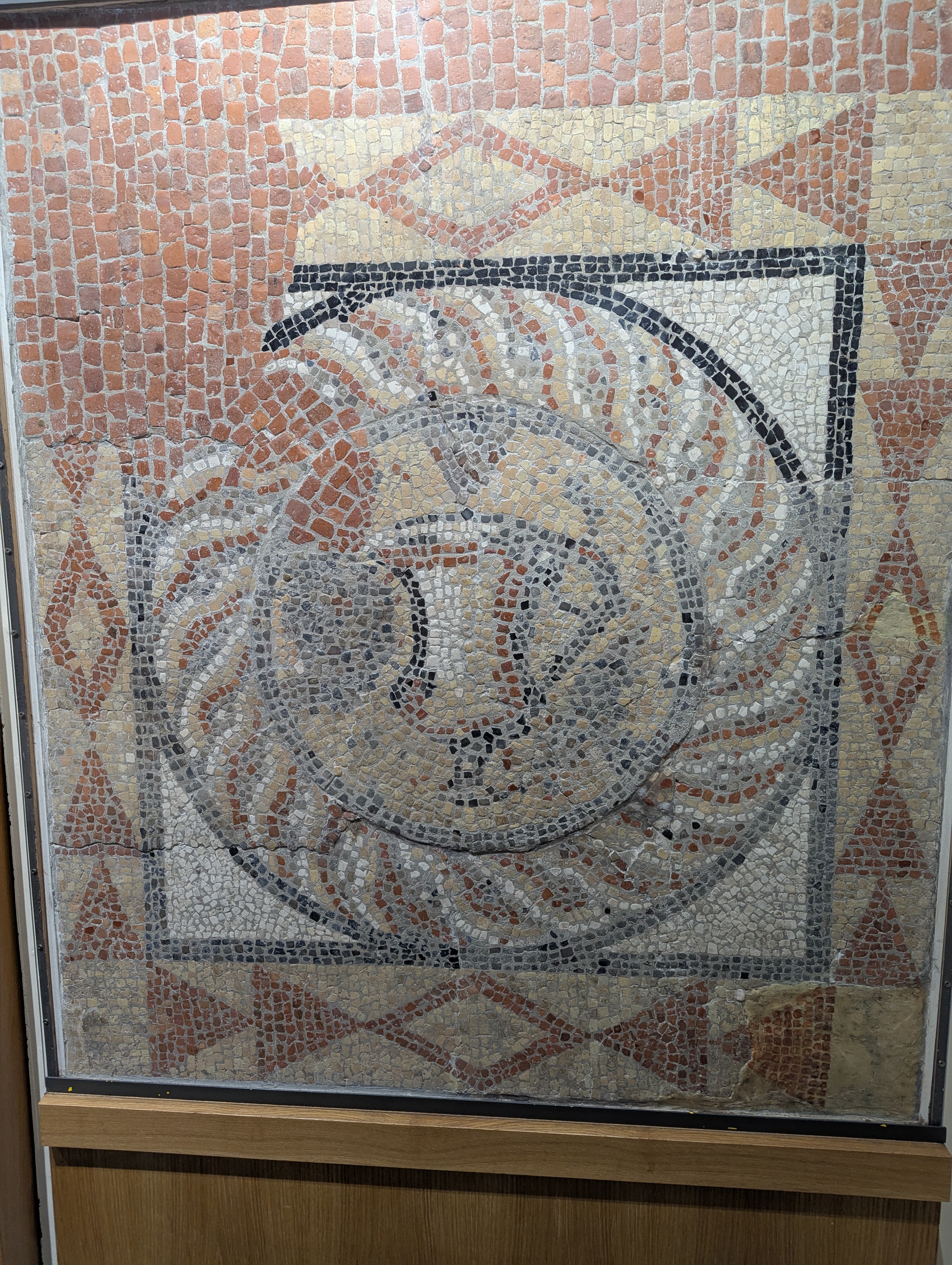
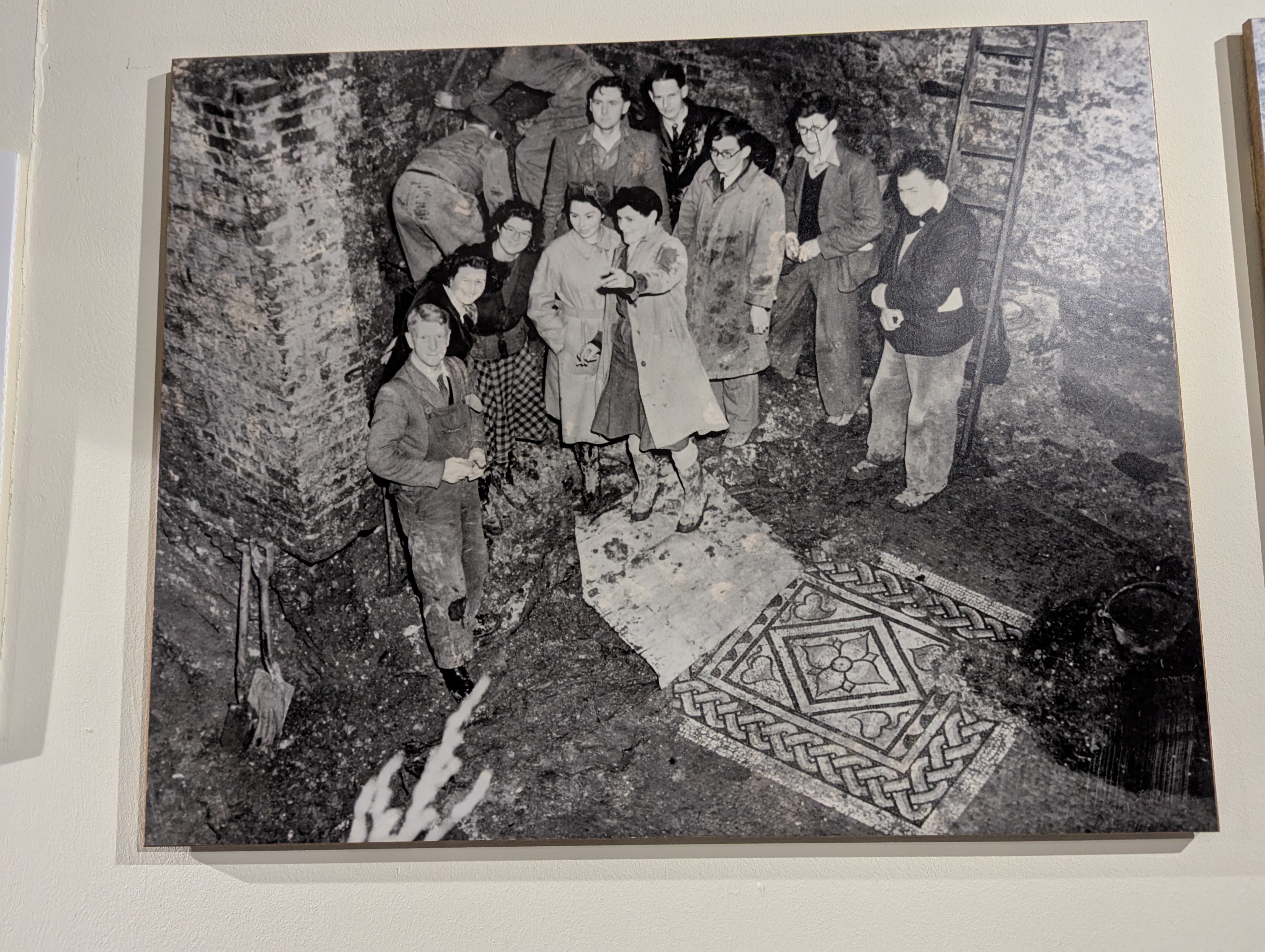
This museum is built on the site where a Roman floor mosaic was unearthed by a public works drainage modernization project. Later, work to excavate rubble from World War II bombings exposed further elements of a Roman home on the same site. These elements are encased and visible for viewing in the museum. Prior to the section of the museum that contains the Roman house, there are interesting exhibits about Roman history in England and Roman life. By the time you get to the excavation site, you feel awfully darned smart about the Romans.

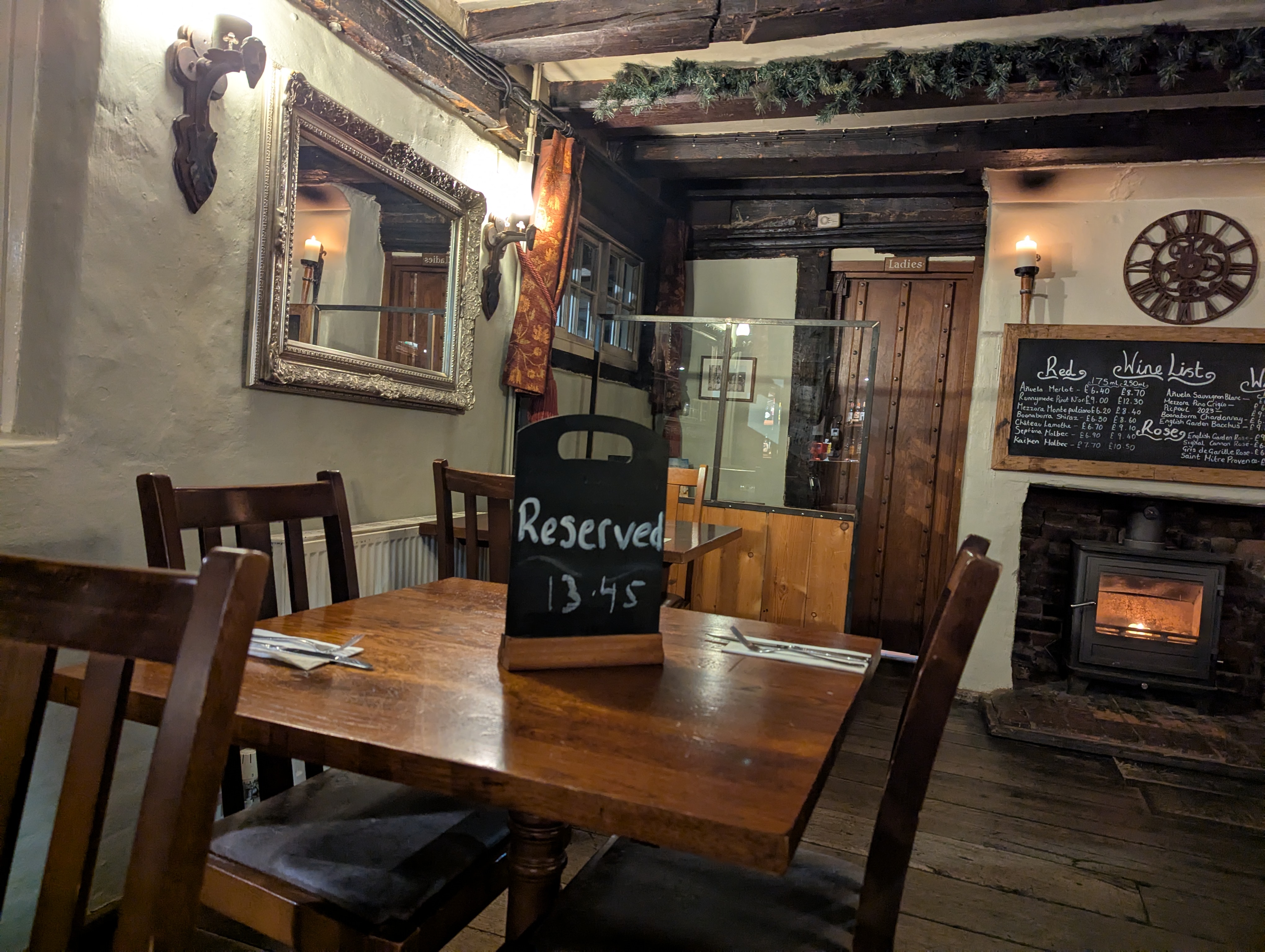
We ended the day with a nice walk through town and along the river and dinner at the oldest pub in Canterbury, the Parrot, dating back to the 1400s. Pretty cool place for a pint.

All the single ladies

I’ve found that when I travel I’m drawn to certain themes and narratives. When I was working in software the themes were often around how projects came about. In software, a big project is usually completed through a series of smaller projects that can involve multiple teams and stages toward the desired end. How that comes about can be quite complicated and is part of why I found my job interesting.

So while traveling and touring I’m drawn to the project aspect of anything. Last week, I was at the Gustave Caillebotte exhibit at the Art Institute of Chicago and especially enjoyed looking at the methodology for completing his projects, how his trial sketches were a key part of the process of producing the final painting. I remember touring the iconic Sydney Opera house years ago and learning that the design for the Opera house was based on an artist’s rendering. After it won a competition, architects had to figure out how to build it somehow. It was a project in which there was a tremendous amount of trial and error toward producing the artist’s vision. Kind of the original Agile project. In this trip around East Anglia, one of my favorite parts of the audio tour for the Ely Cathedral was a representation of the stages of building across close to a thousand years. Every hundred years or so a big project would happen. What made me laugh when reviewing the time lapse representation of the build timeline was the times they would add something in one century that in the next century they would remove. Human nature. One man’s innovation is another man’s mistake.

In this trip, one of the themes that was present in my mind was the impact of women across East Anglia. Don’t get me wrong: history always includes the stories of men, and in our touring of cathedrals and museums there were plenty of male historical figures of note. But the history of East Anglia introduced me to several interesting and notable female figures.

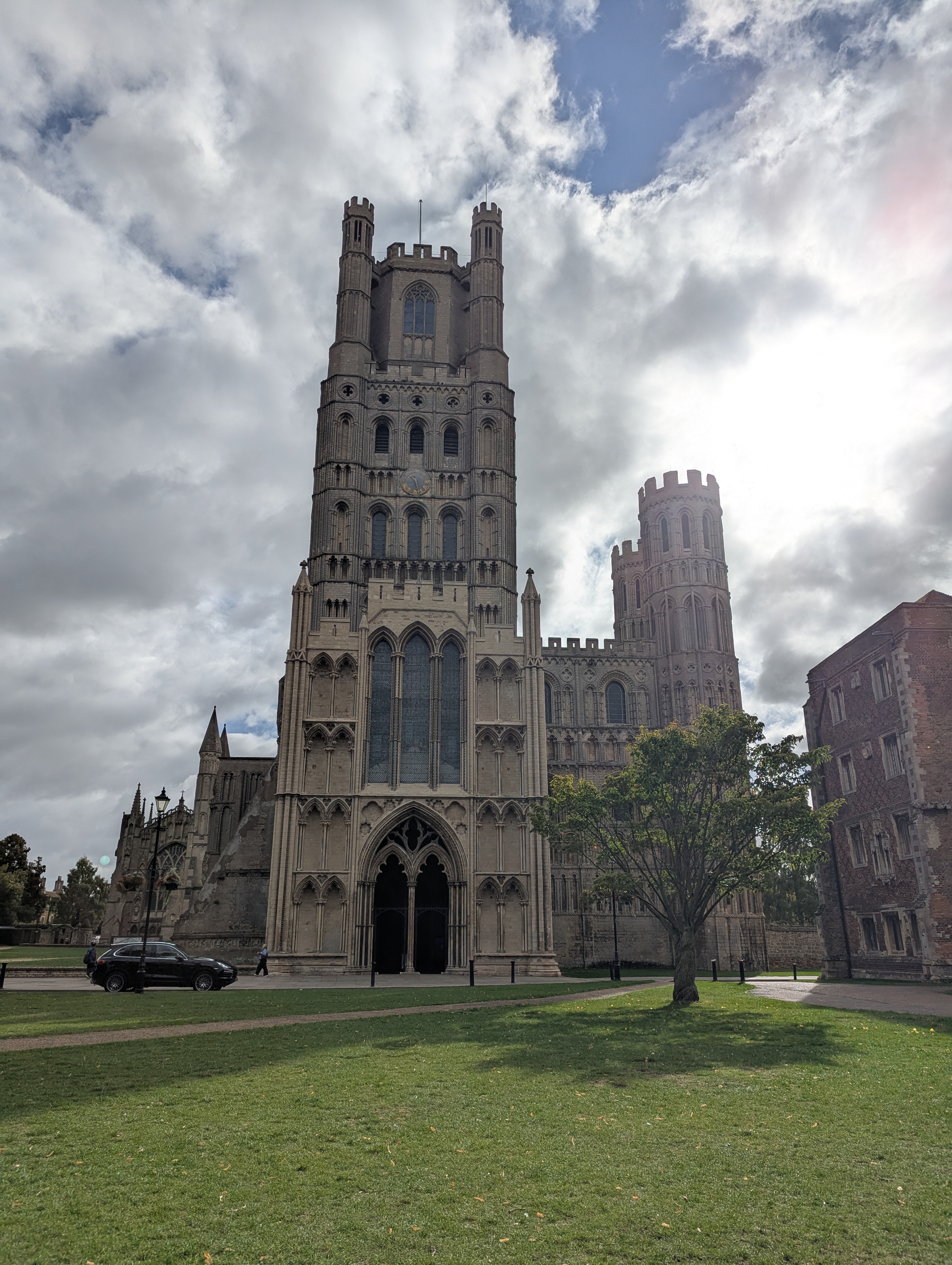
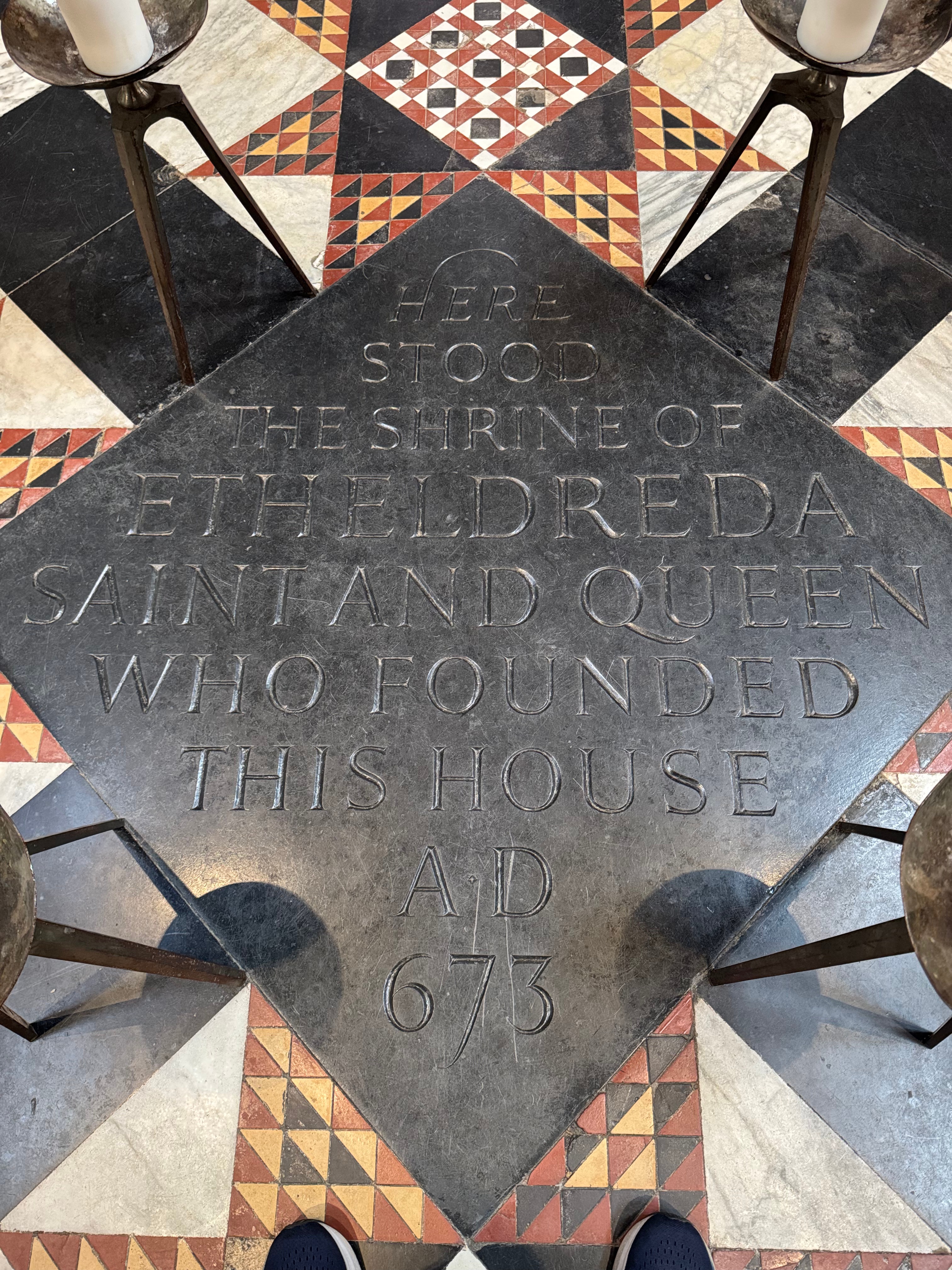
The first one was Etheldredra, important in Ely. Ultimately, she became the founder and abbess for a monastery in Ely in the 7th century, the land on which The Ely Cathedral was later built. But before that she was a king’s daughter and was married off to an elderly king. The audio guide at the cathedral tells us that her husband died before they could consummate the marriage. It says she married a second time, different king, and was released from that marriage since she was still a virgin.

A lot to take in and it made me curious. For one, when I heard about the first marriage in the audio guide, I had the impression that the first husband must have died quickly after the marriage. But other sources indicated they were married for several years. Some sources claim that the deal that was made prior to both marriages–which had been political in nature–that she would be permitted to remain a virgin.

Apparently her second husband came to regret that deal many years in, which led to the marriage being dissolved.

To doubly prove that she really, really was a virgin at the end of that marriage, the audio guide tells a story of her walking stick sprouting leaves overnight.

Interesting that it was an acceptable deal in both marriages that she would remain a virgin when the marriage was presumably for political reasons. The tale of Henry VIII communicates that producing an heir–about 900 years later–is a very big expectation for a royal wife. A lot must have changed in the ensuing years.

Anyway, by today’s standards, kind of a weird origin story for a woman who ended up doing something very, very important when she was allowed to stop getting married off and fulfil her longtime dream of starting an abbey. As an abbess she was highly influential and successful, both in life and after her death, after which she was officially sainted.

The buildings Etheldreda was part of building were destroyed and rebuilt in subsequent centuries. The Ely Cathedral was built on the land starting about 300 years after Etheldreda died. Coincidentally, the monastery at Ely–by then a Benedictine monastery–was closed down by Henry VIII himself.

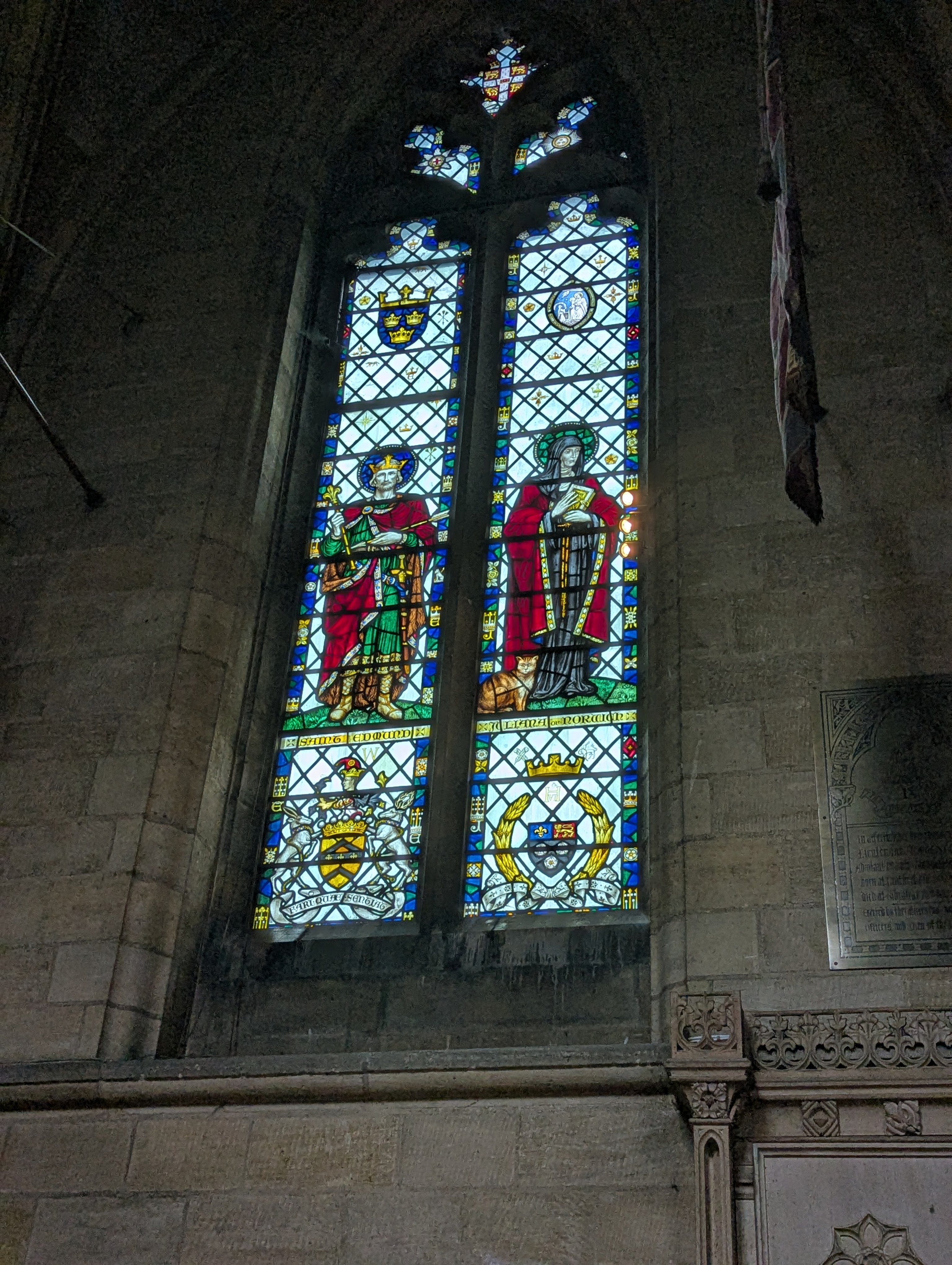
Another woman we became re-acquainted with in Norwich was the mystic and theologian referred to as Julian of Norwich. We had encountered some of her writings when we visited the British Library exhibit Medieval Women: In Their Own Words a few months ago. In the 14th century, Julian wrote the first English language book known to have been written by a woman. Very little is known about Julian, including whether Julian is even her name. She was an anchoress–a religious devotee who lives in a cell–in St. Julian’s church, and her understood name may have come from the church itself. She was inspired to write two versions of a book titled Revelations of Divine Love following an illness in which she was close to death and experienced visions relating to Christ’s death. The first version was written shortly after she recovered from the illness and the second one, much longer, after many years of intellectual and spiritual exploration. Her manuscripts were preserved for 200 years before being published. Although she claims in her writings to be uneducated, her work continues to inspire theologians even in our time. Famously, she posited that God is much like a mother. Our guide at the Norwich Cathedral quoted some famous words of the book that she found comfort in: “All shall be well, and all shall be well, and all manner of things shall be well.” Julian is commemorated in stained glass in the Norwich Cathedral we visited. Note in the picture the woman on the right pane carrying a book.

Photo from Norwich Cathedral web page

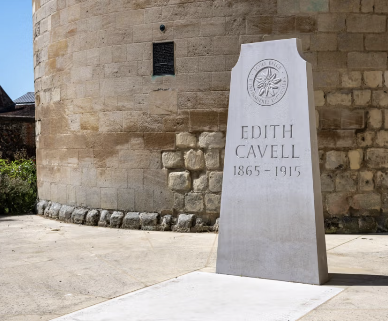
Moving on many years, we quasi-encountered Edith Cavell who was born at the end of the 19th century. As we were walking for the first time from the Norwich train station to The Maids Head I saw a pub named The Edith Cavell. Then once we checked in to The Maid’s Head, on the way to our room, there was a meeting room labeled The Edith Cavell Room. I asked myself “who is this Edith Cavell?” She sounded familiar but I couldn’t remember why. It turns out she was the daughter of Norwich-area clergy and had an increasingly interesting nursing career that presumably started either because experienced a failed romantic relation OR because she helped her father through a serious illness. Or both. Her nursing took her into teaching and administration and allowed extended travel in Europe. She was notable as a nurse in the first World War for treating war wounded from both sides but ended up running afoul of the Germans for aiding the escape of more than 200 soldiers from Belgium. She admitted her “guilt” and was executed at age 49 by a German firing squad. She showed virtually no fear leading up to her death, glad to die for her country and with her soul at peace. Her body is buried outside the Norwich Cathedral.

And finally, we encountered Edith Pretty, the woman responsible for sharing the Anglo-Saxon treasure of Sutton Hoo with the world in the mid 20th century. Born into a wealthy family, she became deeply interested in archeology and, with her husband, purchased the Sutton Hoo property on which the burial mounds were located. (Interesting side note: before her marriage she, too, was a nurse and served in Belgium in the first World War.) Although many people believed the mounds had already been robbed, as indeed they had been, she was convinced that they contained additional treasure. After her husband passed away, she hired a local excavator, Basil Brown, to explore the site further. He is often credited with the find, as he should be, but the excavation occurred only because she was willing to invest toward the work. She waited patiently for the coroner inquest that would rule on who had rights to the treasures, rejected rewards from the crown for gifting the property, and as soon as it was clear it was hers to dispose of as she wished, she donated all artifacts to the British Museum to add to our understanding of the Anglo-Saxon culture and be enjoyed by everyone. Like our other women, Edith Pretty was a Boss.

It occurred to me that every one of these women became known for what she did when she was single, regardless of how she came to be that way. Perhaps being single contributed to their being able to pursue a deep-seated interest given the times in which they lived. You have to admit we are looking at a very long period, more than 1000 years, in which it seems true that it has been quite difficult for a married woman to pursue the kind of work that speaks to them as a person, unless that work happens to be taking care of family. (I do note that some of these “jobs”–like being in a monastery–just require being single.)

To be clear, we know about these women because they became famous. In my mind, fame is not the object for most of us. The object is being able to do work that interests one greatly.

And as much as I note that women have made progress since Edith Pretty’s death in the 1940s, it seems there are still forces that hold us back. In fact, forces that existed in the past that were briefly weakened seem lately to be coming to greater strength.

Ominously, women leaving the workforce at high rates. Although unexplained, some factors believed to be involved include rapidly increasing cost of child care and the newly growing wage gap between men and women workers. Removal of women from government positions under a new regime, where the claim is that they are insufficiently qualified. And my social media feeds over the summer included a video in which a well-known male operative, leading seminars for young women, encouraged them not to work or attend college. Or if they attended college not too work hard at it. Ok to pursue “an MRS degree,” where you are only attending college to meet eligible bachelors. Indeed, ready yourself for a life of servitude where you take care of family and be subservient to your husband, the boss of your family. Sorry for the bad luck of the accident of your gender.

As a recent retiree from a job I loved I’m so thankful for the period in time in which it’s been possible as a woman to pursue interesting work. My fervent hope for all women is that one is not required to be single or childless to be able to freely choose and grow in an occupation. That women be judged on their objective merits instead of assumptions about people of your gender. That when partnered, their partners support their self-actualization, just as they support the same in their partners.

I bet all the single ladies of East Anglia agree.

New territories, Norwich edition: part 2

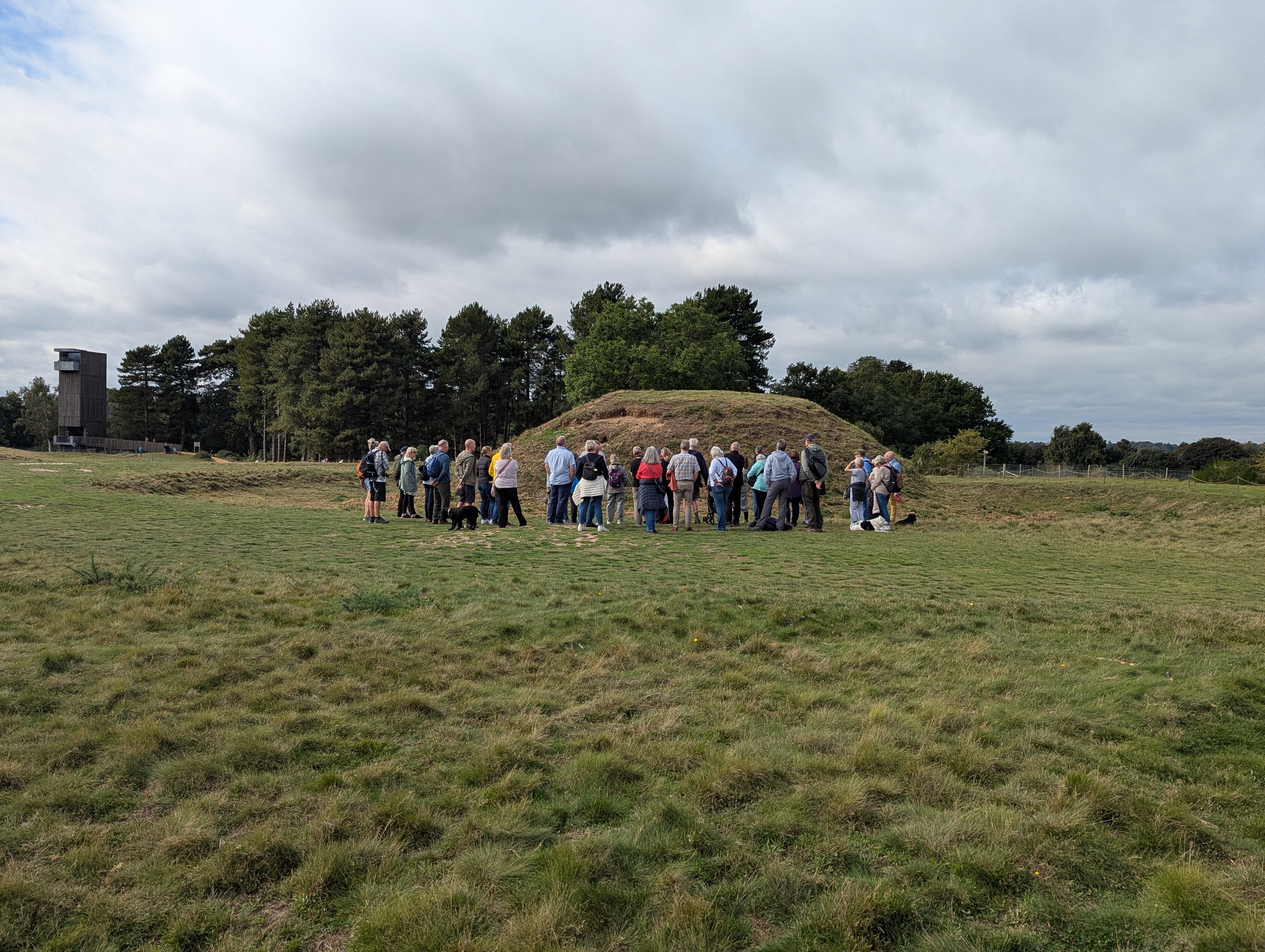
With the rain more or less behind us, we had breakfast at the hotel and then took the train to Melton. The Melton train station has the best butcher shop I’ve ever seen….and very little else. We walked along a narrow sidewalk very close to a busy thoroughfare for 15 minutes to arrive at Sutton Hoo. We initially learned about Sutton Hoo from the Netflix movie called The Dig. The movie tells the true story of how one of the most significant archeological finds in England–an Anglo-Saxon burial ground–came to be discovered. For perversely quick and hopefully not inaccurate history from a touring American, Anglo-Saxons migrated to England starting in the 5th century A.D., about the time the Roman occupation was coming to an end. The find provided a new picture of how Anglo-Saxons lived. They had been much more sophisticated than originally believed.

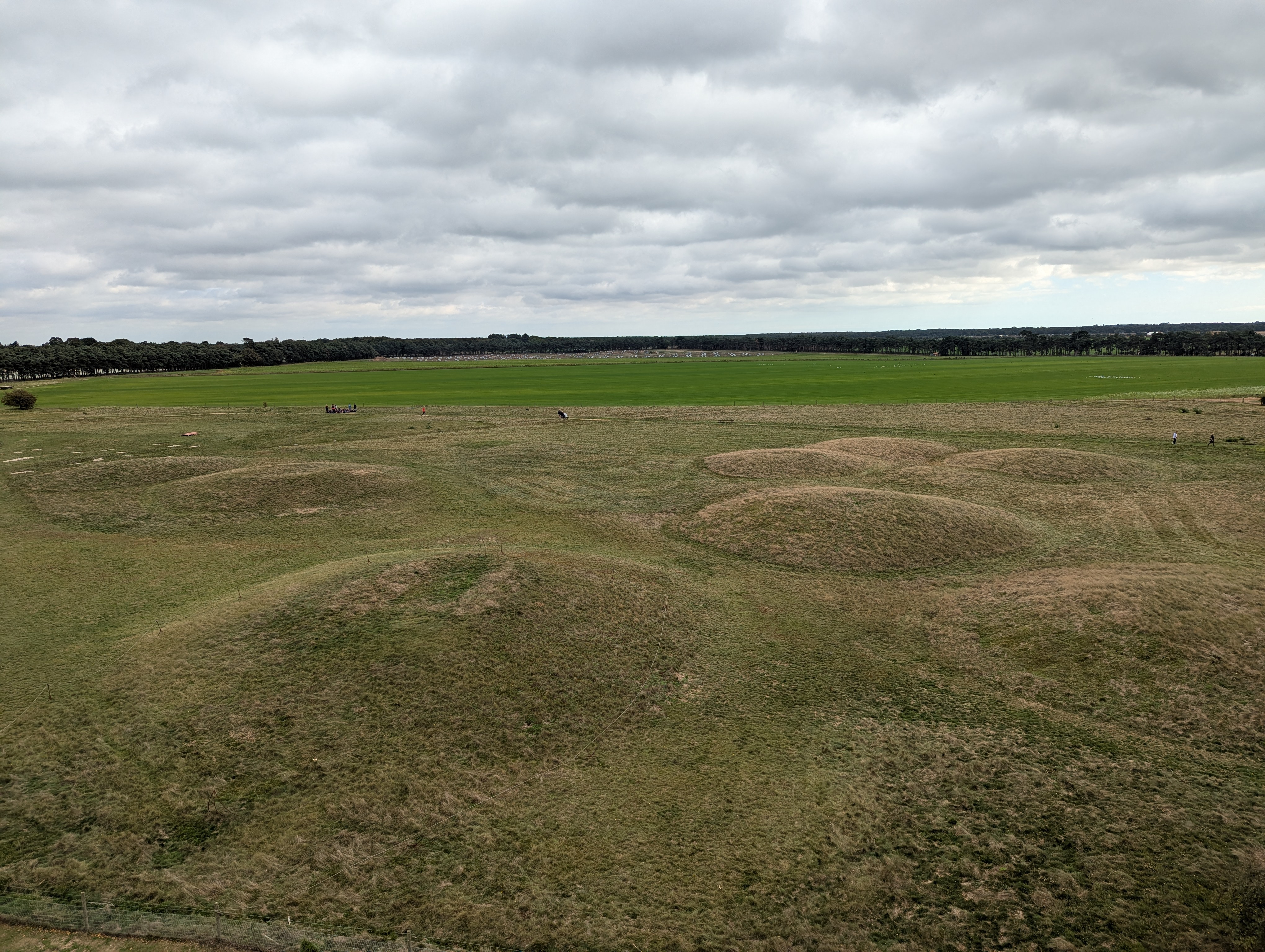
Sutton Hoo was property owned privately by a woman named Edith Pretty that, after her death, was gifted to the National Trust. You can visit the site and walk the property, including into her home and to the location of the burial mounds. There’s an observation tower near the mounds so you can climb up and look down at the mounds. A displayed map on the observation tower describes what was found in each mound. Edith Pretty’s home includes exhibits about her life and details about how the excavation project came about. There’s also a museum about Anglo-Saxon life on site. Outside of the museum, there’s a replica of one of the most interesting objects found in the mounds, the fossilized outline of a ship that was used to bury an important Anglo-Saxon leader. At Sutton Hoo, they seem convinced that the leader was King Readwald. The British Museum, which ultimately received most of the objects found in the mounds, including a famous war helmet believed to belong to the person buried, seems less certain. Pretty’s gift of the artifacts to the British Museum came after a coroner’s inquest into the ownership of the artifacts found on her land. As soon as the inquest established that she alone had rights to the artifacts, she gifted them for all to enjoy.

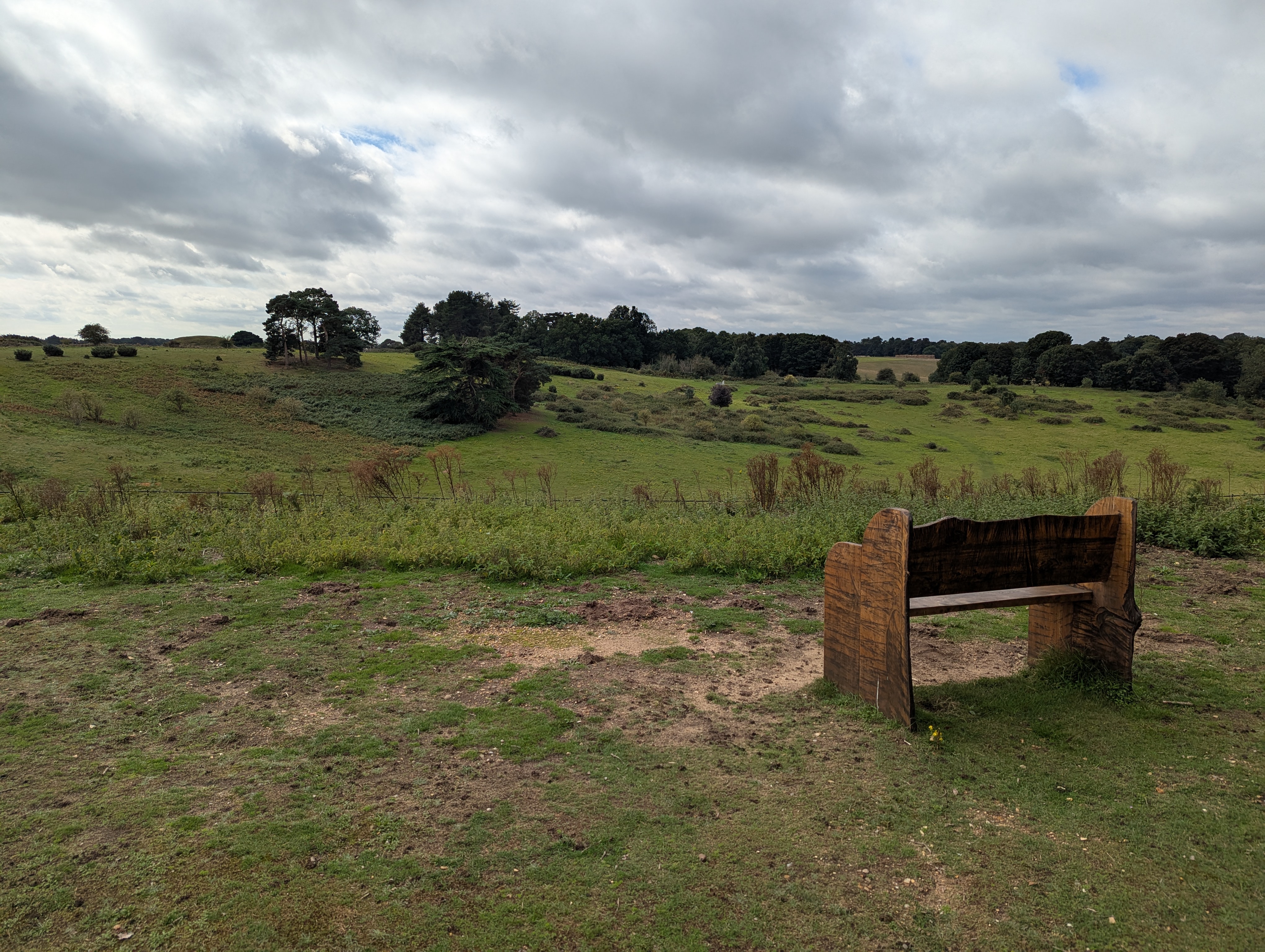
The property is beautiful, rolling hills, wild grasses and flowers. We explored a path through and near the property trying to find the River Deben, which is what the Anglo-Saxons are believed to have used to drag the ship to the burial place. We got to where we could see it but there are a number of beautiful and gated private properties blocking access.

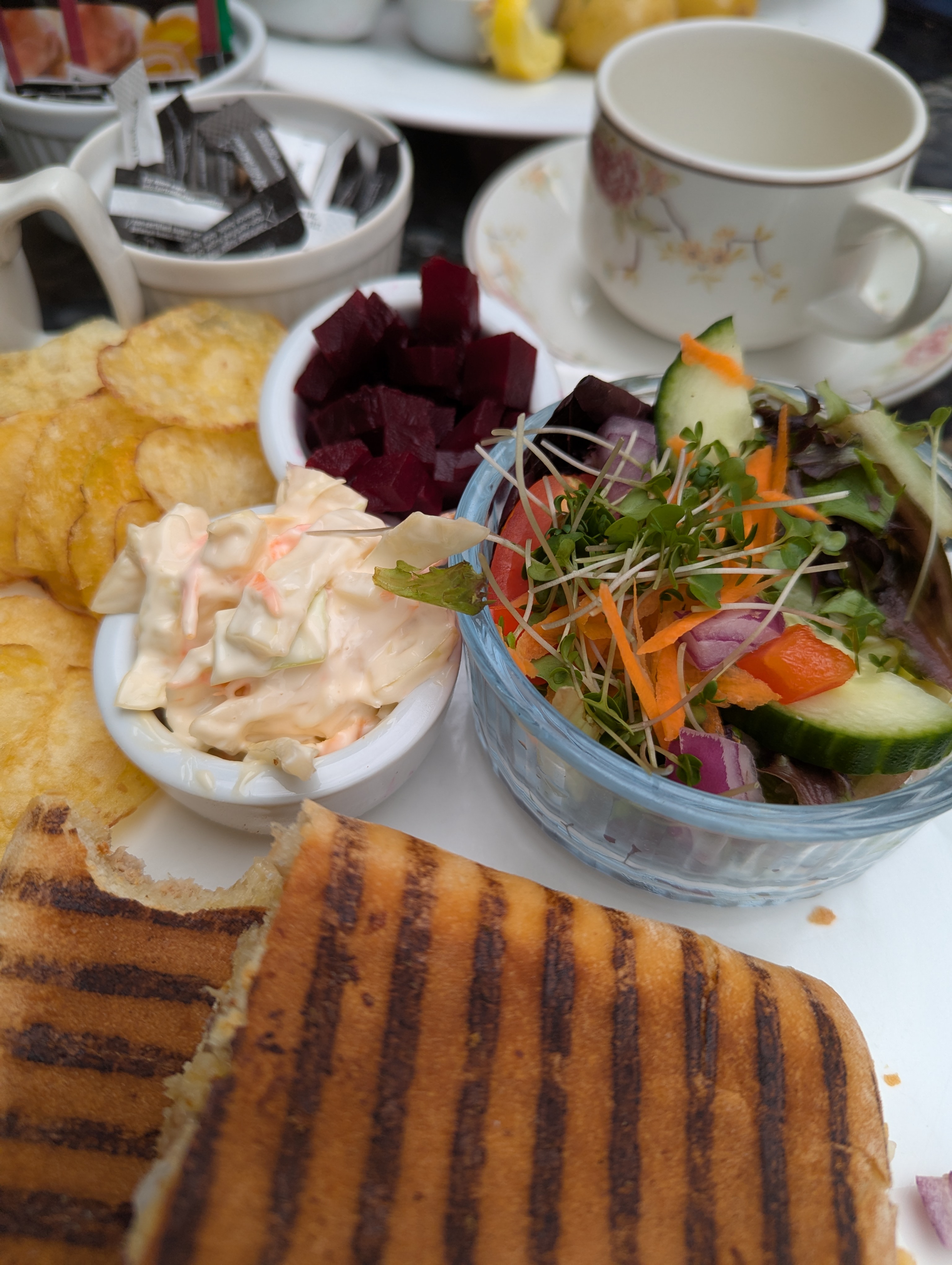
After visiting Sutton Hoo and returning to the train station, we headed to Ipswich. Like Norwich, Ipswich’s football stadium is also near the train station. It’s quite nice from the outside. We walked to the city center and searched out a place for lunch, settling on the highly rated Blends Coffee House. Cute on the outside and kind of rough on the inside, with a menu far too big for the size of the shop, we were pleasantly surprised by how good everything was. I had a pot of tea (third day running, really enjoying this habit) and a BLT. English bacon is really different from bacon in the U.S. and I love it. It’s a bit more like U.S. ham. To be clear, I love all bacon, the English way or the U.S. way. I could easily be vegetarian, except bacon. I guess I would have to be a vegebacontarian. What was so so good about the BLT was the artisan bread. Not to go all crazy about a BLT, but it has long been my belief that what is important in a BLT beyond the quality of the B, the L, and the T is the right proportion of each ingredient and the balance of mayo and bread. Theirs was just about perfect.

As we were paying our bill the person who waited on us asked if we were Canadian. Honestly….there are reasons I would like to pretend to be Canadian while traveling in Europe at this time in history. At all times, America’s relationship with Britain is a bit complicated. But the week we were there, our President was also, and that brings feelings to the fore. But we were honest and that led to a general conversation about why we were in England. We asked if he was an Ipswich fan and he ran to the back of the kitchen to bring out his coffee cup bearing the logo of his favorite team. It was Port Vale. We laughed because that’s who Arsenal was to play in the Caribao Cup the week after we were there. (I am writing this more than a week after the trip; Arsenal ended up winning the match on Wednesday 0-2.) The other worker at the coffee shop was an Ipswich fan. We asked him about the rivalry with Norwich. He said “oh yeah–we hate them.” He was looking forward to the first match in a long time between Ipswich and Norwich. Both teams have been up from the Championship and into the Premier League and then back down to the Championship in recent years, but not at the same time. Both are in the Championship now.

After some good natured trash talking and some advice from the guys about what we should consider doing in Ipswich (they recommended nothing in Ipswich but had ideas about other places we should go in England), we went off to find baked goods. Ultimately, we found a chain called Cookie Barista. We walked back to the train enjoying the scenery and downing our cookies.

Back in Norwich, we made another visit to St. Andrew’s Brew House, this time to try some of their beer. It was Thursday, kind of a popular day for people to meet up with friends at the pub so a bit livelier than our last visit. We had the Anglo-Saxon amber. It was pretty yummy. We walked over near the Guildhall for an easy dinner at my husband’s go-to chain in England, Pizza Express. This one had a great view over Norwich and the market.

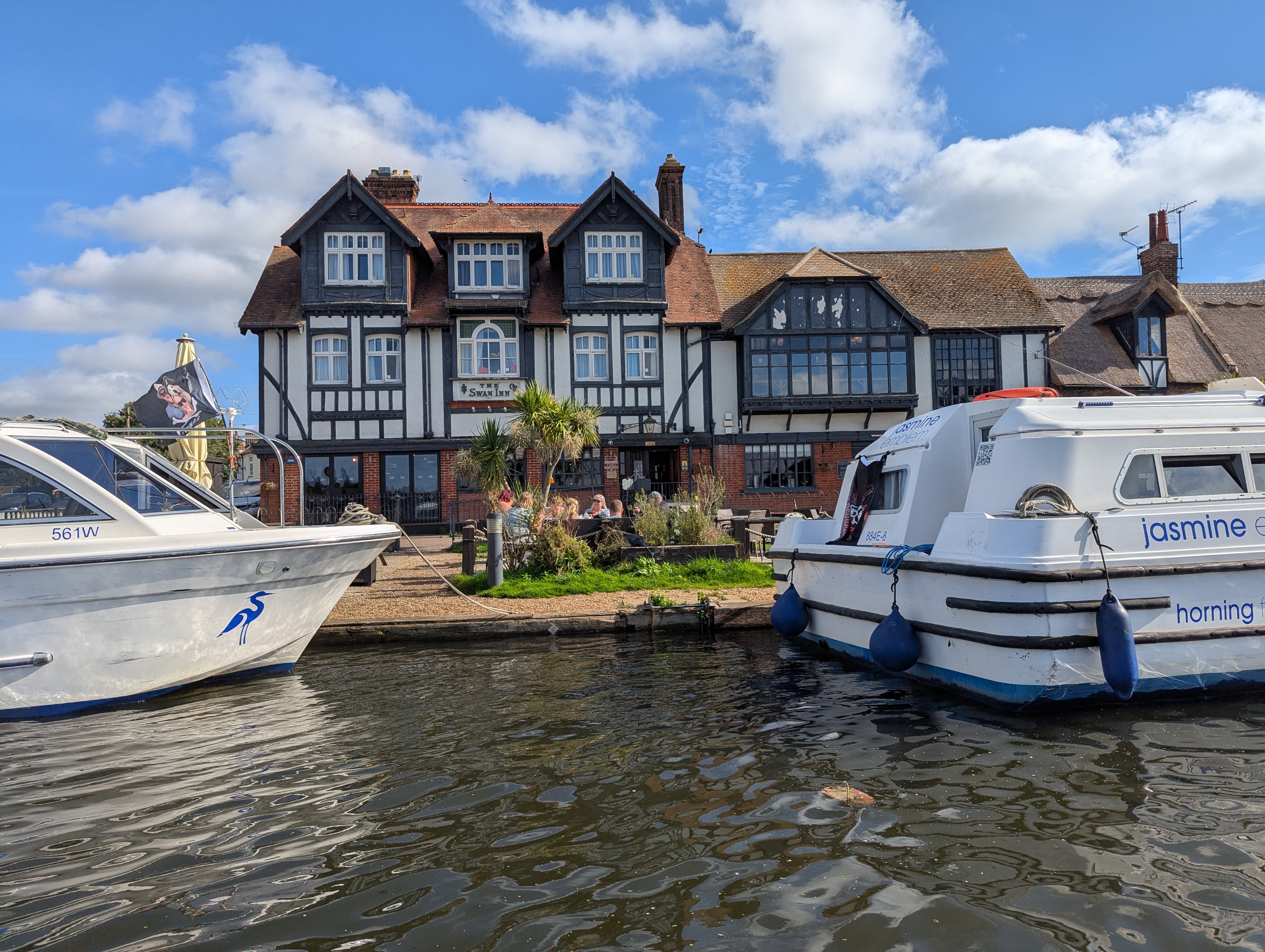
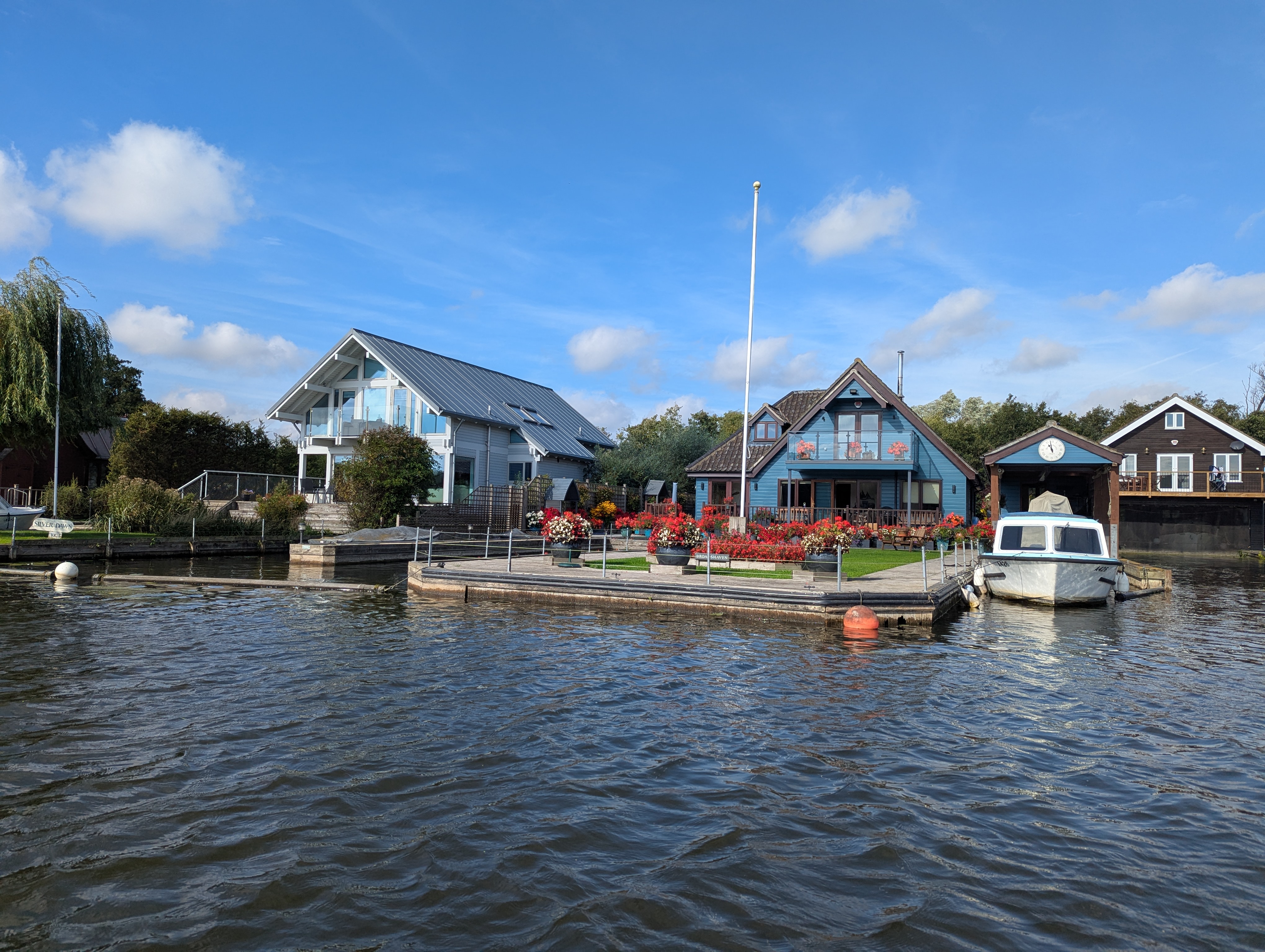
Our last full day in East Anglia was going to be a warm one. We took the train to Hoveton and Wroxham to enjoy the Norfolk Broads. The understood way to enjoy the Broads is to rent watercraft and tool around the Bure river. We found Norfolk Broads Direct and rented a motor boat for 3 hours. It was a September Friday so not too busy on the river, but they had a lot of boats available to rent and had plenty of competition from our boat outfits. I had zero confidence about driving the boat but my husband had full confidence. It was a bit hairy getting out of the dock area but he quickly became comfortable and we enjoyed looking at the beautiful homes along the river, the wildlife, and the scenery. You can only go a maximum of 5 miles an hour on the river so it was quite chill. When people rent for a whole day they are able to dock and go into little towns and pubs along the river. 3 hours was too short for us to do that, but we got a sense for the lifestyle.

We walked back to the train station in Hovetown/Wroxham to embark on our next adventure, a ride on the Bure Valley Railway up to Aylsham. We had to grab a quick lunch so we stopped at an establishment near the station called Fizz and Fromage. I saw they had BLT on their menu but it was not just “BLT.” It was “Famous BLT.” After waxing lyrical about the BLT in Ipswich, you know I was tempted. I really can’t explain how it is possible, but the BLT at Fizz and Fromage was the best I have ever had. By far. My husband was just as enthusiastic about his hummus and sourdough.

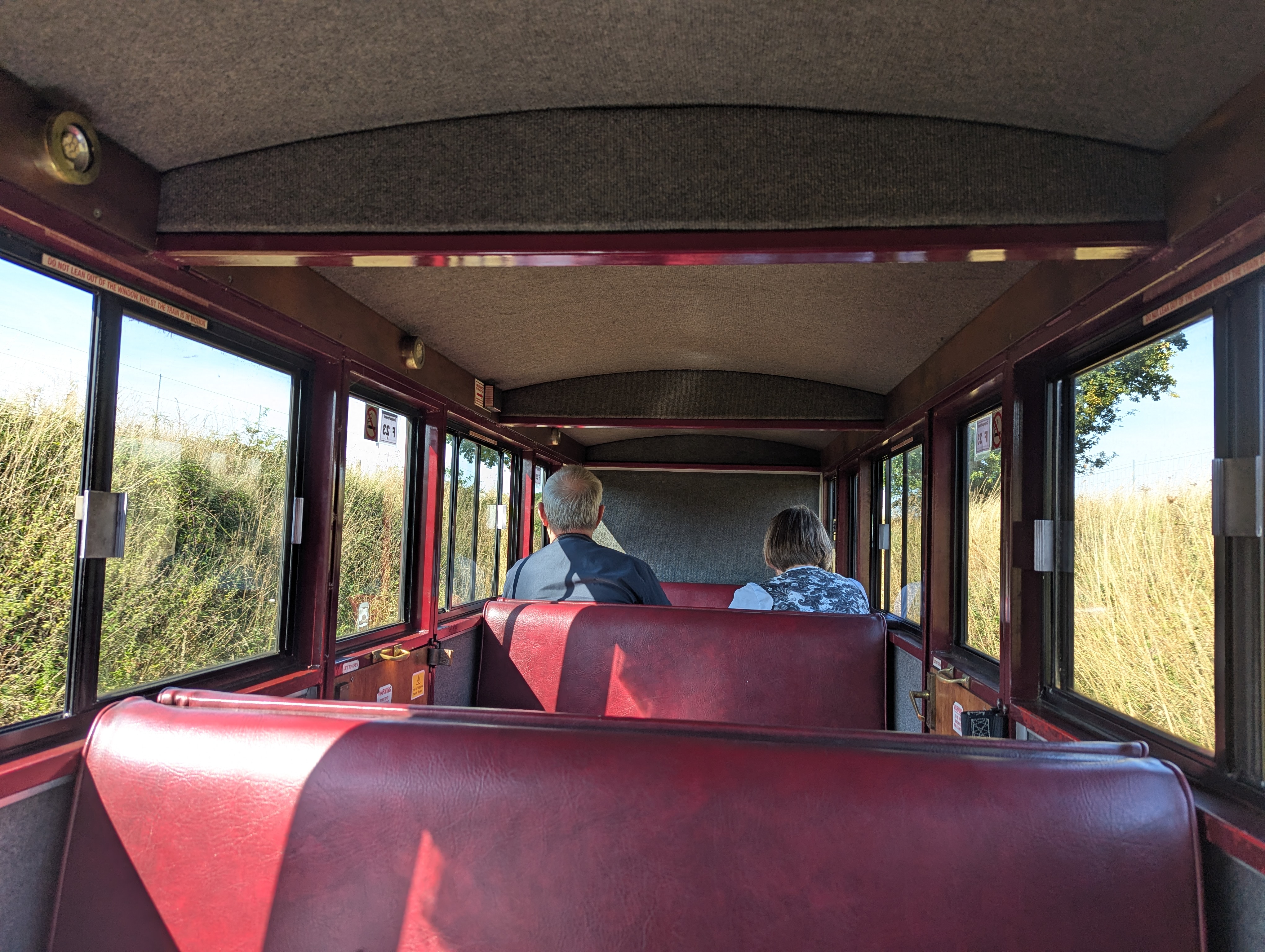
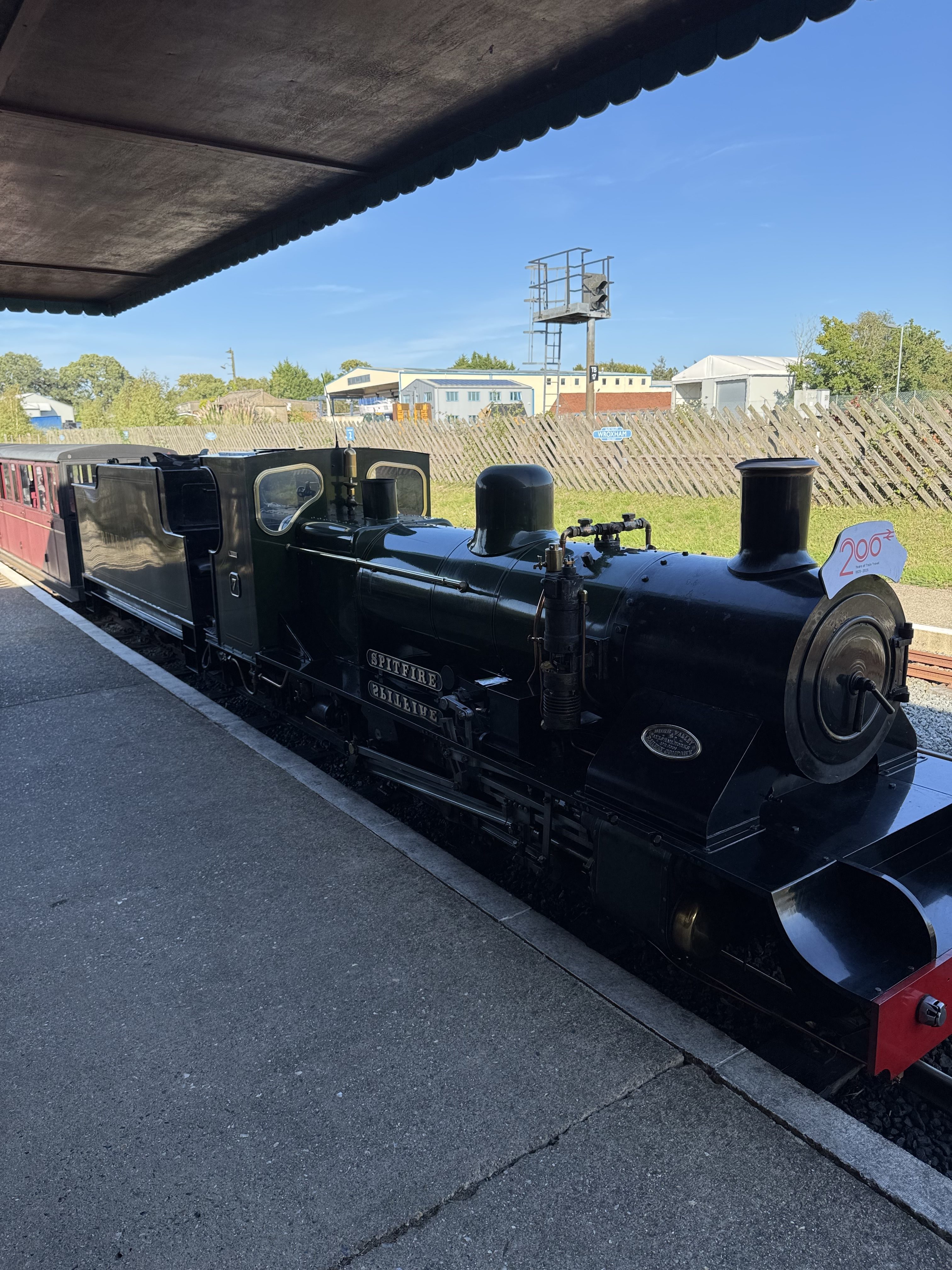
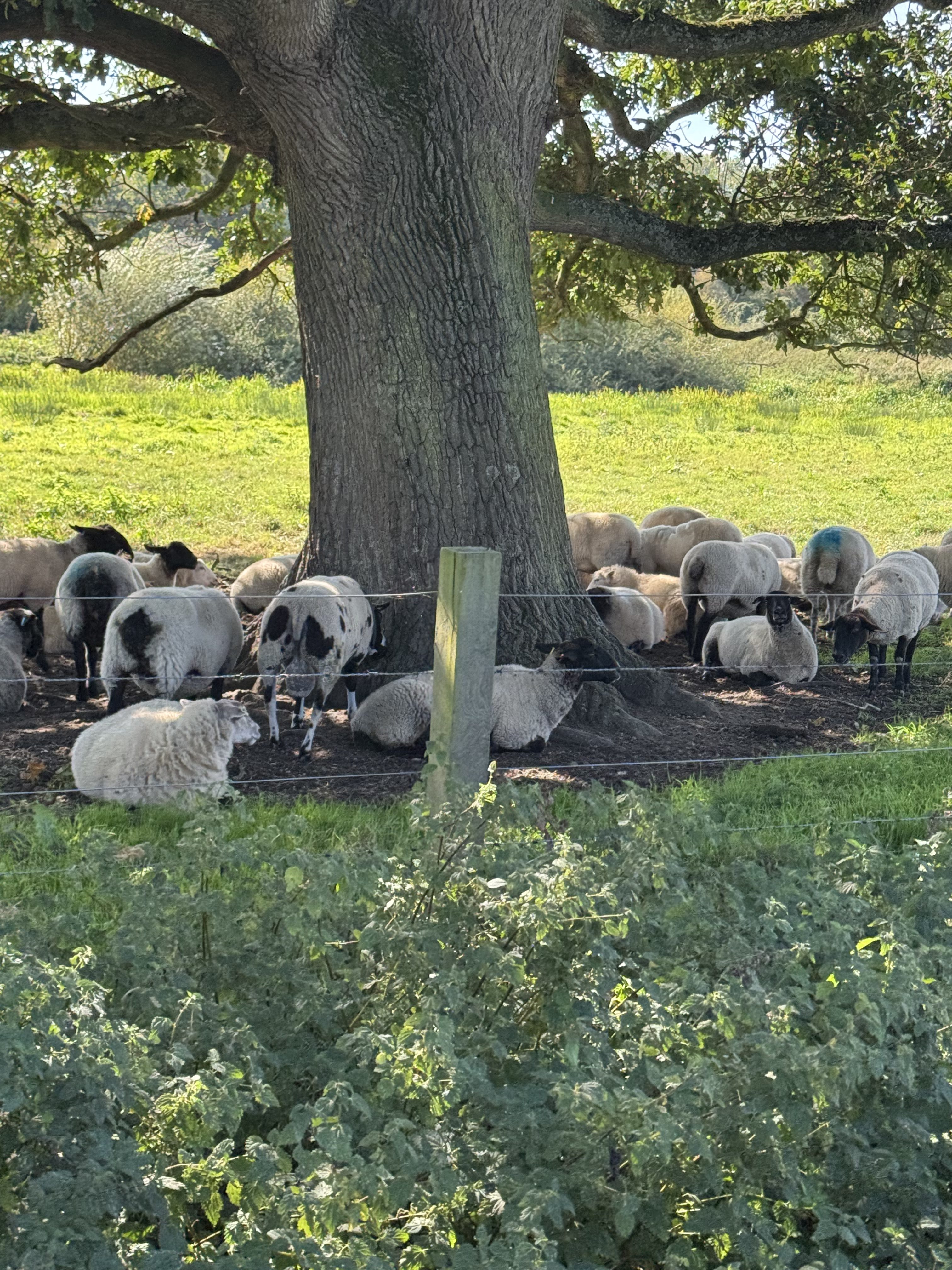
The Bure Valley Railway was a lot of fun. The train was pulled by a steam engine. It was not an old steam engine as we had believed when we booked but rather a new one. The whole railway was actually constructed in 1990. The train went through lovely country side, past villages and the Bure river, and sheep. We passed bikers and hikers using a path next to the tracks, and sometimes they passed us. We arrived in Aylsham and had about an hour to explore before returning by rail to Wroxham. Cute little town.

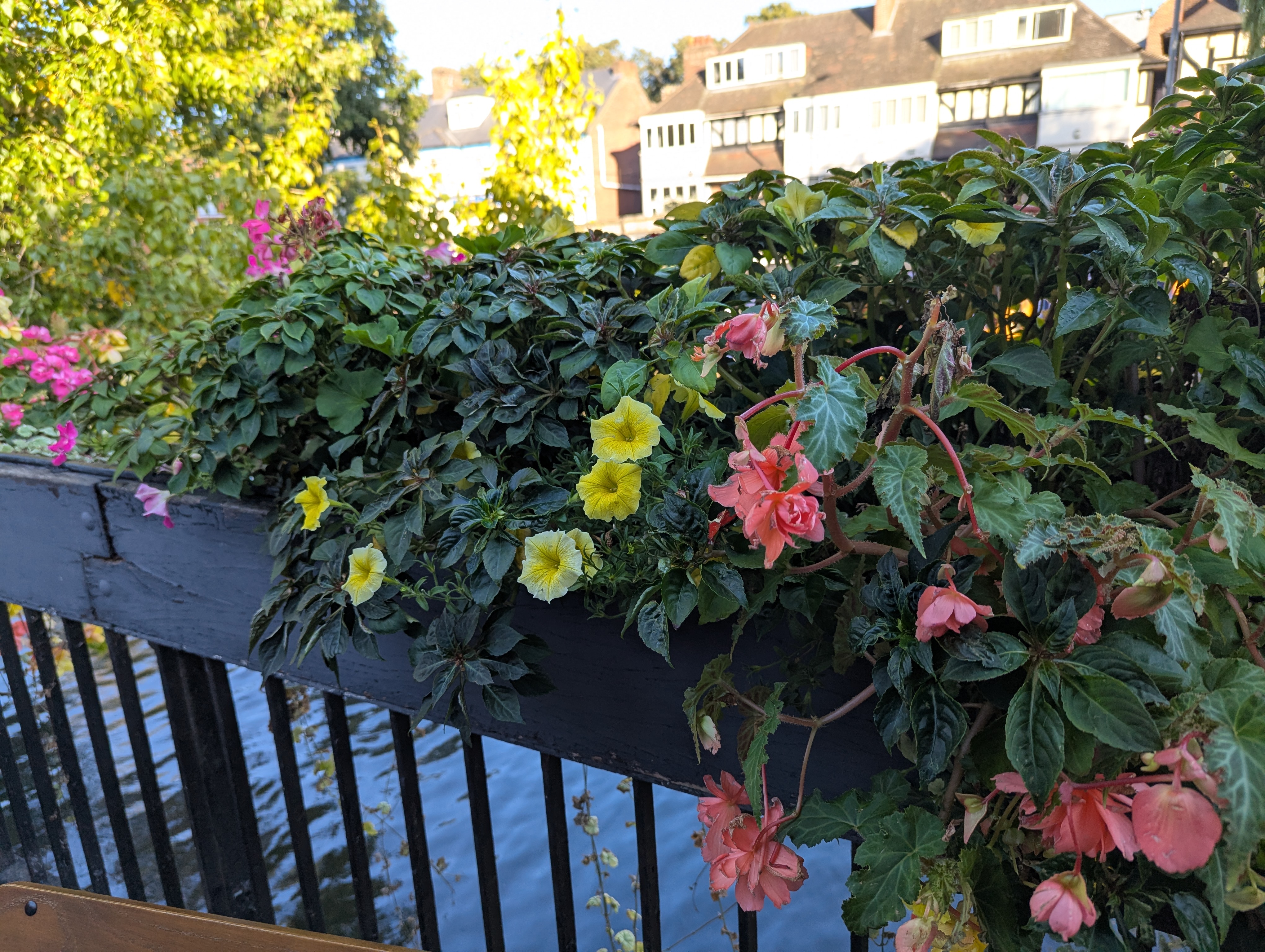
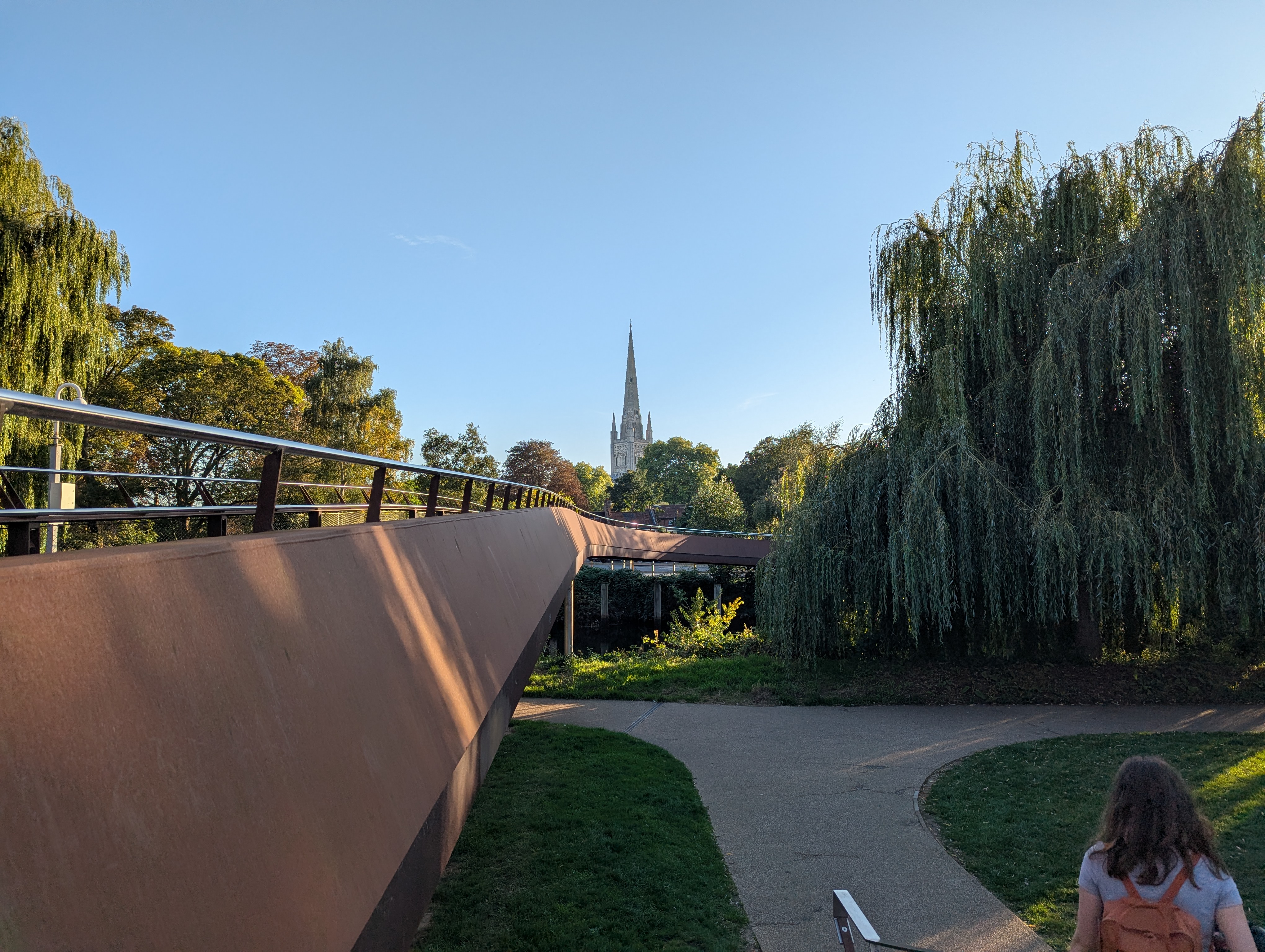
Upon our return to Norwich, we made one more stop at The Compleat Angler for a beer to celebrate our trip to Norwich. It was still so warm and nice we sat out on the porch over the lovely River Wensum. The flower boxes on the exterior of the pub were so pretty. Afterward we followed the path along the river as far as we could on our way back to the Maids Head. It occurred to me that you can see the Norwich Cathedral from many parts of town. I wondered what kind of impact that has on your living when your spiritual home is visible from most places you are.

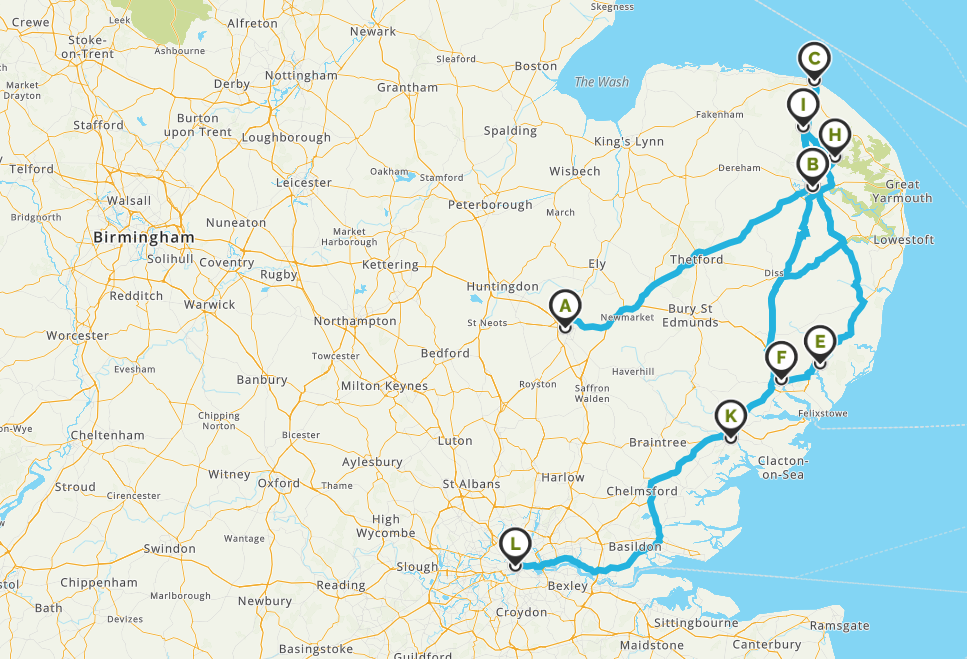
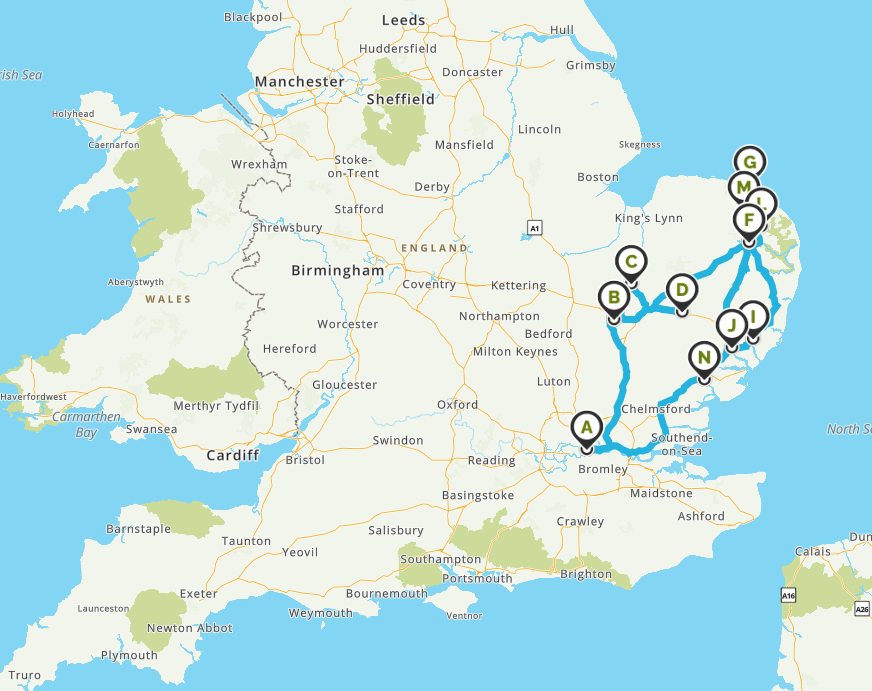
The Norwich leg of our trip, including the ride back to London, looked something like this:

And our whole trip to East Anglia looked like the map below.

We saw and did a lot in East Anglia. Still, I’m left with the feeling that there is so much more to see and do.

Another time….

New territories, Norwich edition: part 1

One “downside” of the Anglia Plus Three-Day Ranger train pass was that you can’t use it before 8:45 a.m. This was a downside only for my husband. He is the early bird for whom the worm is waiting. For me, a consummate midnight oil burner, mostly because I’m too wound up at night to sleep, it meant very reasonable departure times each day. On Tuesday morning, we packed up our suitcases and rolled them to the Cambridge train station across from which we had scones at the bakery chain Gail’s. At the allowed time, we boarded the train to Norwich.

While on the train, we learned that the weather was going to be rainy on Wednesday across East Anglia so we made a quick change on the planned order of activities to take advantage of the rather better weather on Tuesday. Upon arriving in Norwich, we carted our luggage to our Norwich hotel, The Maids Head, and checked it at the desk. Then, instead of touring Norwich as planned, we went back to the train station and took a short trip to a seaside town called Cromer and walked the short distance to the city center.

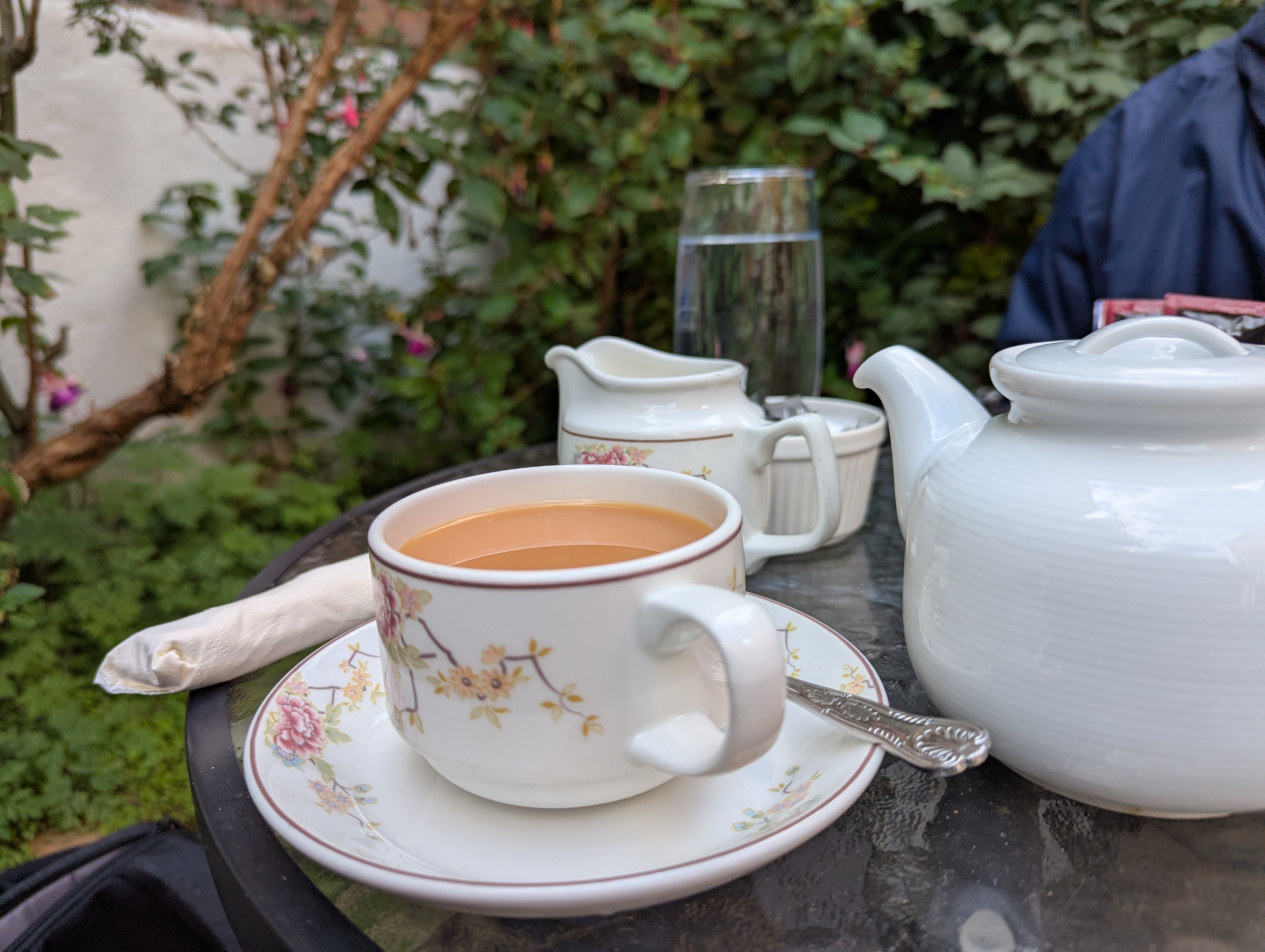
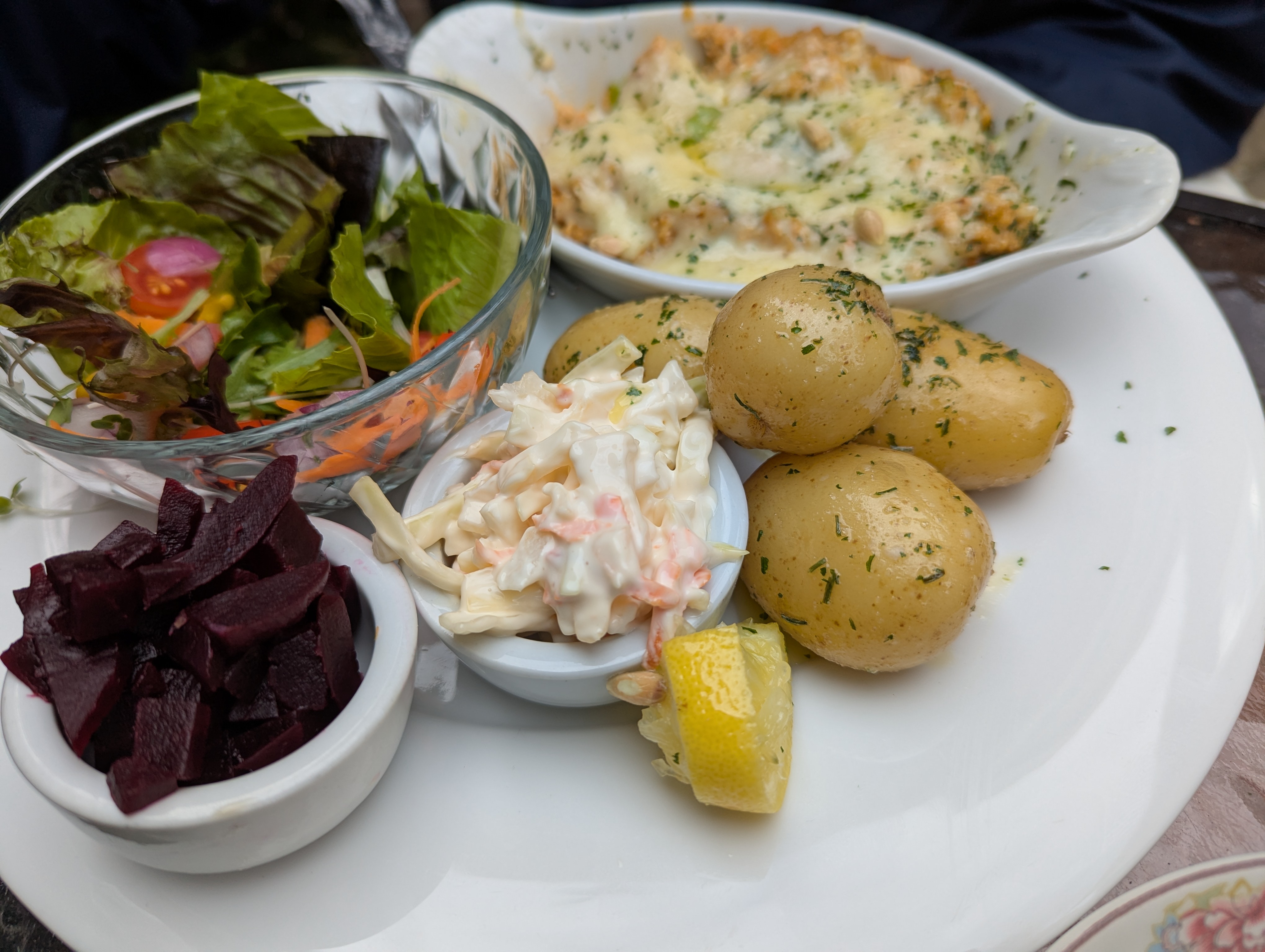
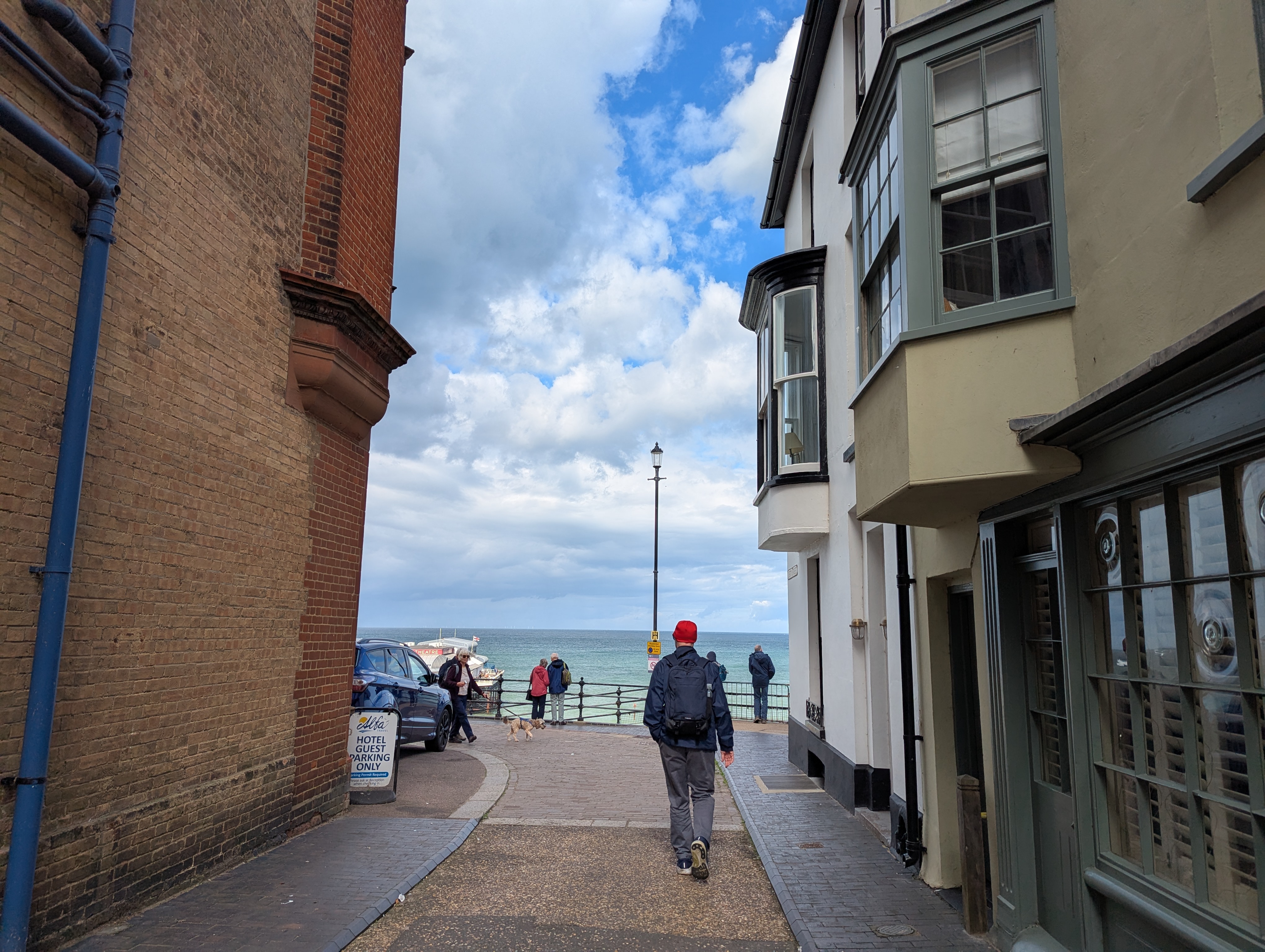
Cromer was lovely. We walked though a charming district looking for where we might have lunch. At last we found a sign pointing from the main drag to a neighborhood for a restaurant called Browne’s on Bond Street. After consultation of very good online reviews we walked over. They were fully booked inside and offered a table in the garden. It was a chilly day but we were dressed for it and happy to have the table. I started with a pot of tea. Having tea was starting to become habitual away from London. My husband had the local dish of Cromer crab prepared kind of like a gratin and I had a tuna melt. Quite yummy.

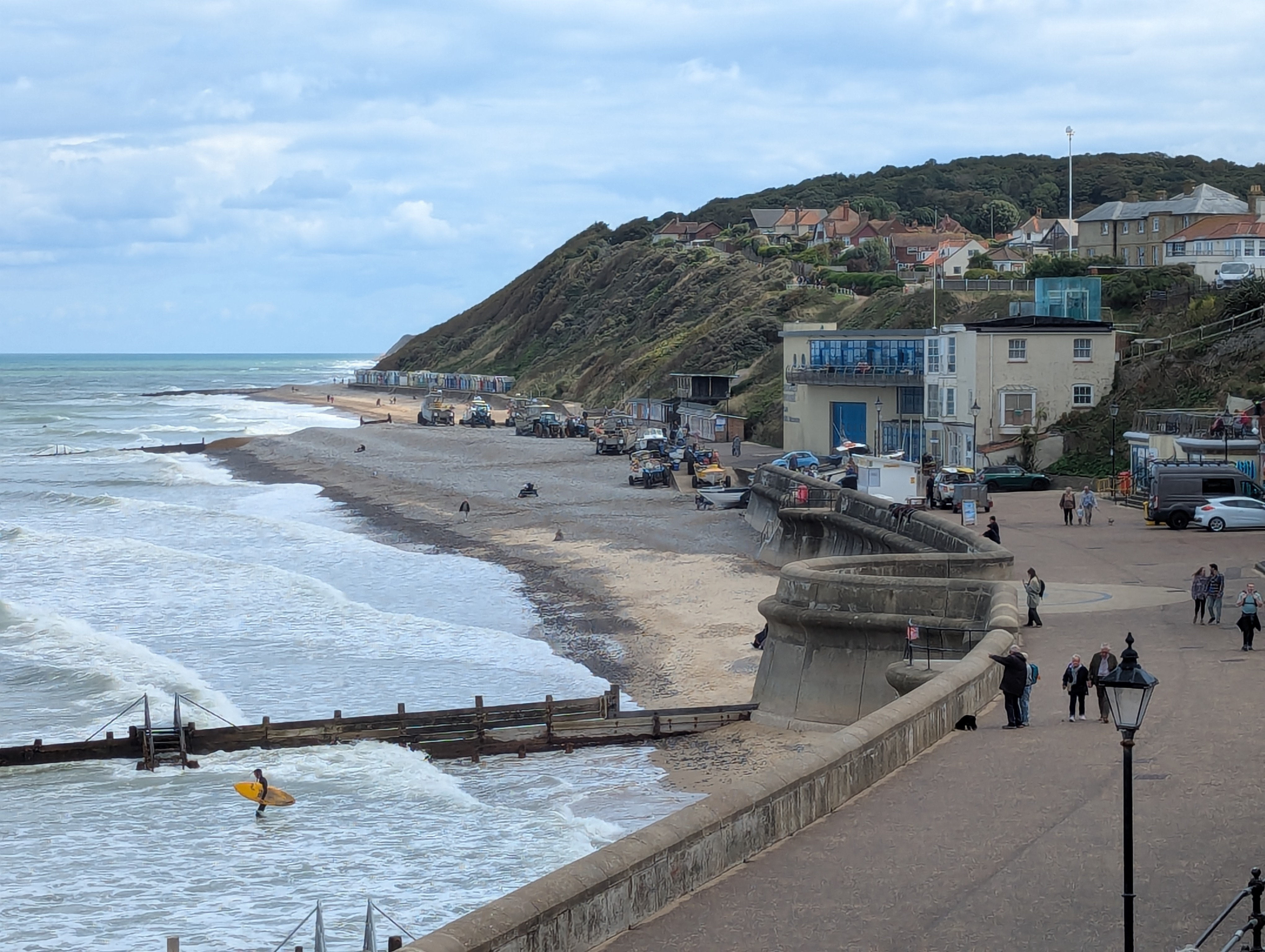
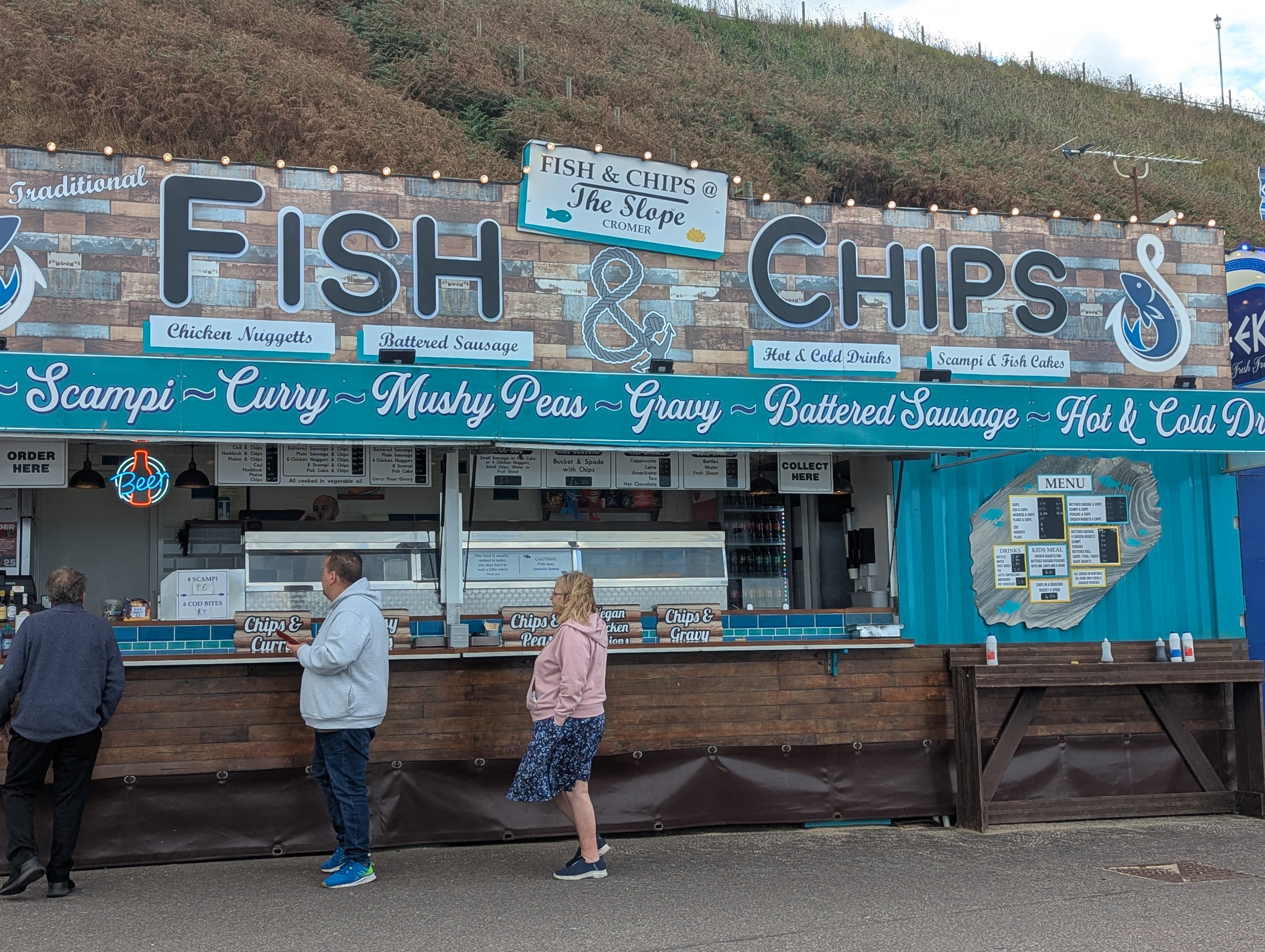
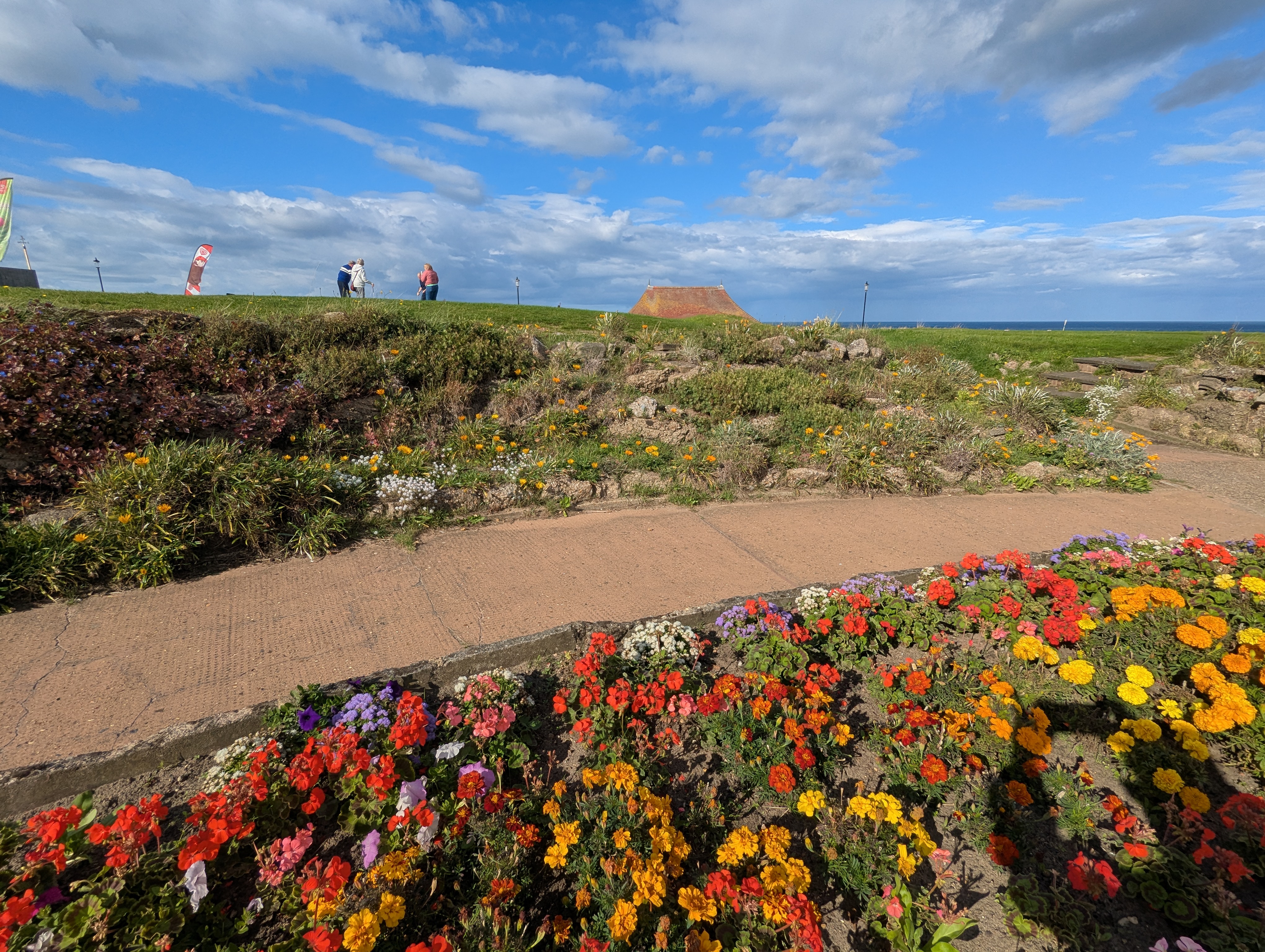
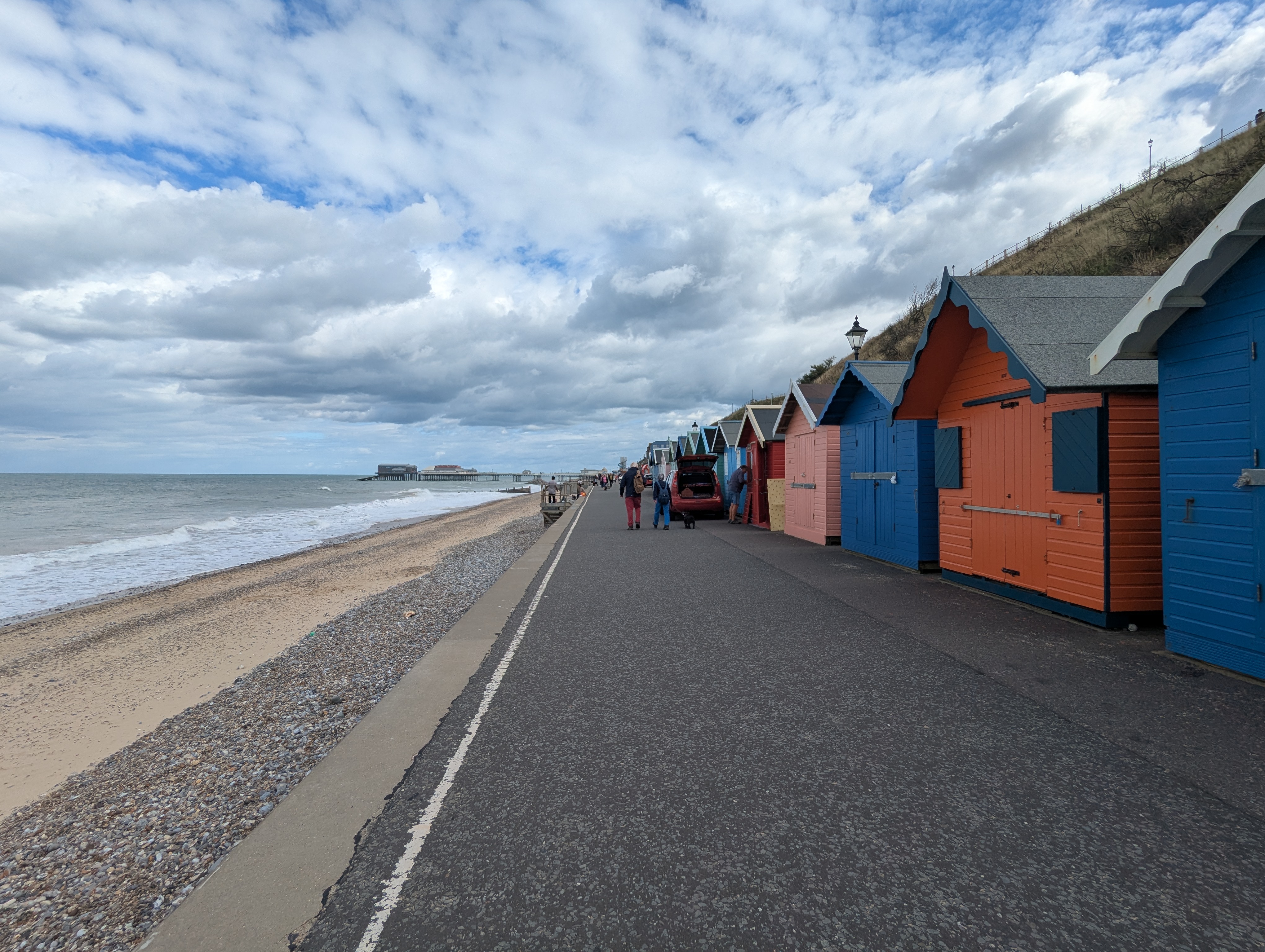
After lunch, we wandered over to the seashore. The wind and waves were wild. A group of wet-suited surfers were having some great rides. We walked on the promenade along the shore and Cromer Pier. Our fellow wanderers included a lot of dogs who were enjoying the walk and the beach. We took a small detour back to town and The Craft Bakery in search of a baked good. I had a delicious Orange shortbread cookie and my husband had something called a white chocolate rocky road cookie which was kind of like a giant block of fudge. (It was so good that on a later date on the trip my husband said “maybe we should go back to Cromer for a cookie?”) We had to work that off, so back to the beach and to a very cool miniature gold course on a bluff above the ocean.

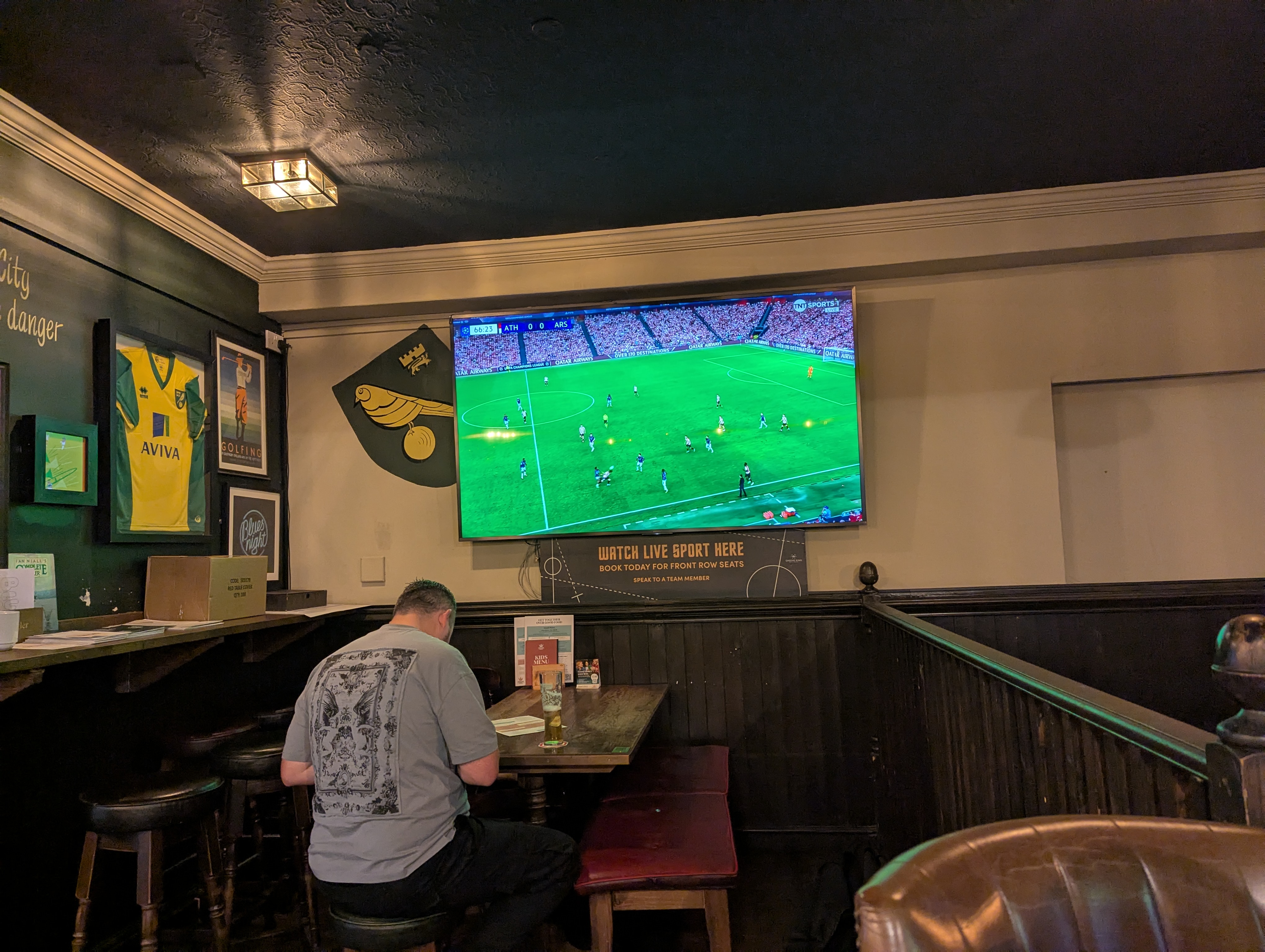
The planned activity for the evening was to watch Arsenal’s first round Champion’s League match against Athletic Bilbao. It was being played in Spain rather than home. Upon returning on the train to Norwich we had to nail down a pub option where the match would be televised. We’ve found using internet search engines to produce unreliable results, so we made an insurance stop at the pub we’d chosen to make sure. It was on the way from the Norwich train station to our hotel. Sure enough, The Compleat Angler intended to televise the match. After quickly checking into our hotel we doubled back to the pub where a kind bartender had reserved us a table.

It was a pretty interesting match. Manager Mikel Arteta selected the same forward line and the same back line as for Nottingham Forest but obviously had to make a decision about what to do in the midfield in the absence of Martin Odegaard. He’d been re-injured in the Nottingham Forest match and didn’t even take the trip to Spain. In the Nottingham Forest match Arteta had replaced Odegaard with 18-year-old Ethan Nwaneri and he did quite well, but in this match he chose Declan Rice along side an unchanged Martin Zubimendi and Mikel Merino. That Declan Rice did NOT start against Nottingham Forest was a bit of a surprise.

The atmosphere in Bilbao was nuts. That must be a wonderful place to attend a match if you’re a fan of the home side. Arsenal dominated possession for most of the match but struggled to produce a goal. Eberechi Eze, who was so wonderful against Nottingham Forest really struggled in this match. Noni Madueke continued to impress. Viktor Gyokeres struggled and, in the second half, also took a blow to the head that produced a big gash that was taped up. Lots of tape. He was ultimately removed, replaced by Leandro Trossard, as was Eze, replaced by Gabriel Martinelli. Good changes that sparked something in Arsenal. About 70 minutes into the match, the Athletic keeper kicked a ball into Arsenal’s defensive half which we cleared out to the halfway line. Trossard dinked it over the defender, perfect for Martinelli to run on to. Keeping two defenders at bay he slotted it under the Athletic keeper into the net. Later Martinelli returned the favor, driving toward the left corner and passing to Trossard who’d made great movement to open up space. Trossard’s shot bounced off a guy’s foot and into the goal. The match ended 0-2, not a bad outing.

Meanwhile, beer and dinner for us.

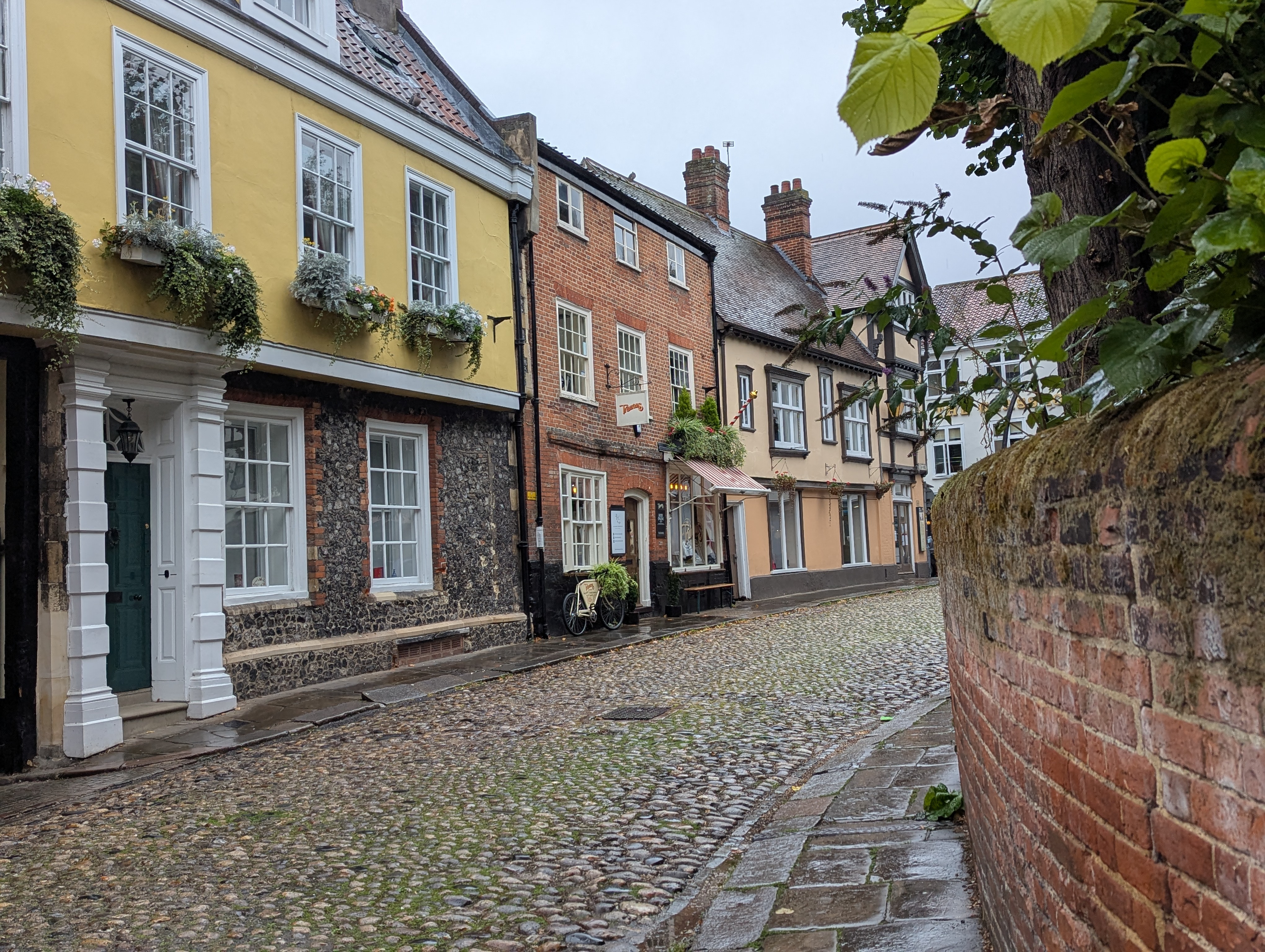
The weather forecast had been accurate. Rain had started early on Wednesday and our new plan was to see Norwich during that rain. Our hotel was very close to a historic area in Norwich called Elm Hill. Like all “Elm” hills in all the world, there are very few remaining Elms due to Dutch Elm disease, but there are cool cobbled streets and interesting old buildings.

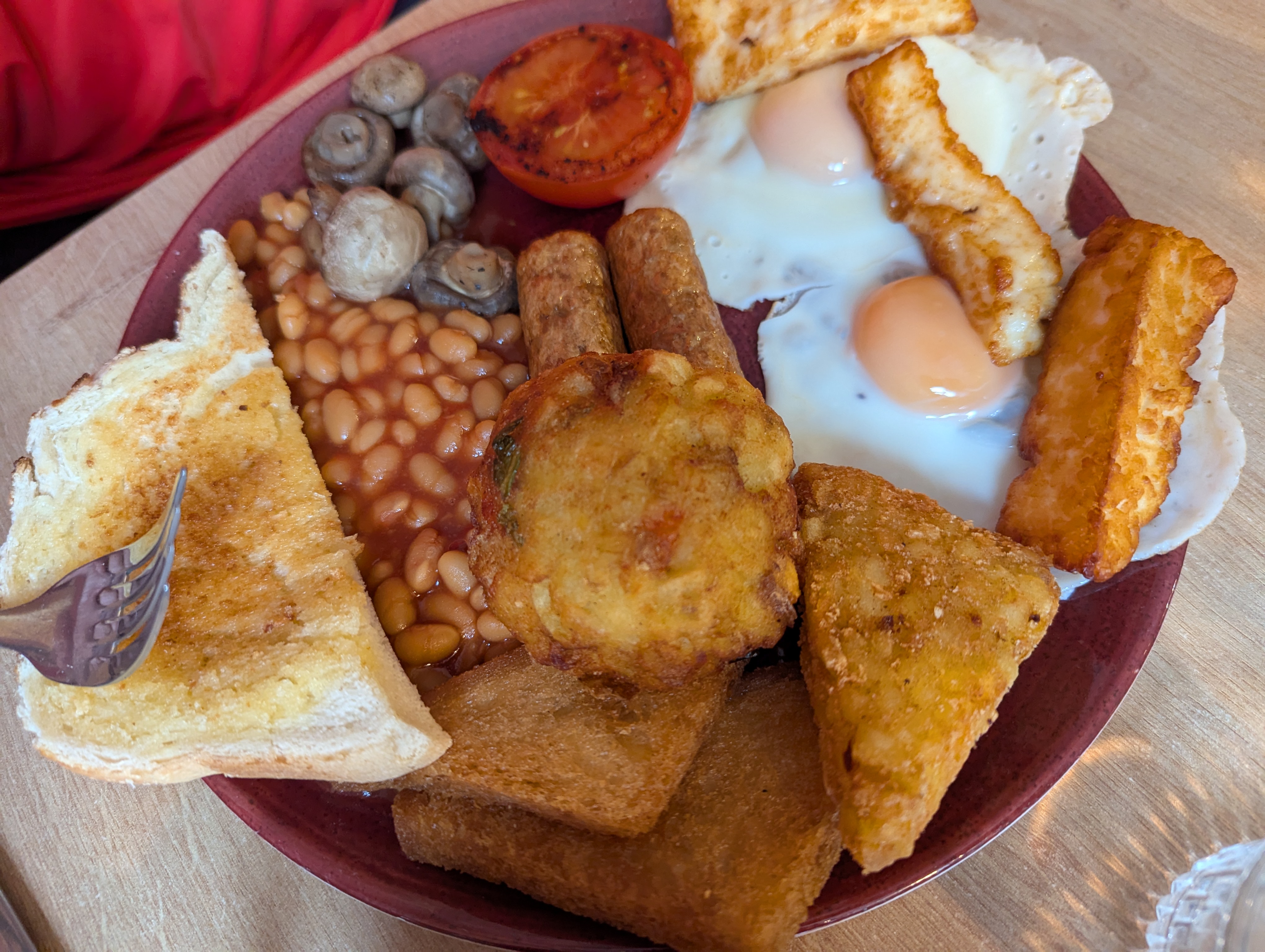
We stopped for breakfast at a place called Olive’s. Mostly traditional British fare. I had a Benedict that had hash browns in place of the usual English muffin. My husband had the veg version of a traditional English breakfast: eggs, sausage, baked beans, bubble & squeak. We had long heard about the thing called “bubble & squeak” but never had it and did not know what it was. Our helpful server pointed it out on the plate and explained it. It’s kind of like hashbrowns but includes cabbage. It was pretty delicious.

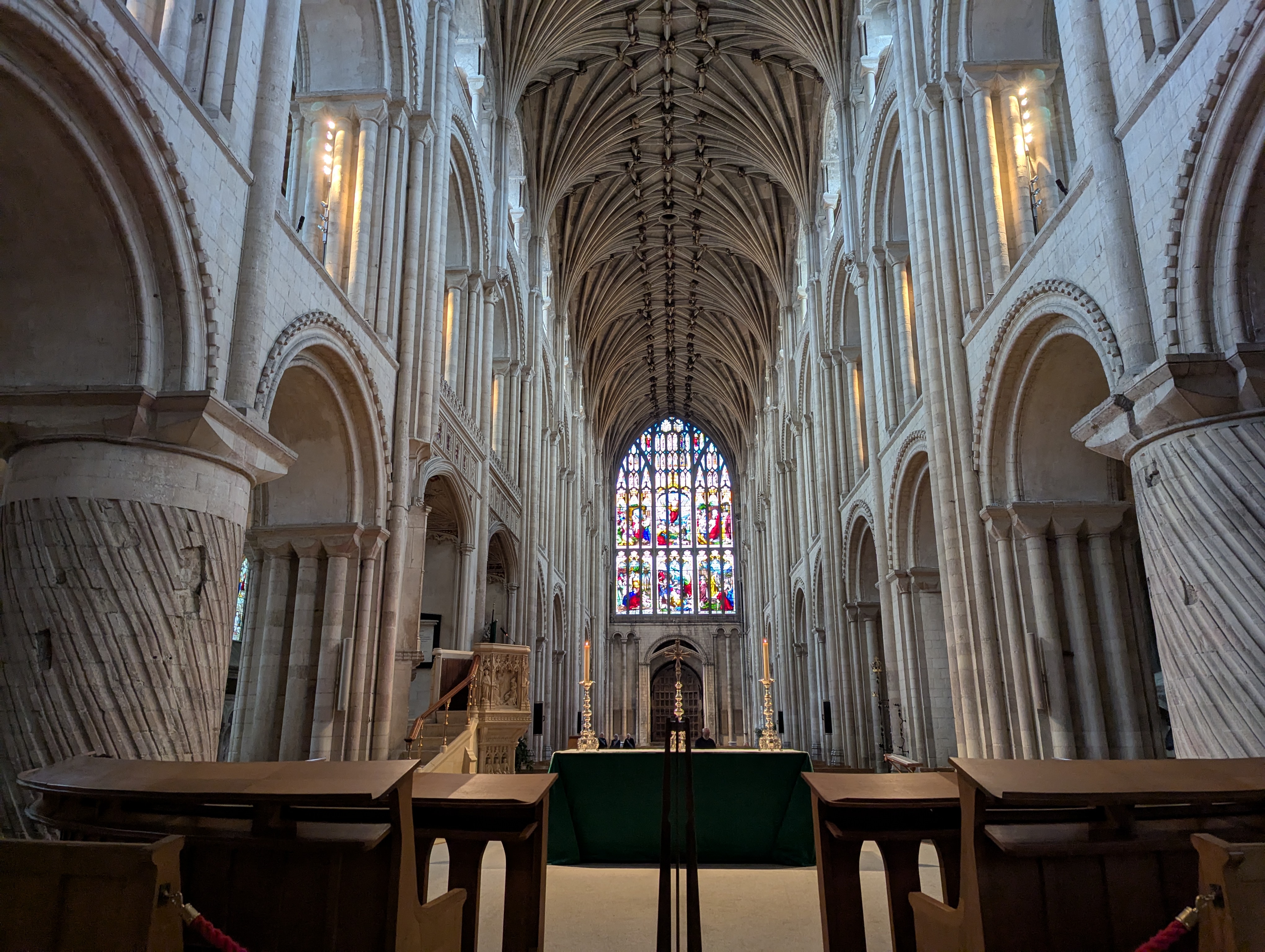
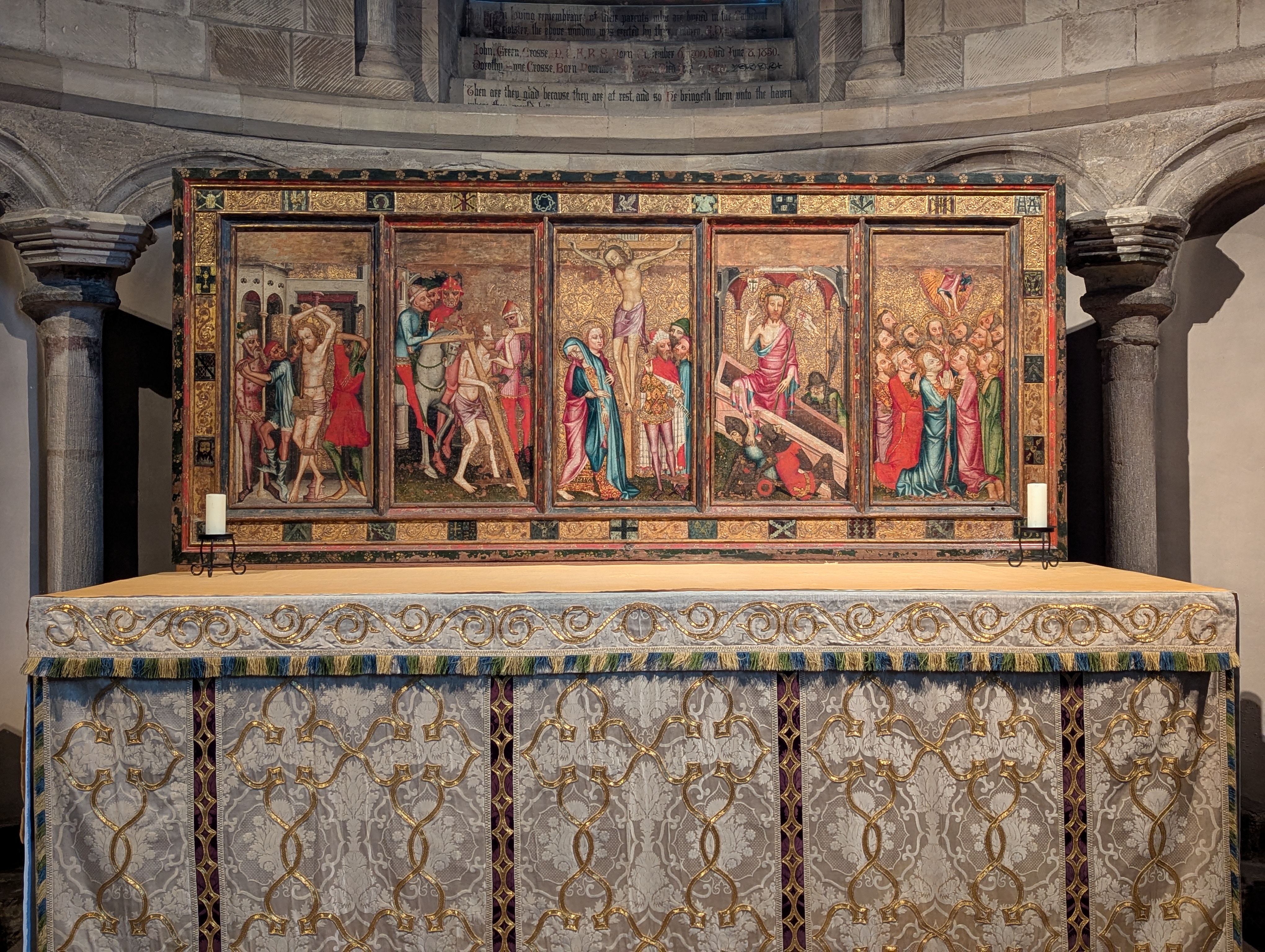
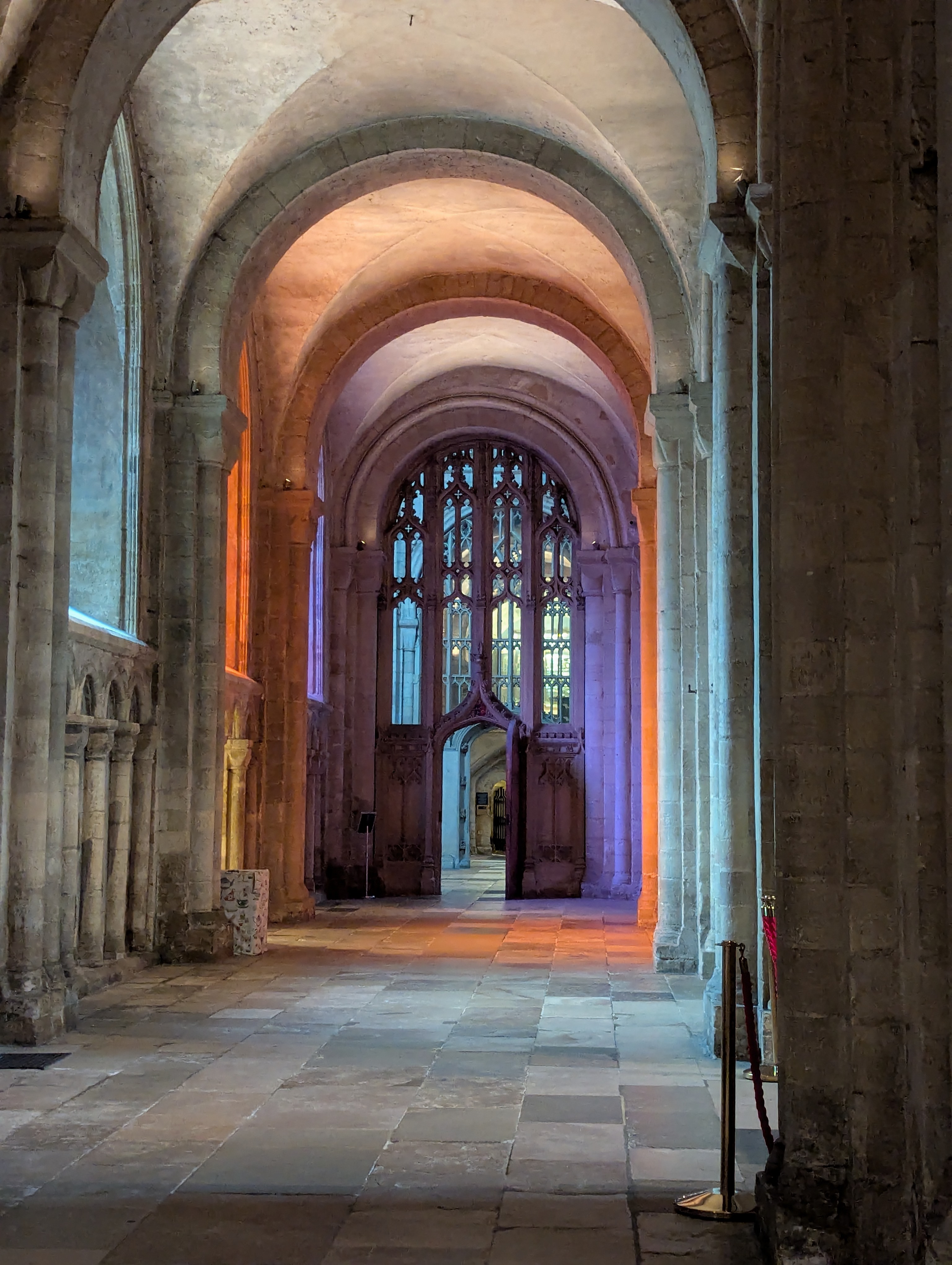
Because it was very rainy by this point, we took our tour inside to the Norwich Cathedral. This cathedral is not quite as old as the one in Ely but it’s old, 900 years worth. We were given a wonderful 1-hour tour of the cathedral by an enthusiastic, elderly volunteer and member of the active church since childhood. Not only did we learn about the very interesting history of the cathedral, she pointed out interesting details, like ancient graffiti, the cool glow from the McClean stained glass windows that were installed in 2014, the misericord in the choir that’s intended for the assistant dean and includes a carving of the Norwich Canaries football team logo, and the amazing 12th century Despenser Reredos that was protected and preserved from destruction allegedly by hiding it as the bottom of a table. We also heard about the cat called Budge that lives in the Cathedral and unofficially serves as the Bishop. Budge did not make an appearance while we were there.

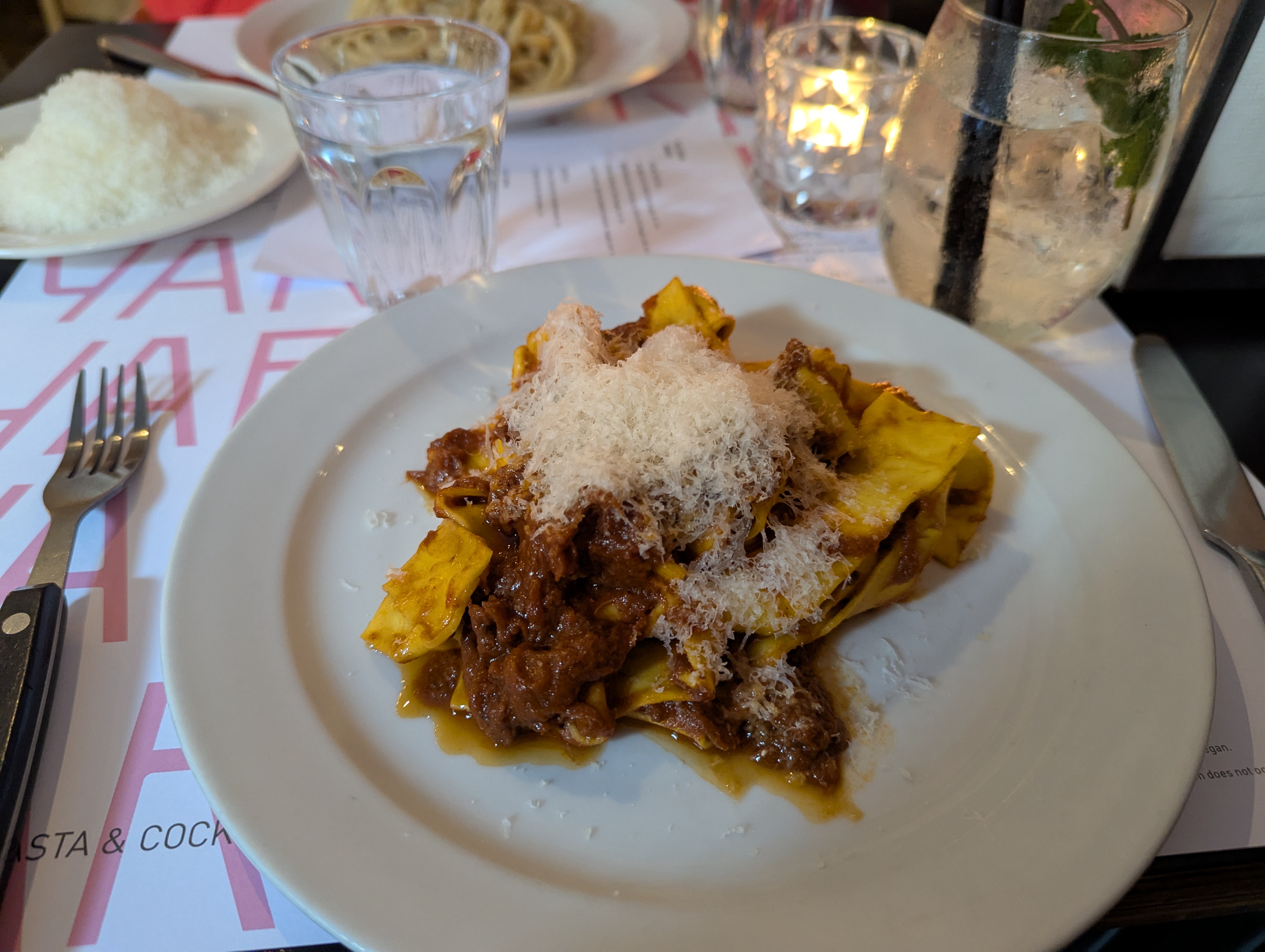
Following our tour we walked near the city center for lunch at an Italian restaurant called Yard. Freshly-made pasta with delicious sauces. I had the Pappardelle with 12-hour beef shin ragu and my husband had Bucatini cacio e pepe. I followed mine up with this crazy and amazing dessert that was a croissant filled with salted caramel ice cream. Oof. Very delicious lunch.

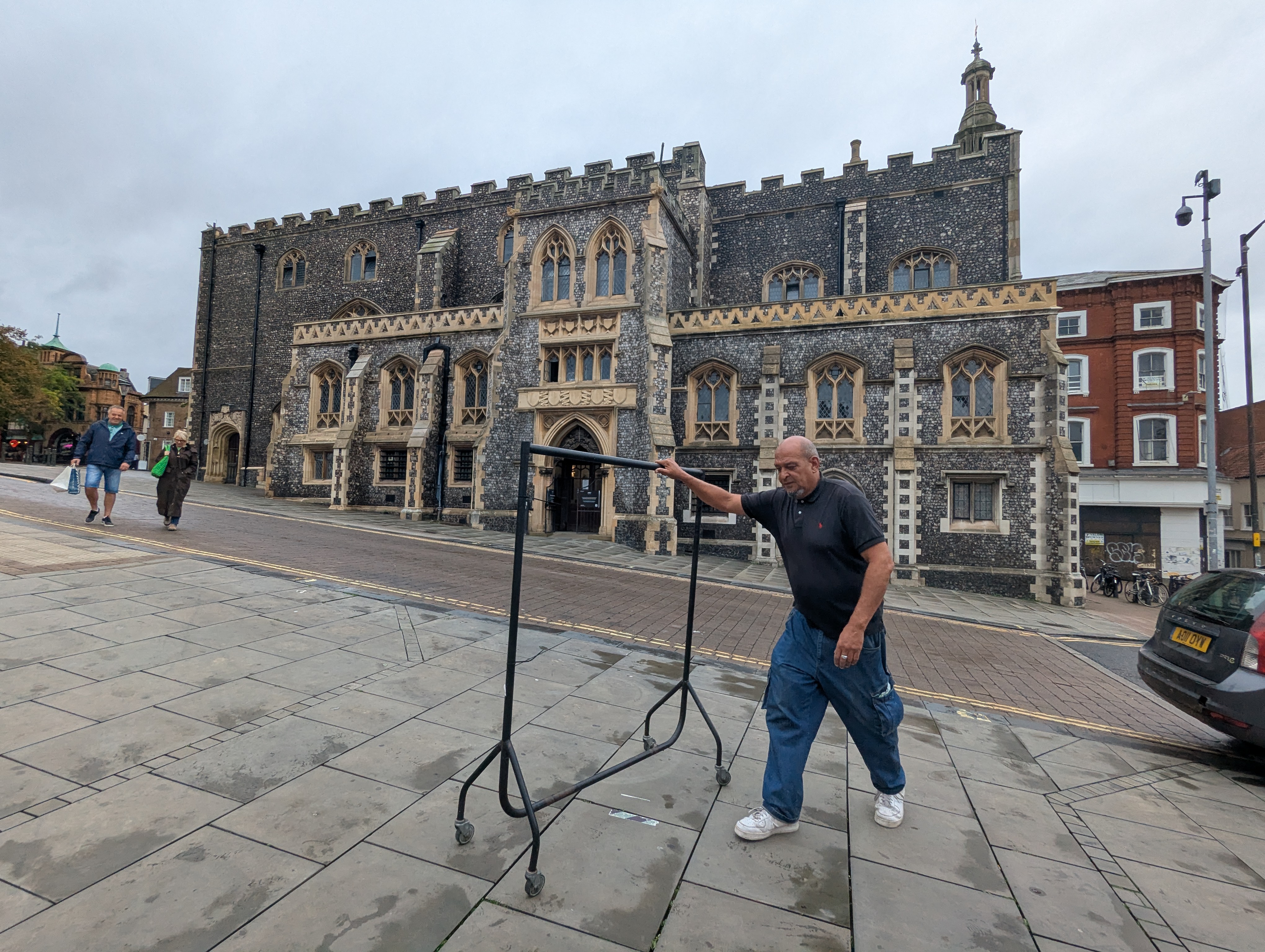
We walked by the beautiful medieval Guildhall and art deco City Hall City Hall and walked through the cool Norwich market. It was a bit late so many stalls were closed but enough was open that you got a flavor for the diverse products on offer. Spices, wine, prepared food, produce, clothes.

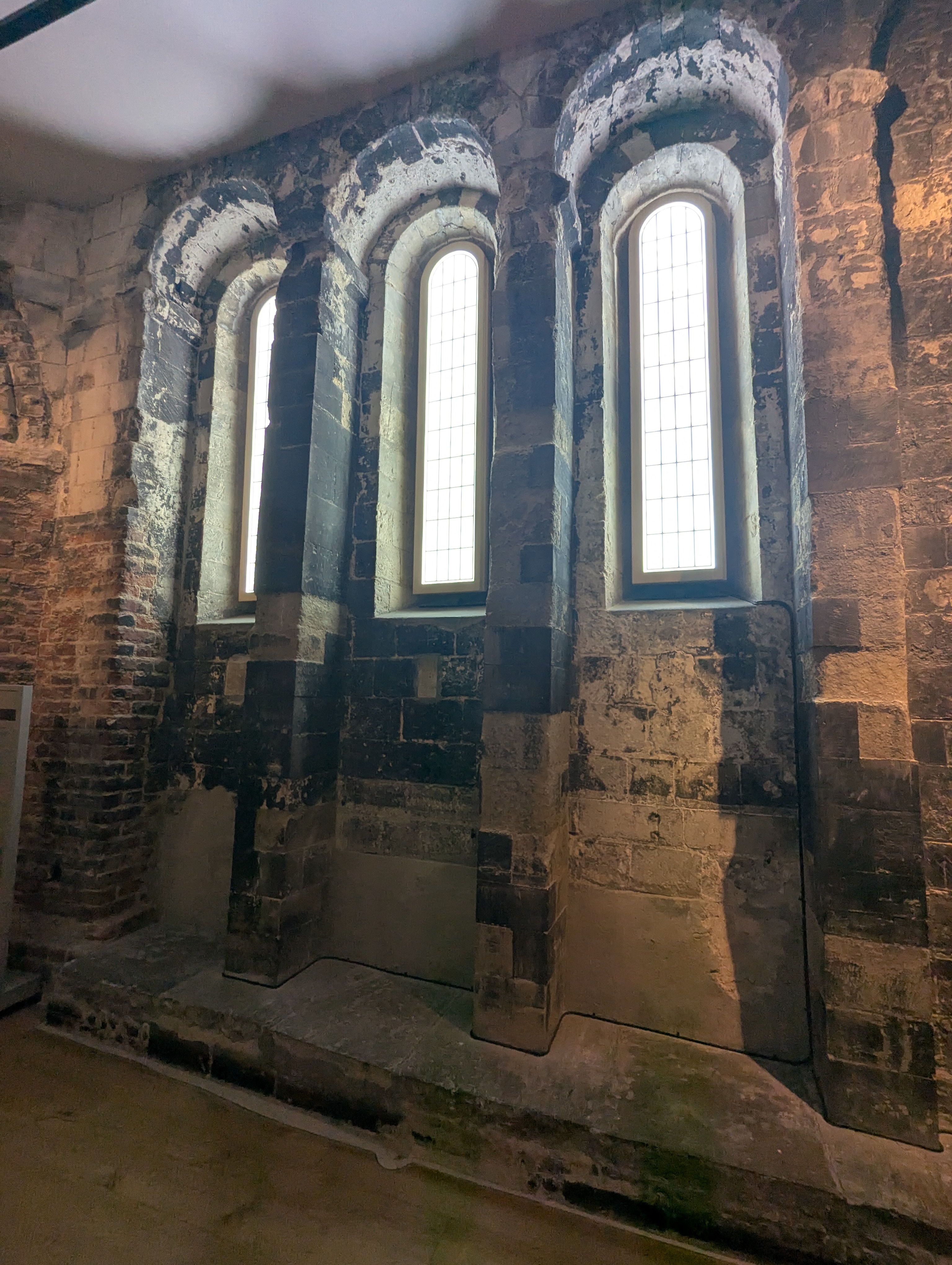
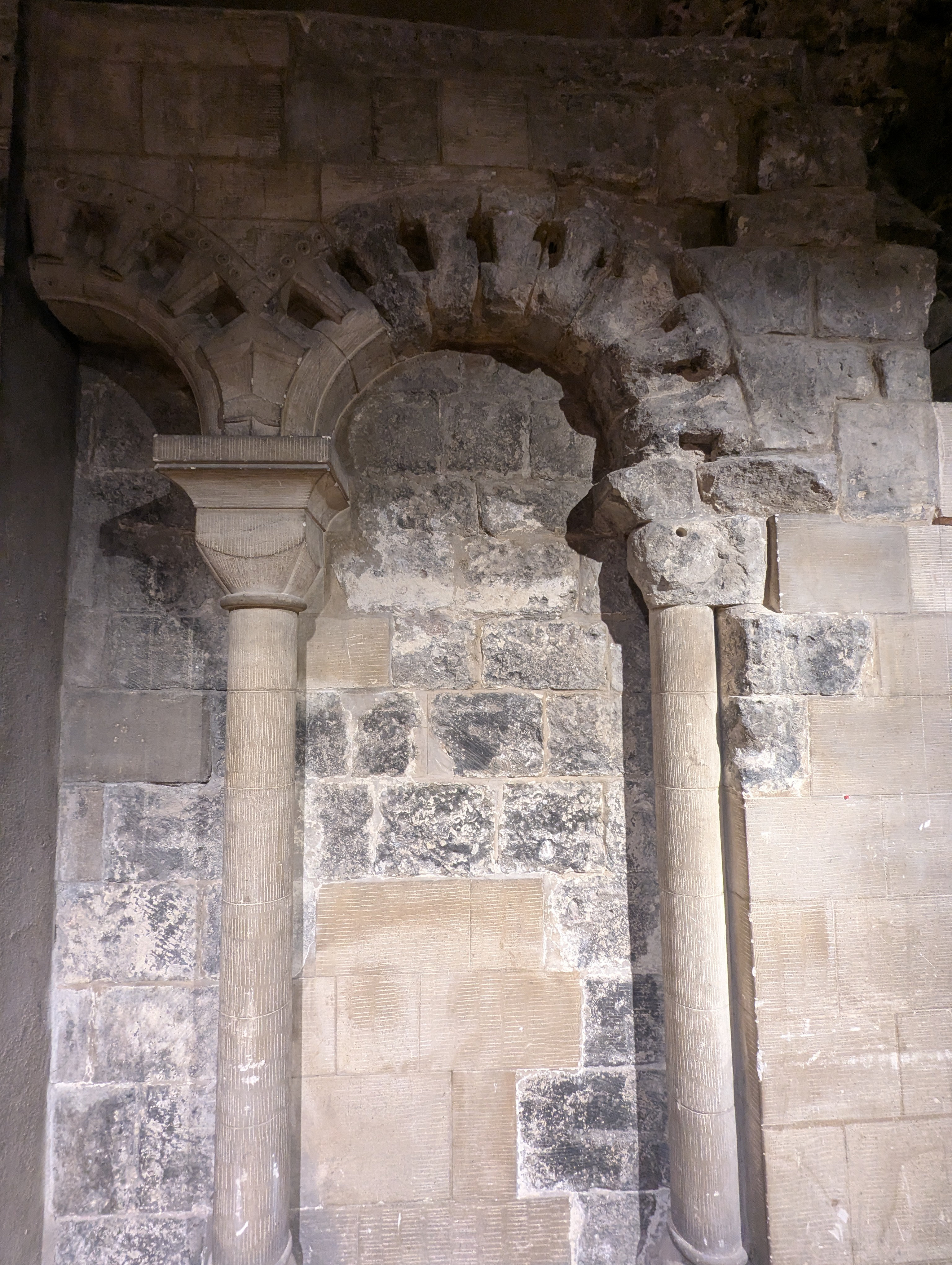
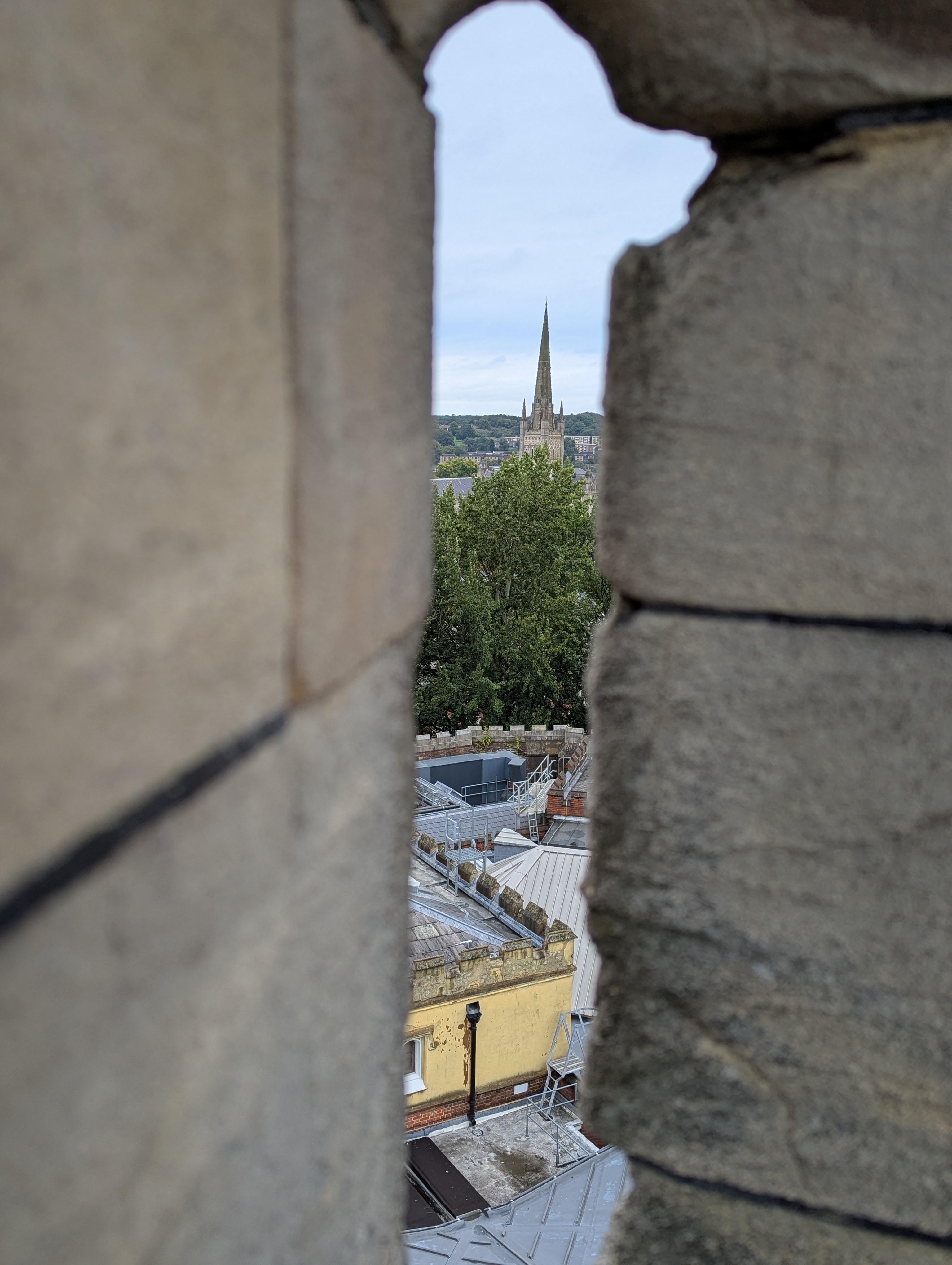
Our last big stop for the day was at the Norwich Castle. This was kind of a crazy, interesting experience. It is a museum that’s built in and around the ruins of an actual Norman castle. The castle was started by order of William the Conqueror in the late 11th century and was only briefly and very occasionally used by a monarch. It also was used as a jail. Where the museum can include the actual remnants of the castle it does; where it cannot, it includes recent building intended to help depict what the original castle looked like. When you stand within any one room you might see one original wall (it’s very clear which one that is) with three new walls that help you imagine what it must have been like. You can also go to the rooftop to see the defensive structure. From the rooftop, I could see all the sights we had seen that day.

We did a quick refresh at our hotel after visiting the castle and then went back over to the Norwich Cathedral for the Evensong service. Our guide from the morning had told us that the Cathedral had had Evensong services every day for the last 900 years. One of them included us. The music was quite beautiful, from a choir of adults and children.

After the service, we went to dinner at St. Andrew’s Brew House, so named because it’s across from a church called St. Andrew’s. A bit comical since they were out of almost everything we wanted to order for dinner. We were together able to cobble something together that worked.

Norwich surprised me. I’m not sure what I expected but it was not that. Such a great city! We thoroughly enjoyed our time there.

No one likes us

Although we weren’t able to do much London stuff in this visit, we did have Saturday gloriously open for fun around town.

Sadly, storm Darragh, which caused rain and winds all over the UK that day, wanted her say. So we made two plans that were respectful of her and one plan that ignored her completely.

It was pouring rain in the morning but we stepped out with our most rain-resistant shoes and umbrellas and went to the highly-rated local diner, Peter’s Cafe, for breakfast. It was nothing fancy but I had a perfectly delicious, basic, and reasonably-priced breakfast of eggs on toast with a latte.

After that, we went over to the Gunpowder Plot Experience close to the Tower of London. This is a tourist attraction whereby you participate with a group in simulating the attempted coup of 1605 on King James by Guy Fawkes. It’s a combination of interactive theatre and virtual reality. Not our usual thing! It was a lot of fun, albeit a part of history I’ve spent zero time thinking about. We played the part of Catholic co-conspirators. My favorite part of the experience was the virtual reality. It’s not that it felt actually real, but it produced some interesting effects and sensations of being there. With virtual reality, we flew over the city, took a boat over to Parliament, saw the aftermath of the attempted coup.

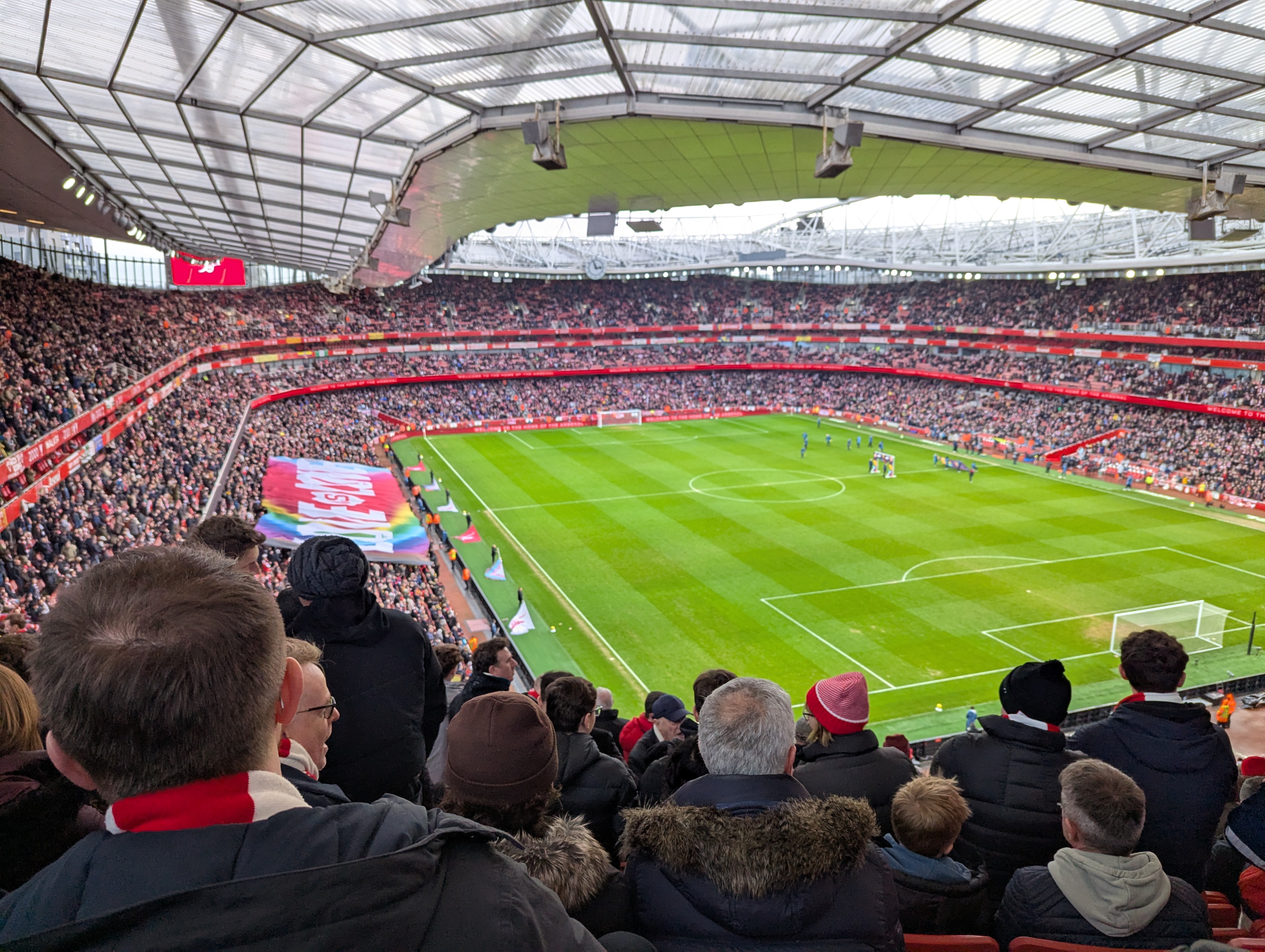
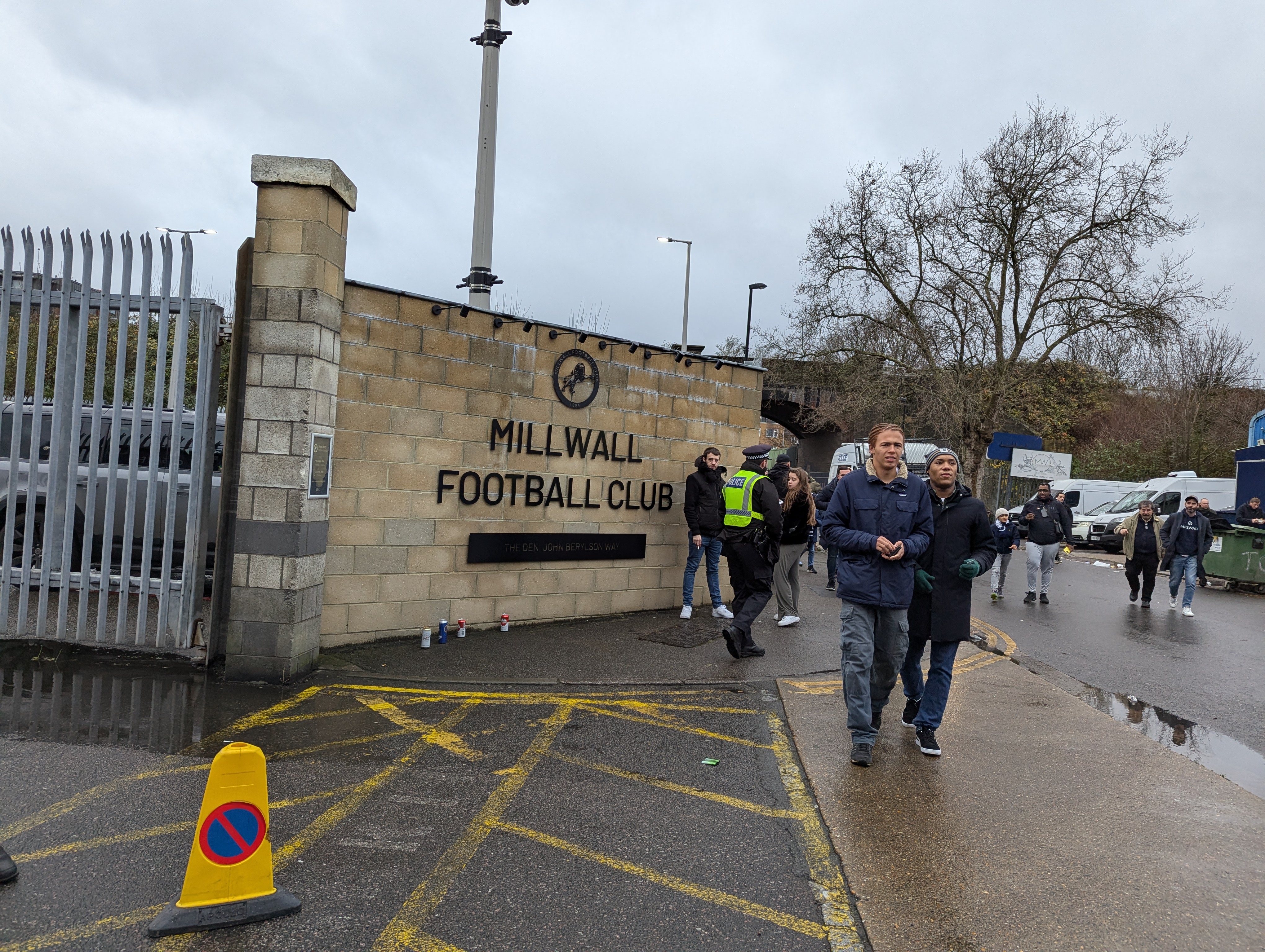
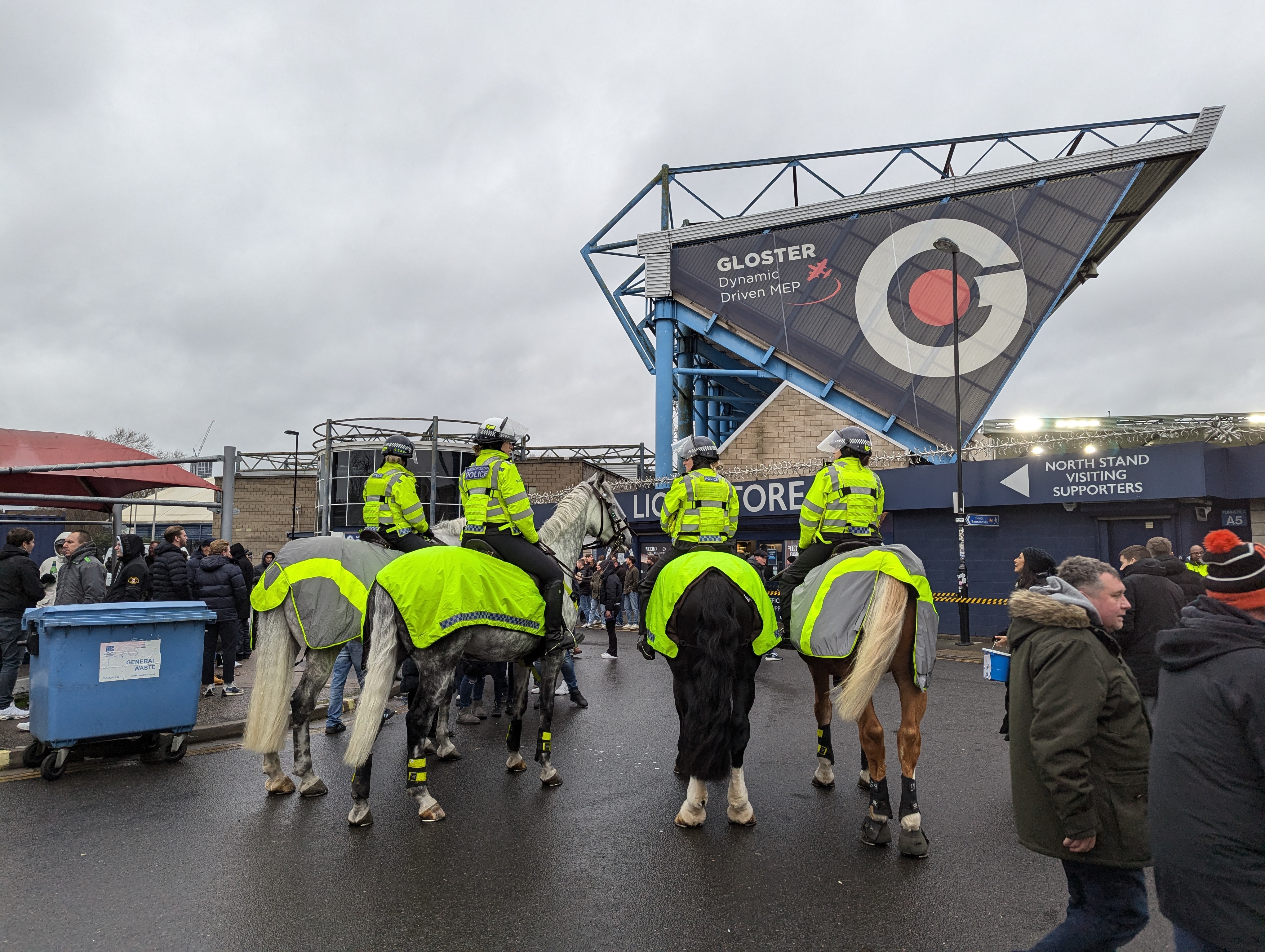
After that nice, dry activity we took the bus over to Millwall’s stadium, The Den, to take in some Championship football. We’ve attended a Championship match in the past at Fulham after they had dropped from the Premier League and before they came back up. Championship matches offer a grittier, and some say purer, experience than the Premier League. Whatever. We just wanted to go.

Millwall currently sits in the bottom half of the Championship and was playing on Saturday against Coventry City. It was very easy to get good tickets because of the expected bad weather and probably that thing I said about “the bottom half.”

Coventry City was even bottom-er in the Championship, and only recently started being managed by the villainous Frank Lampard, formerly of Chelsea. The fans at The Den seemed particularly annoyed by the presence of Frank Lampard. One guy near me shouted at him and insulted him the entire match. There is no possible way Frank Lampard heard a word of it, so far away were we and as windy and rainy as it was. Maybe Frank will read this and know the truth.

The chanting is a bit different at Millwall than at the Emirates. The chant we understood best went something like this:

We are Millwall
No one likes us
We don’t care

It was a bad day for Millwall and good day for Frank Lampard. Coventry City ended up winning the match 0 – 1. It was his first win as the manager of Coventry City, we learned the next day.

We took the bus over toward our evening activity and stopped nearby at a nice pub, The Royal Standard. Beer for my husband, mulled wine for me. Fish & chips for him, Avocado & Mango salad for me. Brownie for him, Apple, plum & Damson (don’t ask me) crumble for me. Very delicious, and a nice atmosphere.

Our final activity of the day was Edwyrdian Tales’ Christmas Ghost Stories at Charlton House. Charlton house is a 400-year old former manor house, so a great setting in which to hear three old ghost stories. For me, it was only two ghost stories, for, as good as the program was, I was exhausted from a long week and being in the cold and rain for hours (and maybe the mulled wine had something to do with it). I slept like a baby during the first tale about Jerry Bundler. Well refreshed from my nap, I thoroughly enjoyed the next two ghost stories, “Smee” about a haunting that occurs while people are playing a game at a holiday party and “The Kit Bag,” where a lawyer is emotionally haunted both by his involvement in a trial for a horrific murder and actually haunted by something in the bag in his room. The stories were performed by a single actor, writer, and historian Matthew Wood, who did a wonderful job transporting us to a time in which these stories would have been very popular. Great atmosphere and great stories, well told.

It was good to get out into London at last before heading back to Chicago.