I’m not a robot

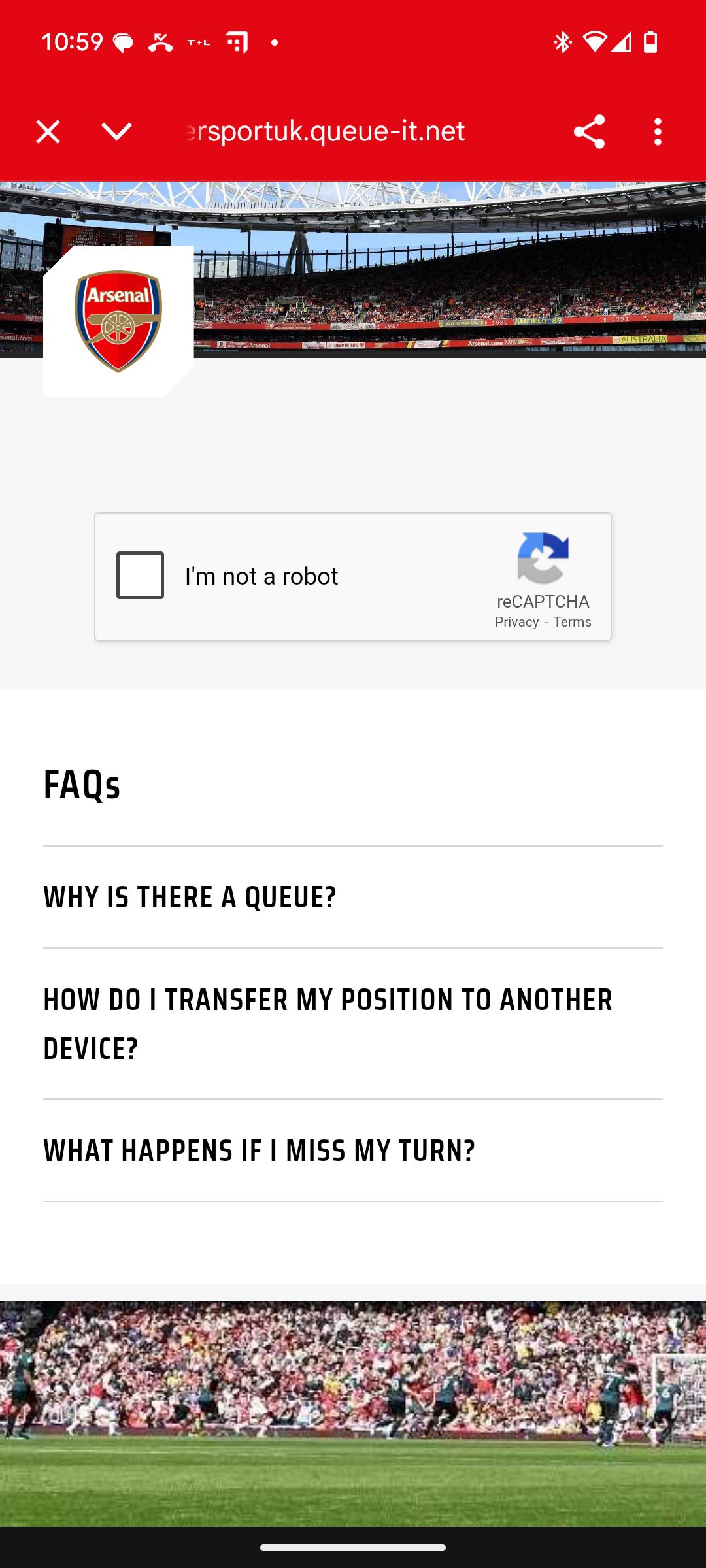
At the time we flew to London, both my husband and I had tickets for the Nottingham Forest game but only I had tickets for the Man City game. That remained true across thousands of clicks on the Arsenal web site. Each time I logged in to try to get a ticket, I had to affirm that I was not a robot. Sometimes I had to prove it by reviewing photos and click on all the ones, for example, that contain street lights. And sometimes even though I seemingly passed all the anti-robot tests put in front of me, I could still take repetitive action on the ticket exchange that made the exchange believe I might have fibbed about being a robot. Then you get the white screen of death and have to start over. Fortunately, I finally found my husband a ticket the very day before the match.

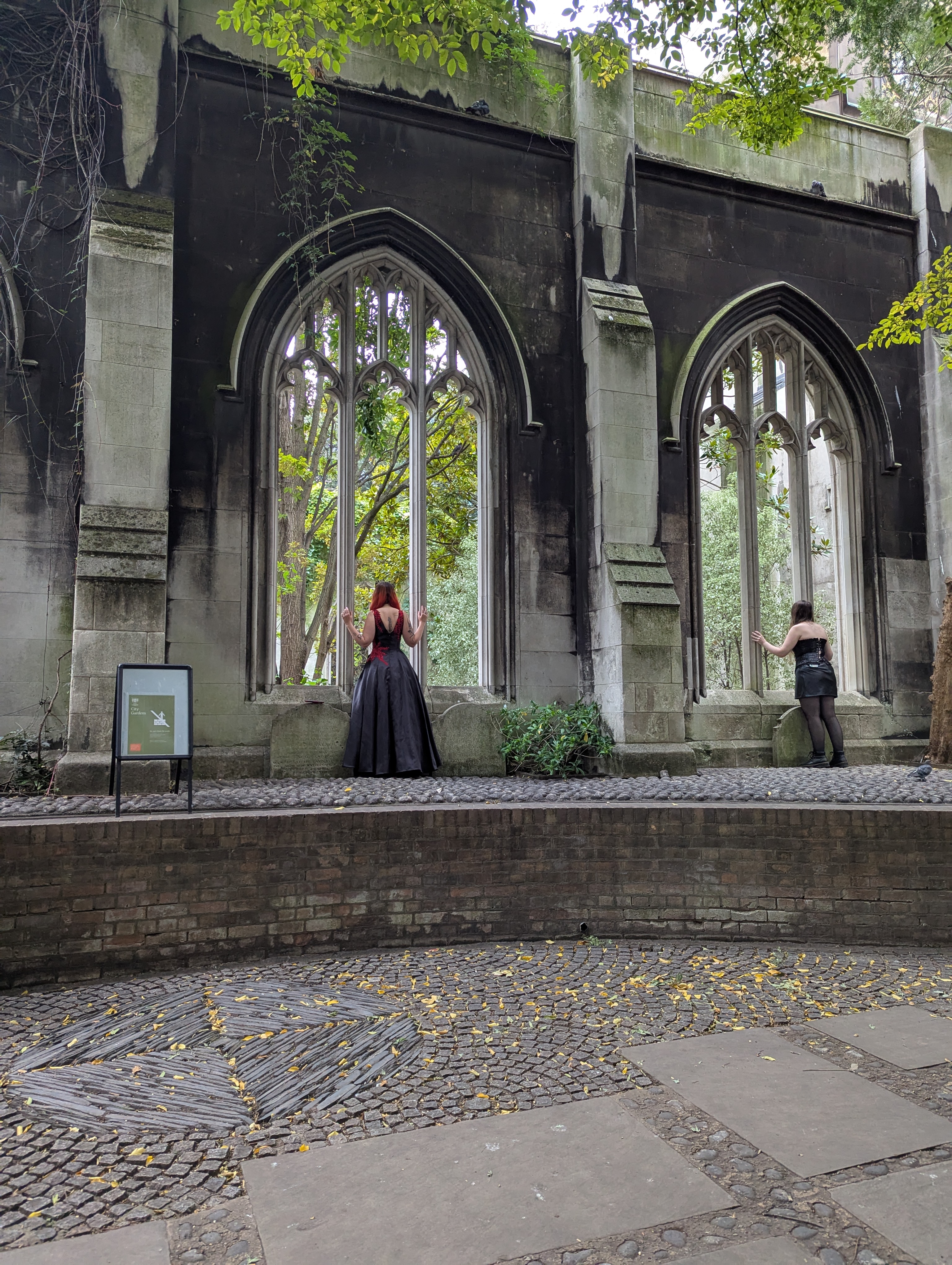
That was the day we travelled back to London from Norwich also. Tracks from Ipswich to Colchester were under maintenance so we had to take a bus for that leg of the trip. It was well organized by the train service and it occurred with very little drama. As we walked from Liverpool Street Station to check into our hotel, The Clayton Hotel London Wall, we crossed through the very pretty Finsbury Circus Gardens. Upon reaching the hotel, my husband was ready to relax. I was feeling inspired by the garden so I set out to find the St. Dunstan in the East Garden. This is a garden associated with a church. It looked lovely and peaceful, except on the day I visited there was a large contingent of goth-dressed women and photographers doing a photo shoot. I took advantage of the poses for my own photos.
Sometimes I recognize what a shame it’s been that we’ve visited so many hotels in London but not really used the opportunity to rank hotels. It happens that we had previously visited the Clayton Hotel London Wall in the past, but I had forgotten what a good option this is. The rooms are spacious, there is tons of storage, and the bathroom is nice. The mattress was like a concrete slab. I happen to be a fan of the concrete slab mattress. This may seem like a weird thing, but the bathroom has an enclosed shower with a ledge that prevents water from entering the rest of the bathroom. You’d be surprised how many do not. The only downside of this hotel is that it’s located in the business district so a lot of restaurants and pubs nearby are closed on the weekend.

We booked a play to attend that night, The Full English at Baron’s Court Theatre. This was a one-woman show by a linguist, poet, and actor Melanie Blanton, literally about the English language and how it developed across time as England both was impacted by migrating, and sometimes invading, forces as well as England’s own experience colonizing other countries. The Baron’s Court Theatre is a tiny space in the basement of a pub called Curtains Up. Before the play people gathered in the pub and then brought their drinks into the space and during intermission, they repeated. The theatre was so tiny that it was in my mind that it would be really bad to sleep in this play because the actor would for sure be able to see that. I was at my alert best. Perhaps because I’d for once had time to acclimate to the time change having been in England for a week. Two older ladies in the first row did not get the same memo. They both slept through a lot of the play. Then again, they availed themselves of several pints. In a warm, dark space we all know what that can lead to for us aged folk.

What I just said might sound like not a ringing endorsement of the play, but I actually loved it. It was entertaining and I learned a lot. I feel like this whole trip reinforced for me how England developed. We’ve spent time in London in the past looking into the Roman invasion, but this trip (including this play) gave insight into the migration of Anglo-Saxons as well as invasions by Vikings and Normans.

The match was the next day, Sunday. Unfortunately, that morning my husband tweaked his back and really could not walk or sit without a lot of pain. He’s had this problem before so he always travels with muscle relaxants which helps get through the night or a long flight in Basic Economy. However, those aren’t good for getting through a day or a soccer match so we invested a bit of time trying to find an electric heating pad or something to help loosen things up. We were successful in locating a disposable heating belt that you can affix under your clothing and that heats for 12 hours. A great solution for our day and for the plane trip back on Monday and it seemed to help quite a bit.

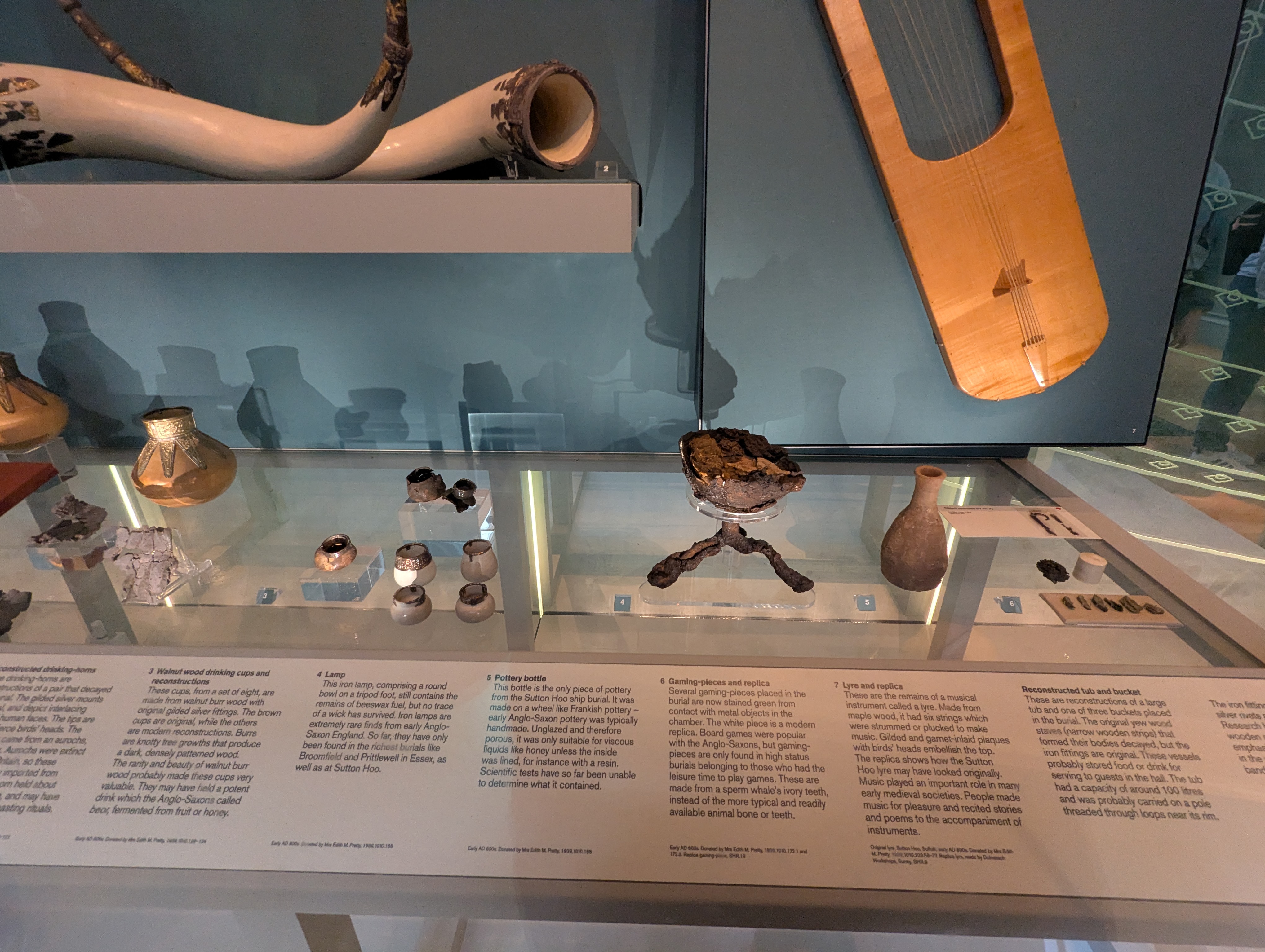
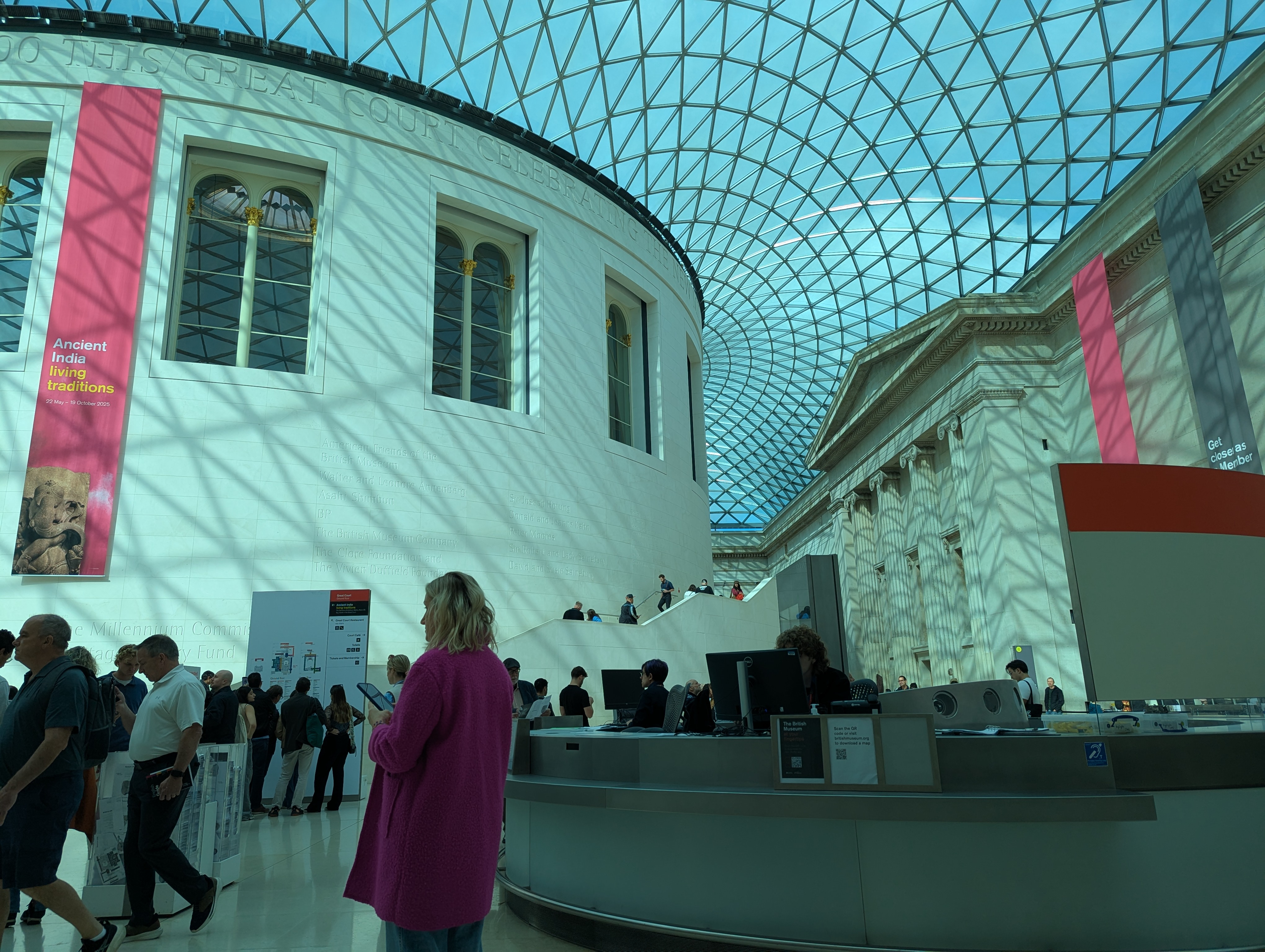
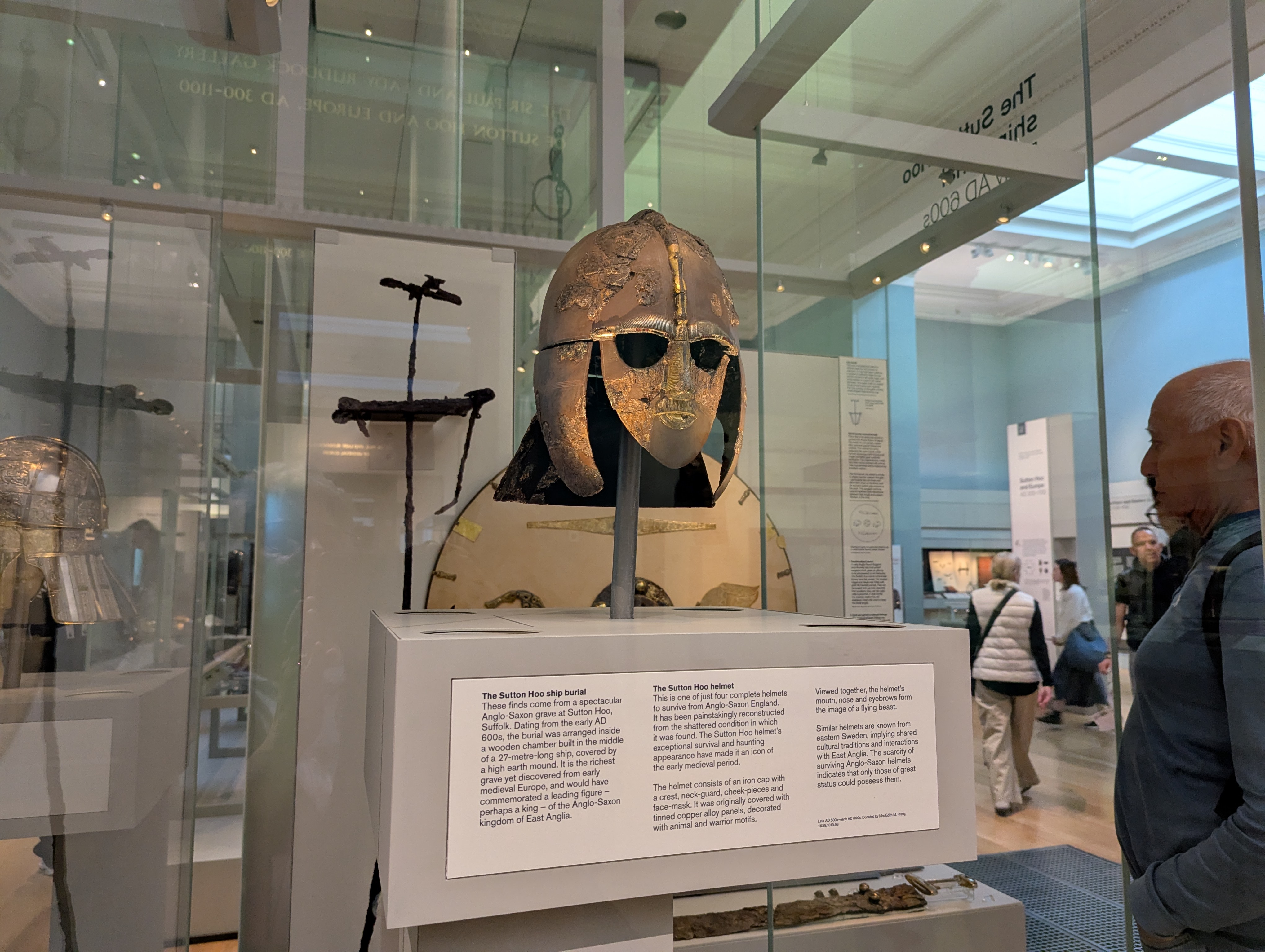
We didn’t want to overdo it so we decided to keep it simple that morning by only visiting one exhibit at the British Museum, the one displaying the treasures found at Sutton Hoo. As you may recall, once it was established that Edith Pretty had full rights to the artifacts found on her property, she donated all of them to the British Museum. One of the most interesting objects was the helmet found–crushed, where the burial compartment of the Anglo-Saxon ship in one of the mounds had collapsed. The British museum made two efforts to put the pieces together, one that they felt good about. The actual reconstructed helmet is displayed, as is a replica of what it may have looked like originally. The display also includes coins, dishes, and other objects of Anglo-Saxon life. Fascinating exhibit and a perfect follow-up to our visit at Sutton Hoo. The British Museum, like many other attractions in London, is free to visit but so expansive it’s really nice to be able to feel like you can just see what you want to see on the day without feeling guilty about wasting admission.
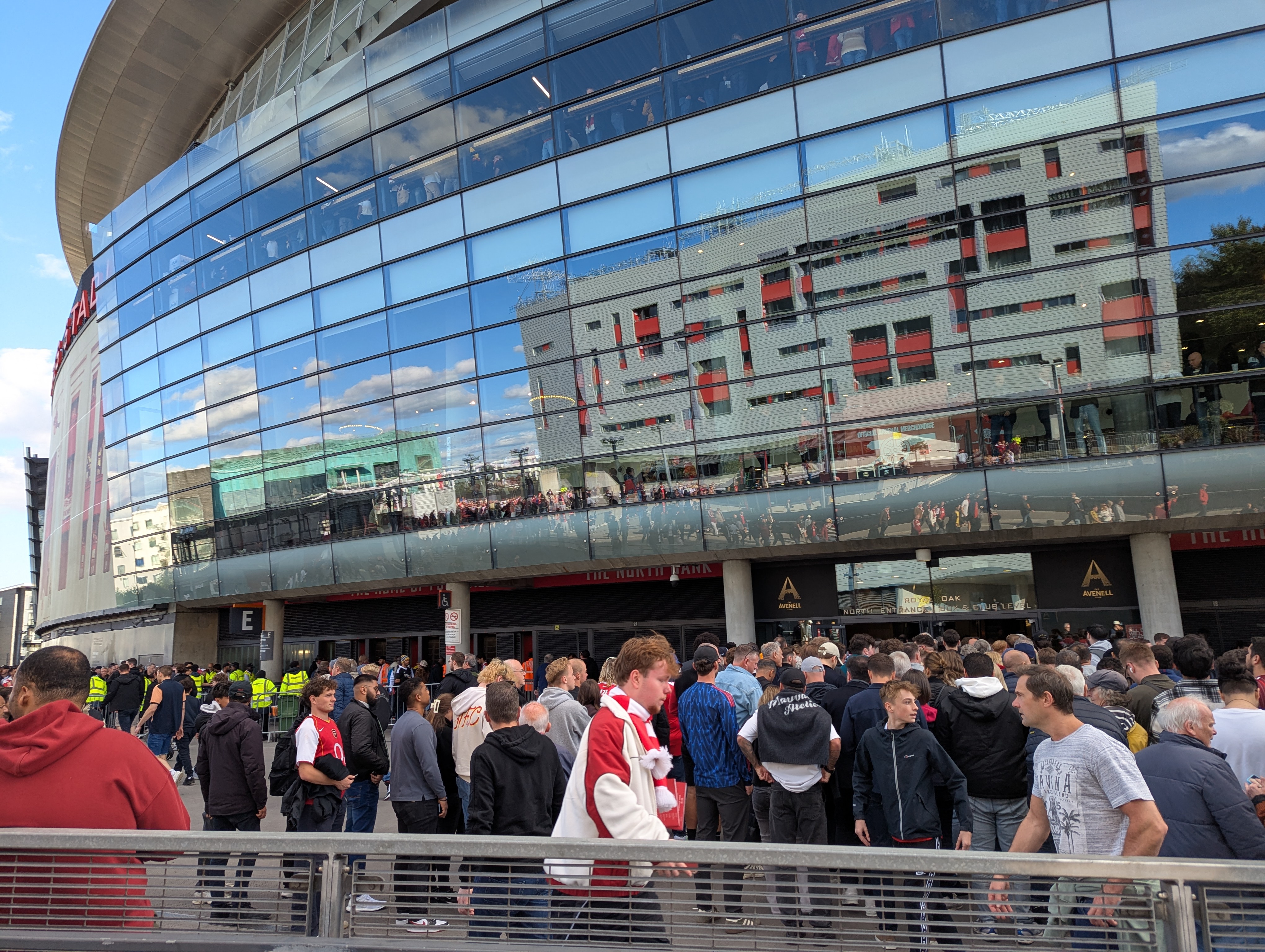
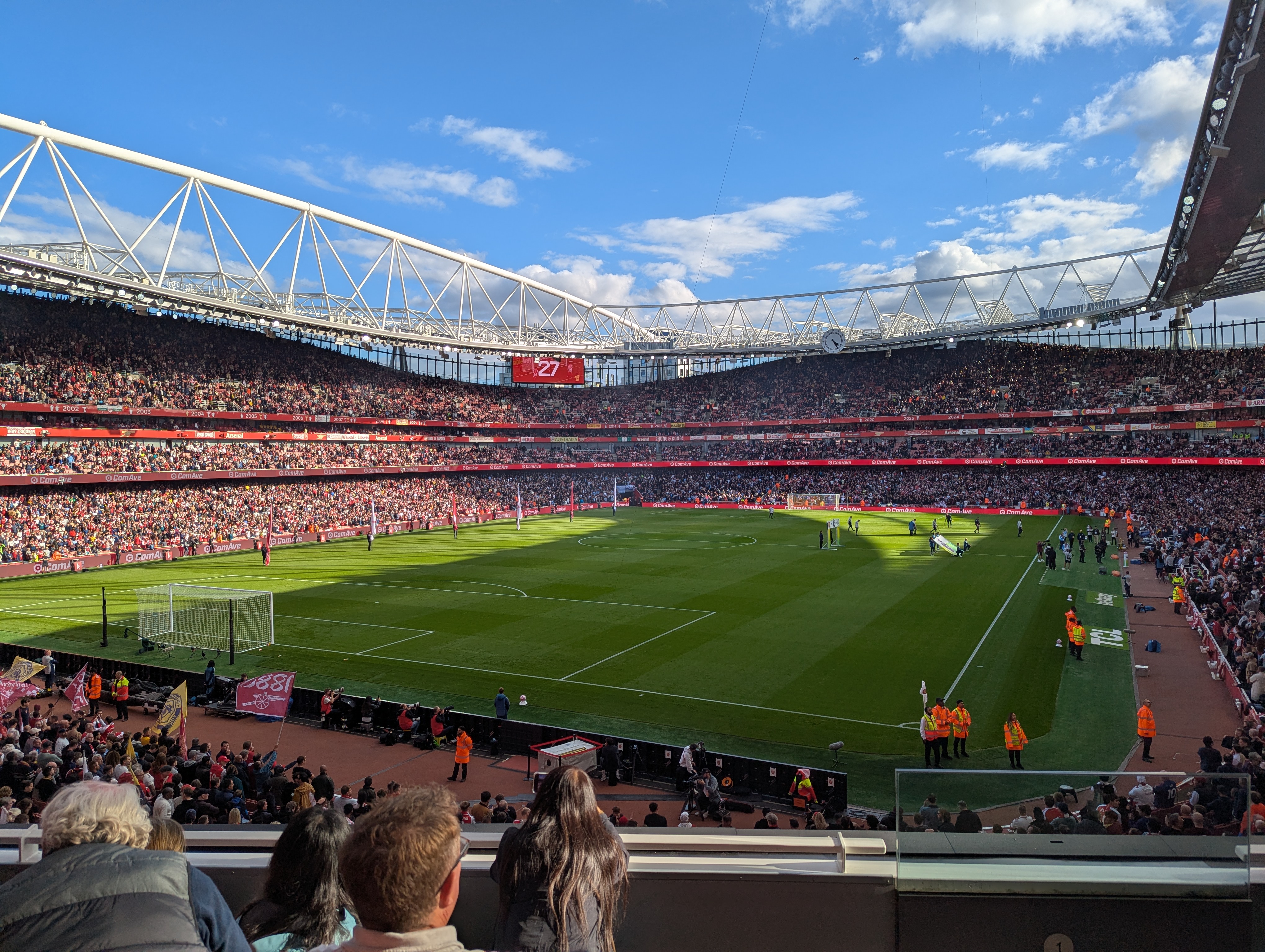
After lunch we travelled over to the Emirates for the match. It took more time than usual to get into the stadium, at least where I was seated in the North Bank. I was lucky to be in my seat as the teams were coming out on the field. You’ve heard me speaking about how much I love singing and being in the stadium as “North London Forever” is being played, but there is a song played at every Arsenal match that I despise. It’s called Good old Arsenal. It’s played both before the first half and the second half. It sounds like it was invented in the 1940s, but my quick google just now tells me it first made its appearance at the stadium in 1971.

Good old Arsenal

We’re proud to say that name

While we sing this song

We’ll win the game
They usually get through it 2 times before the rest of the pomp happens. I was in my seat for it and it annoyed me, like always. I do sing it because while we sing this song we win the game. How can I decline? I’m a model fan. Note: it does not always produce the results it claims.

With Martin Odegaard still injured, Mikel Arteta started exactly the same midfield he had selected for the mid-week Champions League match. He made one change in the forward line, replacing Eze with Leandro Trossard. This was maybe a bit surprising considering the opposition. Kind of a very secure but not very adventuresome lineup. William Saliba was restored to his normal center half position after an ankle injury having not played much since then. He seemed a bit rusty.

If you consider the totality of the match, we were mostly successful at being secure. But there was this one insecure moment pretty early in the first half where there was a turnover on a mistake and Man City’s excellent striker, Erling Haaland, got forward on a breakaway where Man City had three players on two Arsenal players. Haaland didn’t have the ball early in the breakaway but he was clearly the one you didn’t want to see the ball come to. We didn’t have him covered well and he did get the ball. He had no problem placing it in the Arsenal goal beyond David Raya.

All through the match Man City was pretty much bunkered in and we were unable to find a way through. Although I understood after the match everyone watching seemed to find it boring, I thought it was a fascinating match. Kind of like watching chess. I know not everyone likes watching chess when they came to watch football. But obviously frustrating, going at them again and again and never finding a way through.

After halftime, the Arsenal team came out to the the sound of “Good Old Arsenal,” like always. But this time, Man City didn’t come out for ages. It played 6 or 7 times. I enjoyed it less than usual which, as I mentioned, is not at all.

Mikel Arteta made increasingly creative substitutions across the second half and we did start to make headway in penetrating the Man City defense, which by now was just a big, old bus parked in front of the goal. He even removed a defender to put on an attacker, Gabriel Martinelli.

Everyone refers to the players who start the match as “starters.” Lately, Arteta has notably been referring to players who are substituted on as “finishers.” I don’t know where this started but I do know this is terminology that Sarina Wiegman, the winning manager for women’s Euros, used to describe her very accomplished substitutes. One of whom was Chloe Kelly, the Arsenal player who visibly improved the England team in many matches and scored the deciding penalty kick in the final. In my opinion, language matters and I think this is a good development for Arteta’s players. All of the players are good enough to start, but not all of them can be selected. Instead, Arteta needs to be able to use them to change the course of the match. And they are just as important to the match in their different role.

While Arteta was replacing defenders with attackers, Man City’s manager was replacing attackers with defenders. Even Erland Haaland was removed. (The manager said afterward he did this because Haaland said he was tired.) Both managers wanted points from this match but Man City’s manager was definitely working from the preferred position.
It seemed like the match was going to end a Man City win as we entered injury time. But never say never. Eberechi Eze, who ultimately found himself playing, managed to slip a ball over the Man City defenders to a breaking Martinelli, who managed to evade them as the goalkeeper rushed out toward him. The lightest loft of the ball with the edge of his foot and the ball was floating into the air over the keeper and against the far netting. Then a roll into the back of the net to the excitement of an entire stadium. A finisher’s finish. Until it hit the back of the net from my seat–closer to where the ball was lofted and farther from where it nestled into the netting–I was not sure it was in.

With the few minutes remaining, we continued to try to score and Man City made more offensive progress than it had tried in a while. In the end, a 1-1 tie was all we could get done.

Sometimes a late tie like that feels like a win but in this case, well, even though I was really happy the goal happened, it mostly felt like a tie. And you know the stadium DJ was feeling it, too because he played another song I’ve come to really hate at the Emirates, the song he usually plays for a tie (and I think maybe also for a loss): Tears for Fears’ Everybody Wants to Rule the World. Maybe I once liked it, but now I’ve been conditioned. It’s like a song you associate from your youth with the summer some boyfriend broke up with you. Bah. Dislike.

Better luck next time? We shall see.

After the match, Mikel; Arteta took a shellacking in the press conference and in commentary for the week for the starting line-up he used which, again, was the same forward and midfield line as in the Champions League win on Tuesday. “Why are you keeping the handbrake on?” I’ve already seen an “Arteta Out” message on social media. A writer on Football 365, which lately has been on a clickbait tear, likened Arteta to Donald Trump. Admittedly the writer is English so he may not have the clearest picture of Donald Trump’s traits, but I can assure anyone that whatever you might dislike in Trump and whatever you might dislike in Arteta, these are NOT the same traits.

Such is the state of his life. No matter what Arteta does, it’s used as a stick to beat him with. This is a great, young manager in his first head coaching role. He has a large, excellent, diverse team with 8 new players to incorporate, and figuring that out takes time. Which members of the team work together well under the varying conditions you can expect or that unexpectedly are in place?

A 1-1 tie against Man City nearing the end one of the most difficult early schedules in the Premier League while we’re sorting that out? Whatever Mikel does at this time, I’m with him. While Social Media and football commentators try their best to get me riled with media’s proven strategies to rile, I am capable of resisting.

Because, remember, as I have sworn so many times to the Arsenal web site, I’m not a robot.
All the single ladies

I’ve found that when I travel I’m drawn to certain themes and narratives. When I was working in software the themes were often around how projects came about. In software, a big project is usually completed through a series of smaller projects that can involve multiple teams and stages toward the desired end. How that comes about can be quite complicated and is part of why I found my job interesting.

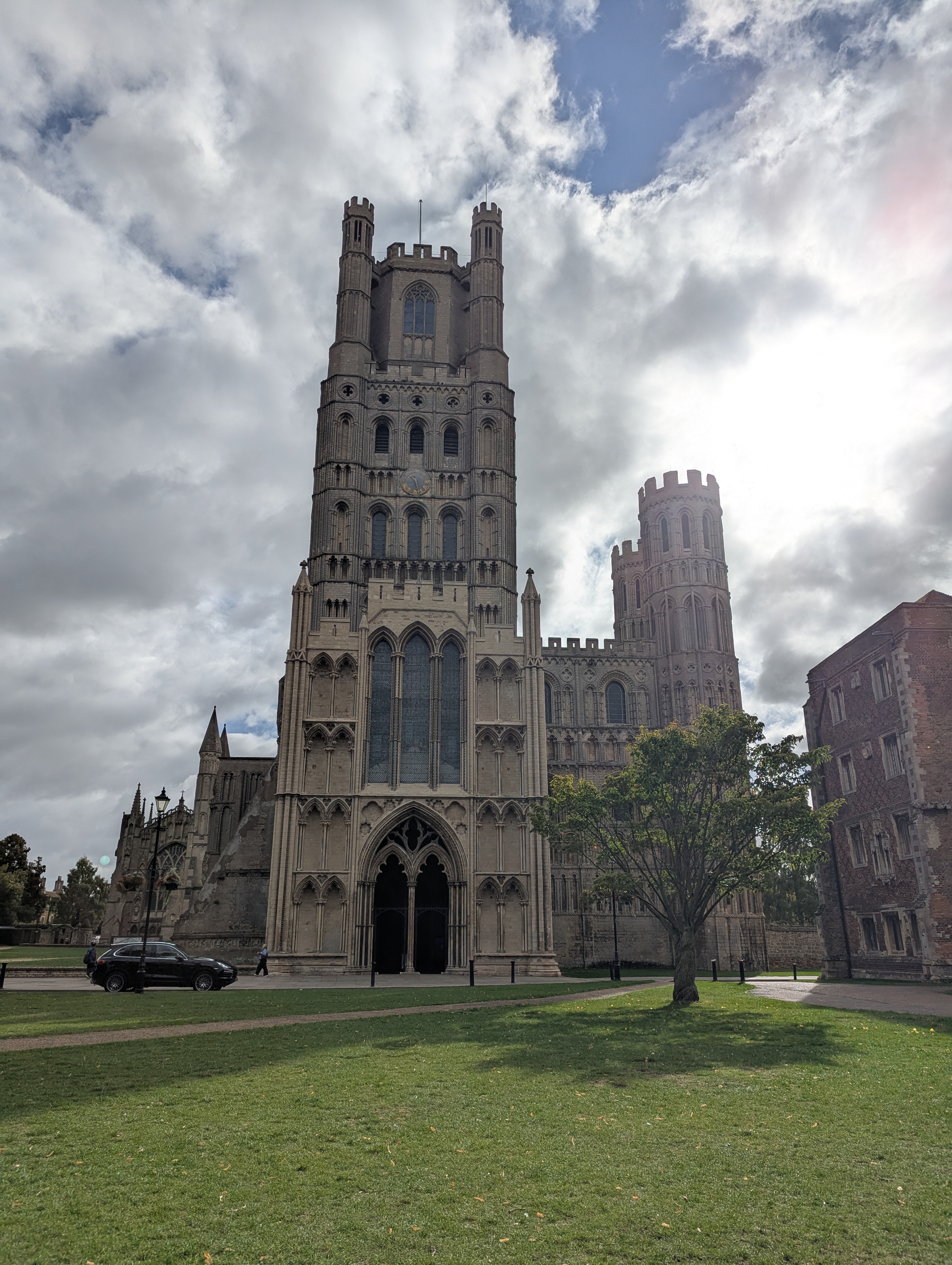
So while traveling and touring I’m drawn to the project aspect of anything. Last week, I was at the Gustave Caillebotte exhibit at the Art Institute of Chicago and especially enjoyed looking at the methodology for completing his projects, how his trial sketches were a key part of the process of producing the final painting. I remember touring the iconic Sydney Opera house years ago and learning that the design for the Opera house was based on an artist’s rendering. After it won a competition, architects had to figure out how to build it somehow. It was a project in which there was a tremendous amount of trial and error toward producing the artist’s vision. Kind of the original Agile project. In this trip around East Anglia, one of my favorite parts of the audio tour for the Ely Cathedral was a representation of the stages of building across close to a thousand years. Every hundred years or so a big project would happen. What made me laugh when reviewing the time lapse representation of the build timeline was the times they would add something in one century that in the next century they would remove. Human nature. One man’s innovation is another man’s mistake.

In this trip, one of the themes that was present in my mind was the impact of women across East Anglia. Don’t get me wrong: history always includes the stories of men, and in our touring of cathedrals and museums there were plenty of male historical figures of note. But the history of East Anglia introduced me to several interesting and notable female figures.

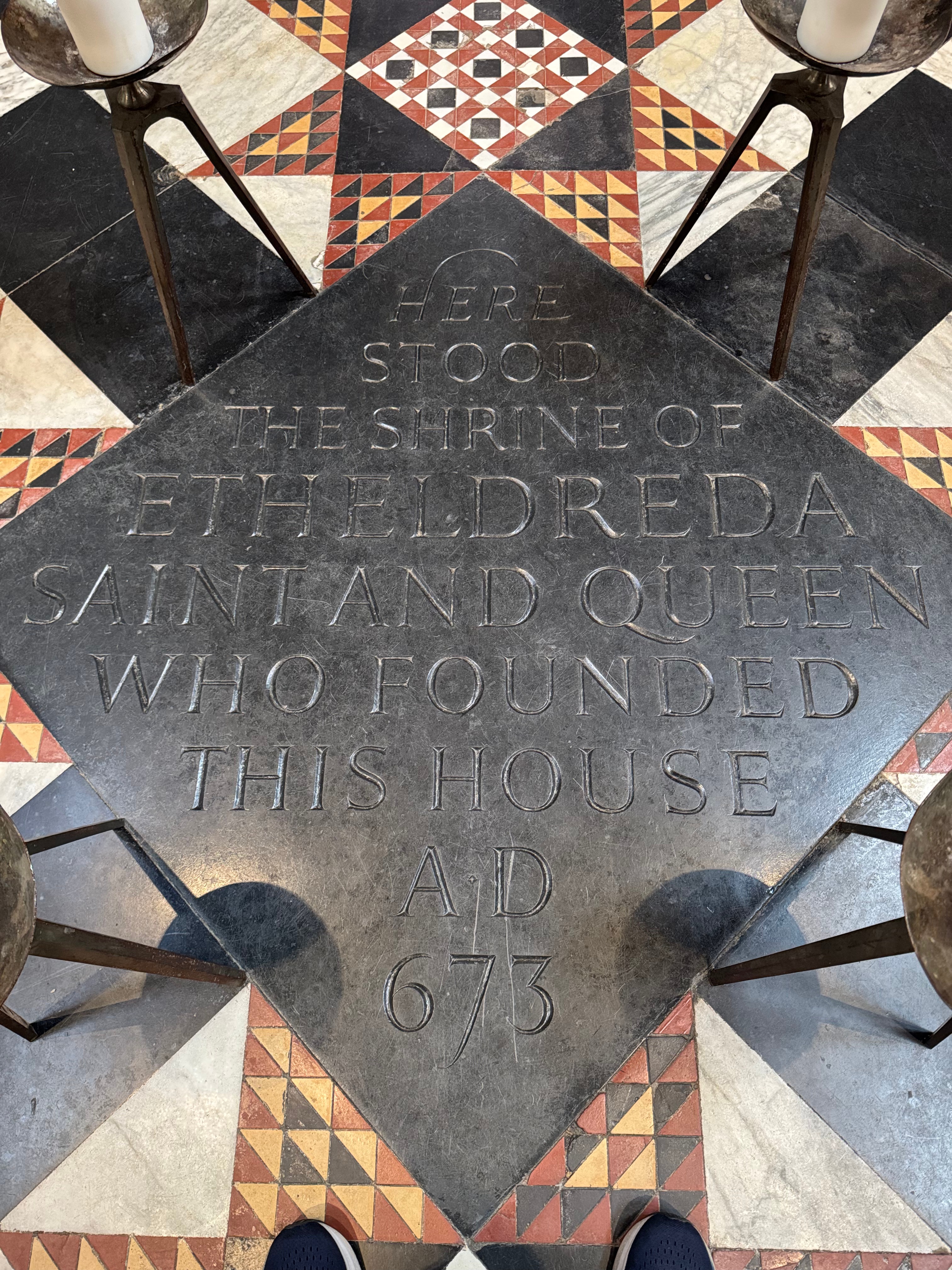
The first one was Etheldredra, important in Ely. Ultimately, she became the founder and abbess for a monastery in Ely in the 7th century, the land on which The Ely Cathedral was later built. But before that she was a king’s daughter and was married off to an elderly king. The audio guide at the cathedral tells us that her husband died before they could consummate the marriage. It says she married a second time, different king, and was released from that marriage since she was still a virgin.

A lot to take in and it made me curious. For one, when I heard about the first marriage in the audio guide, I had the impression that the first husband must have died quickly after the marriage. But other sources indicated they were married for several years. Some sources claim that the deal that was made prior to both marriages–which had been political in nature–that she would be permitted to remain a virgin.

Apparently her second husband came to regret that deal many years in, which led to the marriage being dissolved.

To doubly prove that she really, really was a virgin at the end of that marriage, the audio guide tells a story of her walking stick sprouting leaves overnight.

Interesting that it was an acceptable deal in both marriages that she would remain a virgin when the marriage was presumably for political reasons. The tale of Henry VIII communicates that producing an heir–about 900 years later–is a very big expectation for a royal wife. A lot must have changed in the ensuing years.

Anyway, by today’s standards, kind of a weird origin story for a woman who ended up doing something very, very important when she was allowed to stop getting married off and fulfil her longtime dream of starting an abbey. As an abbess she was highly influential and successful, both in life and after her death, after which she was officially sainted.

The buildings Etheldreda was part of building were destroyed and rebuilt in subsequent centuries. The Ely Cathedral was built on the land starting about 300 years after Etheldreda died. Coincidentally, the monastery at Ely–by then a Benedictine monastery–was closed down by Henry VIII himself.

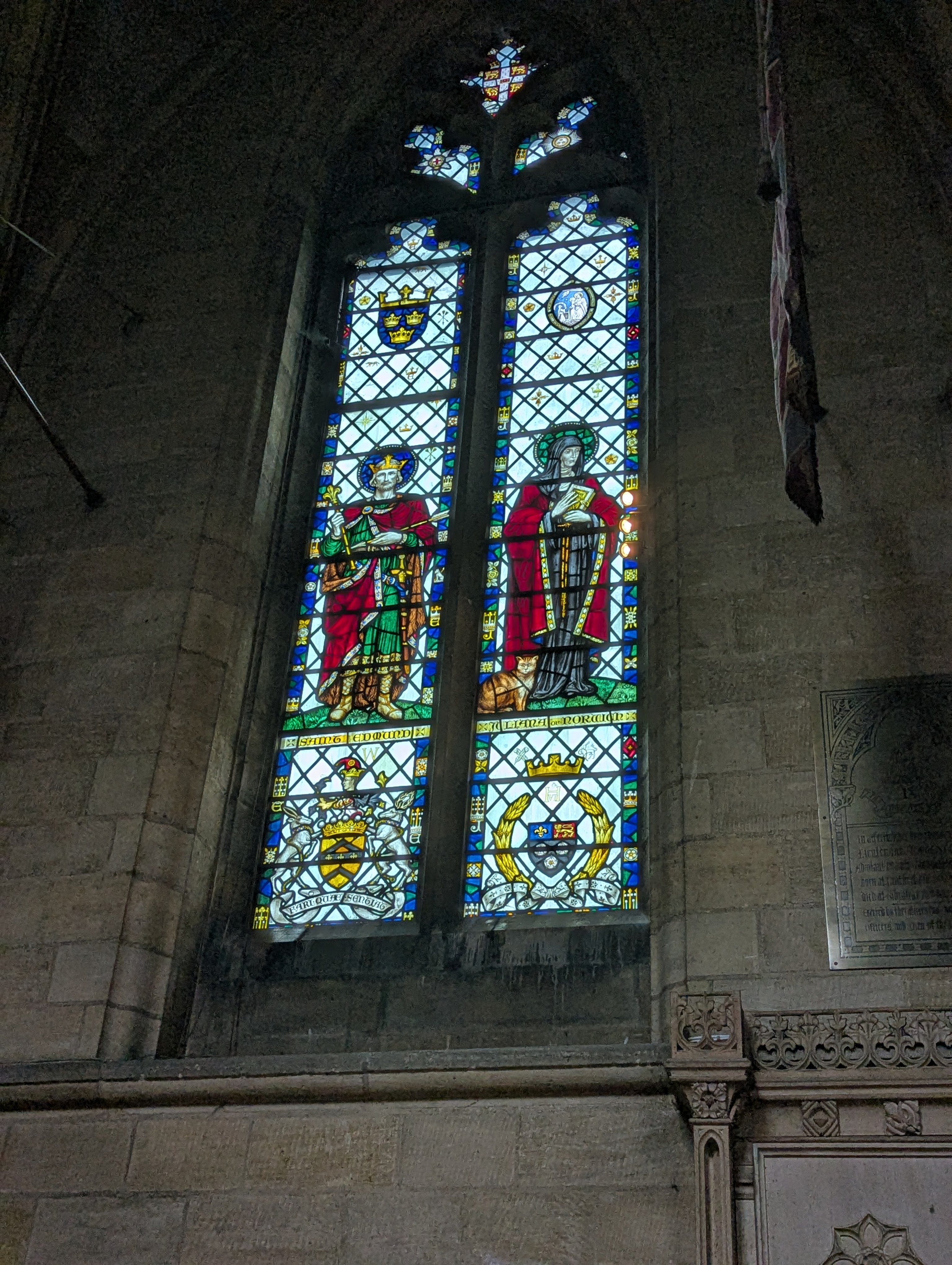
Another woman we became re-acquainted with in Norwich was the mystic and theologian referred to as Julian of Norwich. We had encountered some of her writings when we visited the British Library exhibit Medieval Women: In Their Own Words a few months ago. In the 14th century, Julian wrote the first English language book known to have been written by a woman. Very little is known about Julian, including whether Julian is even her name. She was an anchoress–a religious devotee who lives in a cell–in St. Julian’s church, and her understood name may have come from the church itself. She was inspired to write two versions of a book titled Revelations of Divine Love following an illness in which she was close to death and experienced visions relating to Christ’s death. The first version was written shortly after she recovered from the illness and the second one, much longer, after many years of intellectual and spiritual exploration. Her manuscripts were preserved for 200 years before being published. Although she claims in her writings to be uneducated, her work continues to inspire theologians even in our time. Famously, she posited that God is much like a mother. Our guide at the Norwich Cathedral quoted some famous words of the book that she found comfort in: “All shall be well, and all shall be well, and all manner of things shall be well.” Julian is commemorated in stained glass in the Norwich Cathedral we visited. Note in the picture the woman on the right pane carrying a book.

Photo from Norwich Cathedral web page

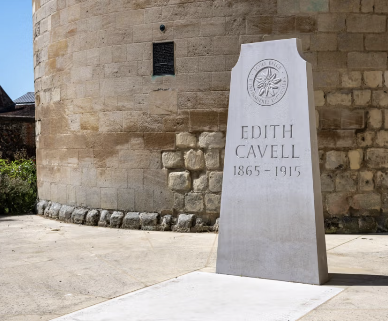
Moving on many years, we quasi-encountered Edith Cavell who was born at the end of the 19th century. As we were walking for the first time from the Norwich train station to The Maids Head I saw a pub named The Edith Cavell. Then once we checked in to The Maid’s Head, on the way to our room, there was a meeting room labeled The Edith Cavell Room. I asked myself “who is this Edith Cavell?” She sounded familiar but I couldn’t remember why. It turns out she was the daughter of Norwich-area clergy and had an increasingly interesting nursing career that presumably started either because experienced a failed romantic relation OR because she helped her father through a serious illness. Or both. Her nursing took her into teaching and administration and allowed extended travel in Europe. She was notable as a nurse in the first World War for treating war wounded from both sides but ended up running afoul of the Germans for aiding the escape of more than 200 soldiers from Belgium. She admitted her “guilt” and was executed at age 49 by a German firing squad. She showed virtually no fear leading up to her death, glad to die for her country and with her soul at peace. Her body is buried outside the Norwich Cathedral.

And finally, we encountered Edith Pretty, the woman responsible for sharing the Anglo-Saxon treasure of Sutton Hoo with the world in the mid 20th century. Born into a wealthy family, she became deeply interested in archeology and, with her husband, purchased the Sutton Hoo property on which the burial mounds were located. (Interesting side note: before her marriage she, too, was a nurse and served in Belgium in the first World War.) Although many people believed the mounds had already been robbed, as indeed they had been, she was convinced that they contained additional treasure. After her husband passed away, she hired a local excavator, Basil Brown, to explore the site further. He is often credited with the find, as he should be, but the excavation occurred only because she was willing to invest toward the work. She waited patiently for the coroner inquest that would rule on who had rights to the treasures, rejected rewards from the crown for gifting the property, and as soon as it was clear it was hers to dispose of as she wished, she donated all artifacts to the British Museum to add to our understanding of the Anglo-Saxon culture and be enjoyed by everyone. Like our other women, Edith Pretty was a Boss.

It occurred to me that every one of these women became known for what she did when she was single, regardless of how she came to be that way. Perhaps being single contributed to their being able to pursue a deep-seated interest given the times in which they lived. You have to admit we are looking at a very long period, more than 1000 years, in which it seems true that it has been quite difficult for a married woman to pursue the kind of work that speaks to them as a person, unless that work happens to be taking care of family. (I do note that some of these “jobs”–like being in a monastery–just require being single.)

To be clear, we know about these women because they became famous. In my mind, fame is not the object for most of us. The object is being able to do work that interests one greatly.

And as much as I note that women have made progress since Edith Pretty’s death in the 1940s, it seems there are still forces that hold us back. In fact, forces that existed in the past that were briefly weakened seem lately to be coming to greater strength.

Ominously, women leaving the workforce at high rates. Although unexplained, some factors believed to be involved include rapidly increasing cost of child care and the newly growing wage gap between men and women workers. Removal of women from government positions under a new regime, where the claim is that they are insufficiently qualified. And my social media feeds over the summer included a video in which a well-known male operative, leading seminars for young women, encouraged them not to work or attend college. Or if they attended college not too work hard at it. Ok to pursue “an MRS degree,” where you are only attending college to meet eligible bachelors. Indeed, ready yourself for a life of servitude where you take care of family and be subservient to your husband, the boss of your family. Sorry for the bad luck of the accident of your gender.

As a recent retiree from a job I loved I’m so thankful for the period in time in which it’s been possible as a woman to pursue interesting work. My fervent hope for all women is that one is not required to be single or childless to be able to freely choose and grow in an occupation. That women be judged on their objective merits instead of assumptions about people of your gender. That when partnered, their partners support their self-actualization, just as they support the same in their partners.

I bet all the single ladies of East Anglia agree.

New territories, Norwich edition: part 2

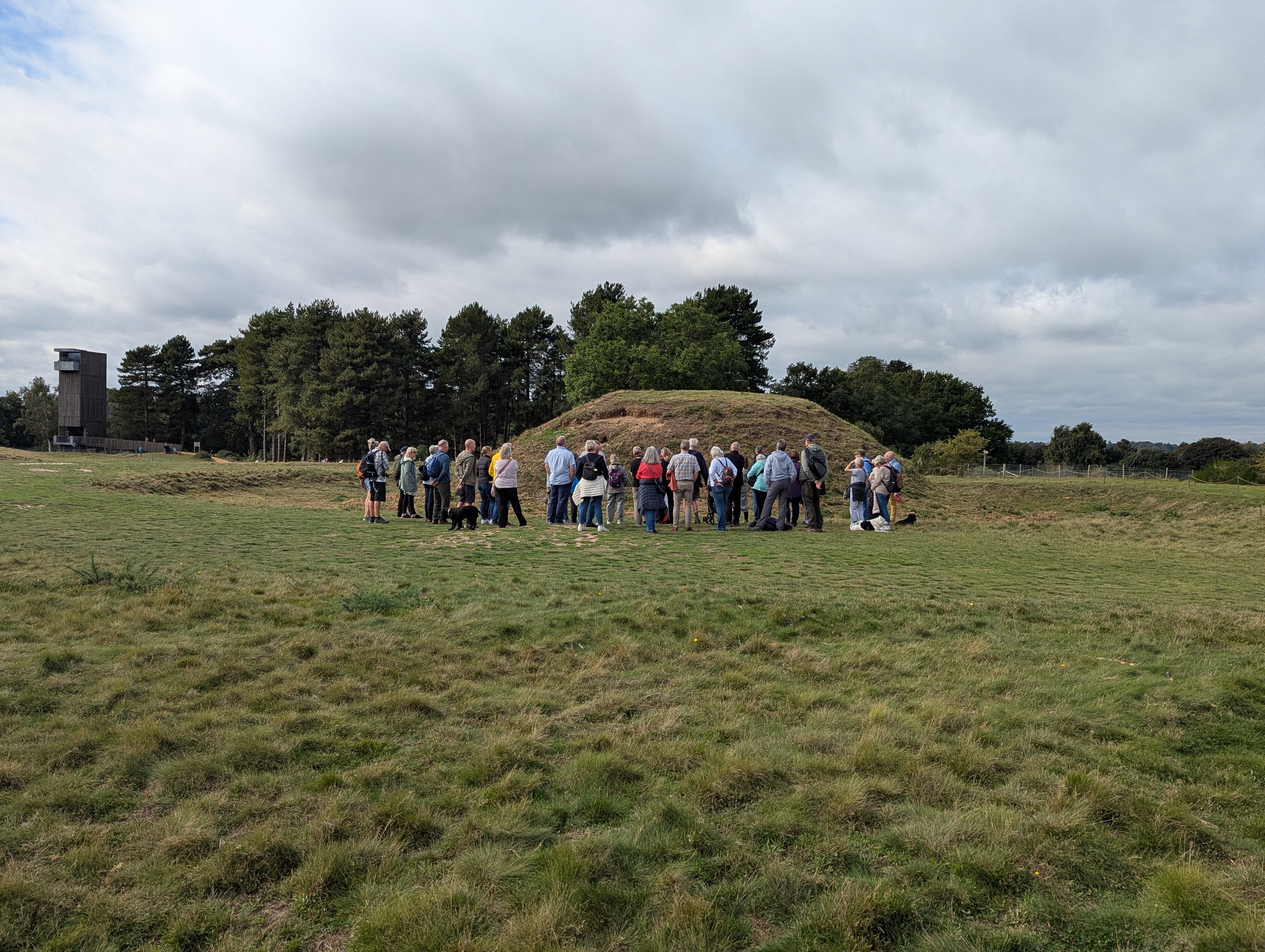
With the rain more or less behind us, we had breakfast at the hotel and then took the train to Melton. The Melton train station has the best butcher shop I’ve ever seen….and very little else. We walked along a narrow sidewalk very close to a busy thoroughfare for 15 minutes to arrive at Sutton Hoo. We initially learned about Sutton Hoo from the Netflix movie called The Dig. The movie tells the true story of how one of the most significant archeological finds in England–an Anglo-Saxon burial ground–came to be discovered. For perversely quick and hopefully not inaccurate history from a touring American, Anglo-Saxons migrated to England starting in the 5th century A.D., about the time the Roman occupation was coming to an end. The find provided a new picture of how Anglo-Saxons lived. They had been much more sophisticated than originally believed.

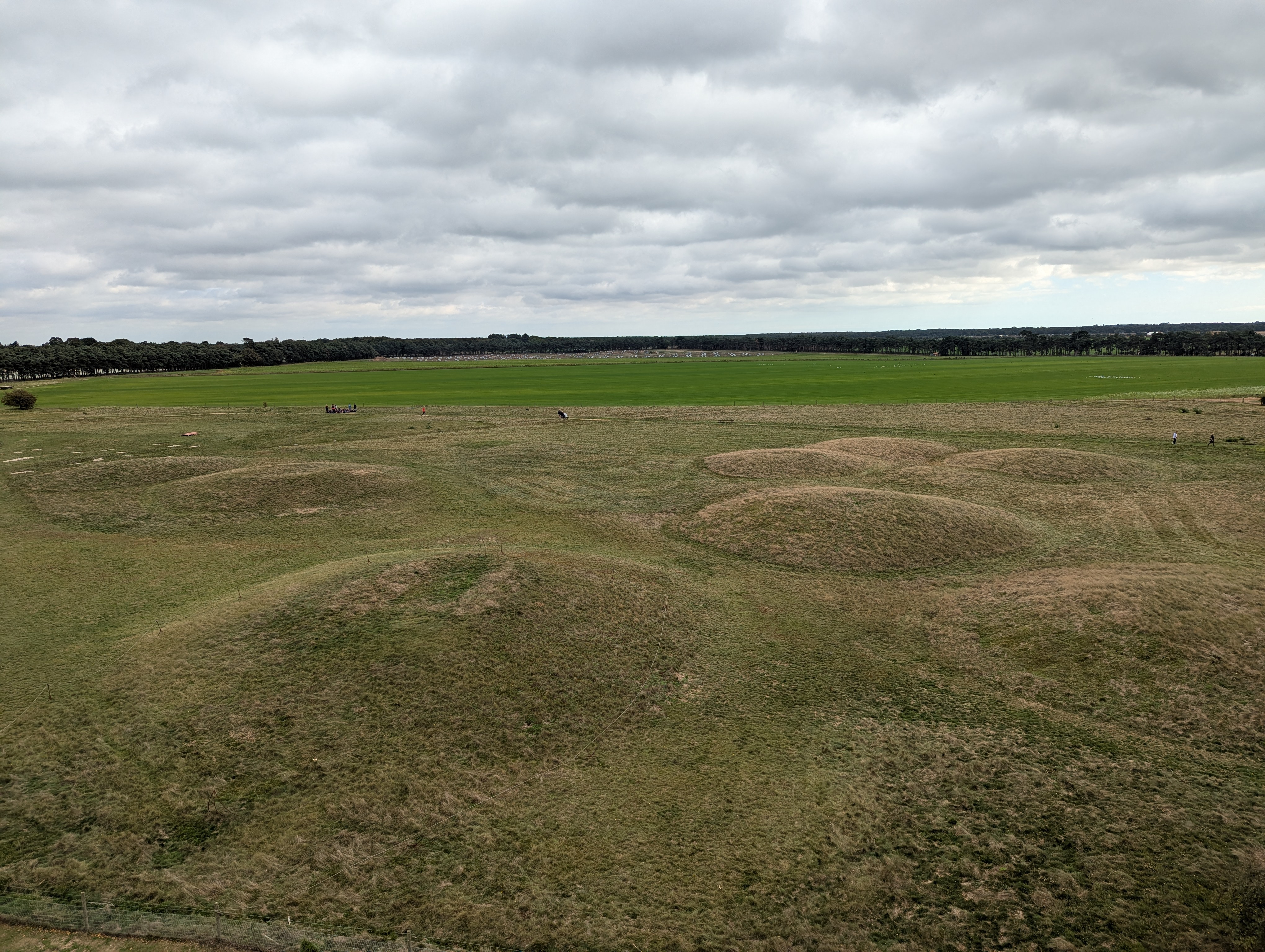
Sutton Hoo was property owned privately by a woman named Edith Pretty that, after her death, was gifted to the National Trust. You can visit the site and walk the property, including into her home and to the location of the burial mounds. There’s an observation tower near the mounds so you can climb up and look down at the mounds. A displayed map on the observation tower describes what was found in each mound. Edith Pretty’s home includes exhibits about her life and details about how the excavation project came about. There’s also a museum about Anglo-Saxon life on site. Outside of the museum, there’s a replica of one of the most interesting objects found in the mounds, the fossilized outline of a ship that was used to bury an important Anglo-Saxon leader. At Sutton Hoo, they seem convinced that the leader was King Readwald. The British Museum, which ultimately received most of the objects found in the mounds, including a famous war helmet believed to belong to the person buried, seems less certain. Pretty’s gift of the artifacts to the British Museum came after a coroner’s inquest into the ownership of the artifacts found on her land. As soon as the inquest established that she alone had rights to the artifacts, she gifted them for all to enjoy.

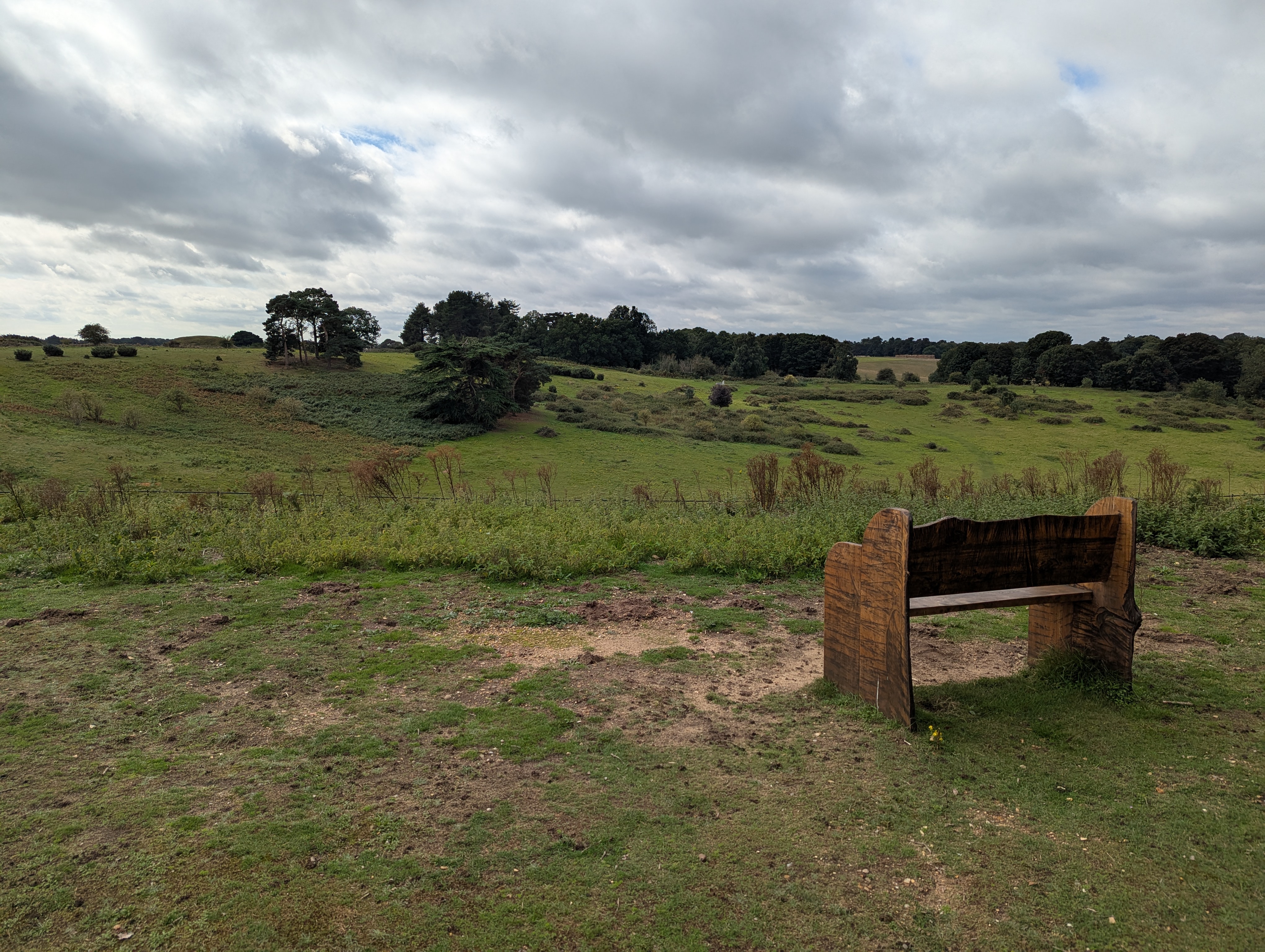
The property is beautiful, rolling hills, wild grasses and flowers. We explored a path through and near the property trying to find the River Deben, which is what the Anglo-Saxons are believed to have used to drag the ship to the burial place. We got to where we could see it but there are a number of beautiful and gated private properties blocking access.

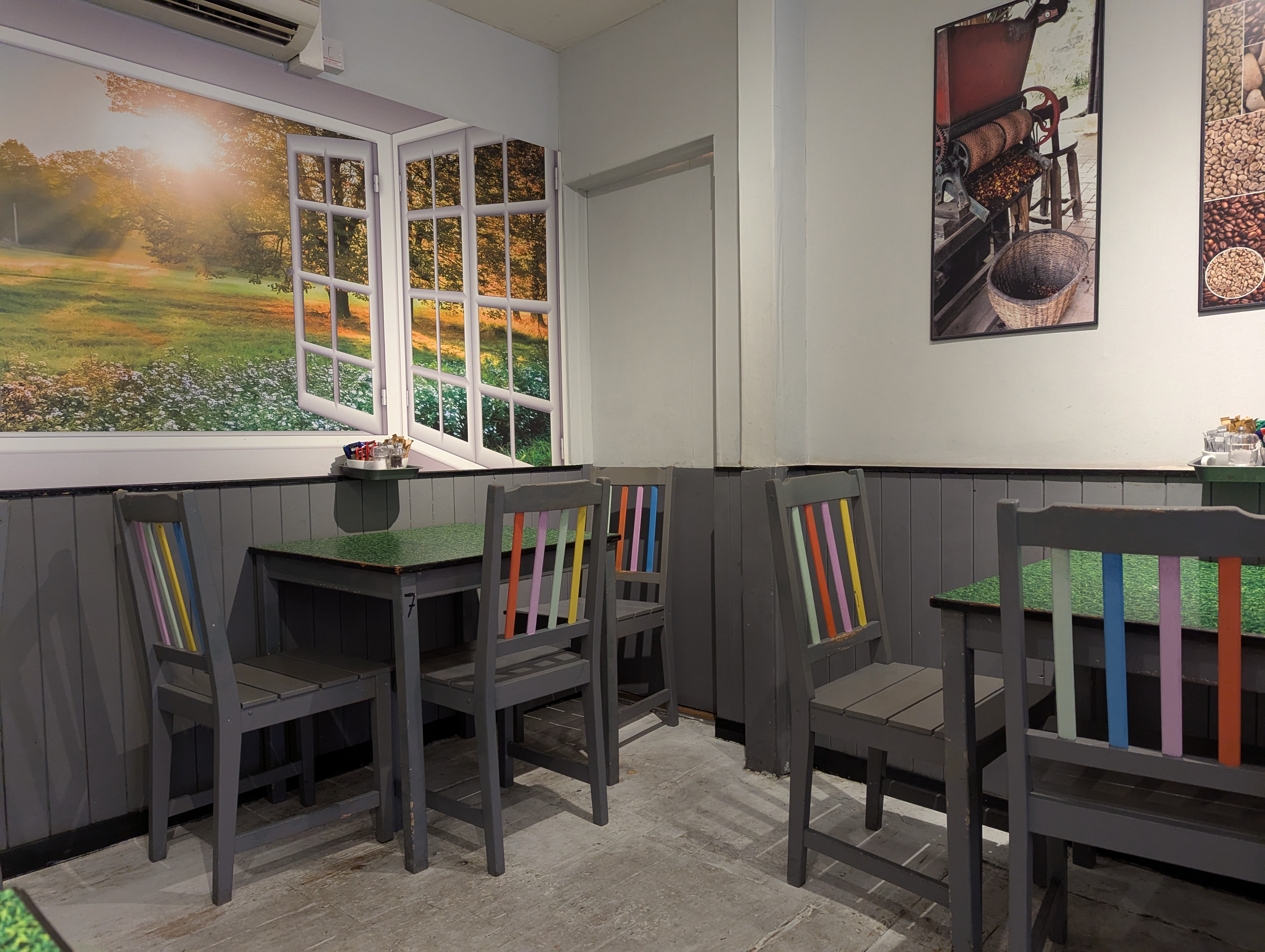
After visiting Sutton Hoo and returning to the train station, we headed to Ipswich. Like Norwich, Ipswich’s football stadium is also near the train station. It’s quite nice from the outside. We walked to the city center and searched out a place for lunch, settling on the highly rated Blends Coffee House. Cute on the outside and kind of rough on the inside, with a menu far too big for the size of the shop, we were pleasantly surprised by how good everything was. I had a pot of tea (third day running, really enjoying this habit) and a BLT. English bacon is really different from bacon in the U.S. and I love it. It’s a bit more like U.S. ham. To be clear, I love all bacon, the English way or the U.S. way. I could easily be vegetarian, except bacon. I guess I would have to be a vegebacontarian. What was so so good about the BLT was the artisan bread. Not to go all crazy about a BLT, but it has long been my belief that what is important in a BLT beyond the quality of the B, the L, and the T is the right proportion of each ingredient and the balance of mayo and bread. Theirs was just about perfect.

As we were paying our bill the person who waited on us asked if we were Canadian. Honestly….there are reasons I would like to pretend to be Canadian while traveling in Europe at this time in history. At all times, America’s relationship with Britain is a bit complicated. But the week we were there, our President was also, and that brings feelings to the fore. But we were honest and that led to a general conversation about why we were in England. We asked if he was an Ipswich fan and he ran to the back of the kitchen to bring out his coffee cup bearing the logo of his favorite team. It was Port Vale. We laughed because that’s who Arsenal was to play in the Caribao Cup the week after we were there. (I am writing this more than a week after the trip; Arsenal ended up winning the match on Wednesday 0-2.) The other worker at the coffee shop was an Ipswich fan. We asked him about the rivalry with Norwich. He said “oh yeah–we hate them.” He was looking forward to the first match in a long time between Ipswich and Norwich. Both teams have been up from the Championship and into the Premier League and then back down to the Championship in recent years, but not at the same time. Both are in the Championship now.

After some good natured trash talking and some advice from the guys about what we should consider doing in Ipswich (they recommended nothing in Ipswich but had ideas about other places we should go in England), we went off to find baked goods. Ultimately, we found a chain called Cookie Barista. We walked back to the train enjoying the scenery and downing our cookies.

Back in Norwich, we made another visit to St. Andrew’s Brew House, this time to try some of their beer. It was Thursday, kind of a popular day for people to meet up with friends at the pub so a bit livelier than our last visit. We had the Anglo-Saxon amber. It was pretty yummy. We walked over near the Guildhall for an easy dinner at my husband’s go-to chain in England, Pizza Express. This one had a great view over Norwich and the market.

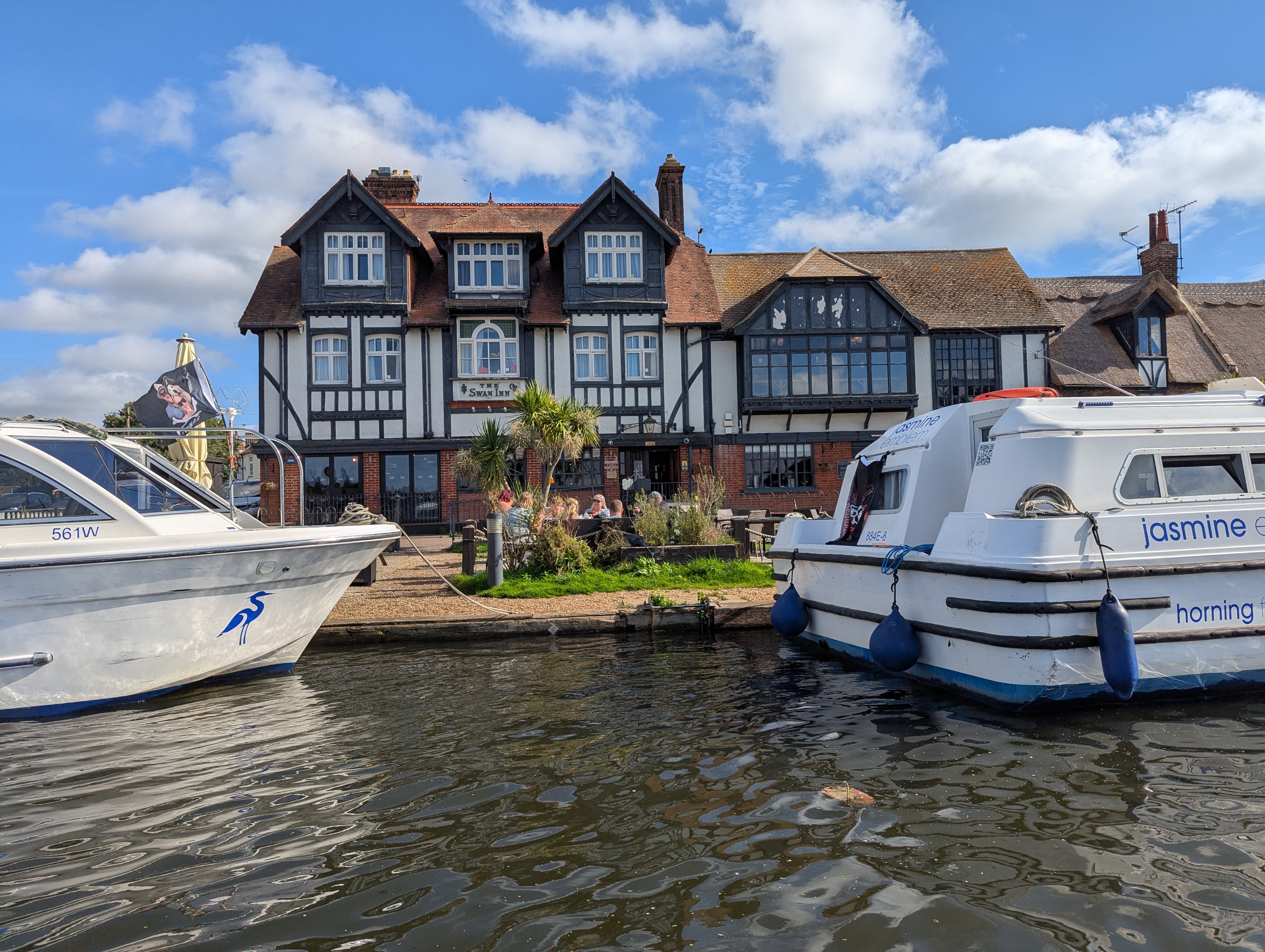
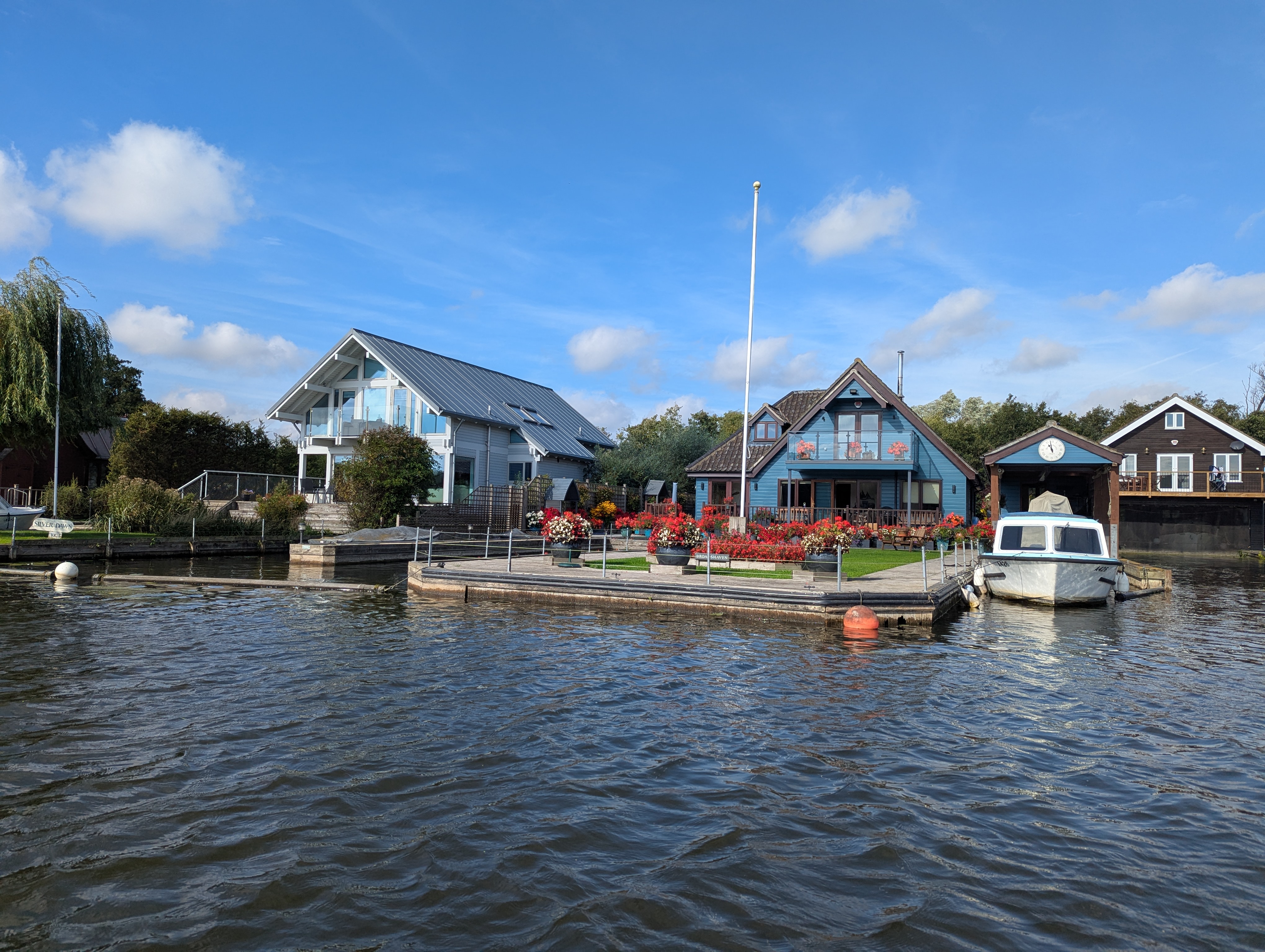
Our last full day in East Anglia was going to be a warm one. We took the train to Hoveton and Wroxham to enjoy the Norfolk Broads. The understood way to enjoy the Broads is to rent watercraft and tool around the Bure river. We found Norfolk Broads Direct and rented a motor boat for 3 hours. It was a September Friday so not too busy on the river, but they had a lot of boats available to rent and had plenty of competition from our boat outfits. I had zero confidence about driving the boat but my husband had full confidence. It was a bit hairy getting out of the dock area but he quickly became comfortable and we enjoyed looking at the beautiful homes along the river, the wildlife, and the scenery. You can only go a maximum of 5 miles an hour on the river so it was quite chill. When people rent for a whole day they are able to dock and go into little towns and pubs along the river. 3 hours was too short for us to do that, but we got a sense for the lifestyle.

We walked back to the train station in Hovetown/Wroxham to embark on our next adventure, a ride on the Bure Valley Railway up to Aylsham. We had to grab a quick lunch so we stopped at an establishment near the station called Fizz and Fromage. I saw they had BLT on their menu but it was not just “BLT.” It was “Famous BLT.” After waxing lyrical about the BLT in Ipswich, you know I was tempted. I really can’t explain how it is possible, but the BLT at Fizz and Fromage was the best I have ever had. By far. My husband was just as enthusiastic about his hummus and sourdough.

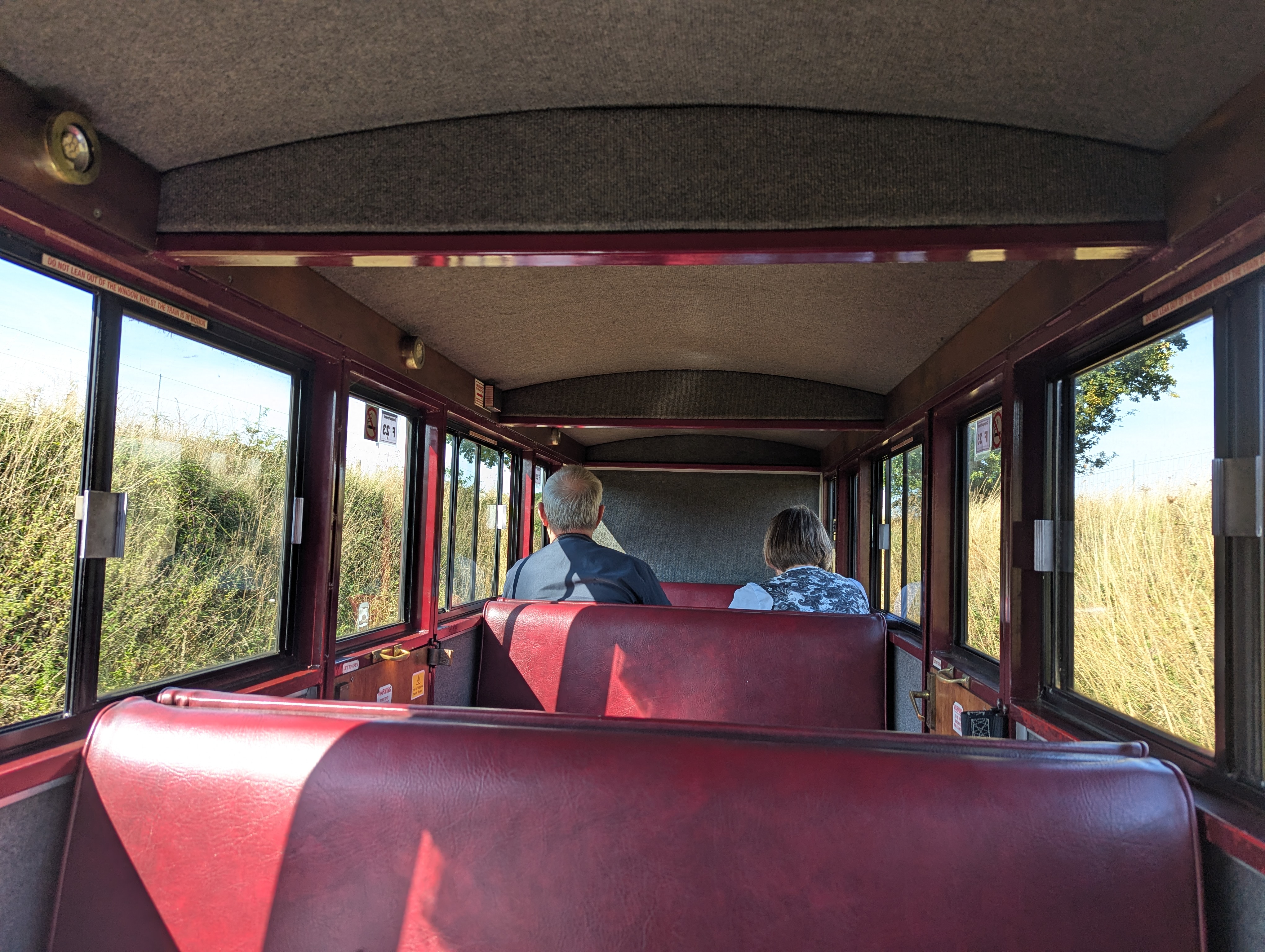
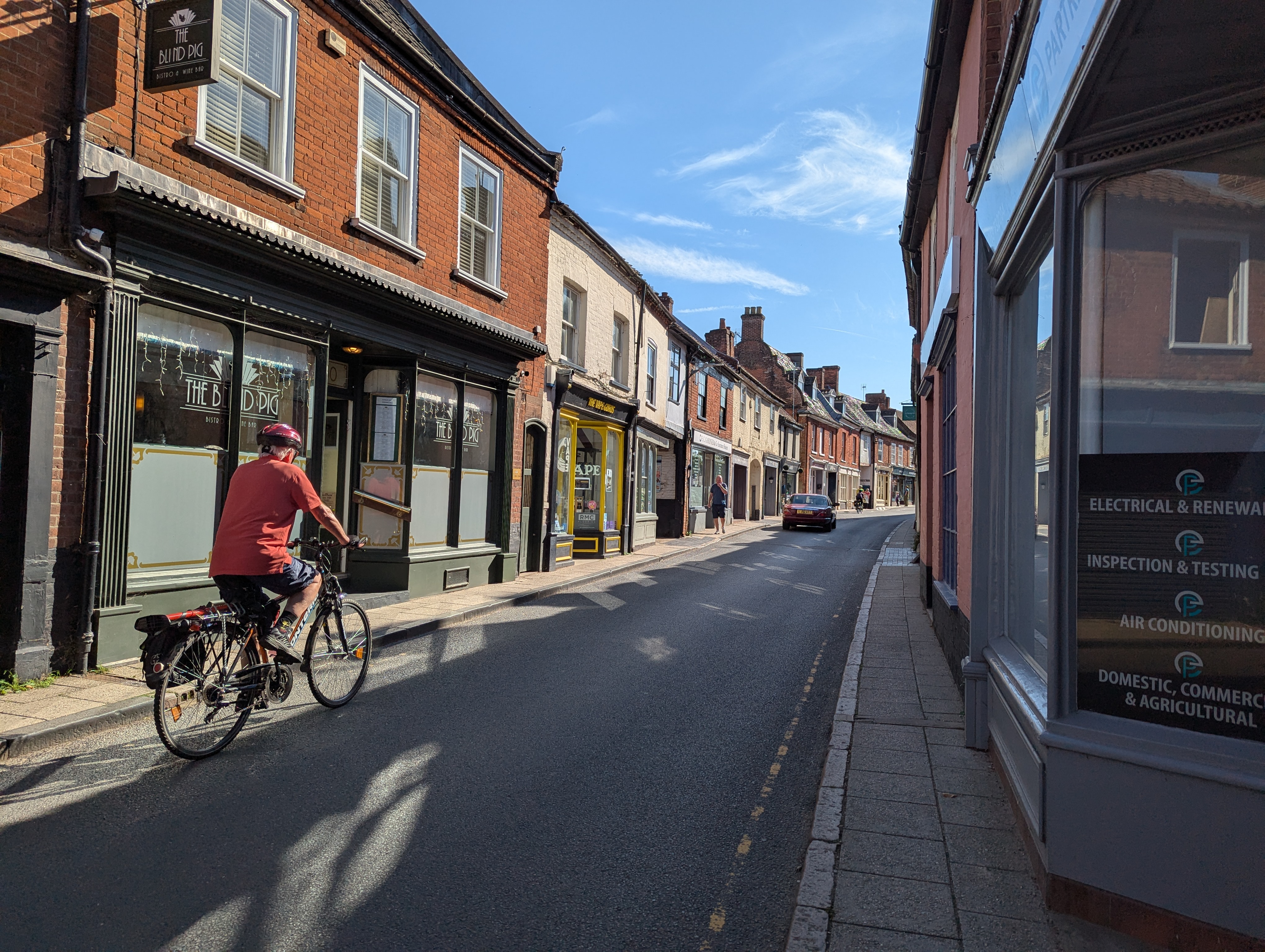
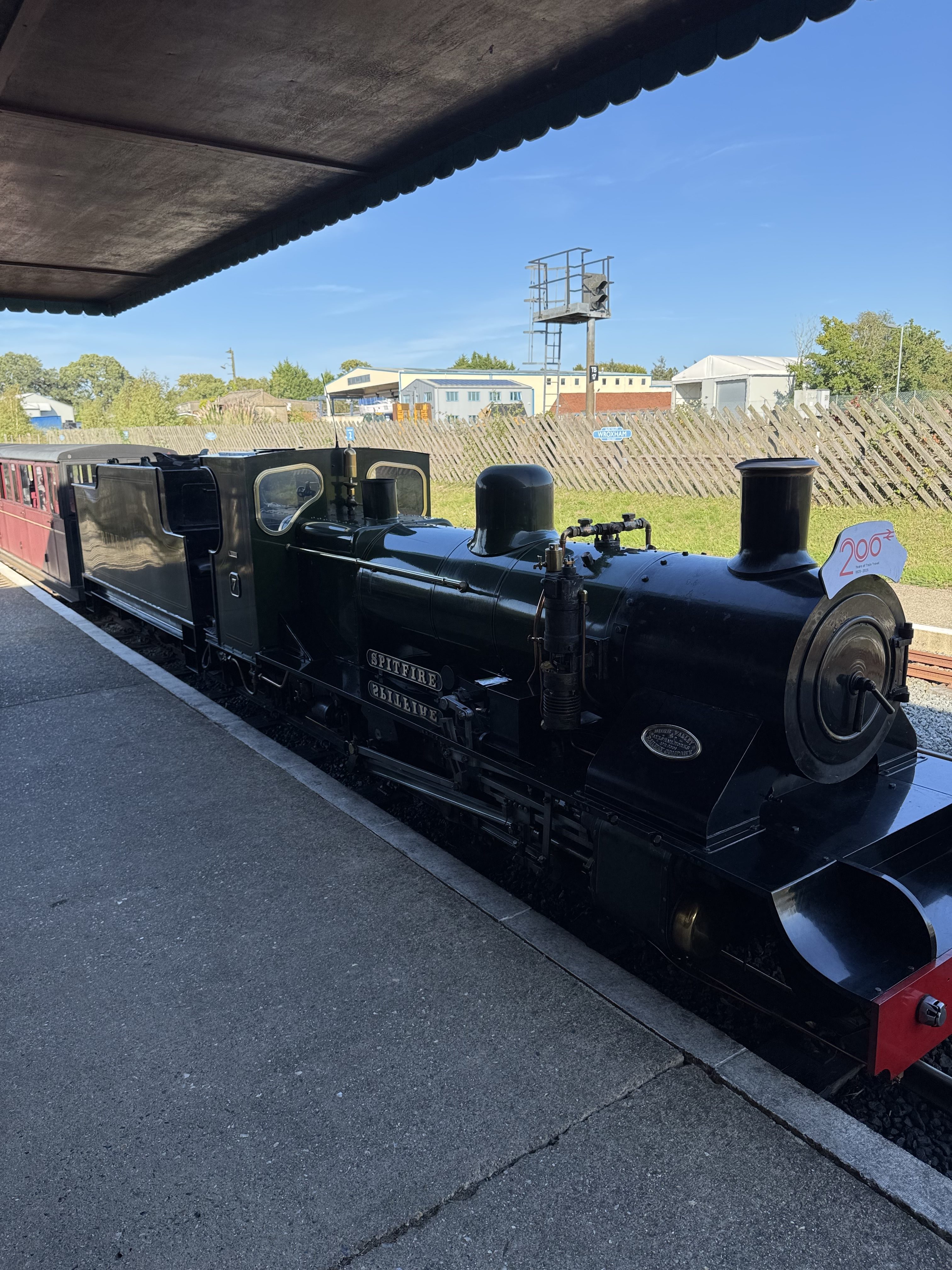
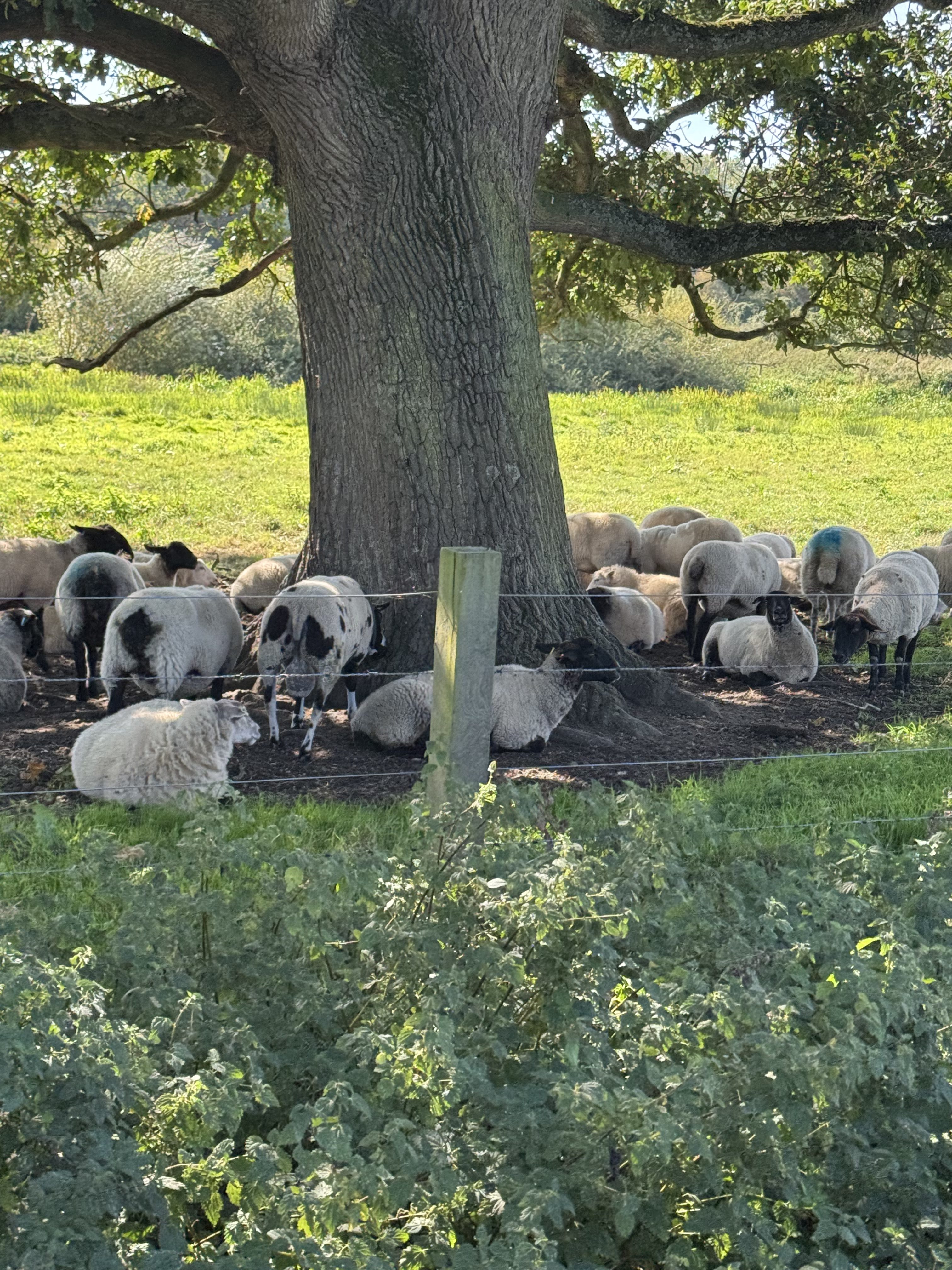
The Bure Valley Railway was a lot of fun. The train was pulled by a steam engine. It was not an old steam engine as we had believed when we booked but rather a new one. The whole railway was actually constructed in 1990. The train went through lovely country side, past villages and the Bure river, and sheep. We passed bikers and hikers using a path next to the tracks, and sometimes they passed us. We arrived in Aylsham and had about an hour to explore before returning by rail to Wroxham. Cute little town.

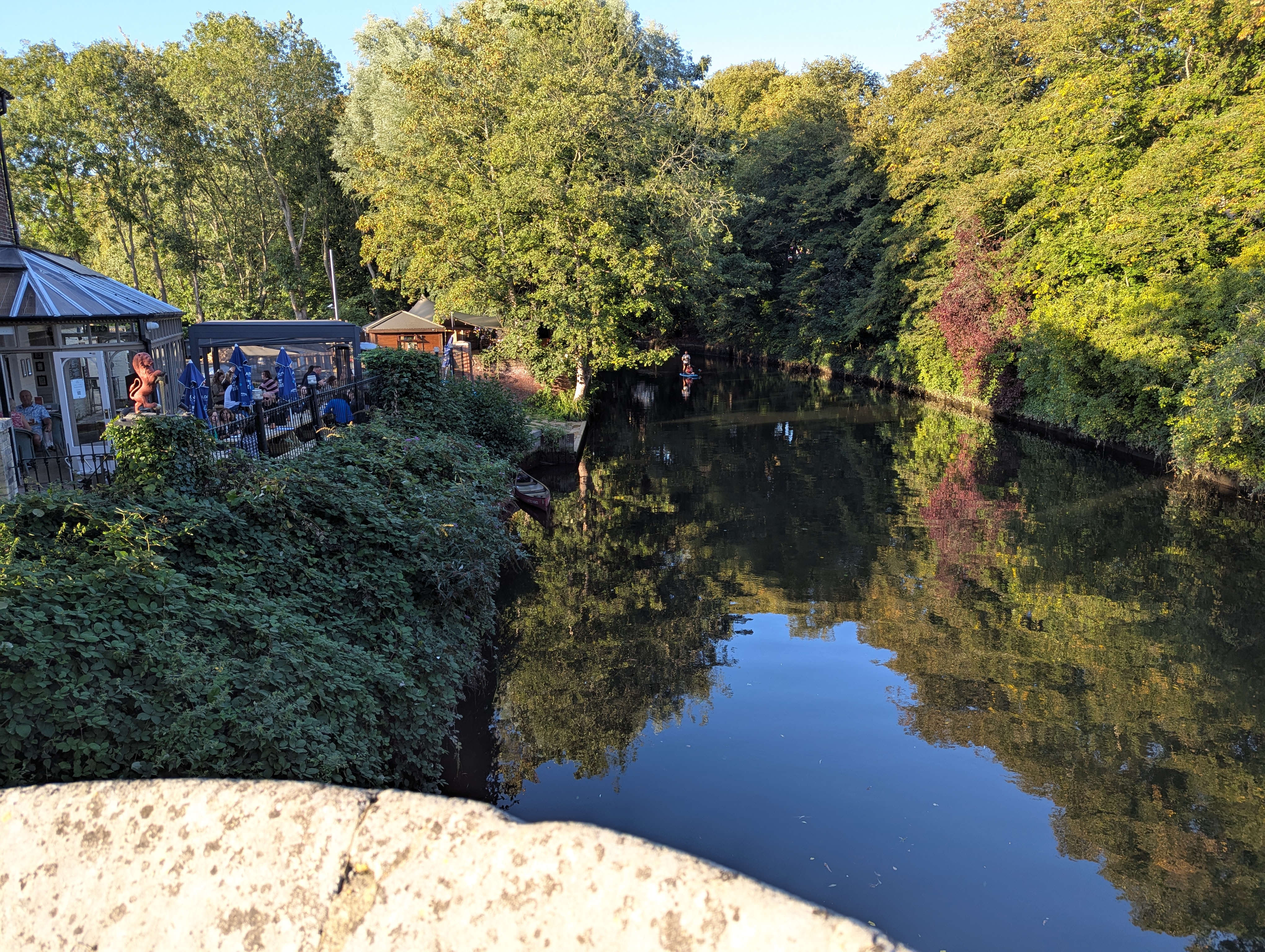
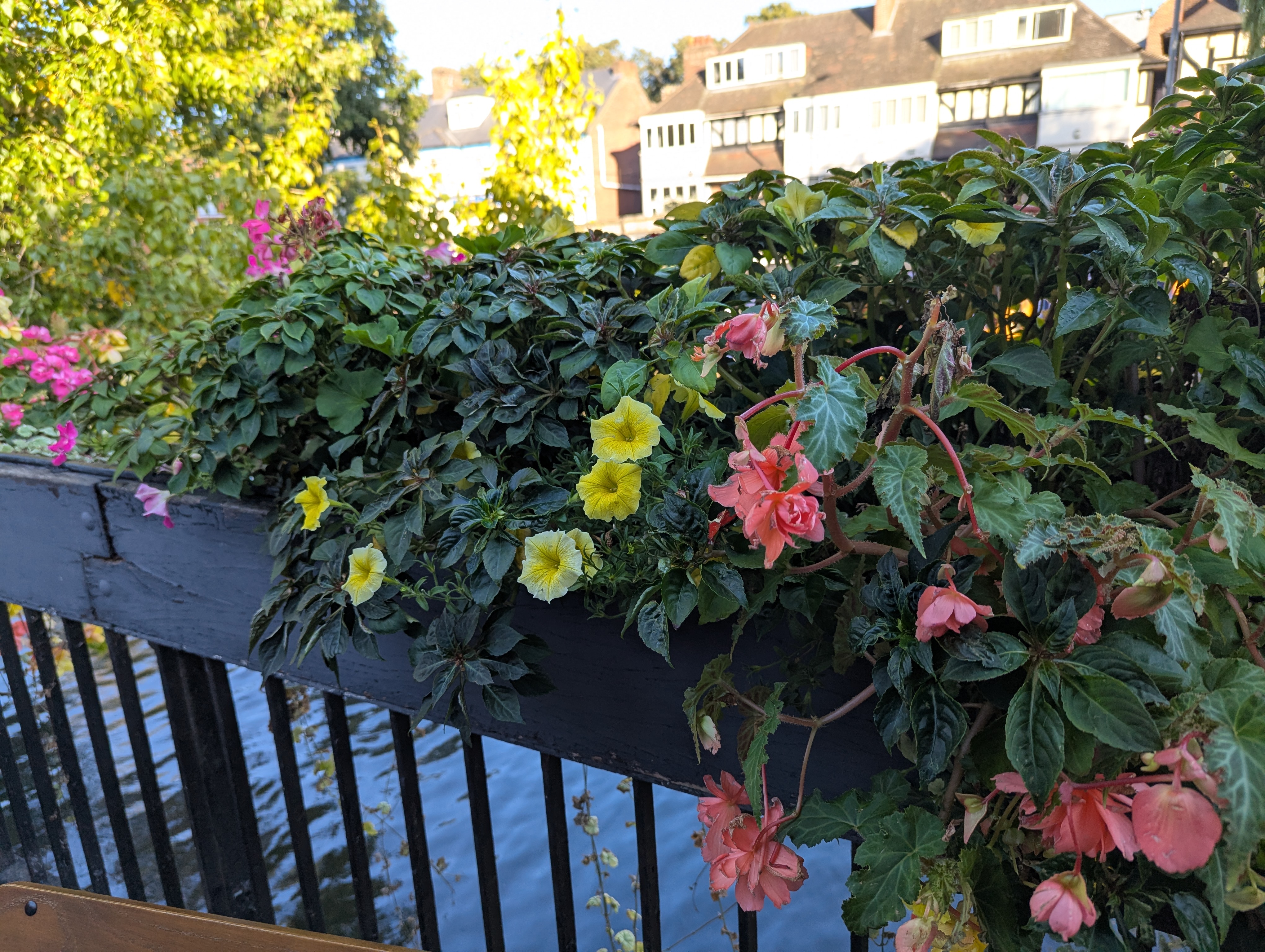
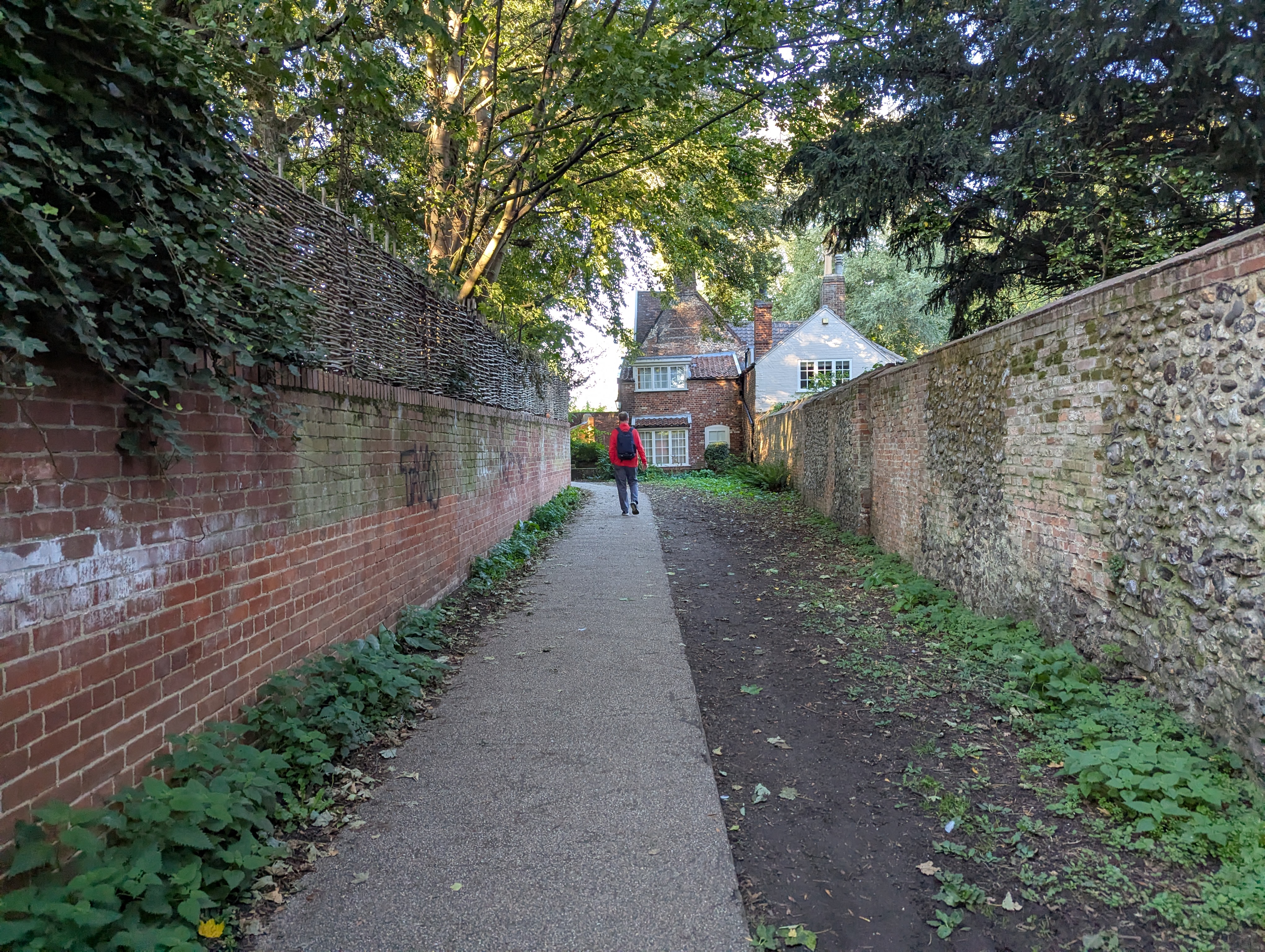
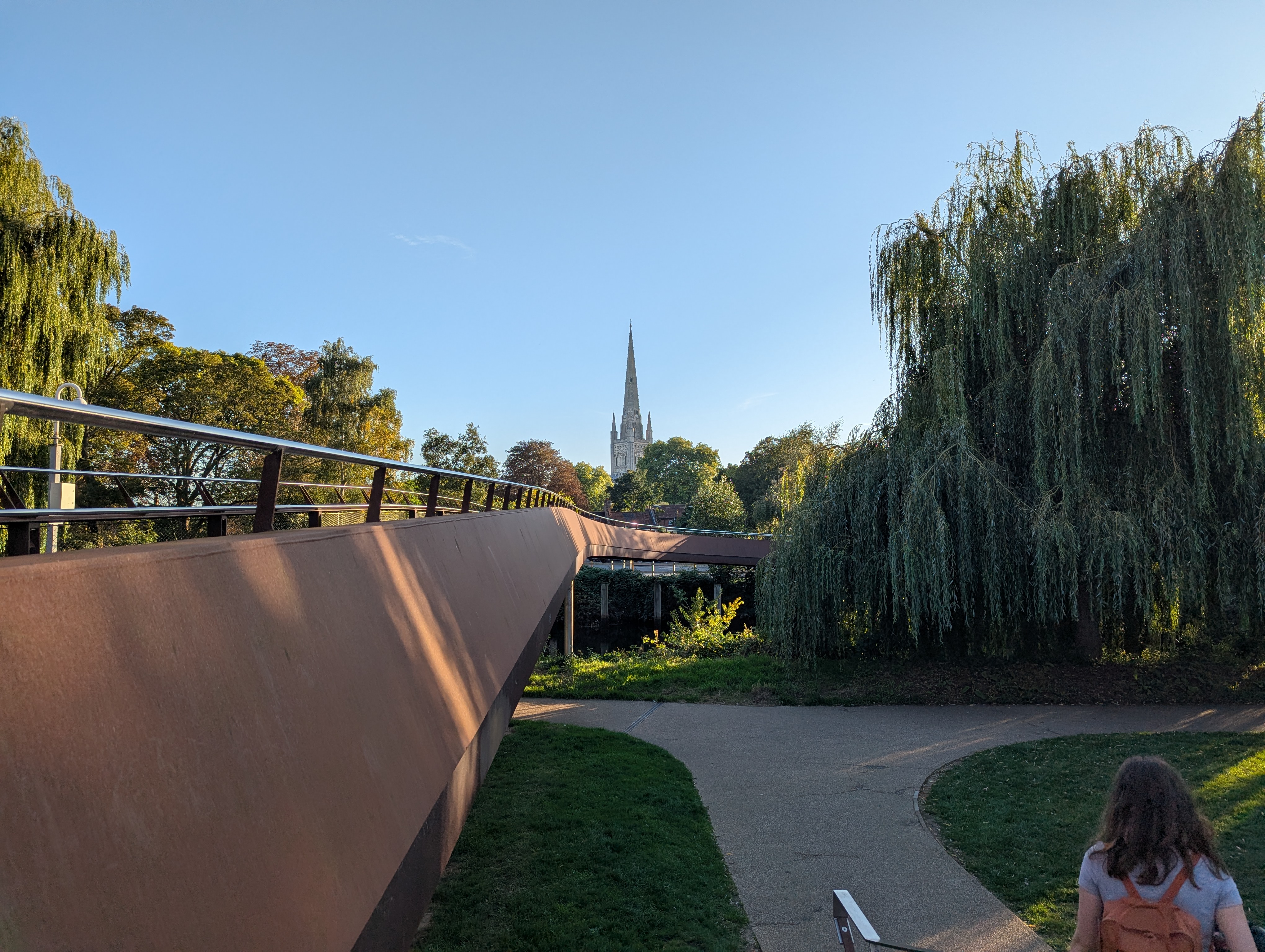
Upon our return to Norwich, we made one more stop at The Compleat Angler for a beer to celebrate our trip to Norwich. It was still so warm and nice we sat out on the porch over the lovely River Wensum. The flower boxes on the exterior of the pub were so pretty. Afterward we followed the path along the river as far as we could on our way back to the Maids Head. It occurred to me that you can see the Norwich Cathedral from many parts of town. I wondered what kind of impact that has on your living when your spiritual home is visible from most places you are.

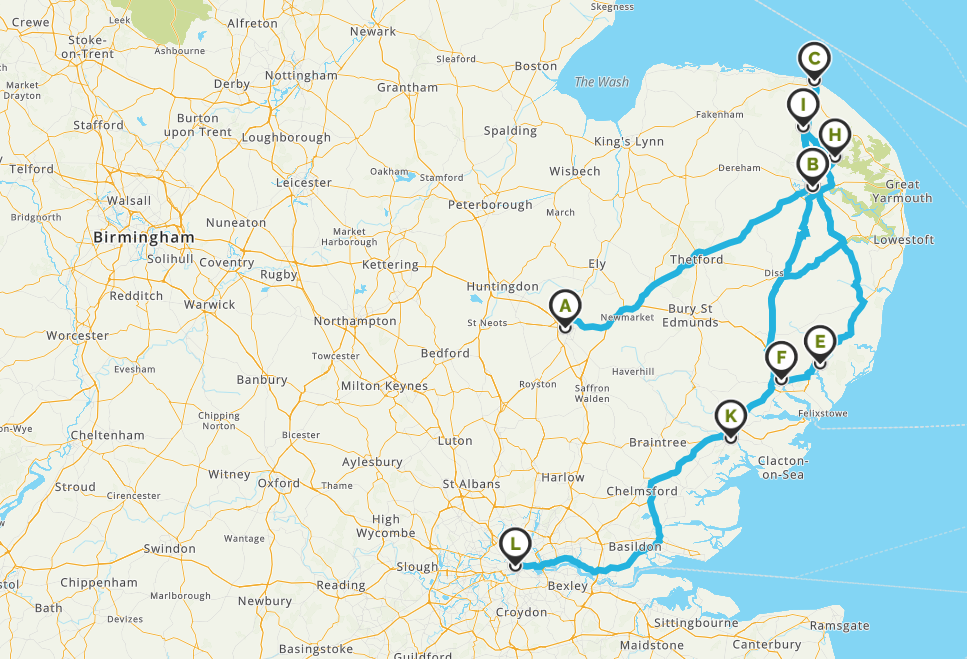
The Norwich leg of our trip, including the ride back to London, looked something like this:

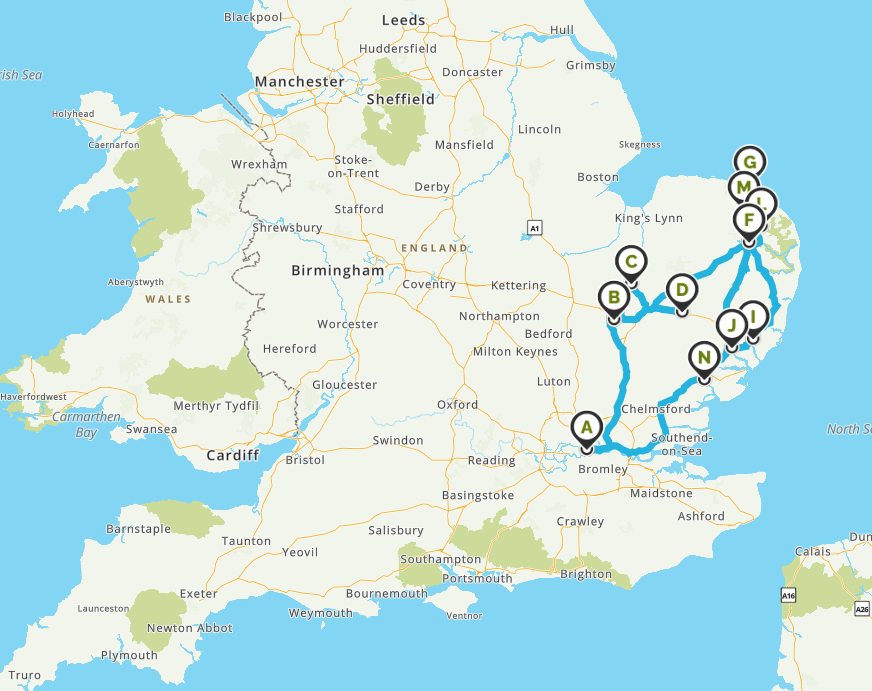
And our whole trip to East Anglia looked like the map below.

We saw and did a lot in East Anglia. Still, I’m left with the feeling that there is so much more to see and do.

Another time….