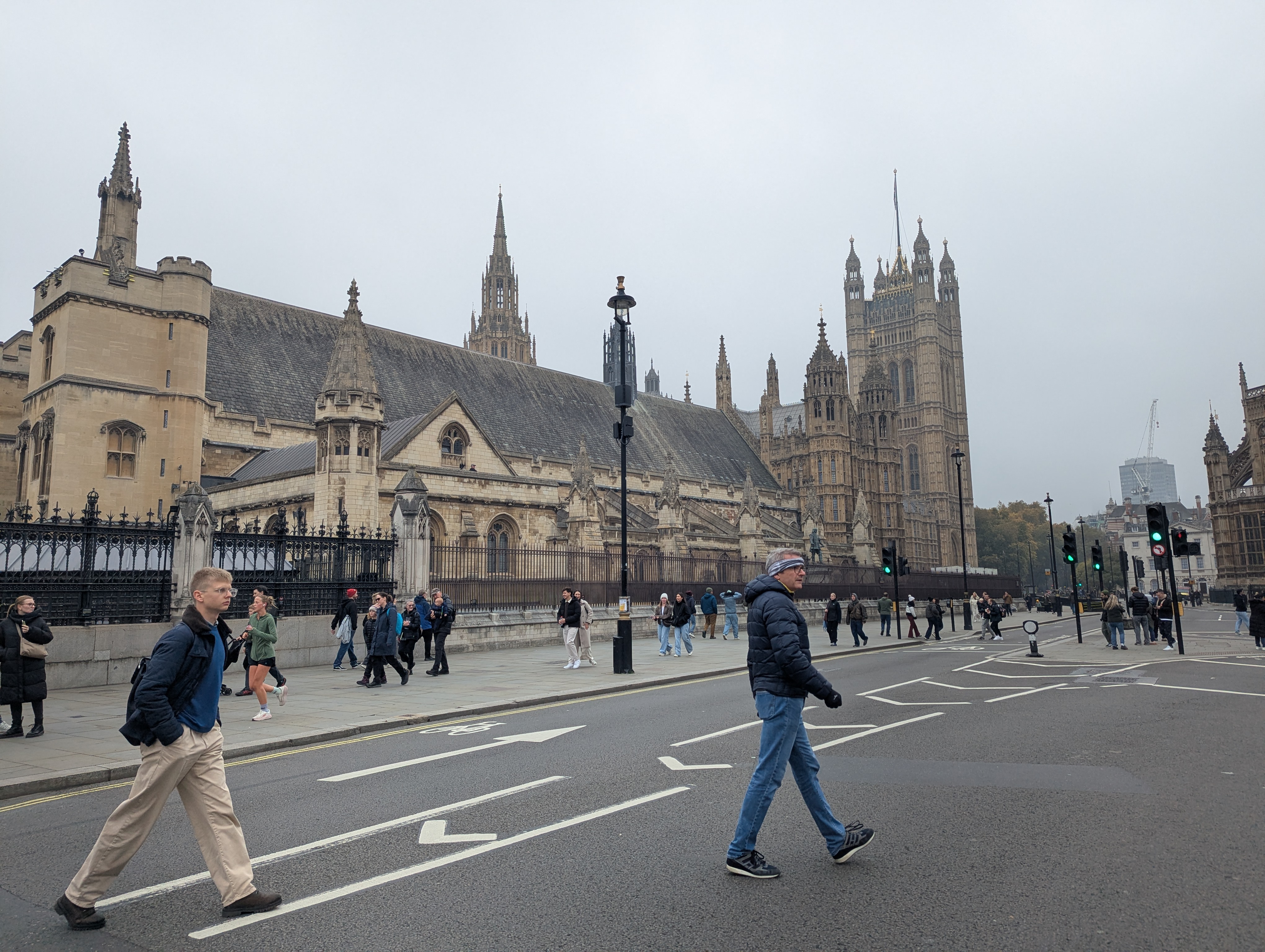
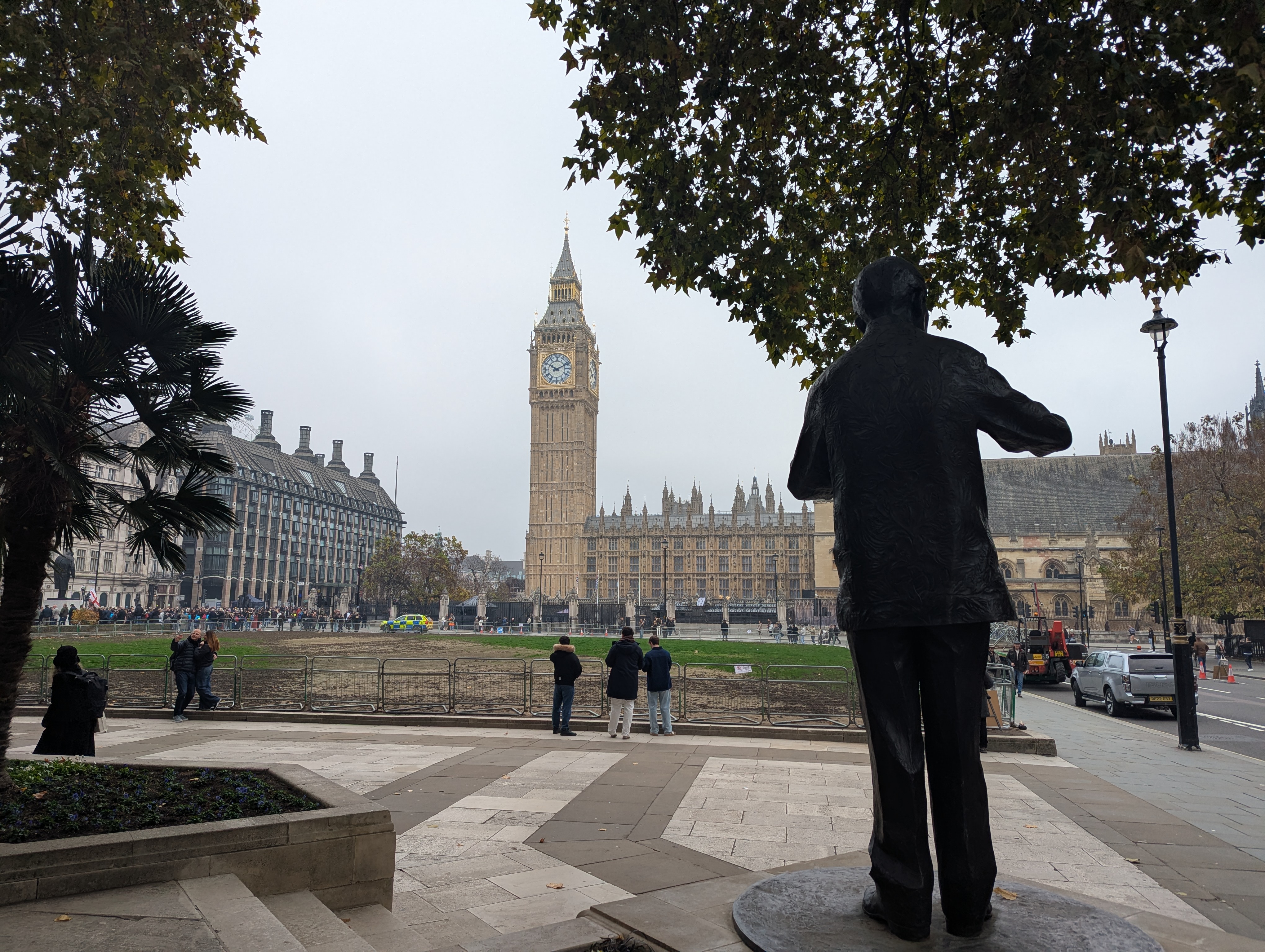
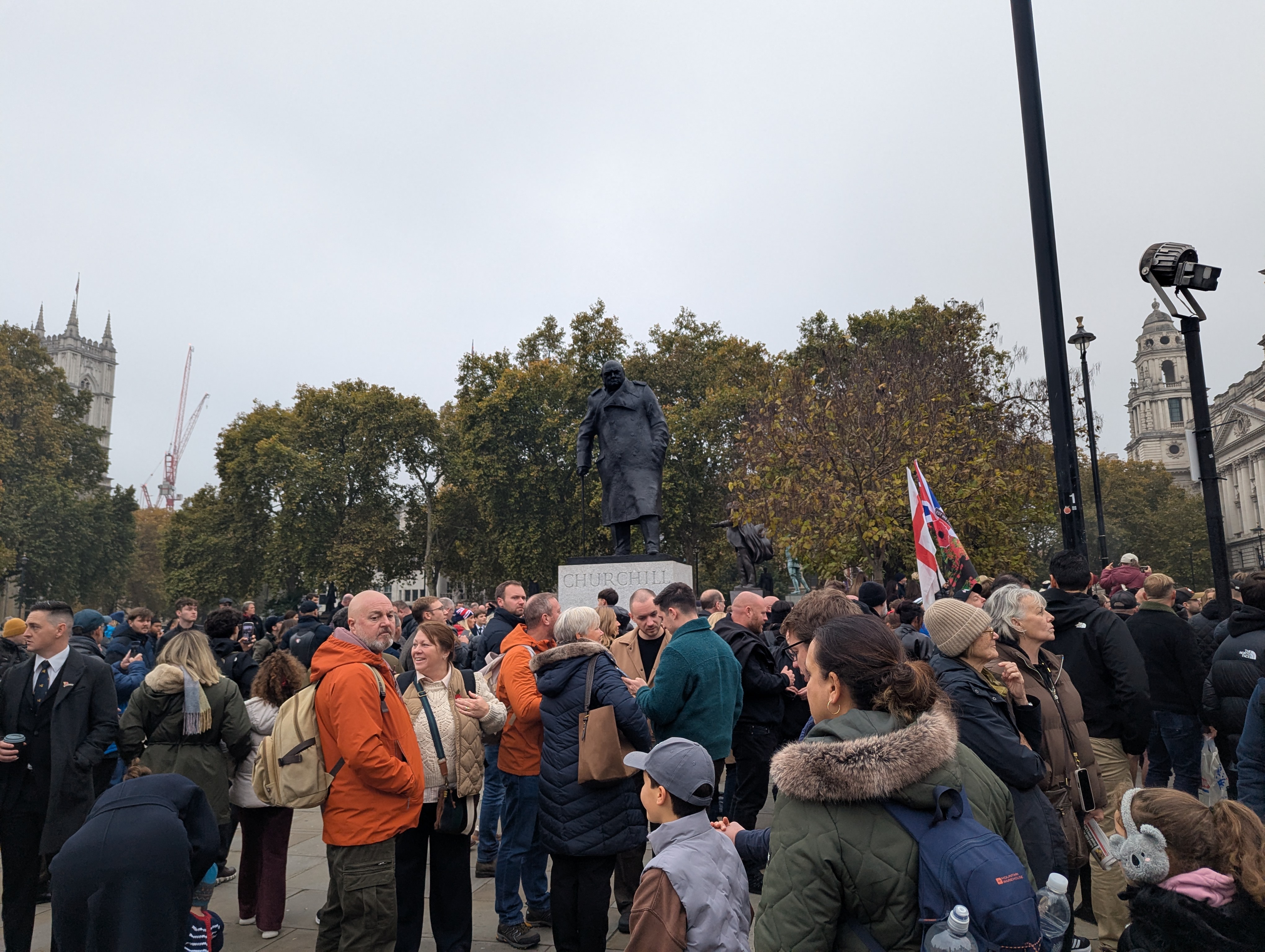
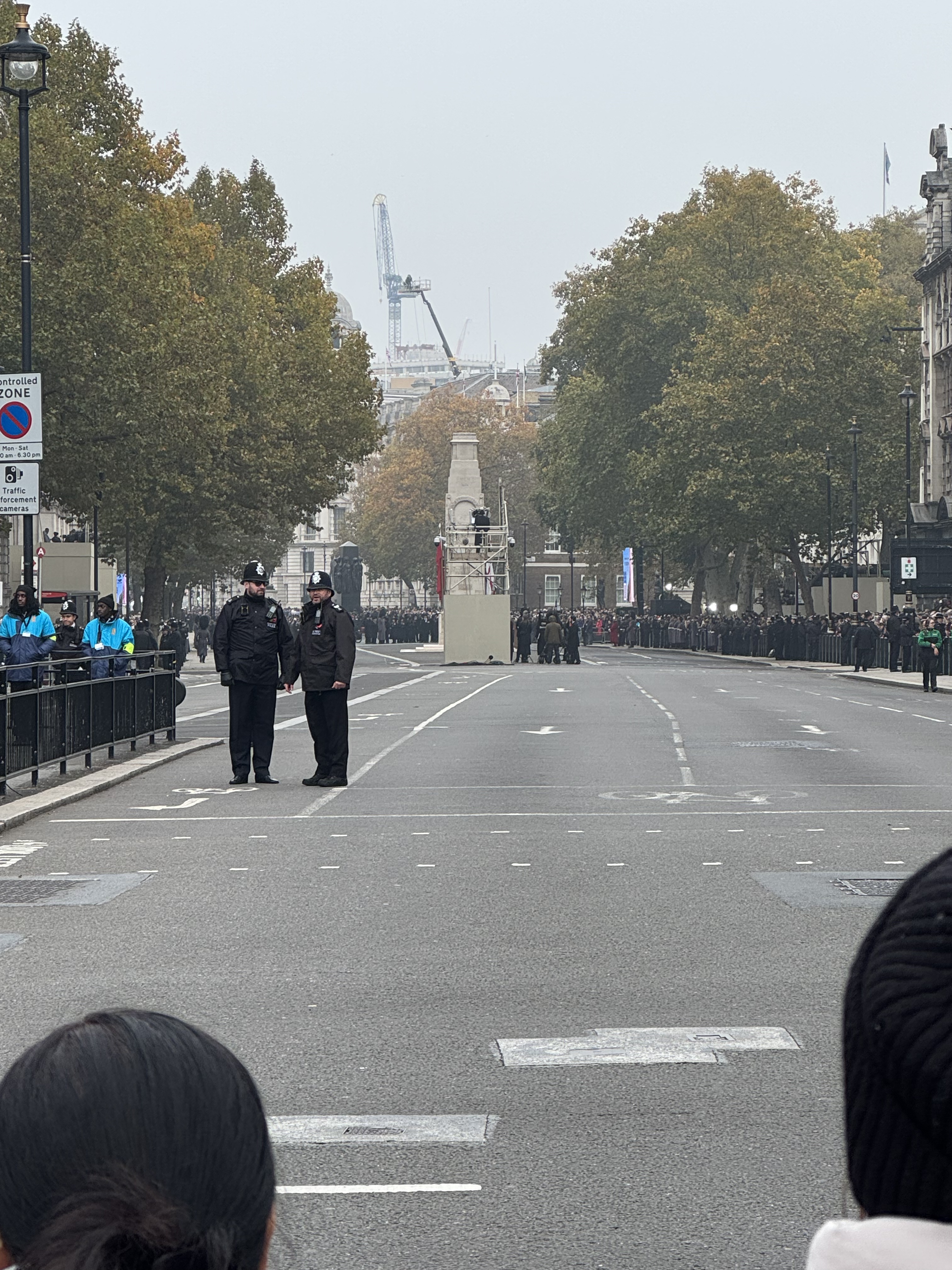
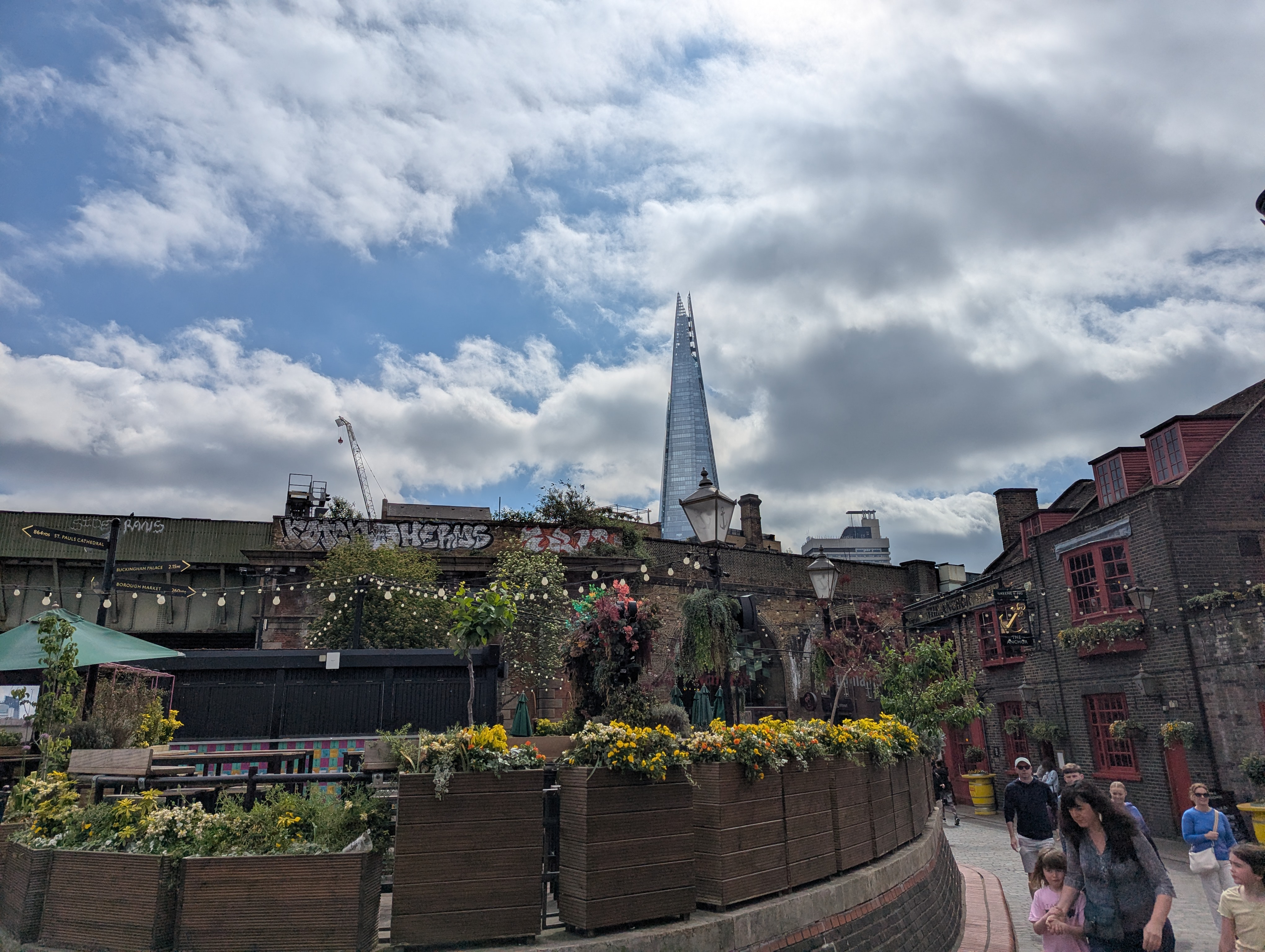
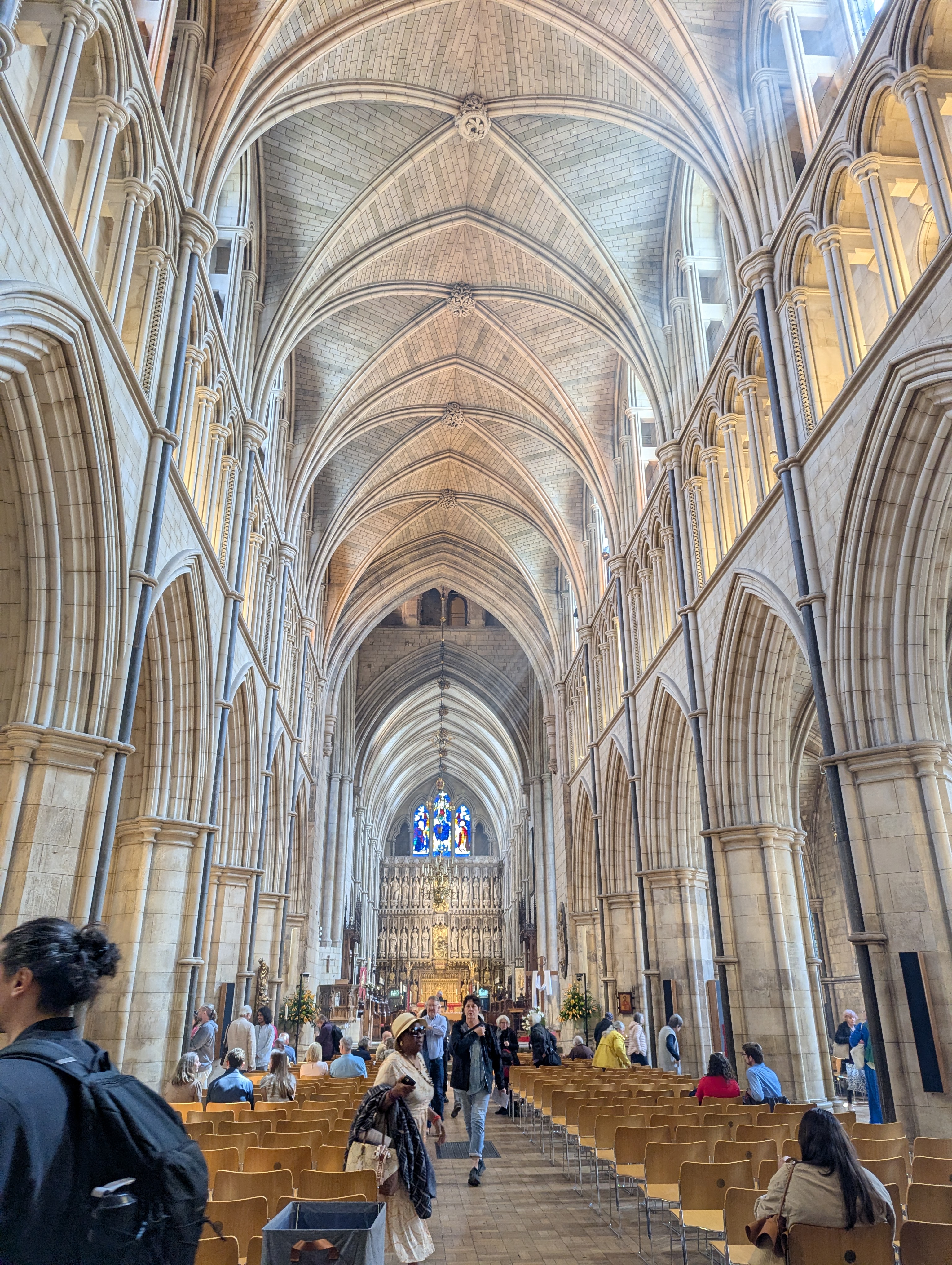
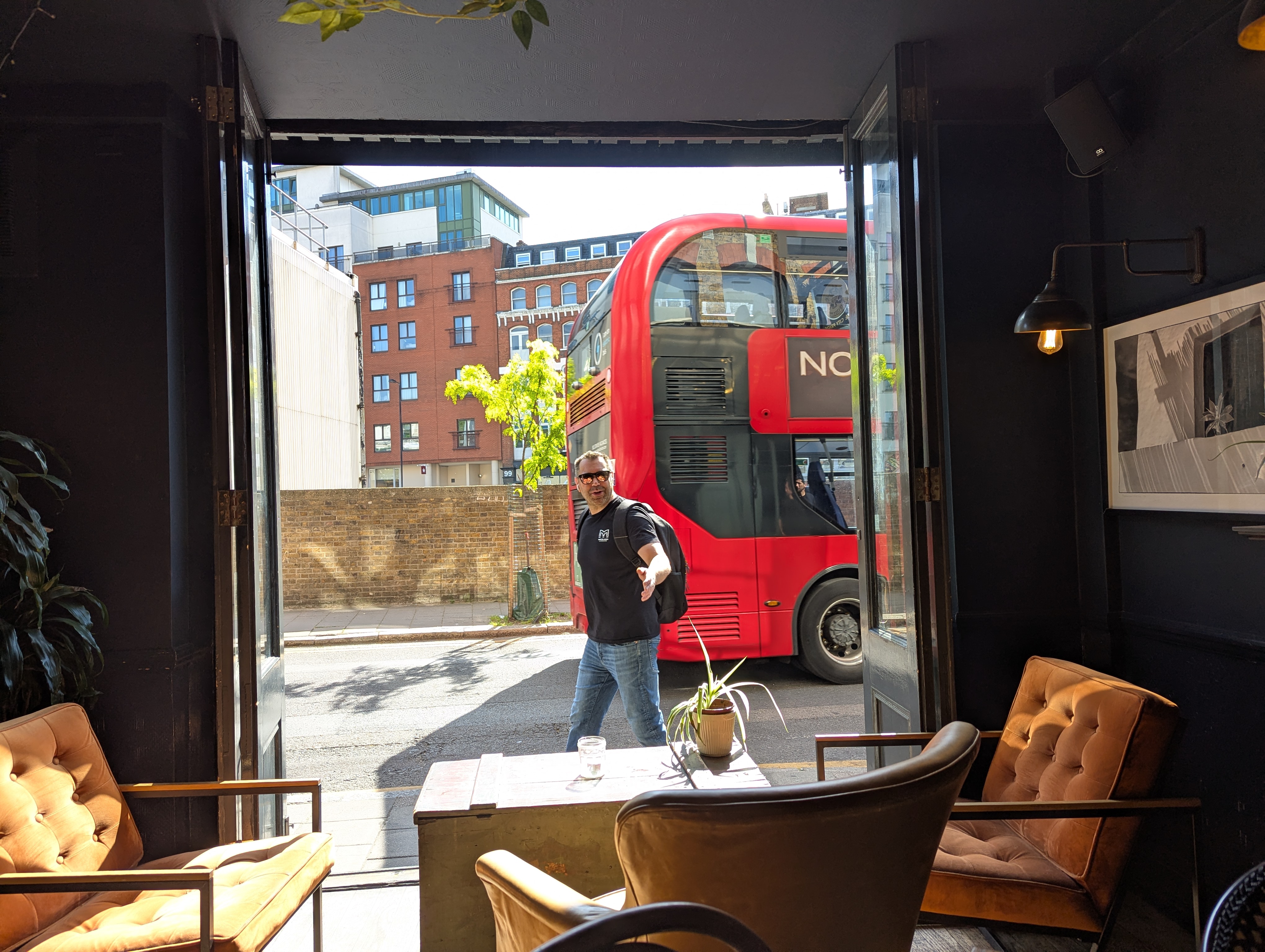
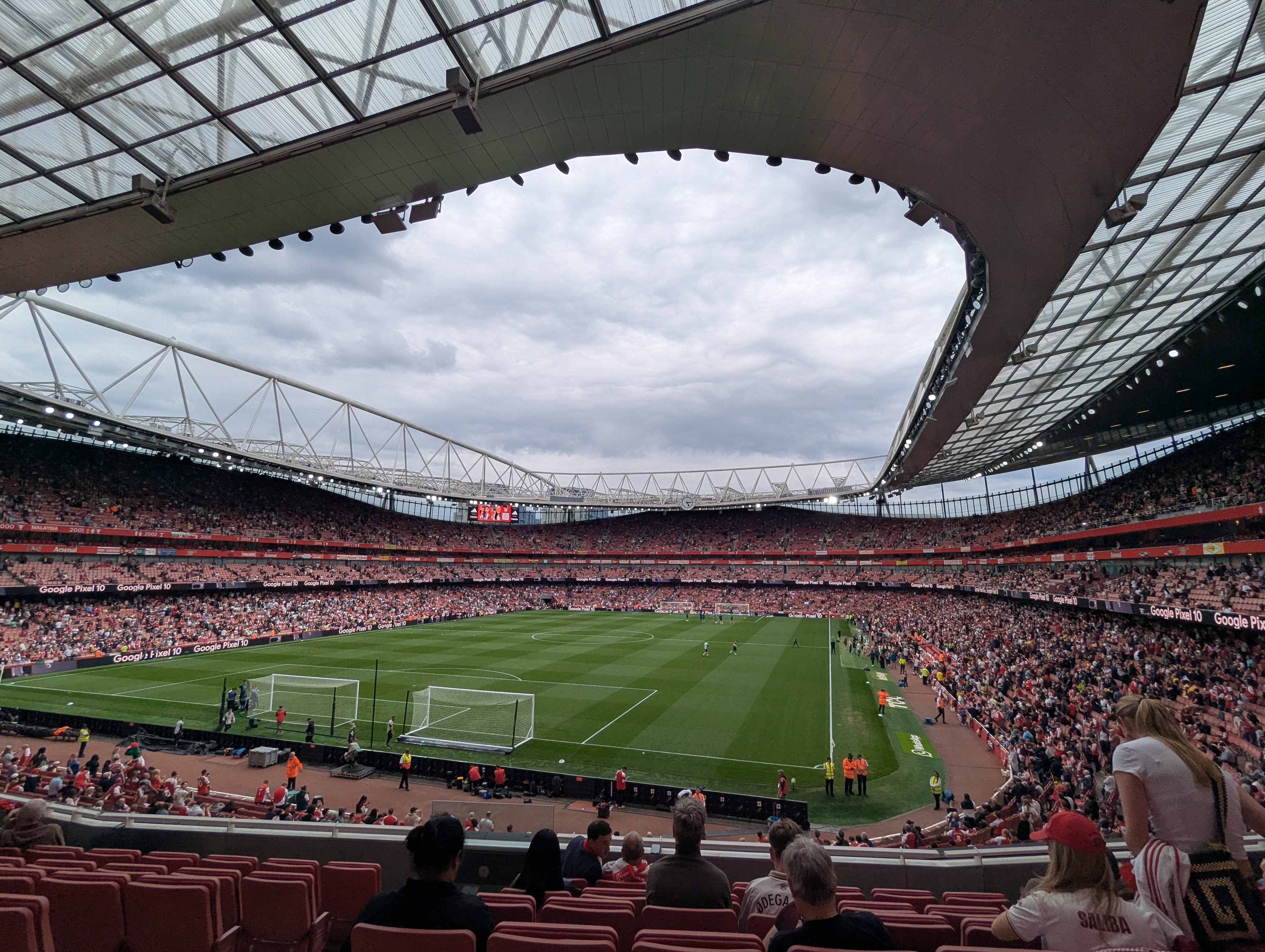
It was Remembrance Day in the UK on Sunday and we decided to get over to the Cenotaph, or as close to it as possible, to watch the wreath-laying ceremony in tribute to the war dead. As we approached the area near Westminster Abbey, Big Ben, and the Houses of Parliament many roads were blocked off to accommodate the thousands who came to watch the ceremony and the military bands marching along the street. We found a place to watch but there were at least 5 rows of people in front of us and the Cenotaph was quite far in the distance. I was able to view the parading bands, the arrival of the King, and the ceremony mostly through the camera of the very tall man in front of me. Not only was his camera very bright and clear, he was very professional about getting the right view, and proficient with zooming in and out as needed.
Unfortunately, at some point a short man barged in front of him. He, too, was holding up his phone to camera mode, which should have allowed me to view what was going on, but he just wasn’t as good. His camera was often not even pointing at anything interesting. And, because he was in front of the original guy, that guy stopped recording. Still, I had seen far more than I expected when we entered the crowd.
At one point of the ceremony there was a moment of silence. It was so very strange to be in such a large crowd of people–thousands–in the middle of a giant city and experience such silence.
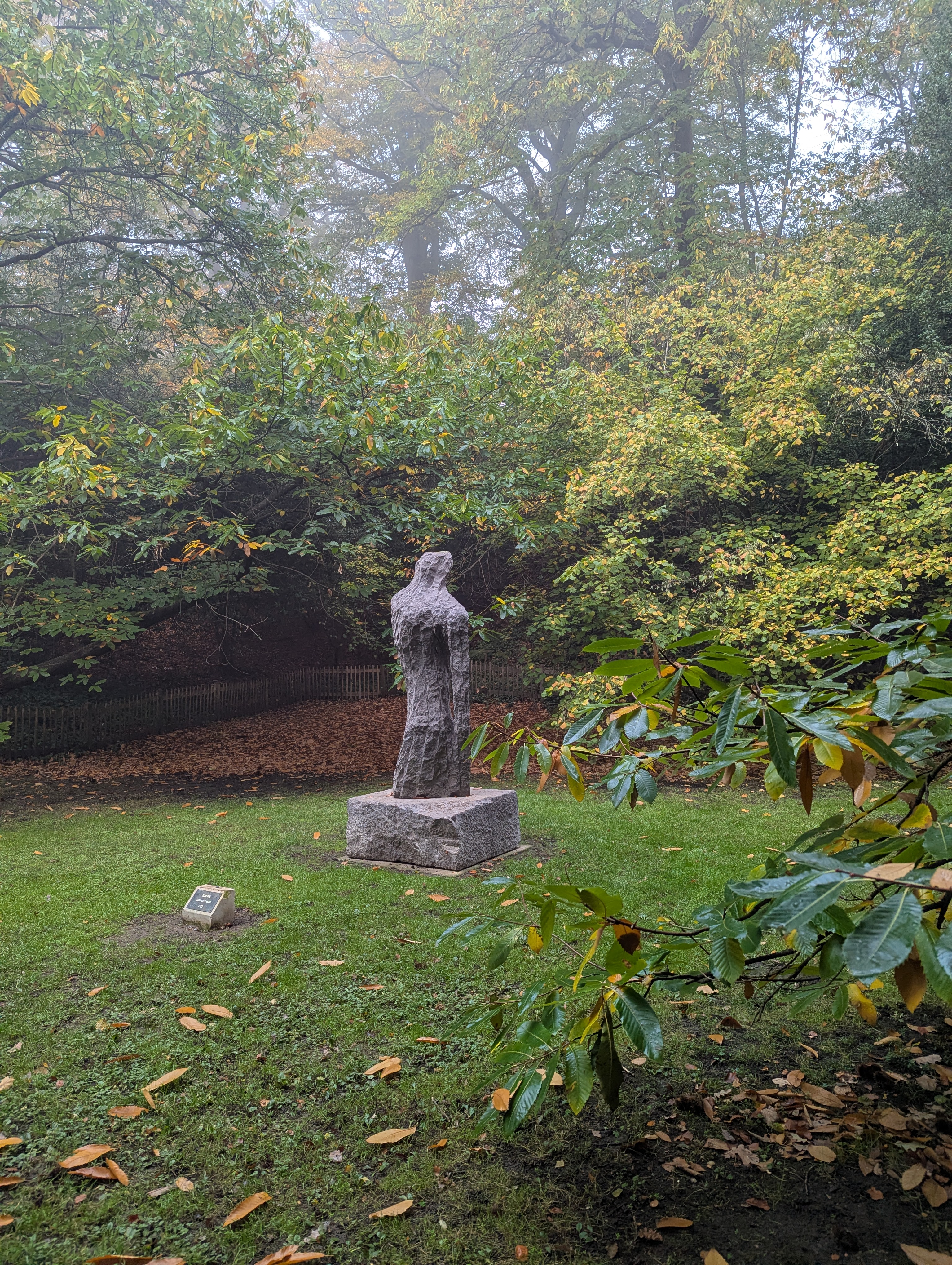
My pictures below took place near where we watched the ceremony. There was nothing I could photograph of the ceremony, unfortunately. (It would just be a guy holding a phone in front of me.) 🙂 I did add a photo my husband took of the Cenotaph from great distance.
“We gave our today” that I used as the title of this post is from an epitaph in the 2nd British Division Memorial at the WWII Battle of Kohima. “When you go home. tell them of us and say, for your tomorrow, we gave our today.”
I hope it is taken as no disrespect to members of the military who have made or offered a unique and complete sacrifice of life that has given all of us a future we would not have without it. But I note that some people who have not offered full sacrifice of their very lives have given their today in a way that impacts our tomorrow. It may not have been uniformly selfless nor was it always clear to them that what they did and gave might have an impact. Or even that it was “giving” at the time. But impact us they have. As we look at what they delivered we can distinguish the things that have been a force for good.
We had a few other experiences in London that reminded me of this.
The Tate Britain
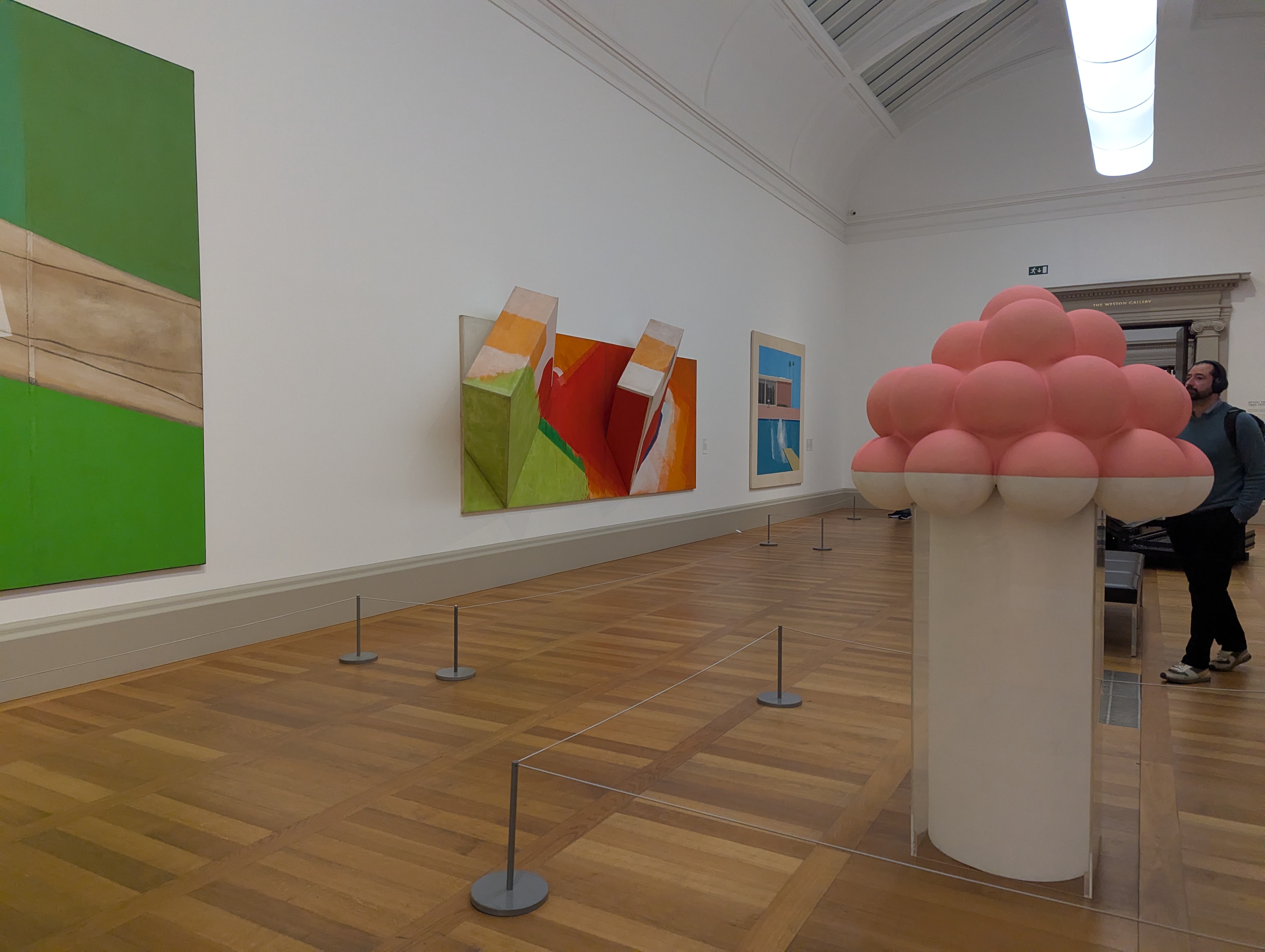
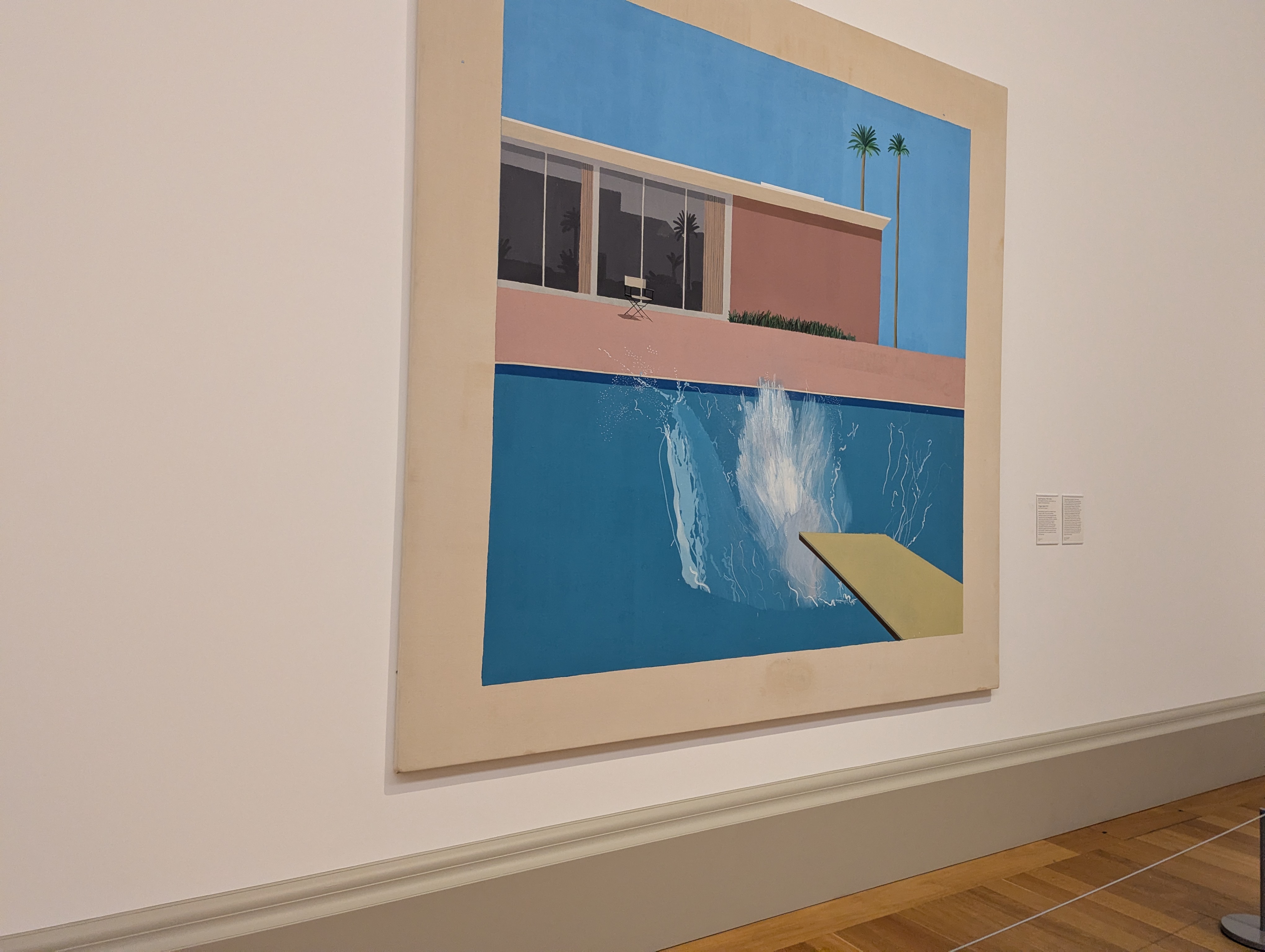
After we visited the Jugged Hare, we walked over to the Tate Britain, an art gallery my husband had visited long ago, but I never had. The Tate Britain focuses on British artists. There was a helpful poster explaining the “don’t miss” pieces in the museum. We saw some of them by happenstance and the David Hockney work, A Bigger Splash, by painstakingly tracking down the proper gallery. I feel like all galleries have the same system. The rooms are numbered and mapped but finding them is impossible. A picture of Hockney’s work is shown below.
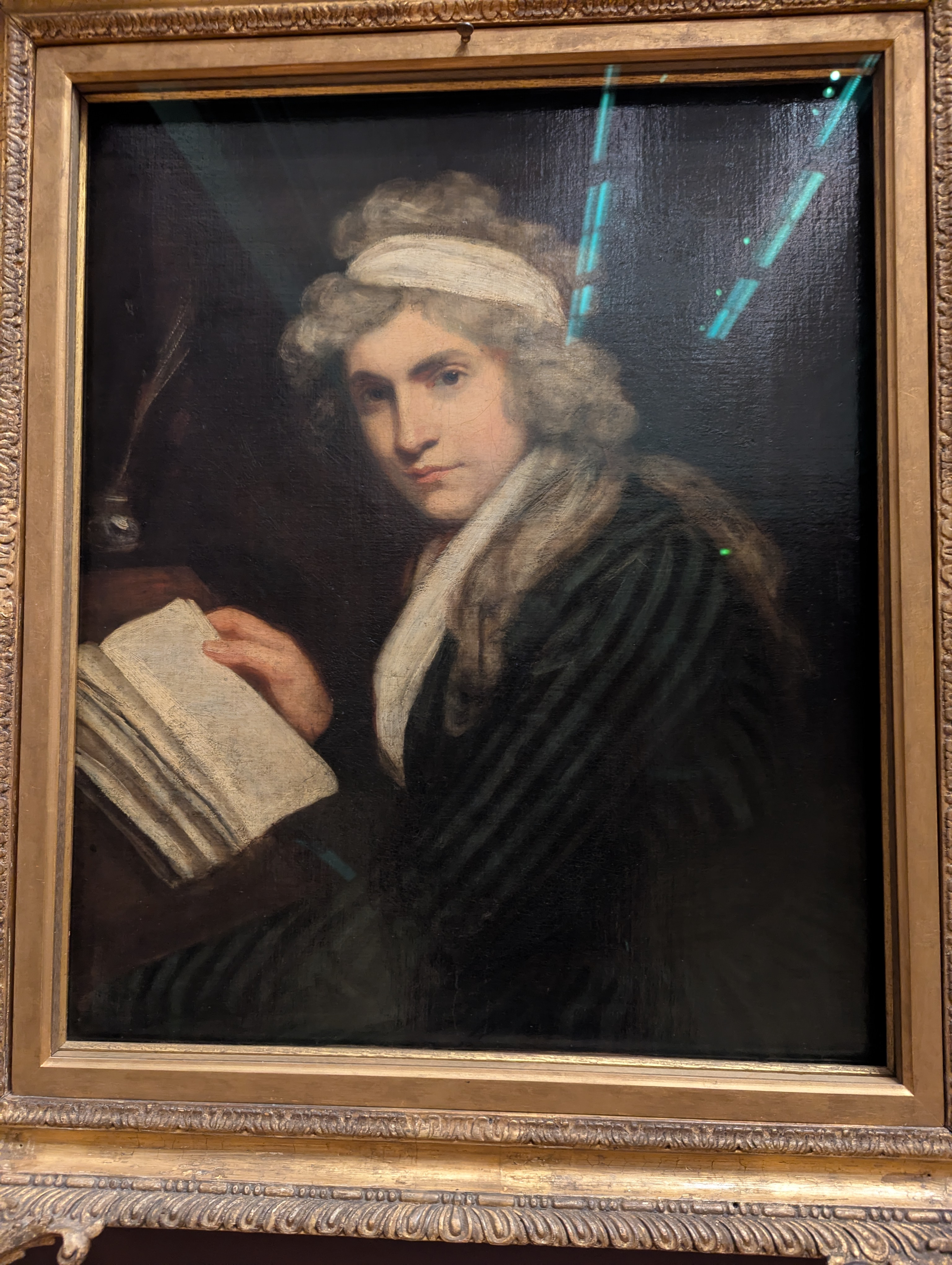
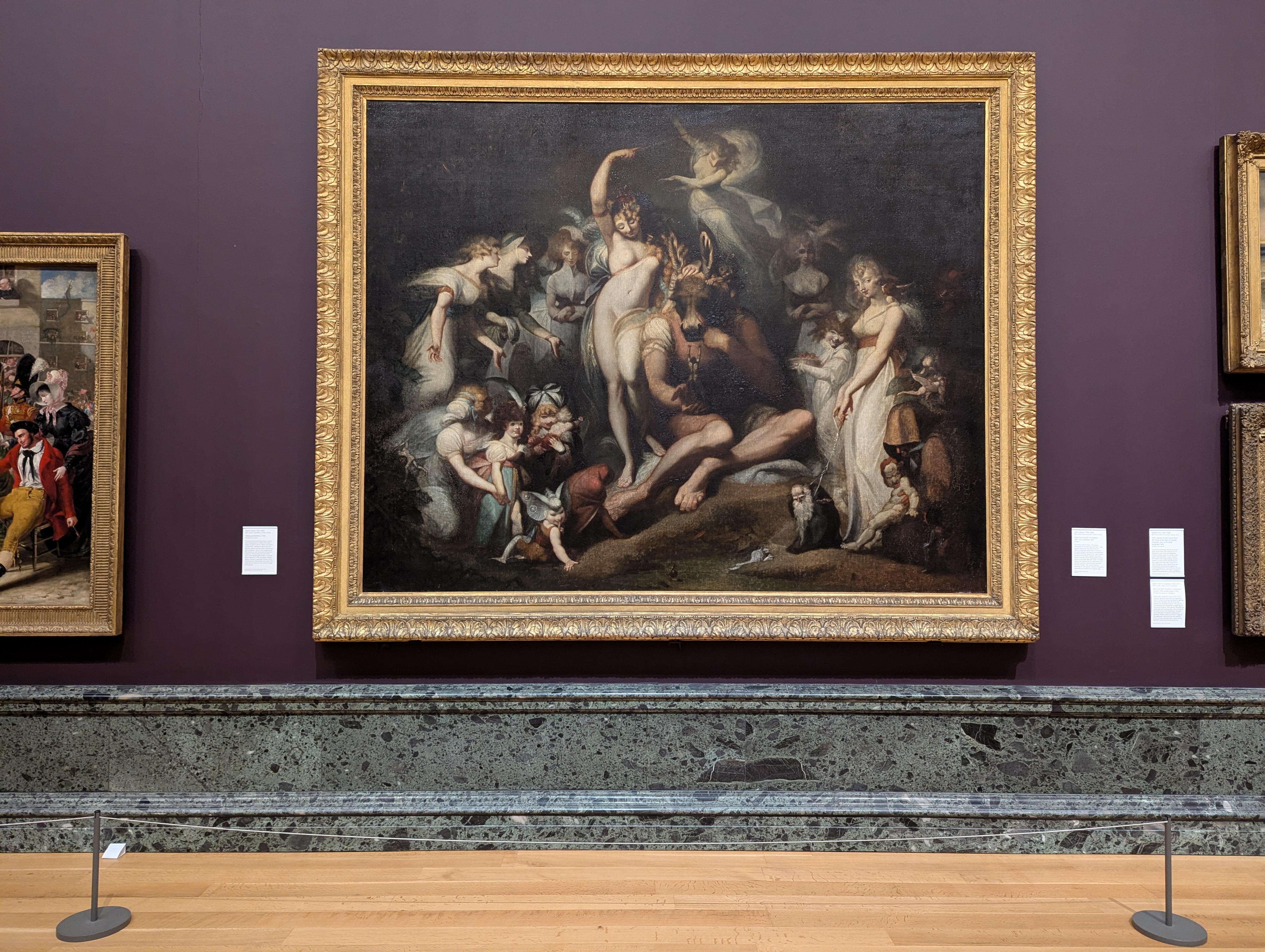
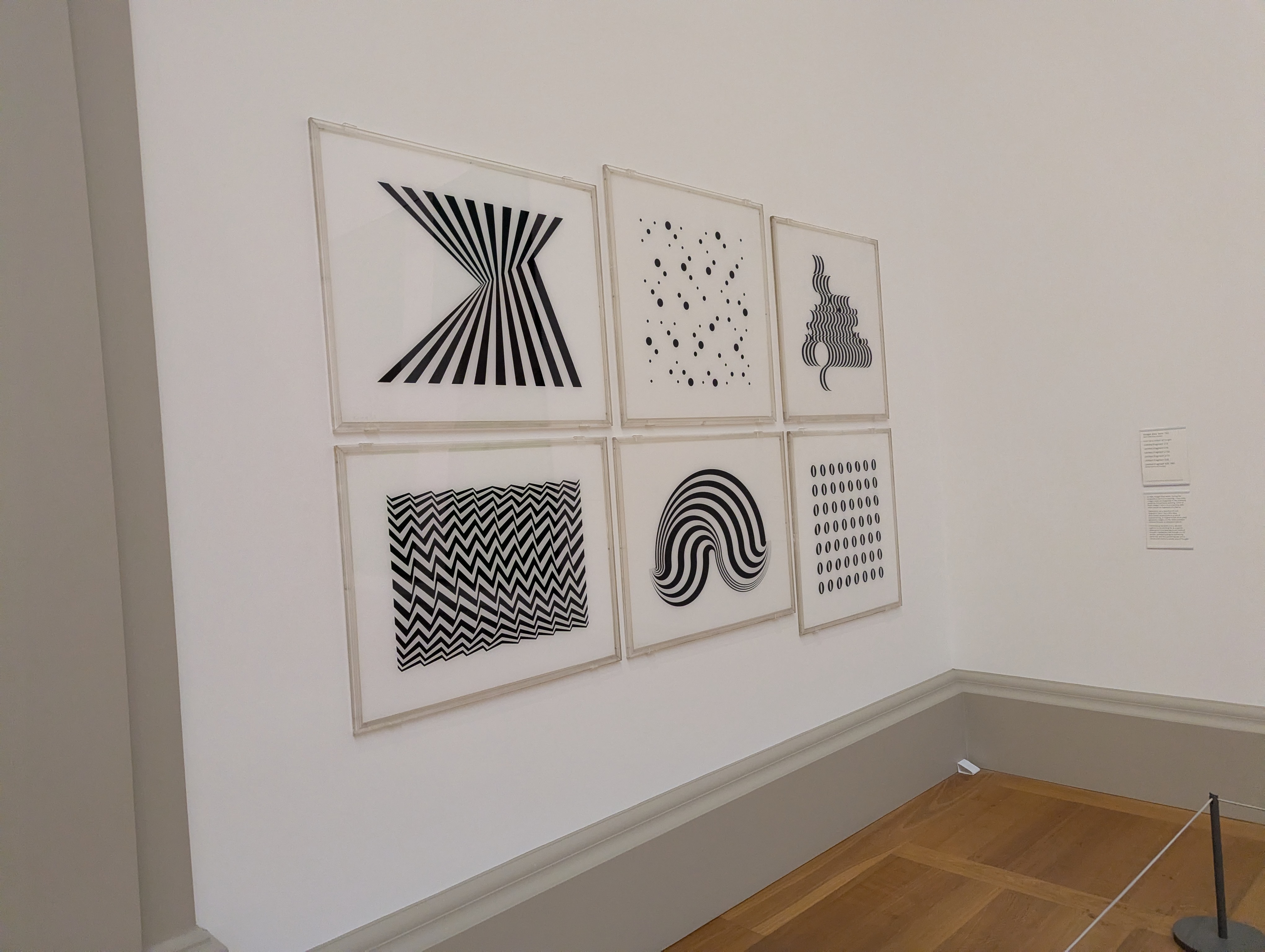
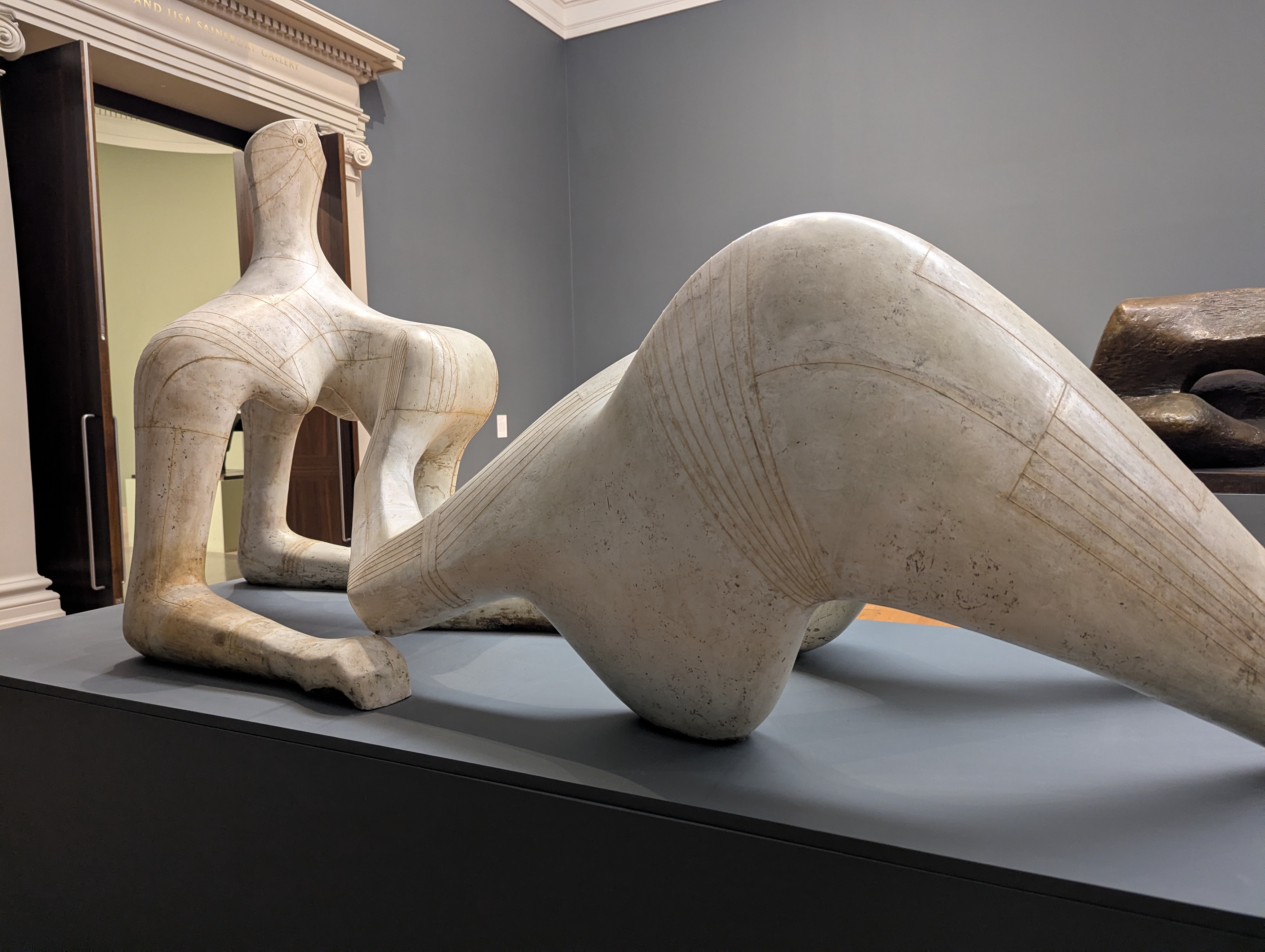
In my photos below, I see that I tended to focus on modern art during our visit, not really a perfect representation of what the Tate Britain offers.
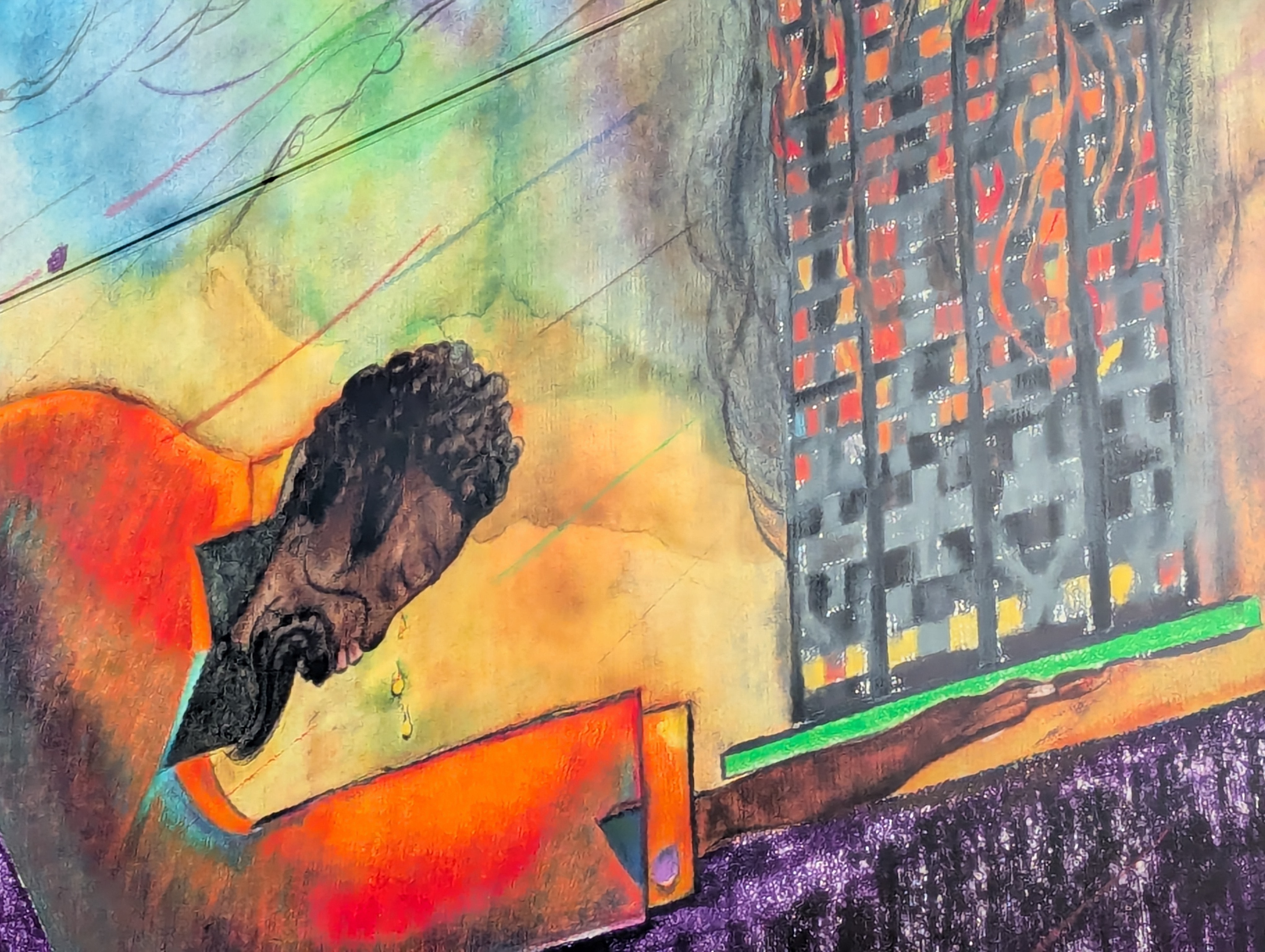
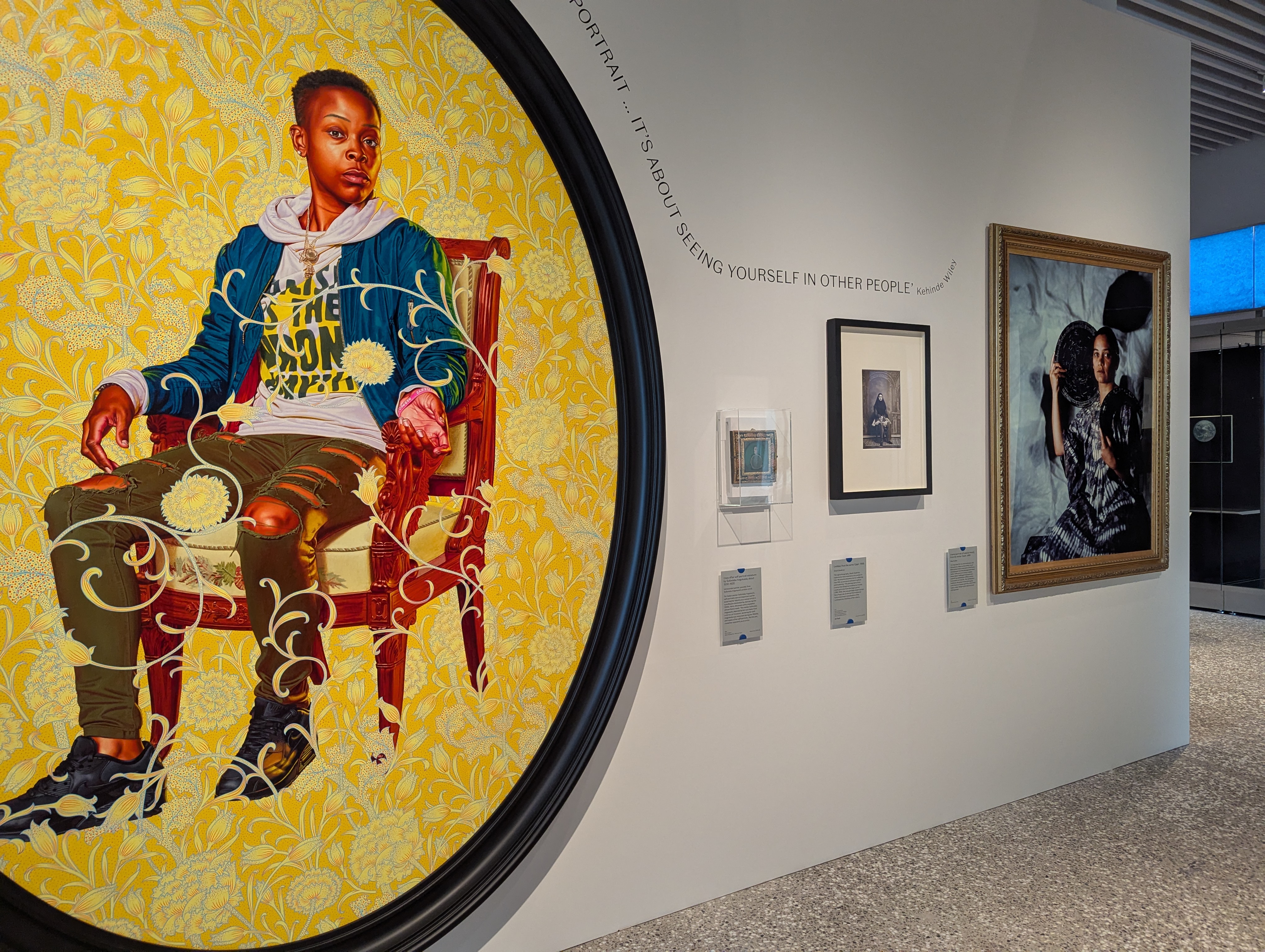
It’s finally starting to dawn on me that art isn’t just being able to execute techniques. The best art says something the artist feels we need to hear, see. My favorite display was in the stairwell close to where we entered the museum, a depiction by Chris Ofili called Requiem that offered tribute to another artist, Khadija Saye, who died in the Grenfell Tower fire in 2017. Painted on all walls of the stairwell, it not only honors Saye, an artist Ofili met only briefly, shortly before she died, it reminds us that we are witnesses. Witnesses of all that led to the tragedy, a perfect storm of greed, hubris, incompetence, complacency. Witnesses, too, of unspeakable human loss. Saye, of course, and many others whose gifts we may never know. As witnesses, we cannot look away from what happened here. One wall evokes redemption, peace, transformation we seek as we collectively process this tragedy. I posted a photo of only part of the exhibit below.
Kenwood House
Our first appointment on Saturday before the match was at Kenwood House. It didn’t open until 10 a.m. but we arrived a bit early and walked the grounds. It was a very foggy morning and hard to get good pictures of the house exterior. The house is situated on a large property at the edge of Hampstead Heath. In the fog it was hard to tell where the property ended and the heath began. We found ourself on a path on the heath and every so often a dog being walked on the heath would come bounding toward us. There were a lot of dogs out enjoying themselves.
Kenwood house, as it is now called, was built in the 1600s by a guy named John Bill who was, ahem, the king’s “printer.” Basically the publisher for the Crown’s documents, news and religious texts (like the King James Bible) at a time when publishing was probably pretty effort-intensive. The home was owned and modified by several different families. The last private owner was Edward Guinness. Yes, that Guinness. He bought it in 1925 to house his art collection. He set up his estate to donate the property and all of his art to the British public. That happened very soon after he bought the house, only two years later. It’s now operated by the English Heritage trust.
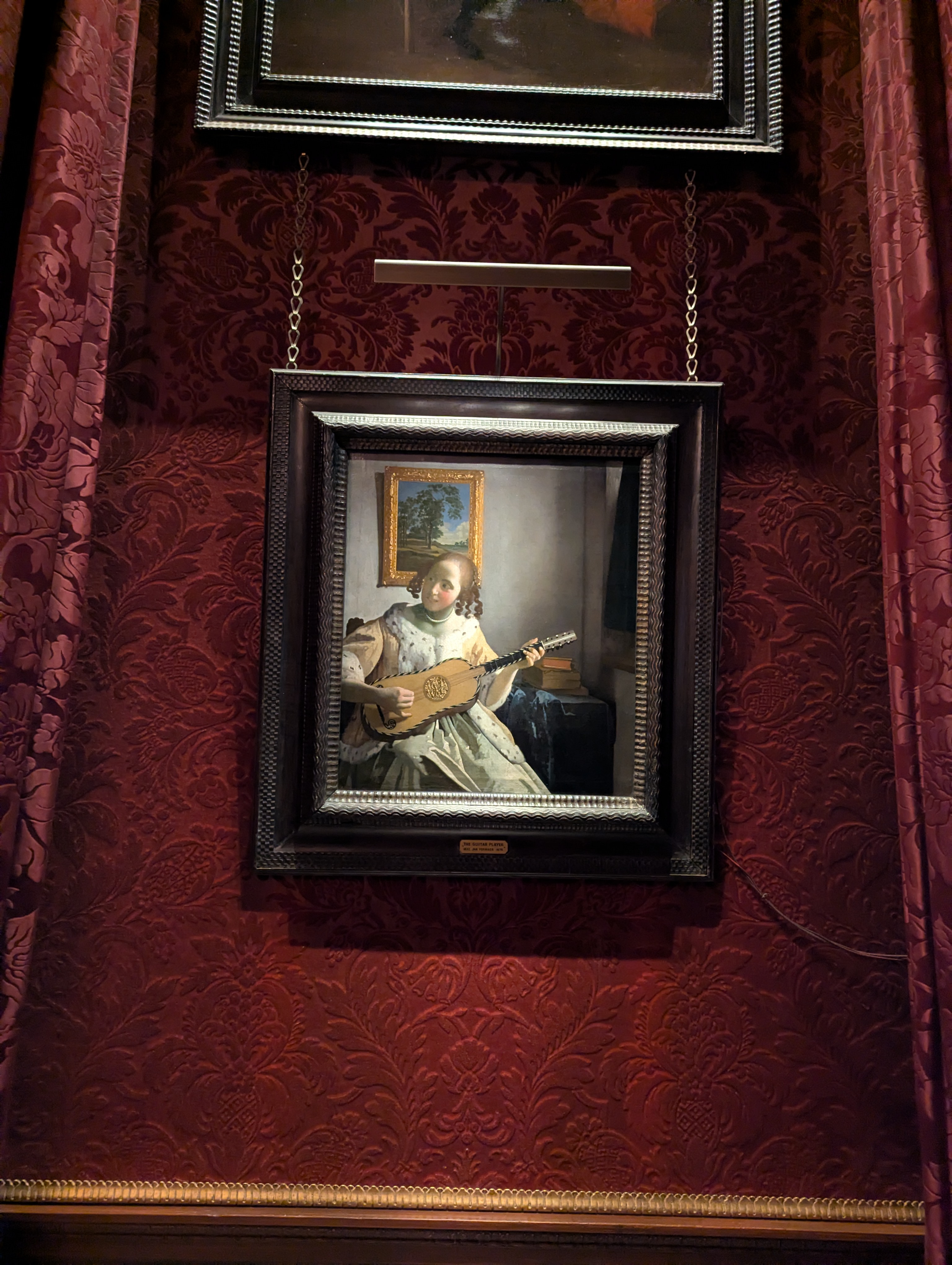
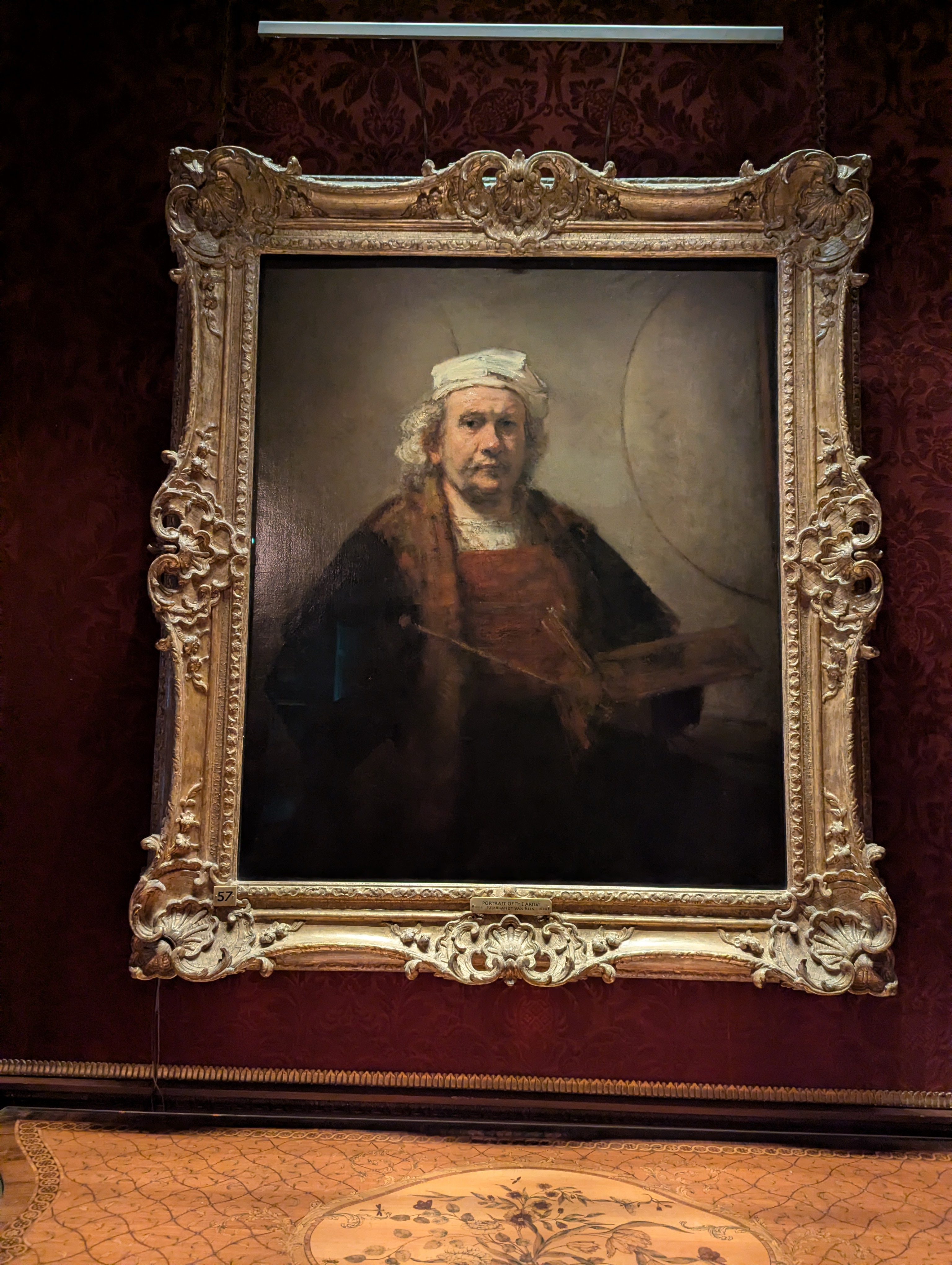
We were greeted at the door by a guide who told us all about the house and then were invited to wander about. Many of the rooms had a guide who could tell us about the work in the room. This was useful because we needed to keep our visit brief and they were great about providing information and artistic interpretations. The most famous piece displayed is a Rembrandt self-portrait.
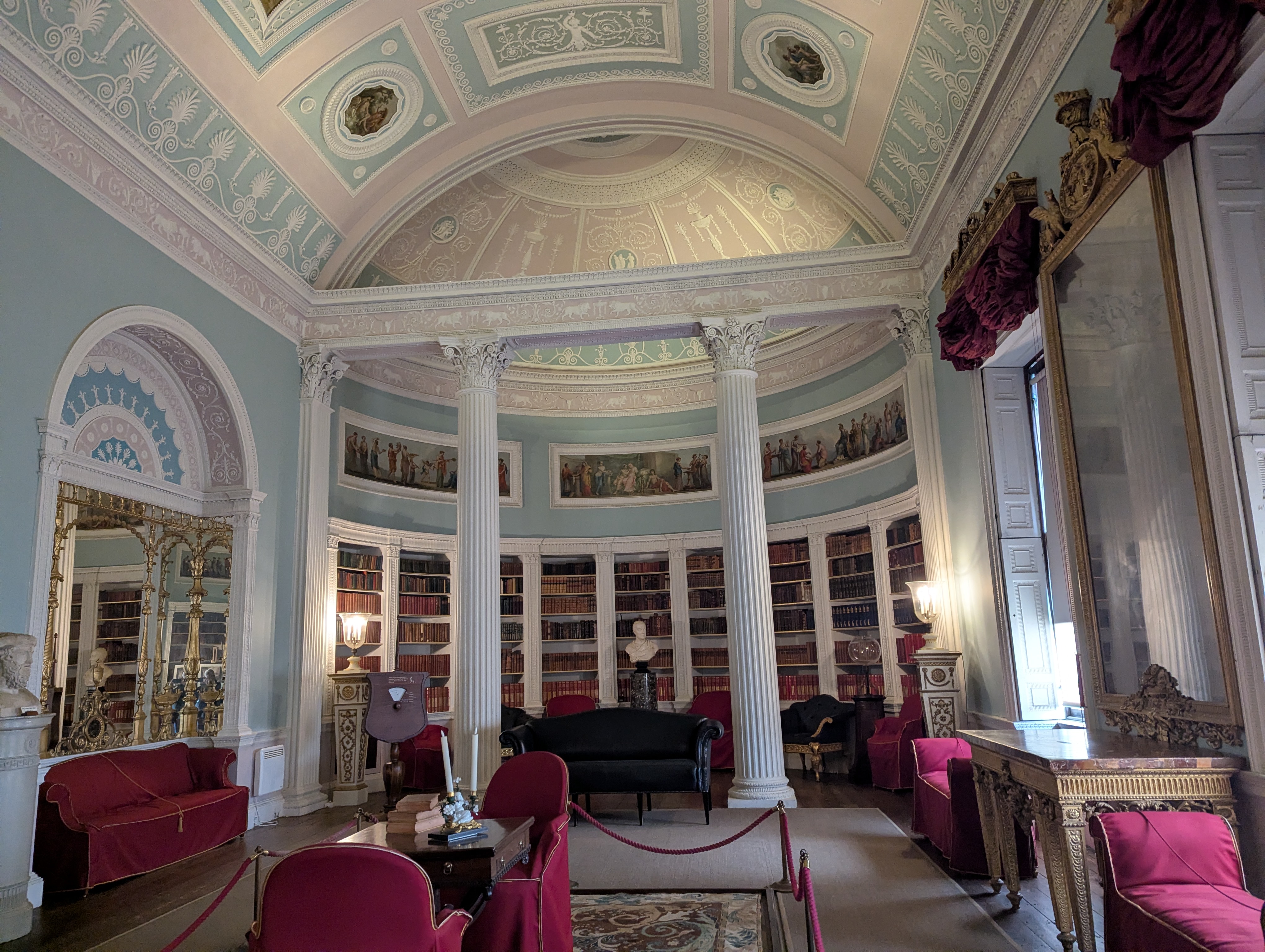
Although Guinness didn’t much use the house as a home to live in, the guides also pointed out how the house would have been used by families before him, for example, where an orchestra might have been located near the formal dining room. There was a cool, old piano, pipe organ, and harp in the music room among the art. And the library, which I have a picture of below, was very, very cool.
We’ve visited a number of homes and/or museums in England that are in place because a wealthy person had a collection of art or ancient artifacts that they ultimately left to the public. I love being able to visit them and see the collections and/or the way they lived. They provide a picture that I would not otherwise be able to see and experience and that I think is a force for enriching my life. I’m honestly not sure how I feel about them from a moral point of view. I’m a bit uncomfortable in the idea of so much excess wealth that you can engage in an activity that has profoundly little value to anyone else while you are alive. And is given when you can no longer use it. But would these things exist for us to enjoy without the initial imbalance of wealth? I have to give some credit to the rich guy.
Highgate Cemetery
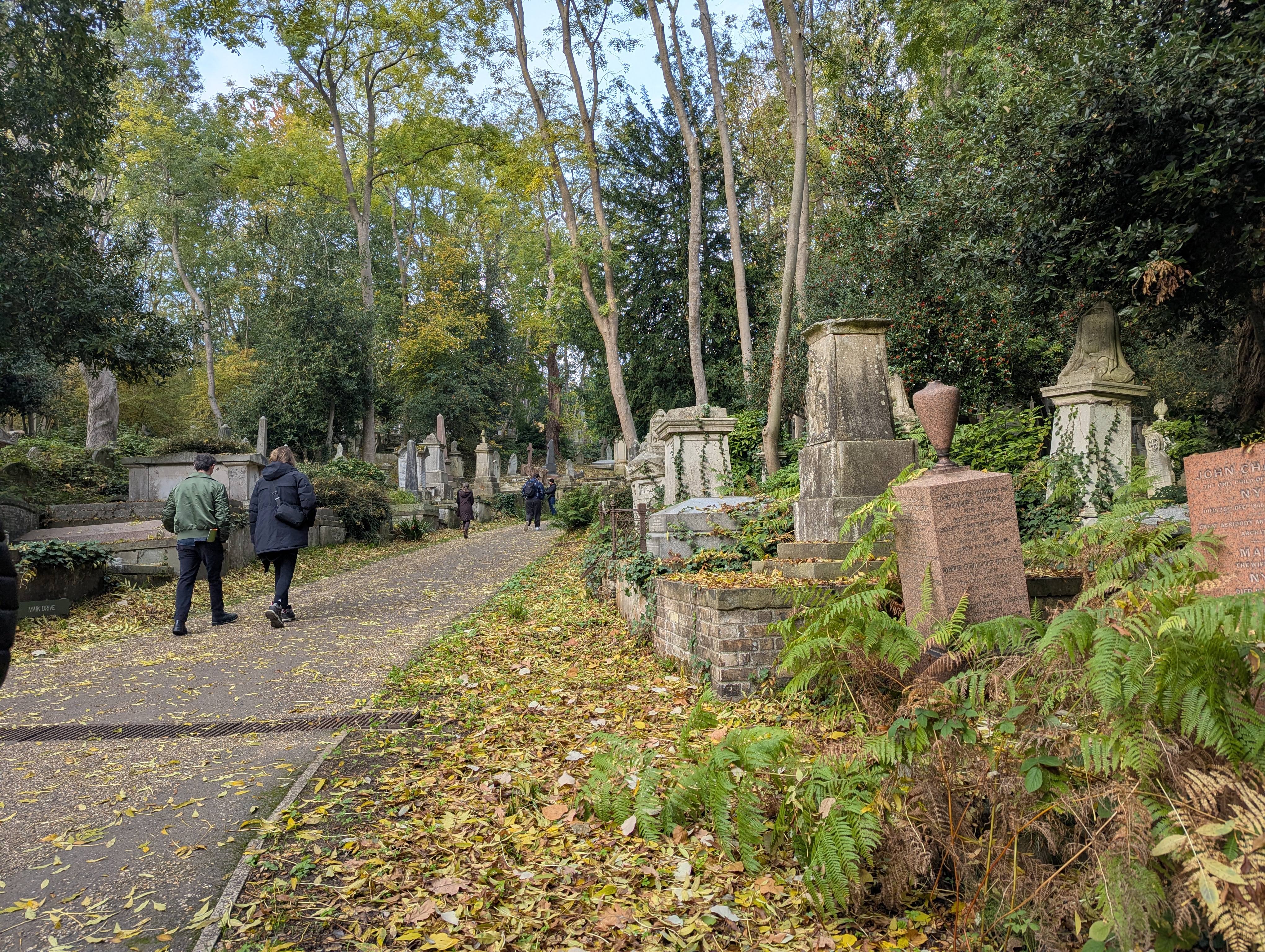
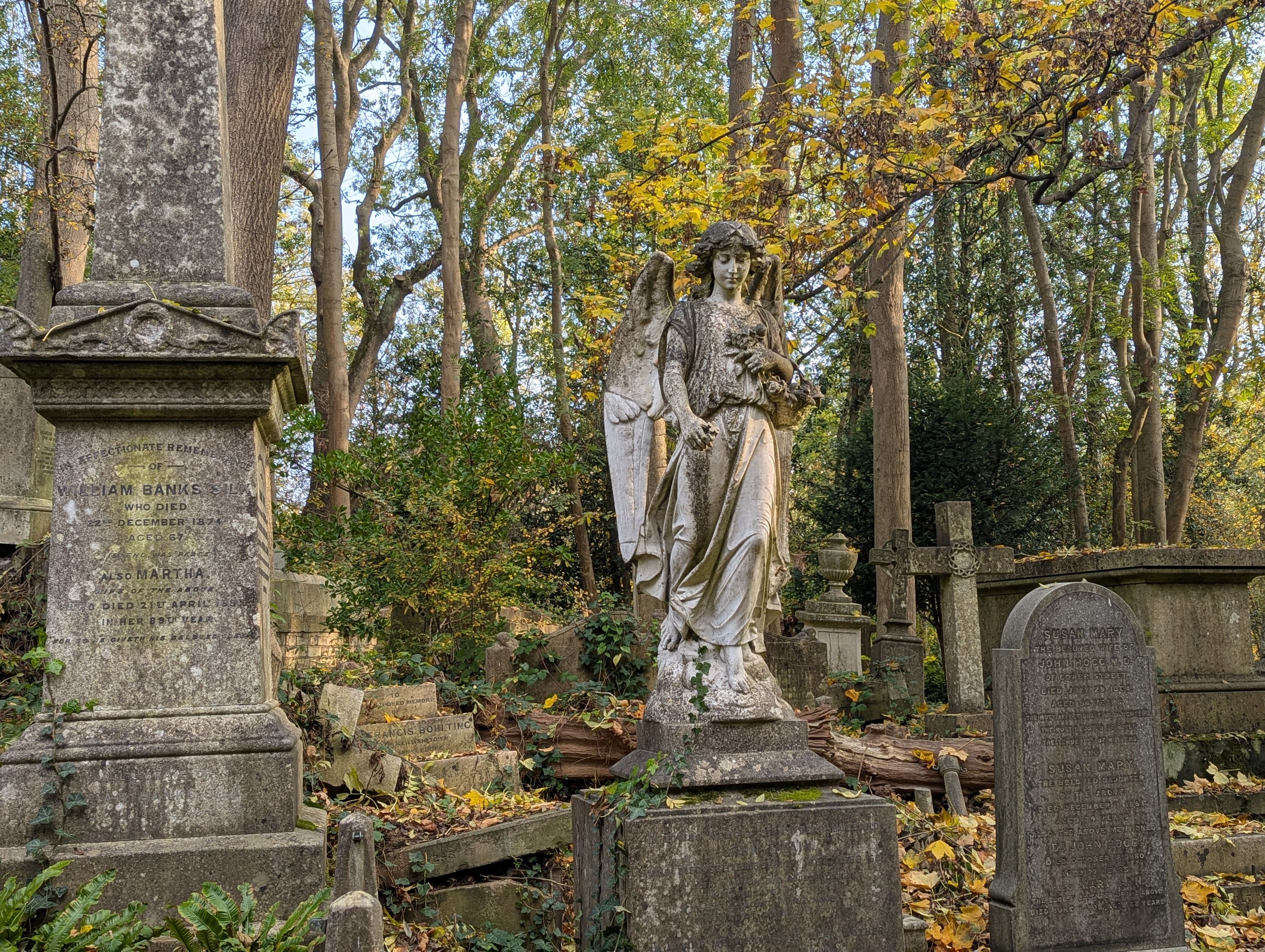
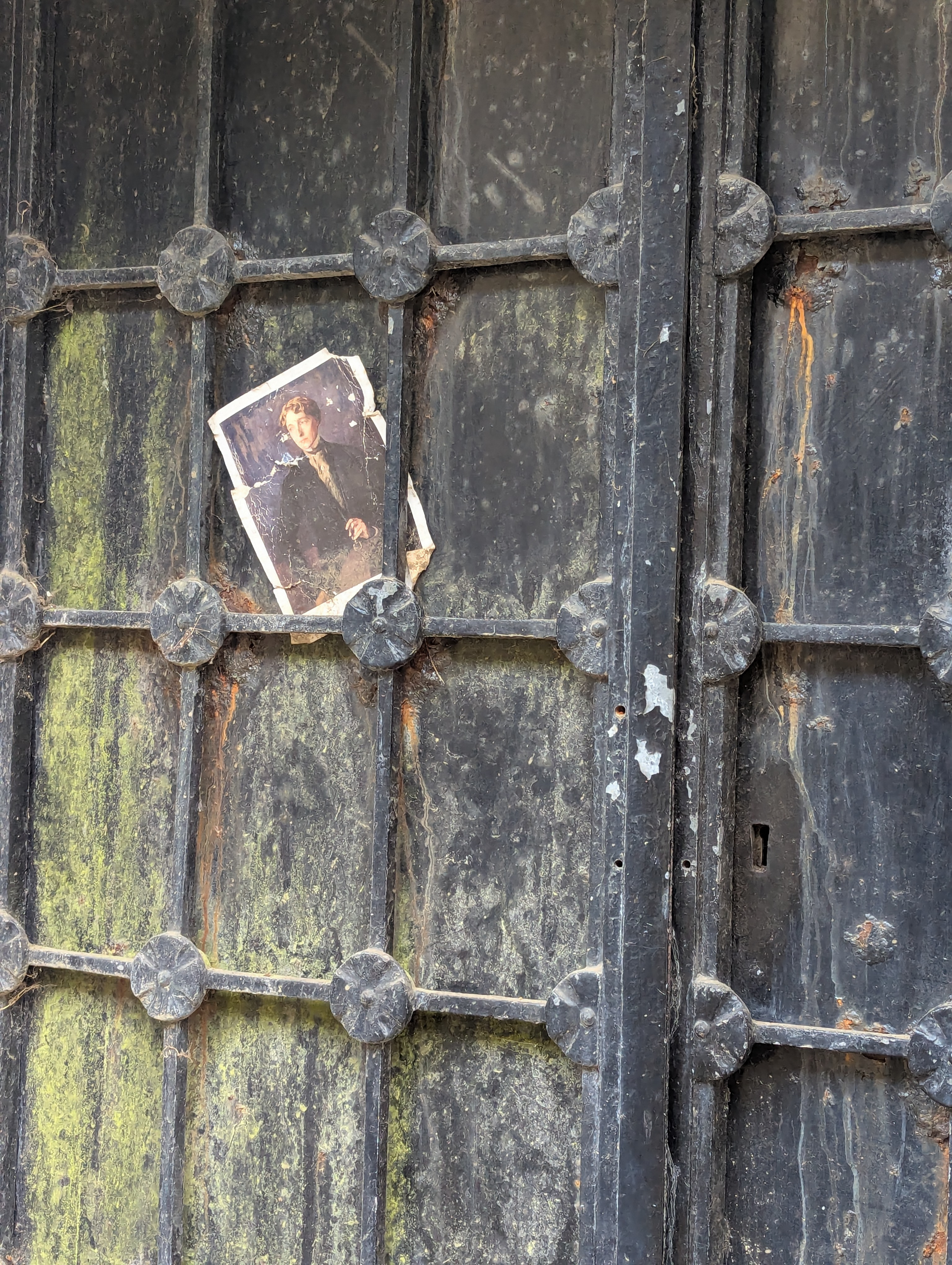
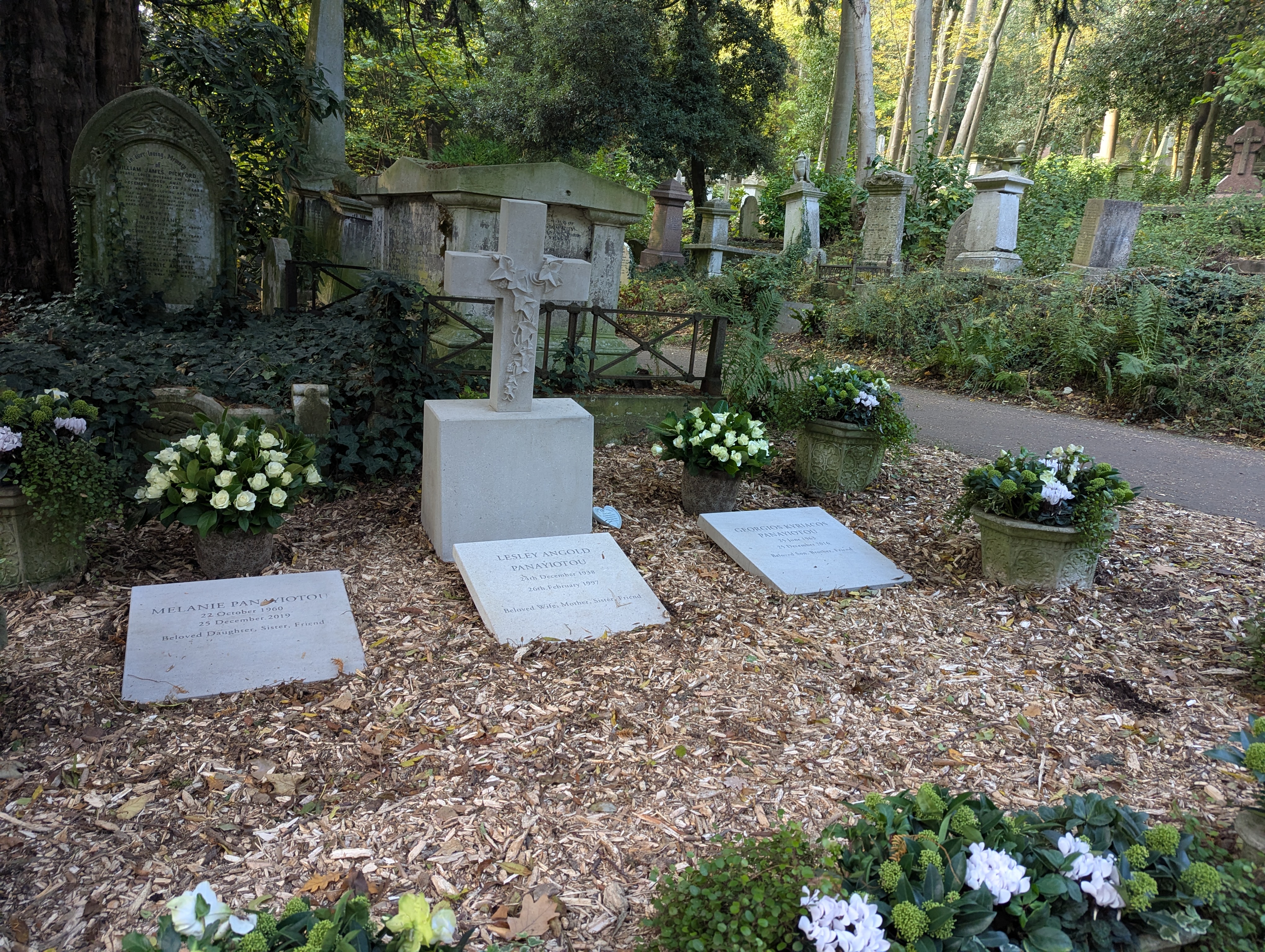
Visiting a cemetery is literally morbid, but it can also be quite interesting. In how we treated our dead, we learn lot about how we lived, what we believed. And a cemetery is almost always a peaceful place. You can visit the famous Victorian Highgate Cemetery using a day pass and it’s also possible to take a tour. We decided on the 90-minute “Highlights” tour. The tour is through the “west” cemetery which does not include one of the most arguably well-known inhabitants of the cemetery, Karl Marx. Unfortunately, we didn’t have enough time to find his grave in the East cemetery. Another day. I have it on good authority he’ll be there for a while.
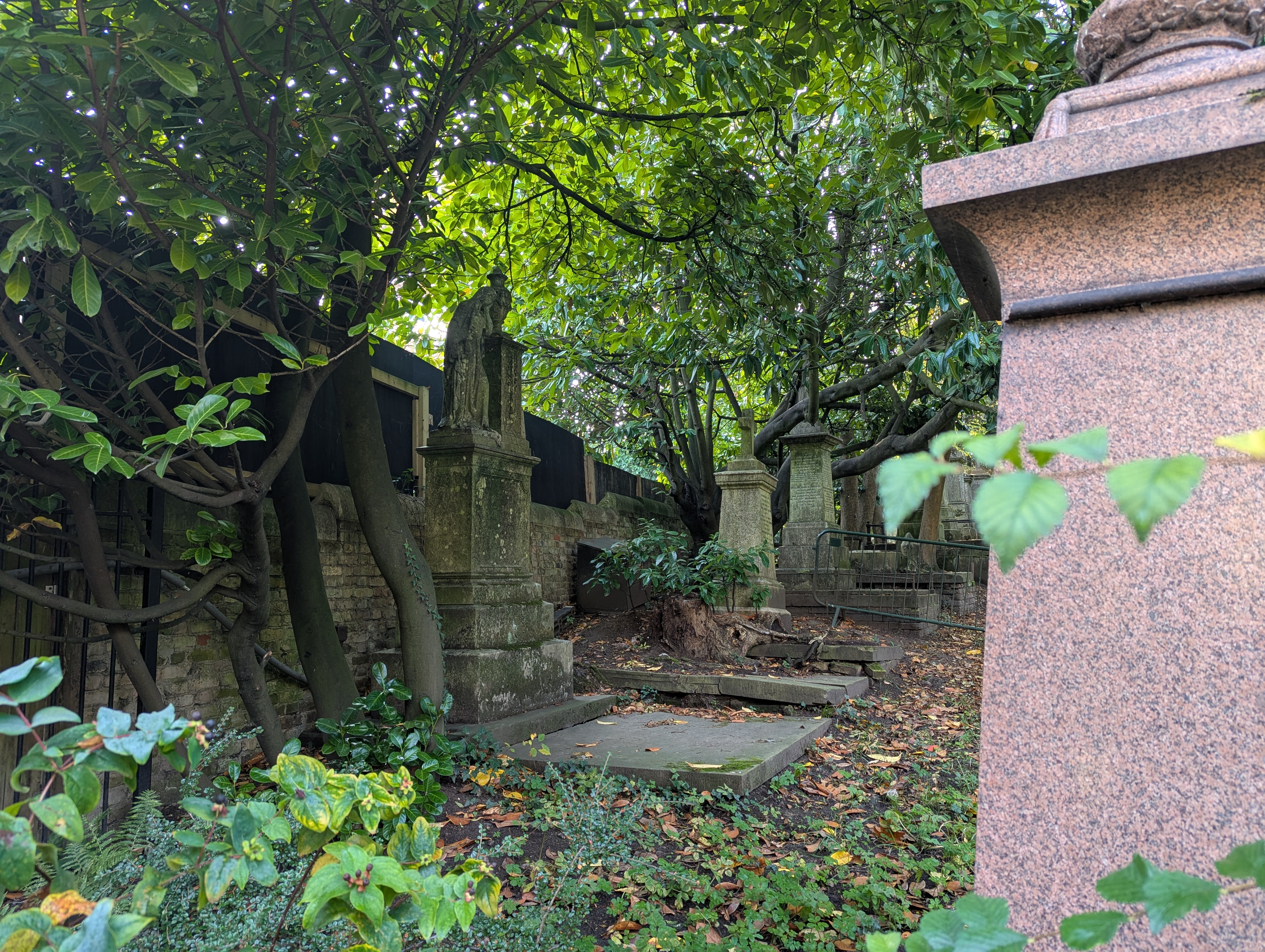
The tour gave a flavor for burial practices in the Victorian era, some of which were intended to foil grave robbing which was a thing at the time. Our guide took us through grave sites with stories he found interesting, for example, the grave of James Selby, a famous stagecoach driver. Let’s first marvel that one could become famous as a stagecoach driver. Apparently, in 1888, Selby was involved in a bet worth £1,000 to himself that he could drive a horse-drawn carriage to Brighton and back in under 8 hours. He succeeded with a margin of 10 minutes in his favor, using multiple teams of horses that were changed out with the near-efficiency of a NASCAR pitstop. Unfortunately, he died within months of receiving the prize. It appears that some of the winnings were used for his grave marker, which is decorated with imagery of upside-down horseshoes, symbolic of luck running dry, and a whip.
We also saw the mausoleum where supposedly Bram Stoker, the author of Dracula, was walking past and heard voices coming from a large family vault. The story goes that he peeked inside and saw the living family having tea among the dead. This appears to be nothing more than a fun story. Bram Stoker did have some history of being in the area near Highgate and maybe was inspired by Highgate in some way, and it is true that families of the Victorian dead would visit the cemetery and picnic, but the actual details of the tea story? Perhaps a “truth” story rather than a true story.
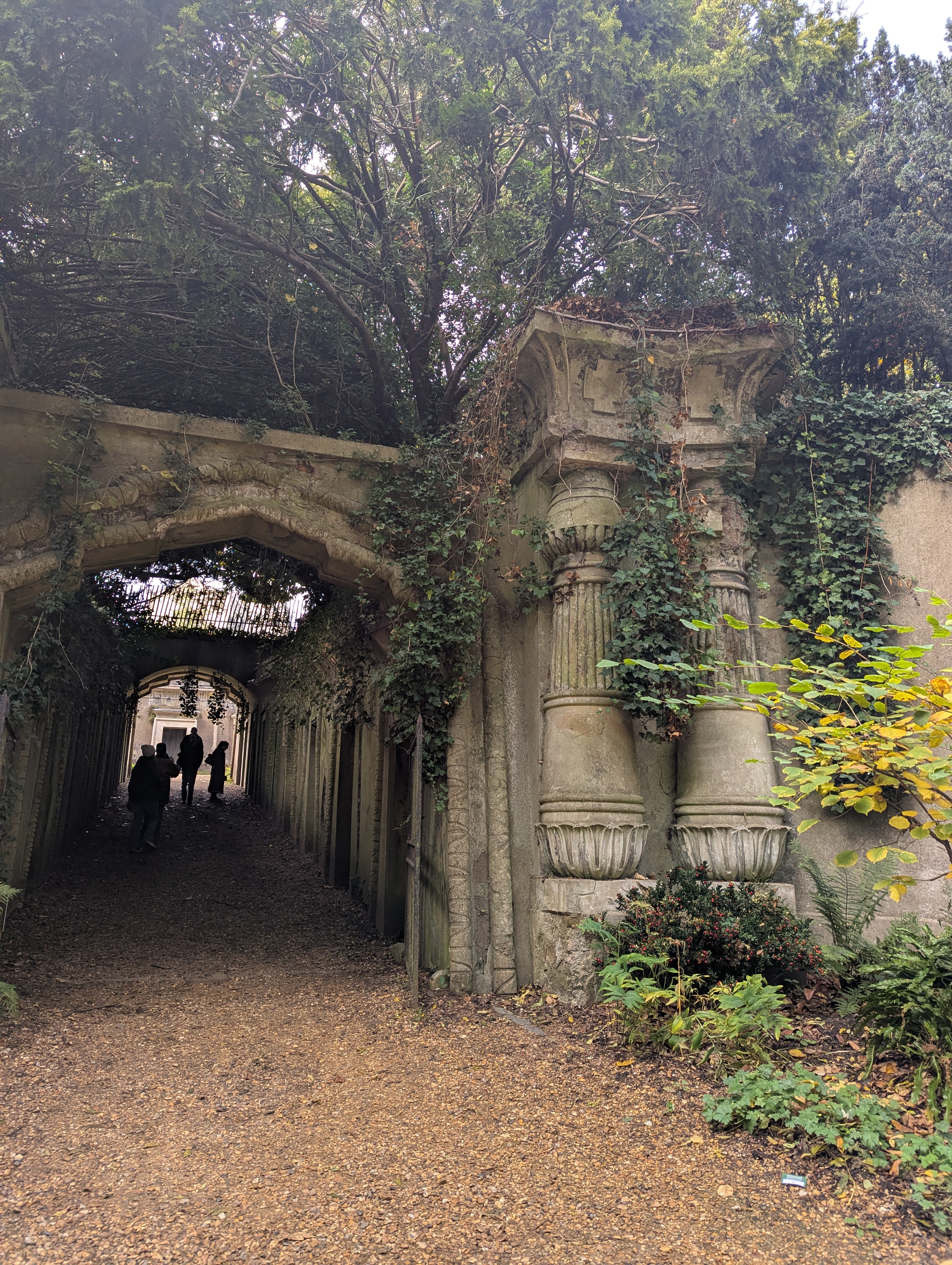
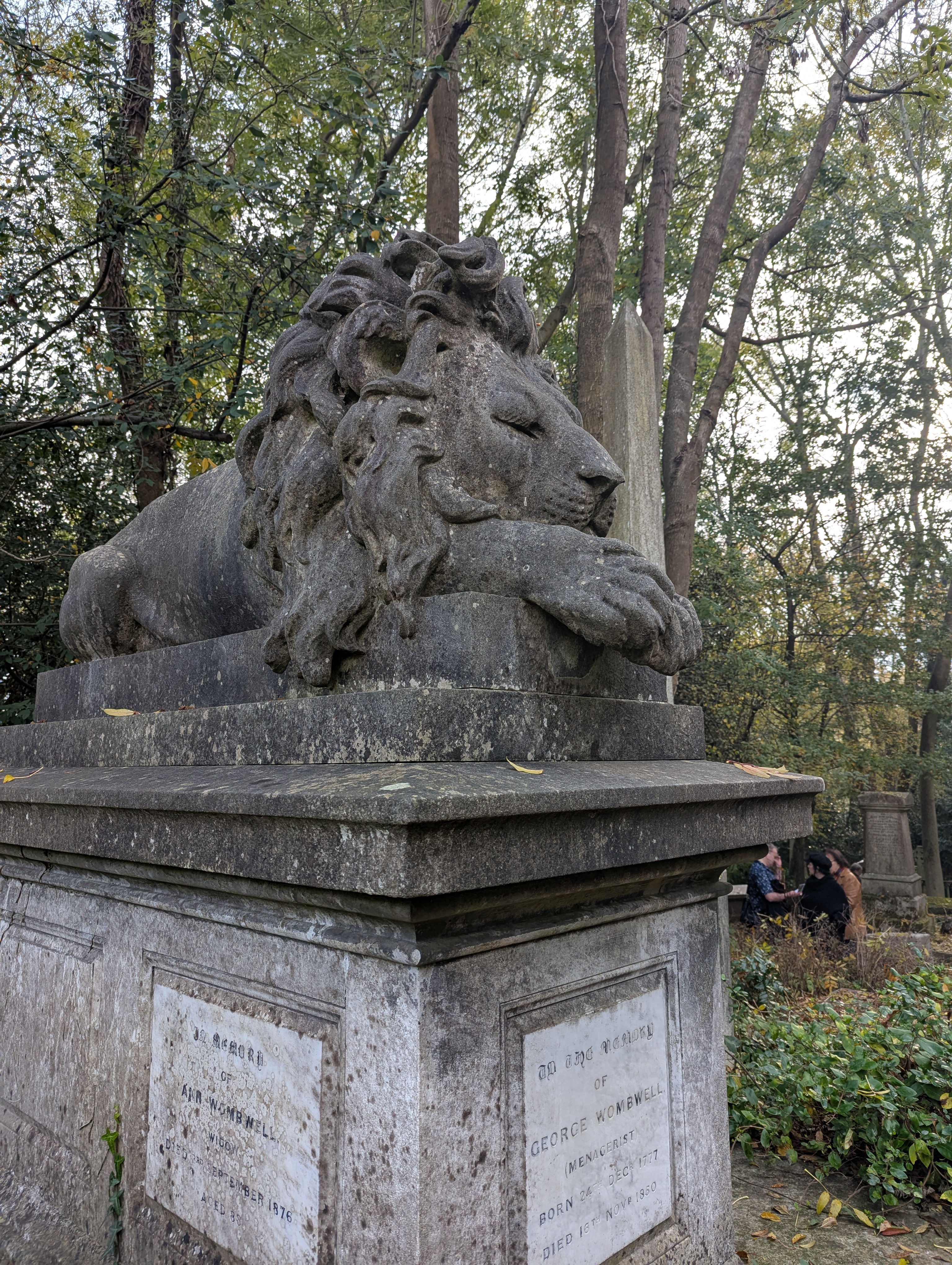
That vault is very close to the much newer graves of the Russian journalist and former intelligence officer, Alexander Litvinenko, who was poisoned by Russian agents in 2006, and also to the pop music star, George Michael. The tour also goes into the beautifully creepy Egyptian Avenue and Terrace catacombs. The picture of the grave with a lion on the grave stone, below, was from the grave of George Wombwell, an 1800s collector and exhibitor of wild animals. The lion on his grave was intended to be a likeness of his tame and very docile lion, Nero.
Temple of Mithras
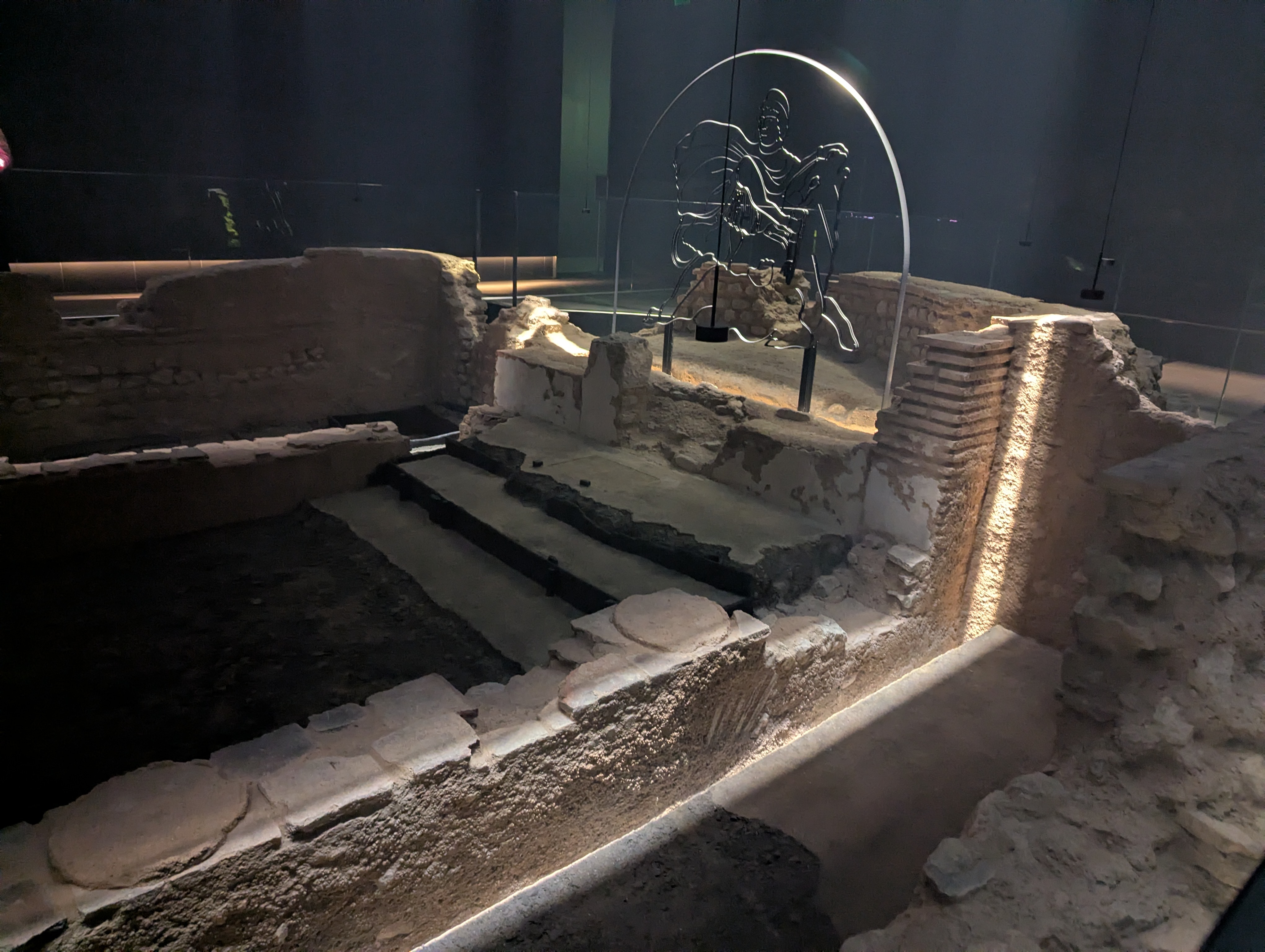
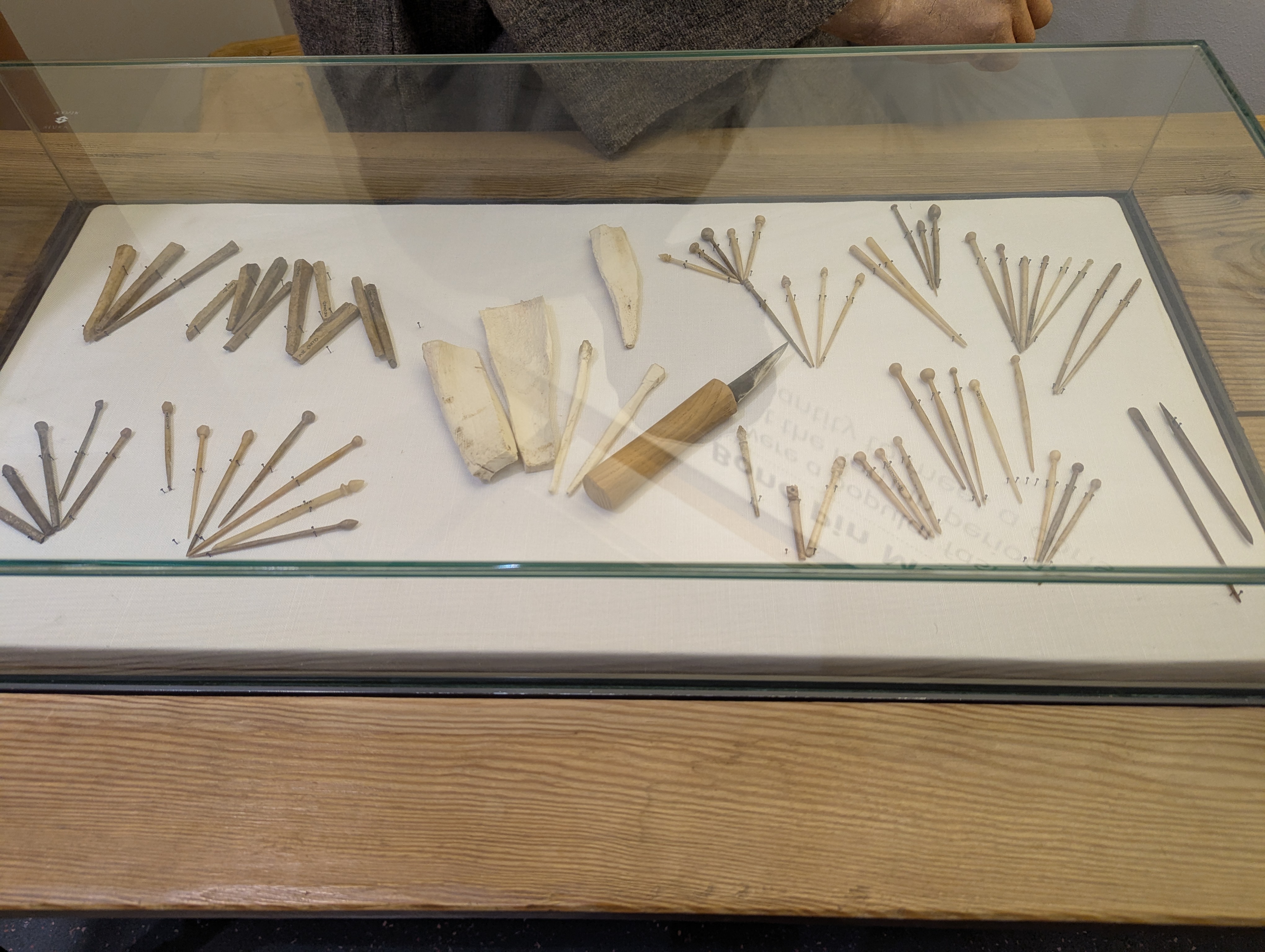
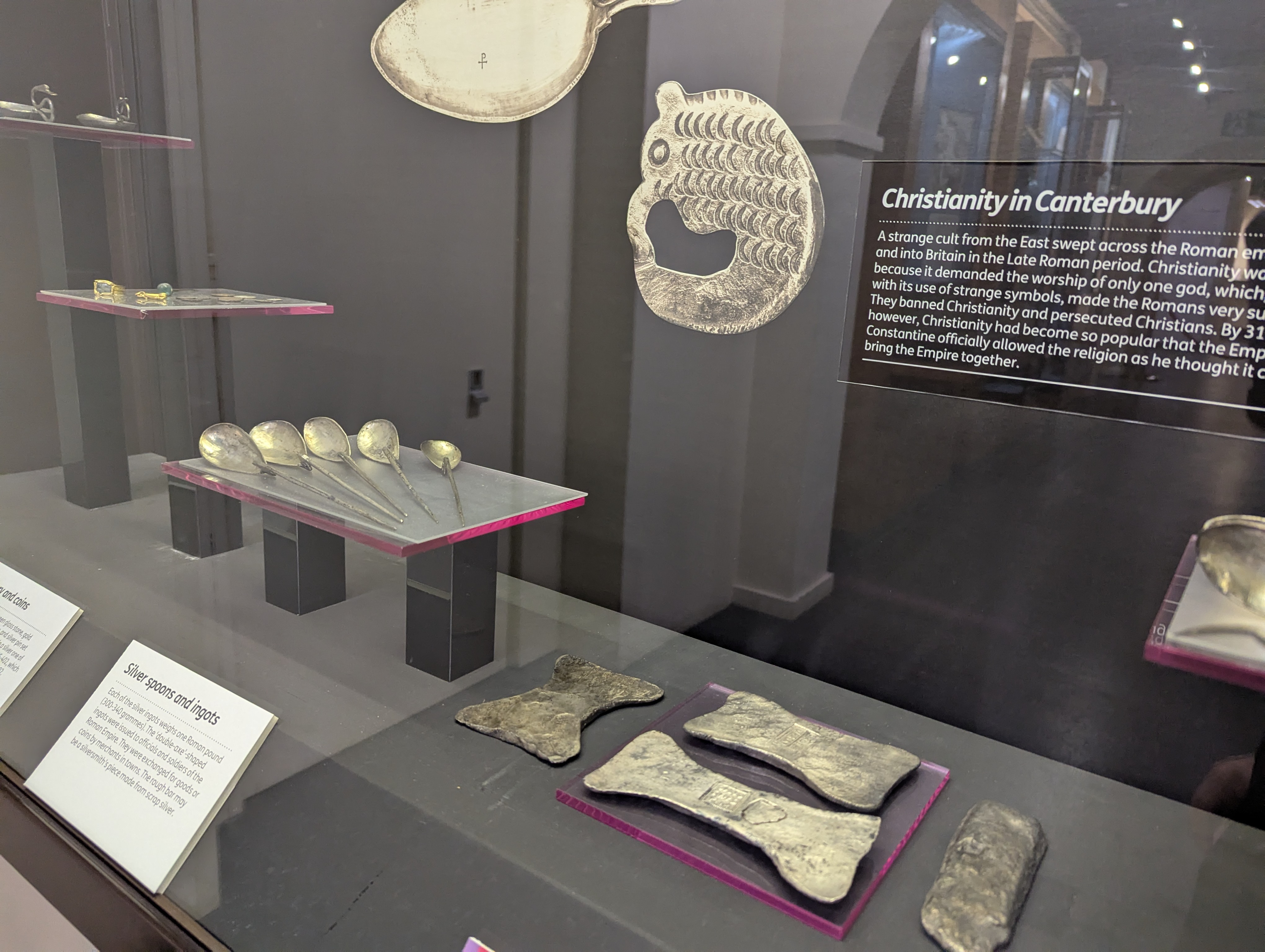
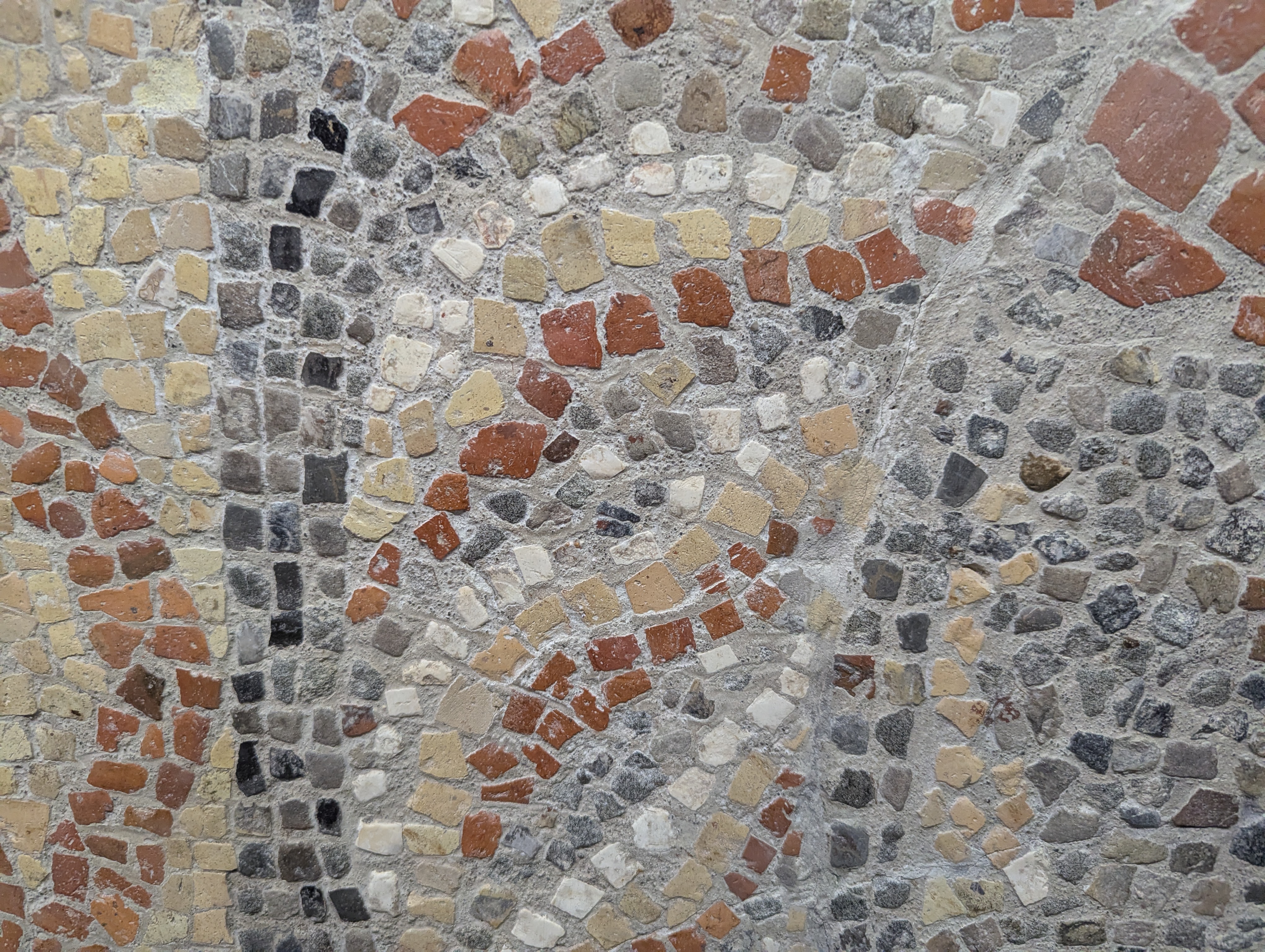
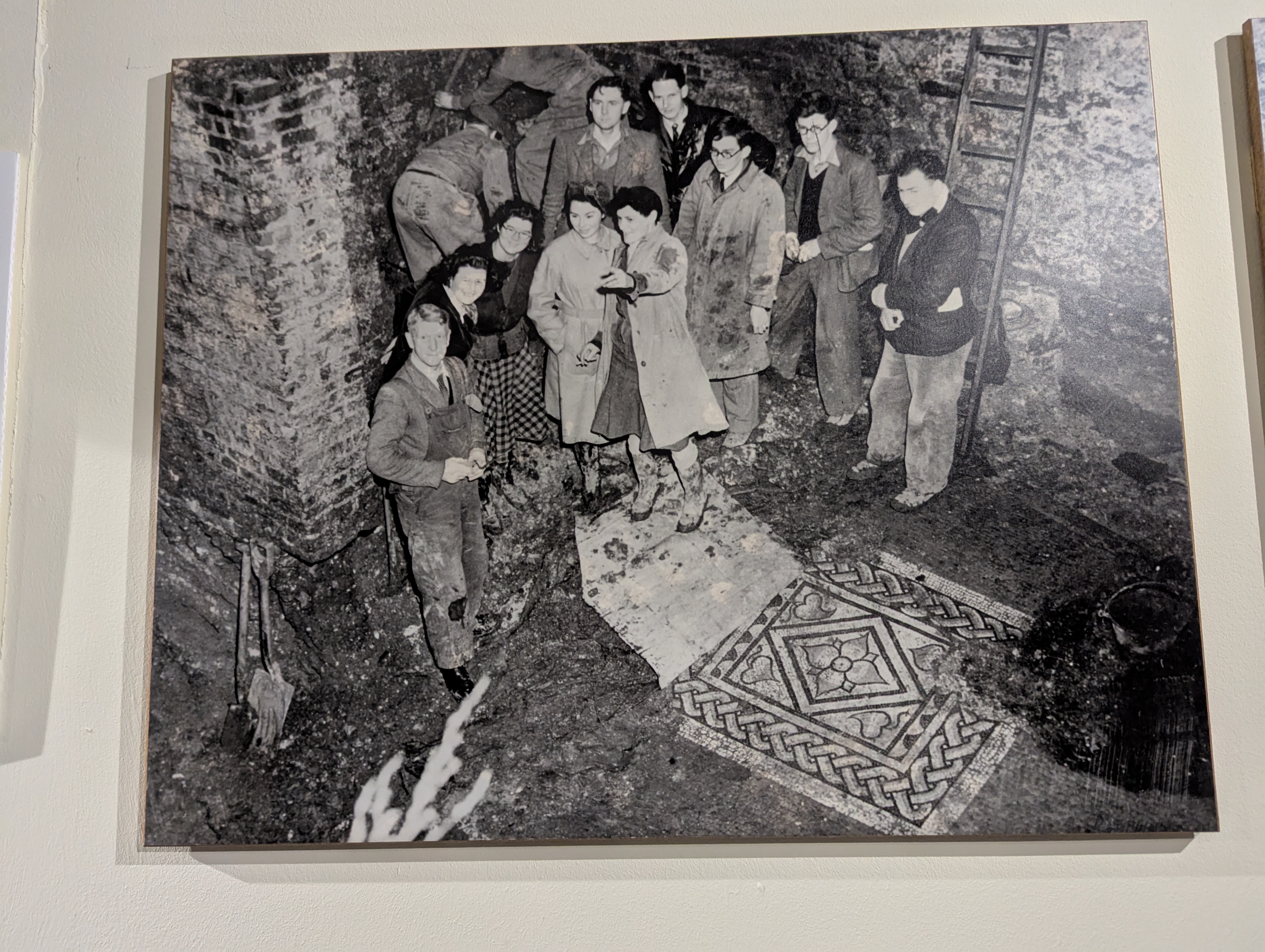
We’ve been to a few sites around London (and elsewhere in England) where ruins from the Roman occupation during the first few centuries AD have been found underground. Sometimes because of bombing during WWII and sometimes because of commercial development. Ruins from the Temple of Mithras were found in 1954 during a construction project and the temple was believed to have been built in 240 AD. It was used by a secretive cult that honored a god named Mithras. The head of a marble statue of Mithras was found near the temple excavation.
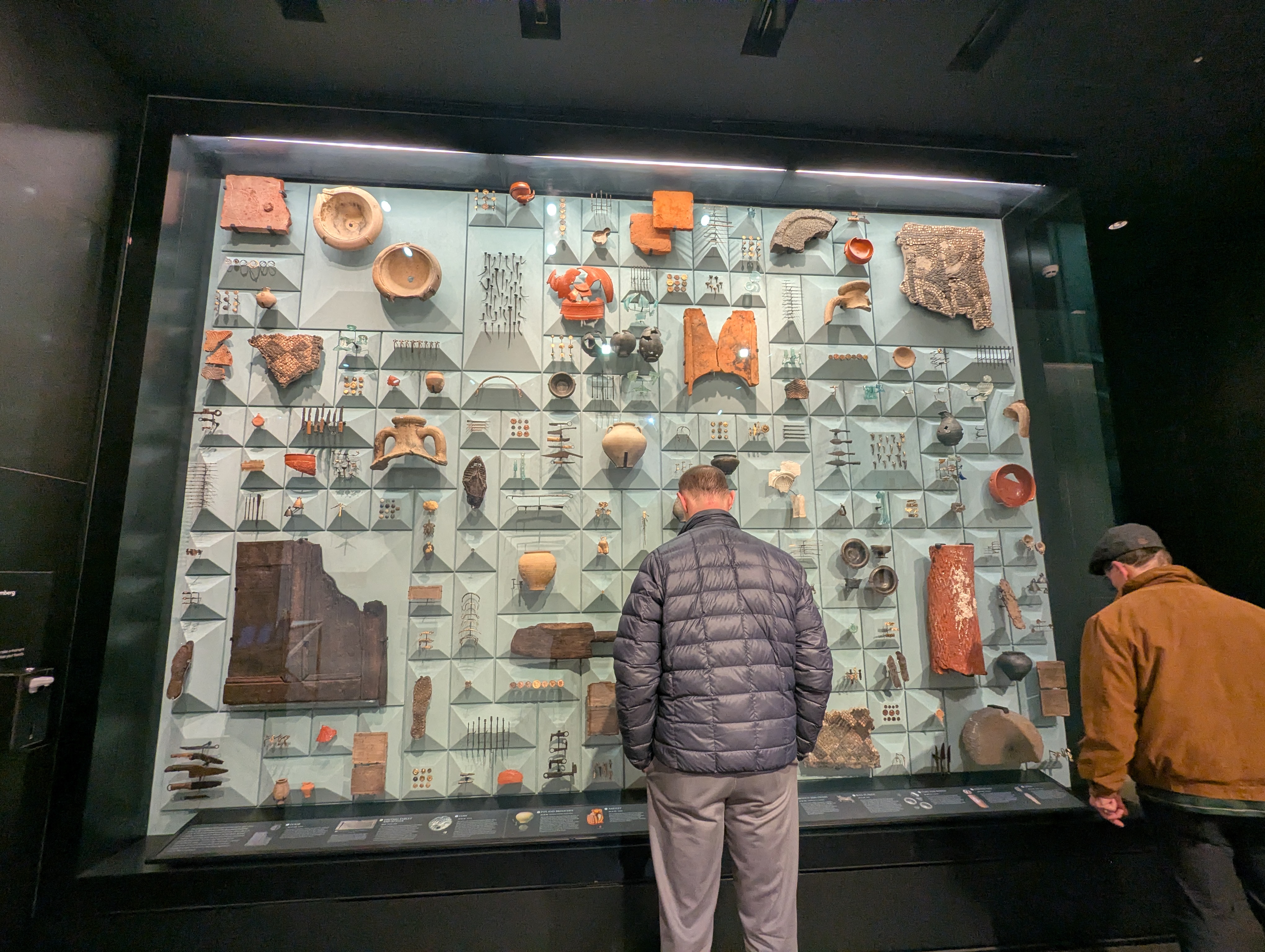
The actual remnants of the temple are stored in the London Museum which has been closed pending a move. What you are able to visit is an authentic model of the temple in close proximity to where the real temple was found. It’s accessed from the very modern Bloomberg building. There is also a model of the Mithras head. In the upper lobby of the Bloomberg building are actual artifacts found at the site. What I loved about the artifact display was that it is very, very concise. One wall. Sometimes displays of Roman artifacts are so extensive you kind of lose yourself. This one gives good samples of everyday objects, well organized and easy to digest.
I enjoy looking at these ruins and ancient objects–pins, buttons, pots, jewelry–because they remind me in so many ways that how we live is similar to these ancient ones. We haven’t much changed some objects we have used for thousands of years, just made them more uniform and easier to produce. And humans still are drawn to religious orders and cults which offer much the same as they did thousands of years ago.
Conversely, we can also see ways in which human lives are much changed. For someone to have found these ruins and known they were worth preserving for all: credit is due.
The lobby also currently has an art display by American artist Anne Ryan, called Folkmoot, an old English word representing a public gathering. The imagery is intended to reflect the city’s ongoing rebuilding across time. Quite interesting.
Ah, London. We never seem to exhaust what there is to take in and experience in this city and the people and events who have shaped it.
And that’s a good thing because there is nothing more we want to do than come back again and keep exploring. As of this writing we have no firm plans to return but what we know with certainty: we will be back.
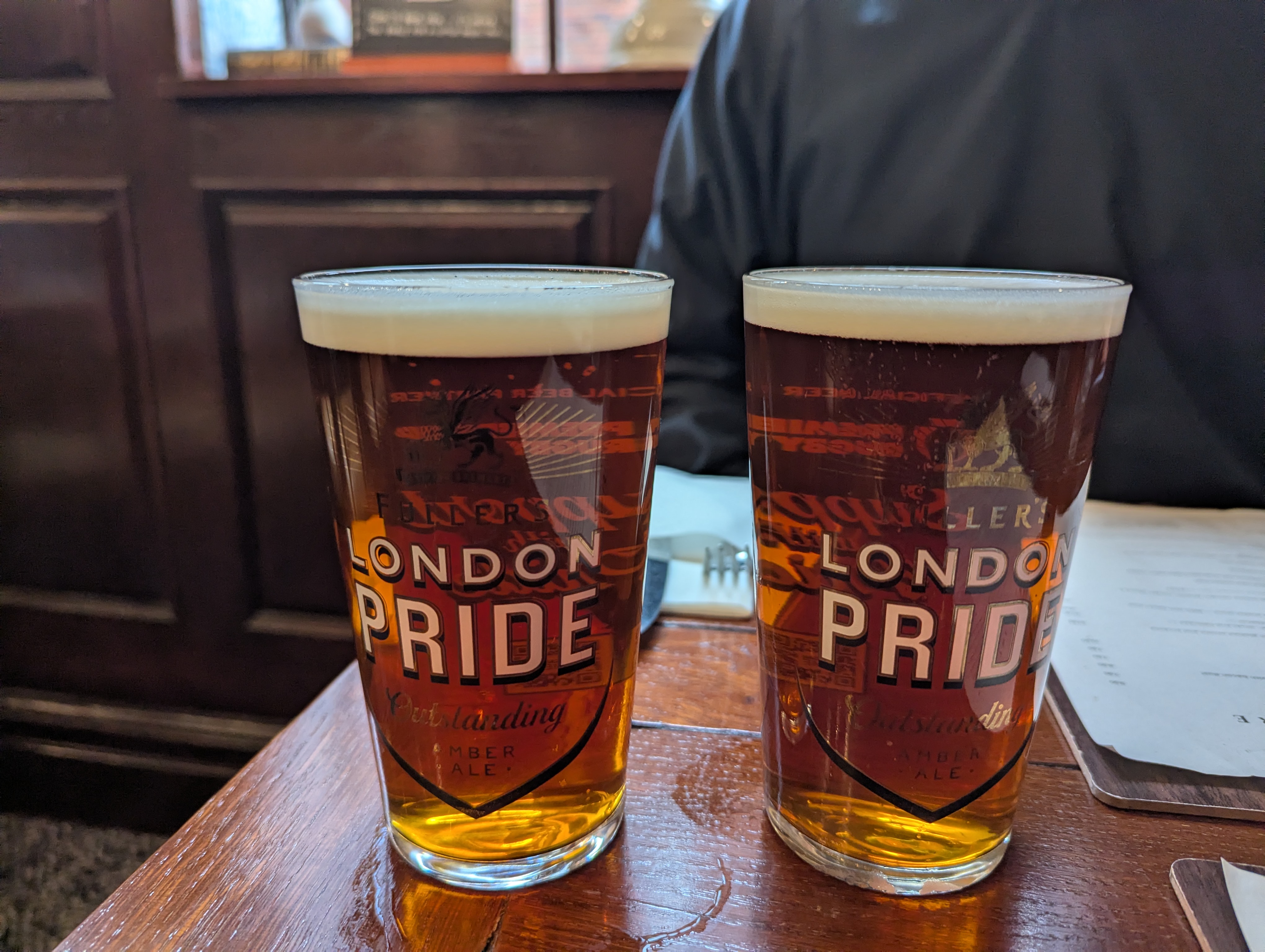
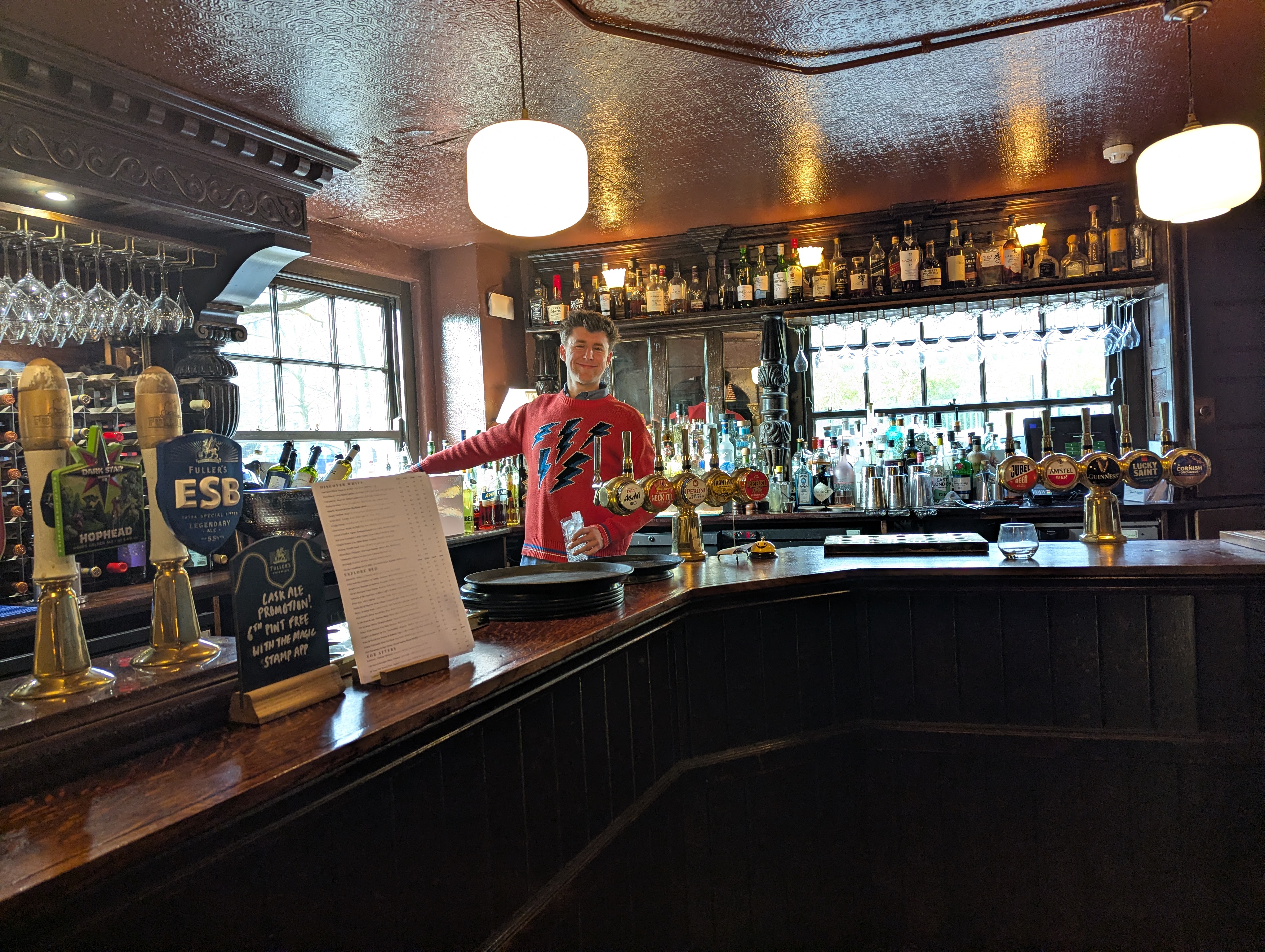
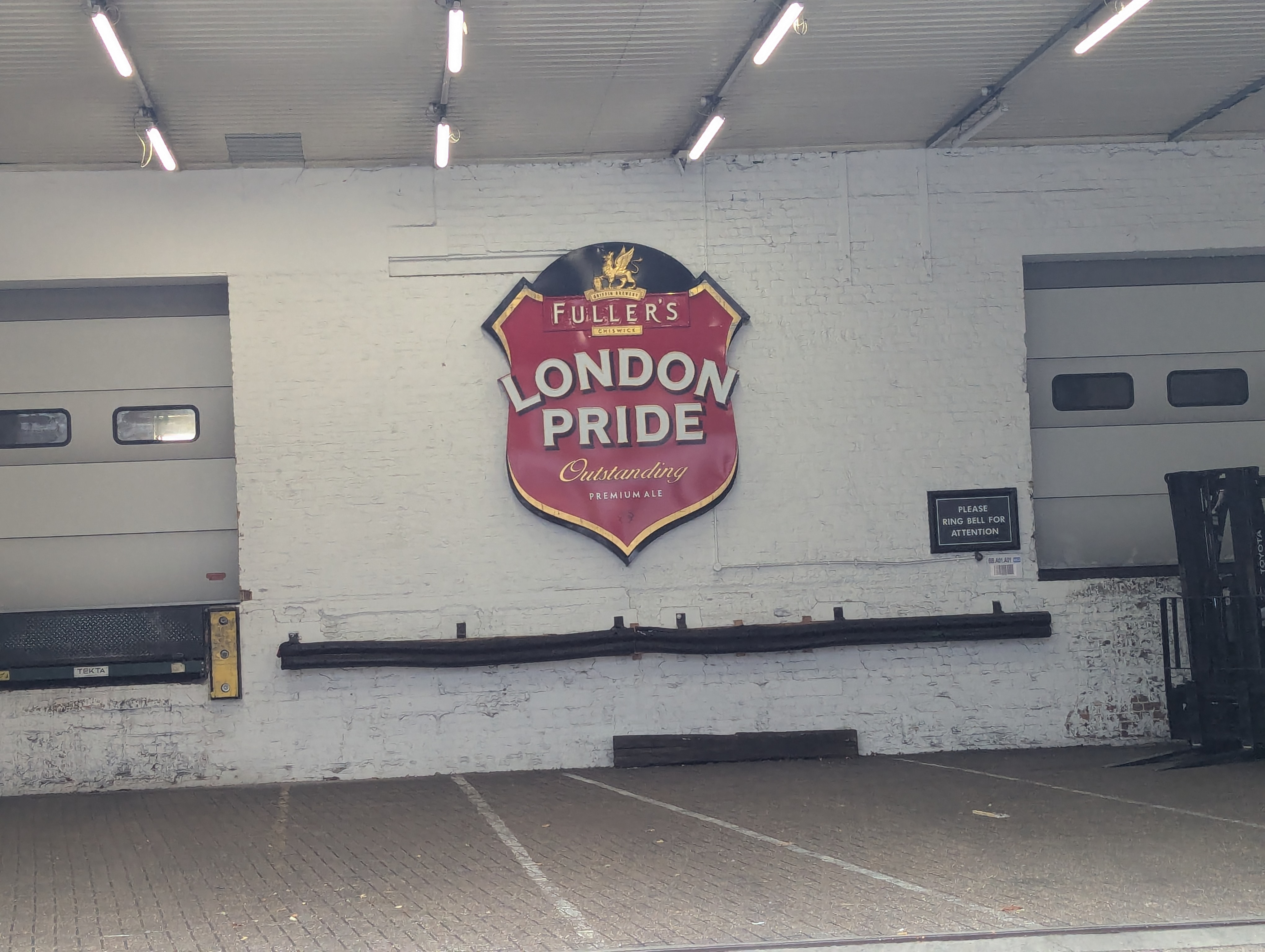
When we visit London, my husband always wants to enjoy a London Pride, a cask ale that is made by Fuller’s brewery in London and served in pubs. Fuller’s not only brews beer, it owns many pubs in Southern England. London Pride is sometimes available in pubs that are not run by Fuller’s, but it’s always available in a Fuller’s-owned pub.
A “cask ale” is a form of beer that is unfiltered and unpasteurized and experiences a second fermentation inside the barrel. The barrel is delivered to the pub and, traditionally, placed in the basement where it would be chilled to the temperature of that basement. It’s drawn to the glass using gravity (if stored above the bar) or a hand pump (if stored below the bar).
I enjoy London Pride as well, but I’m not as committed to it as my husband. I like Guinness and, while in London, I enjoy exploring drinks with gin, a popular option in England. These are available everywhere. But when the spouse wants a London Pride, the pub scene is more limited.
At some point, we started making it a point to visit the local Fuller’s pubs in any neighborhood we are temporarily living in while we visit London. And later, that became trying to have a London Pride in every Fuller’s pub in London.
There are a lot of Fuller’s pubs in London and there is virtually no way we will hit them all, but we are making an honest attempt. And while I am not quite the London Pride afficionado my husband is, the more I find out about Fuller’s the more I really appreciate what they have done in building out their line of pubs. What I love most of all is that there is no attempt to make every pub like any other pub. Instead, Fuller’s often leans into the history of the pub’s building or neighborhood when naming and decorating the pub. Many of the pubs are in old, historic buildings or spaces that have been pubs for decades or even centuries.
When we arrived in London, we attempted to check into out hotel near Victoria Station, the July Victoria. We were a few hours before official check-in. Interesting and strange: our room was ready and they would be willing to check us in early, but for £15 an hour. We checked our bags and decided to go out and find a pub for lunch.
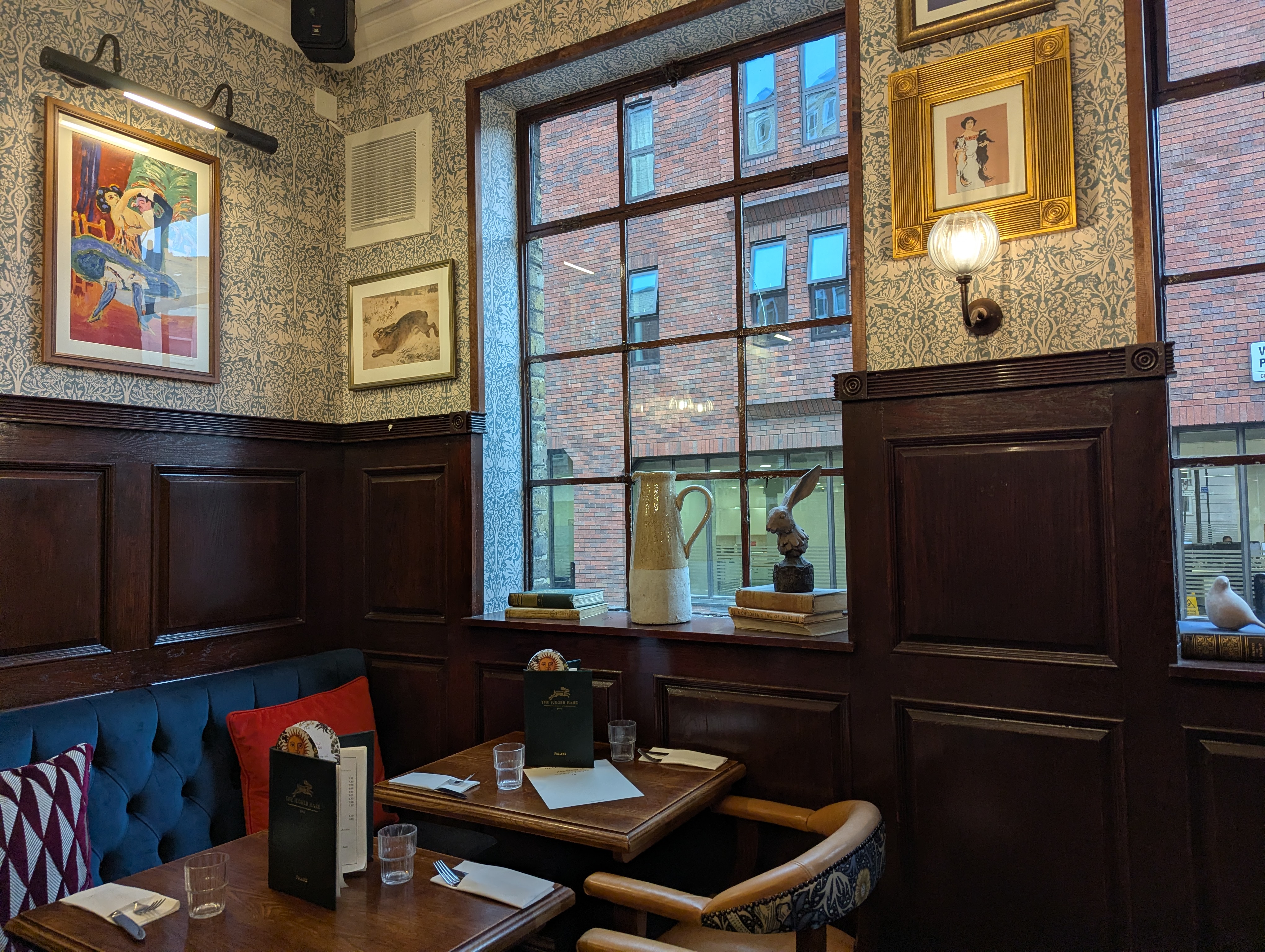
The nearest Fuller’s pub, The Jugged Hare, was a short walk away. We entered and walked over to the bar and requested a pint of London Pride, but were told that they didn’t have any currently available. One worker went downstairs to find out when London Pride would be available while the other helped us find another Fuller’s pub. We had a long chat with that worker. At last, the other worker came back and announced that he’d hooked up the next barrel. London Pride could now flow freely.
So we found seats and enjoyed our London Pride while perusing the menu for lunch. We also looked up the meaning behind “jugged hare.” Apparently, it’s a dish of old England in which a rabbit was cut up and placed in a jug. The jug was placed in boiling water and cooked for hours. The pub was located in a refurbished bank and had beautiful, dark wood panels. Decor included many different kinds of jugs and rabbit imagery.
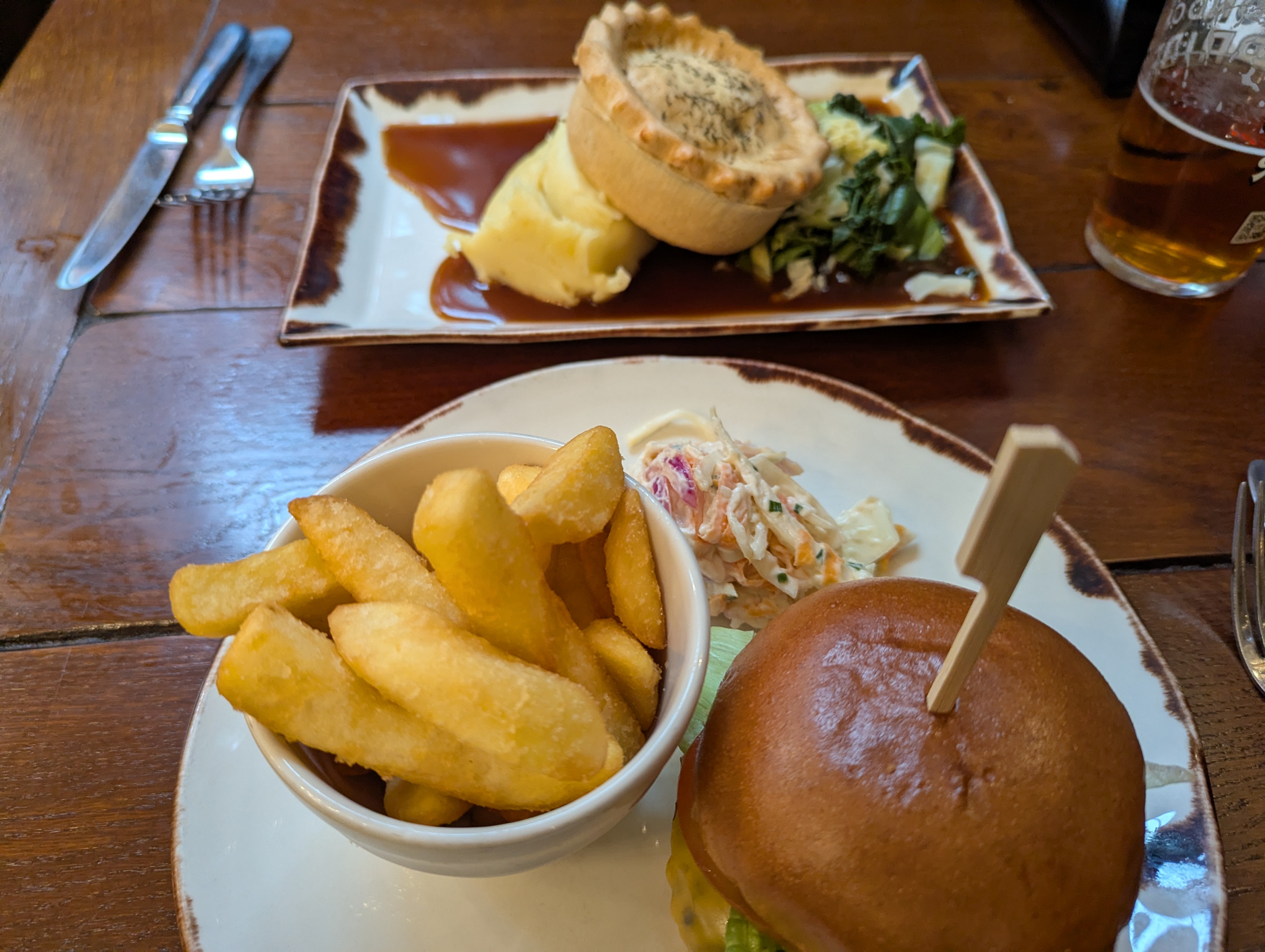
No rabbit on the menu. My husband had a steak pie and I had a cheeseburger. My husband asked our server if the pub sold London Pride glasses. She disappeared for a long time and then came back with a glass. A gift from management. It looked like it had been through some things, and we were delighted to have it.
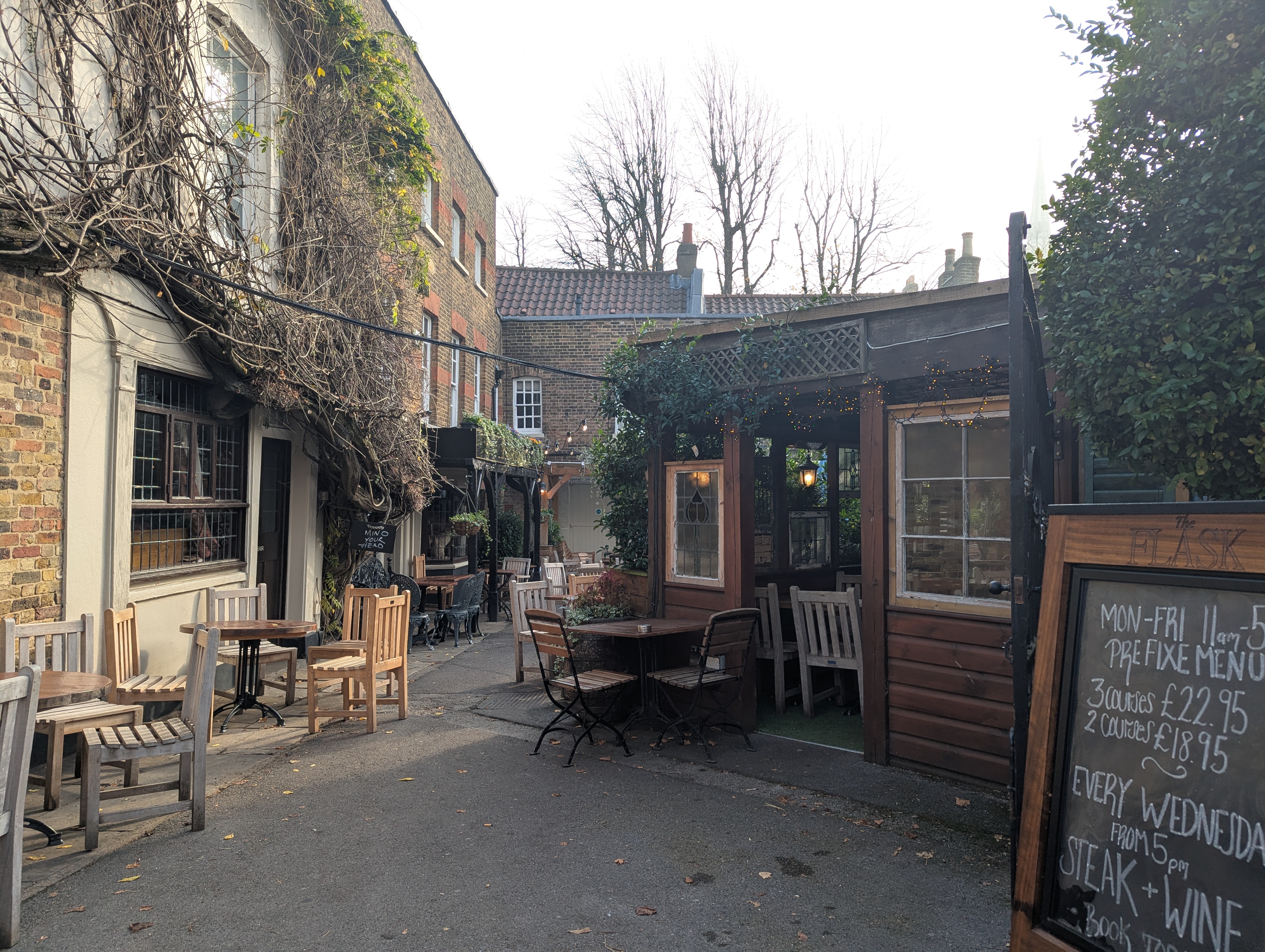
The next day, my husband and I were planning to engage in a number of activities around Highgate in North London (including the Arsenal match), so I’d made reservations at a Fuller’s pub called The Flask. We were threading the needle on timing between visiting a historic house and touring a historic cemetery, and were at the pub at a time that was certainly before the lunch rush. Beautiful historic pub with plenty of seating inside and a beautiful garden with seating outside.
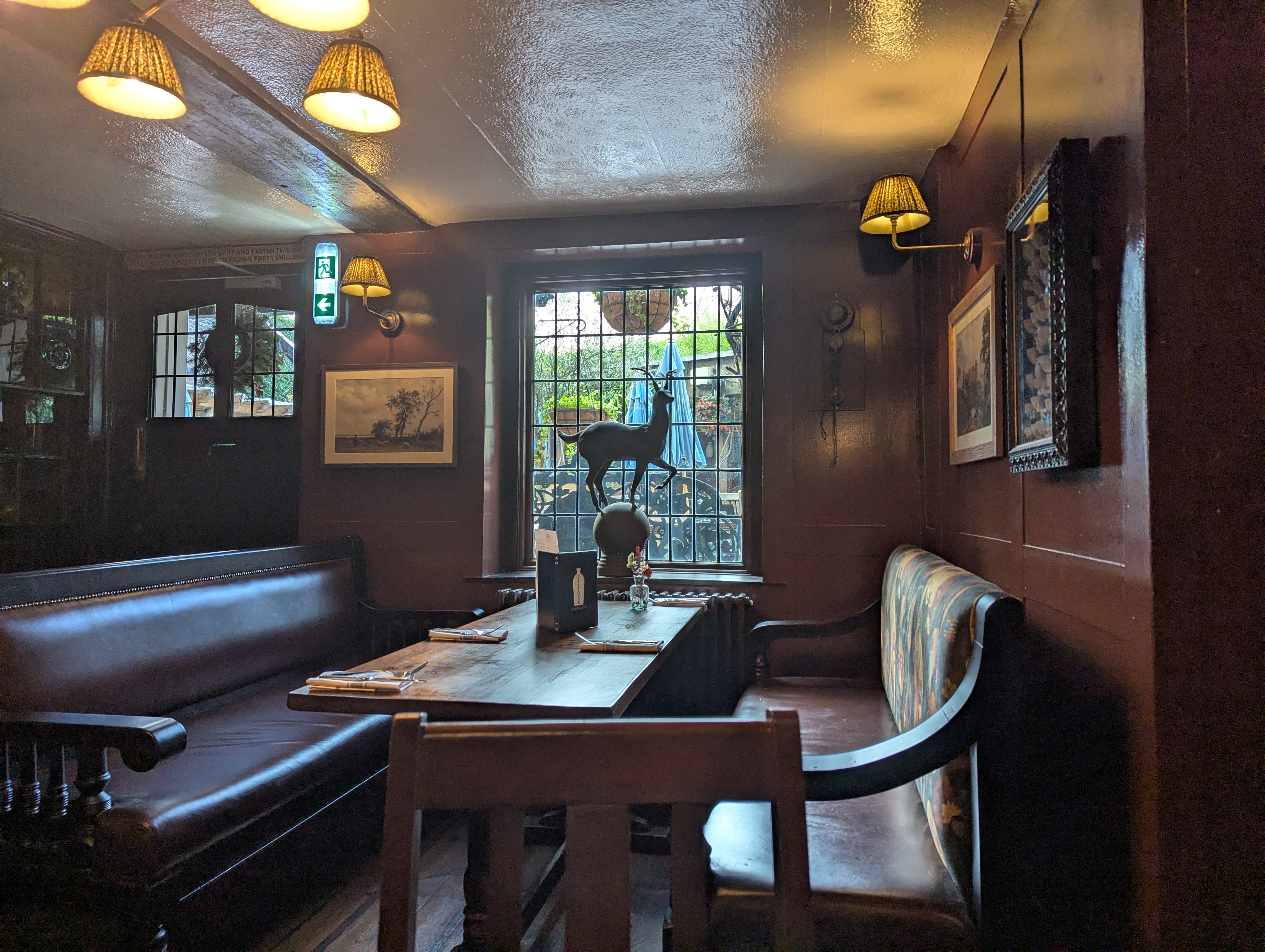
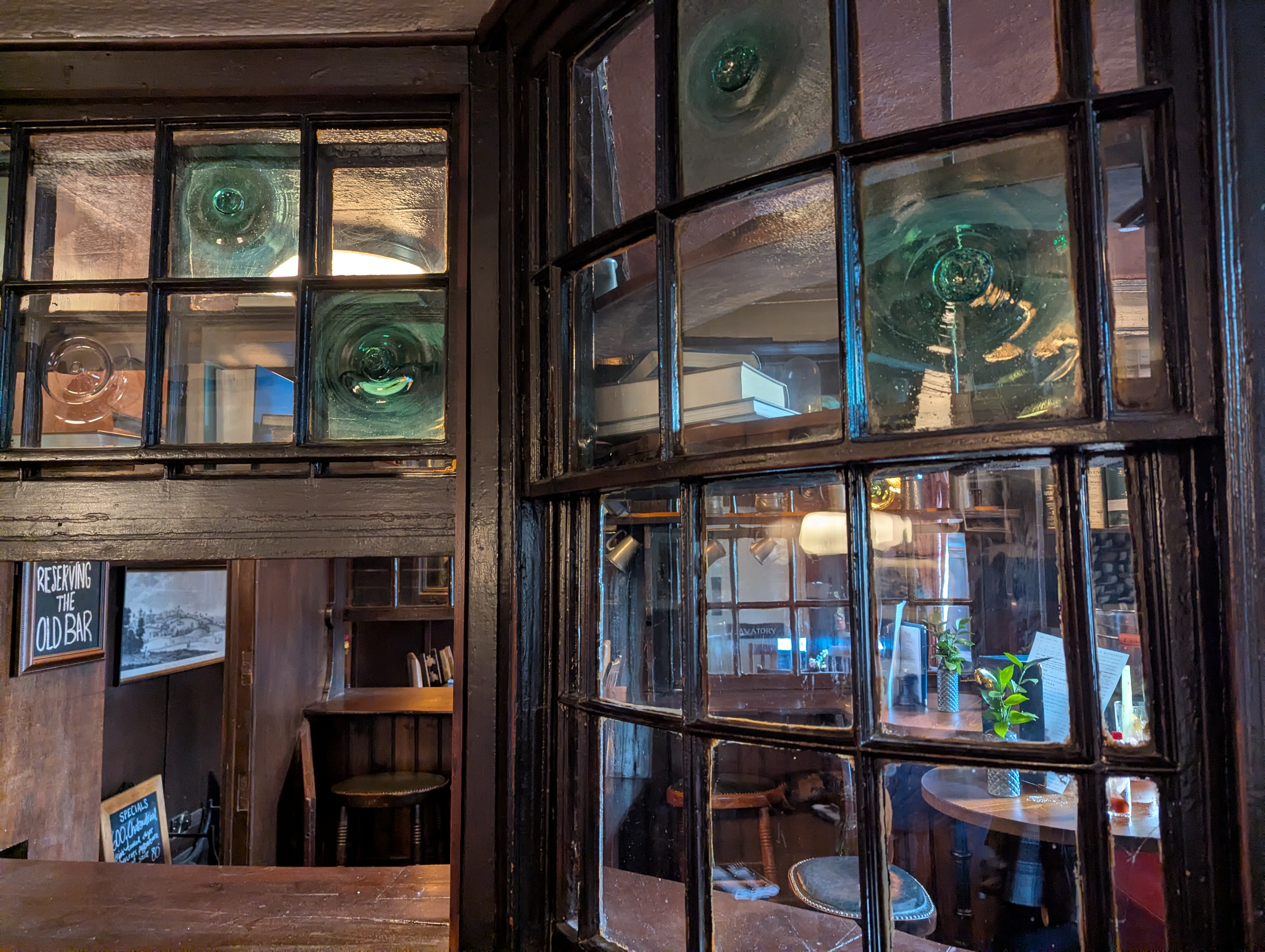
We were seated near a toasty fireplace and served our beer. Our server was friendly and personable and when he heard about our mission to visit many Fuller’s pubs made some suggestions for ones we should target soon. He also told us some about The Flask, parts of which are very historic. The property includes a former stable that has been on the property since 1663 and some of the parts of the building housing the pub date to the 1700s, including what was until only recently the main bar. That area is now a small seating area. It still is surrounded with “bullseye glass” panels from the 1700s.
The name, “The Flask,” references water collection vessels sold by the pub many years ago that people would use to get water from a natural spring nearby.
The pub has a very colorful history and has served famous writers like Byron, Shelley, and Keats. More recently, it’s served the famous songwriters George Michael and Taylor Swift. My husband was shown the exact chair Taylor Swift sat in when she enjoyed her own London Pride. I have great admiration for Taylor Swift but I left her memory alone by remaining by the fire. Our server also told us Taylor had visited a kebab shop in Kentish Town. According to our server there are some amazing kebab shops in Kentish Town, but she went to the worst one.
Taylor, speak with your servers. They will never steer you to bad kebabs.
The Flask also has some resident ghosts, including a barmaid who hanged herself in the basement and a 17th century Cavalier who has been known to show up in uniform. Our server told us he’s never seen a ghost but sometimes at night he’s heard strange noises.
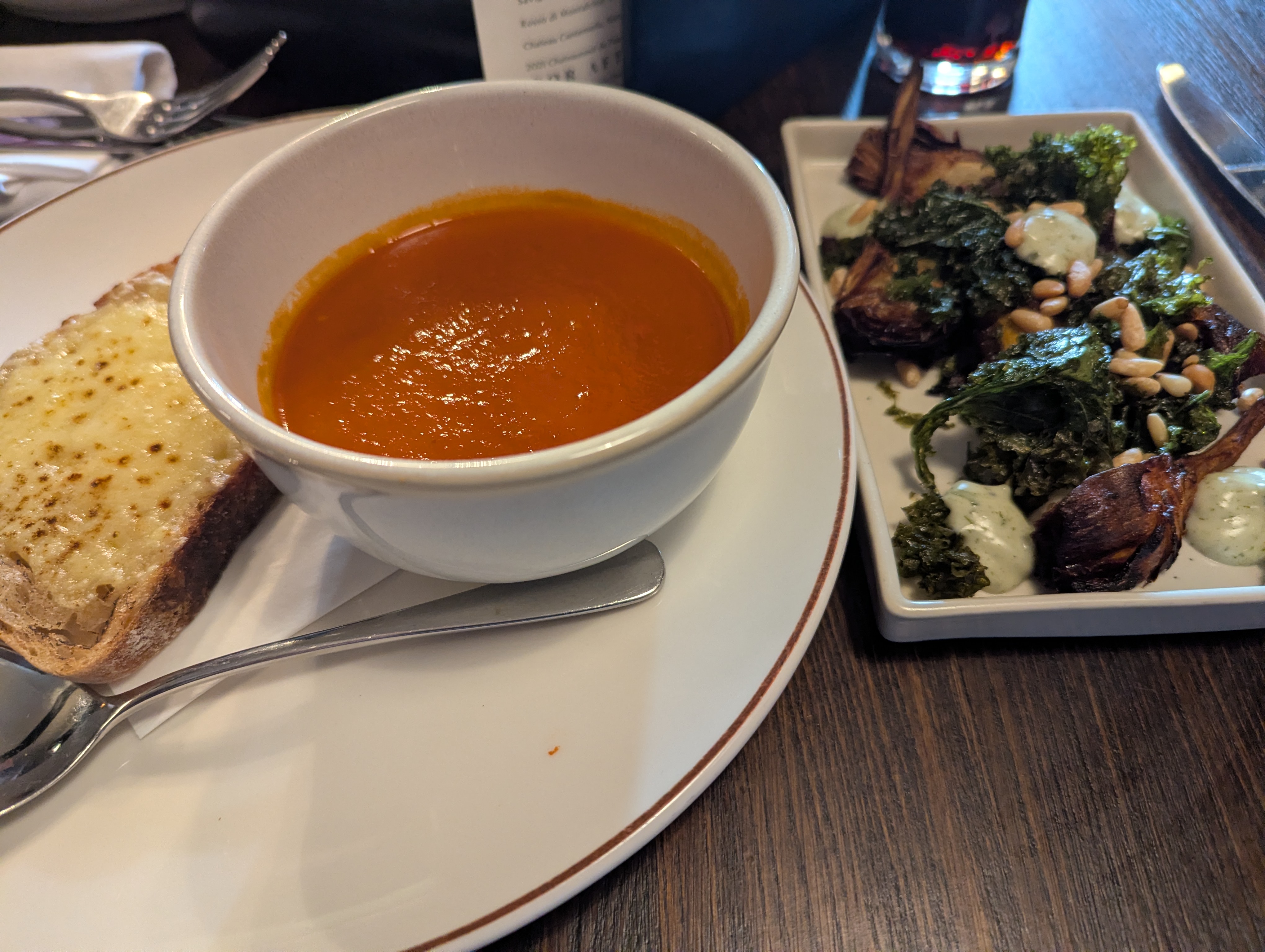
It was so early for lunch I just had a roasted tomato soup with a cheese toasty and an appetizer of roasted artichokes and kale. It was one of the yummiest things I ate on this trip.
Our server not only gave us some recommendations for Fuller’s pubs, he also suggested that we take a tour of the Fuller’s brewery. It had not occurred to us you could do that. So the next day, we trashed our plans for Sunday Roast and made reservations for a tour.
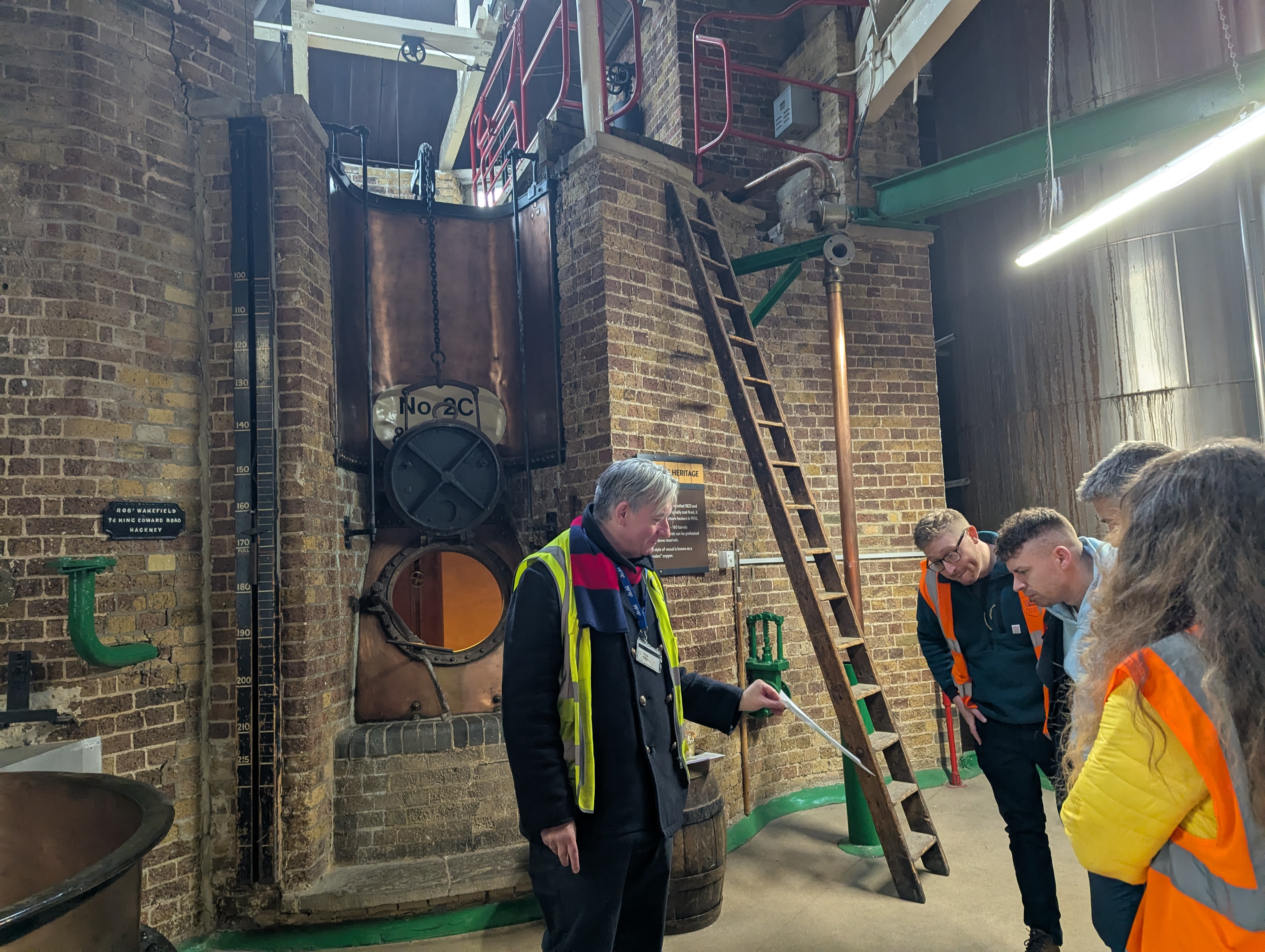
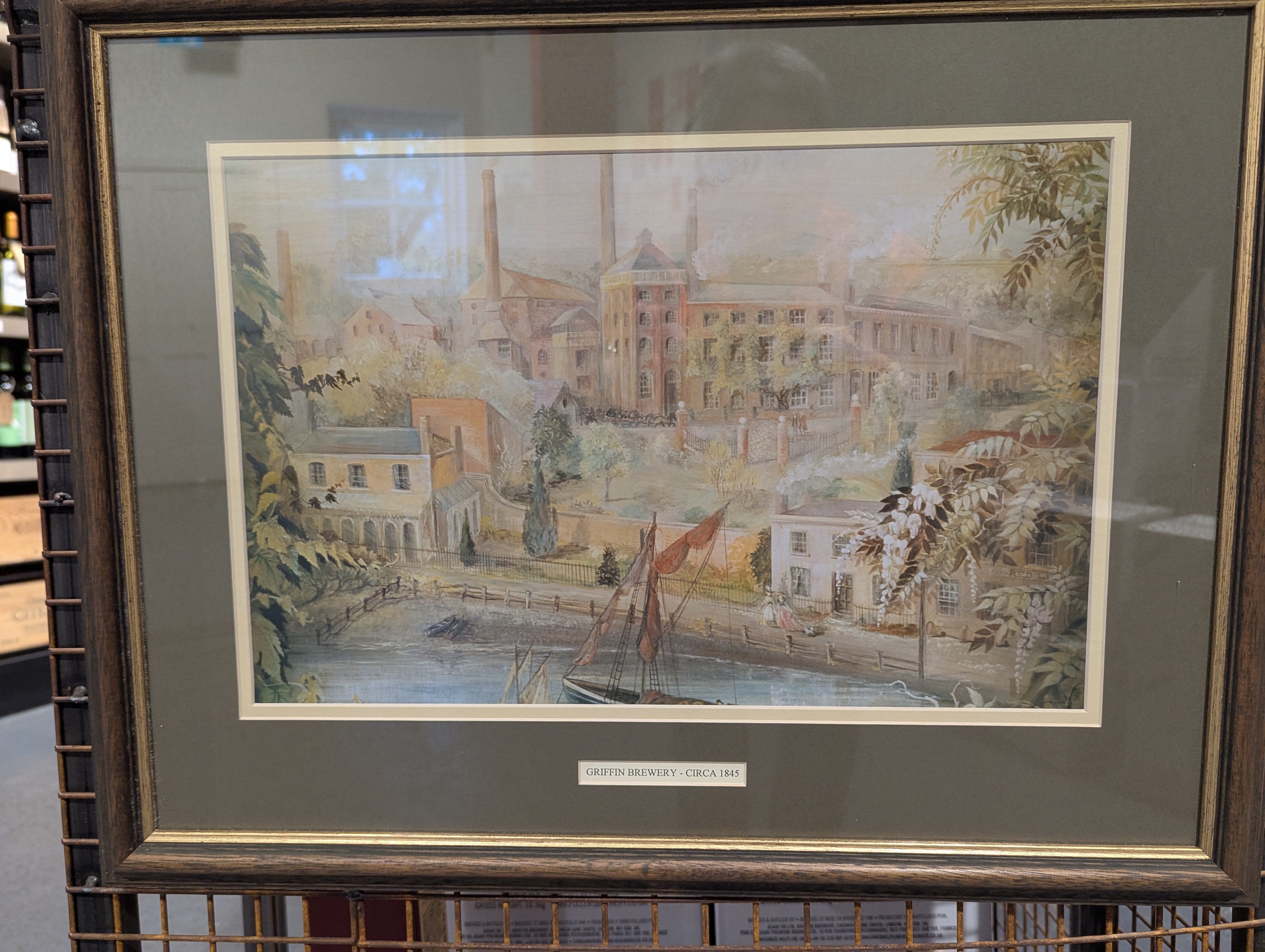
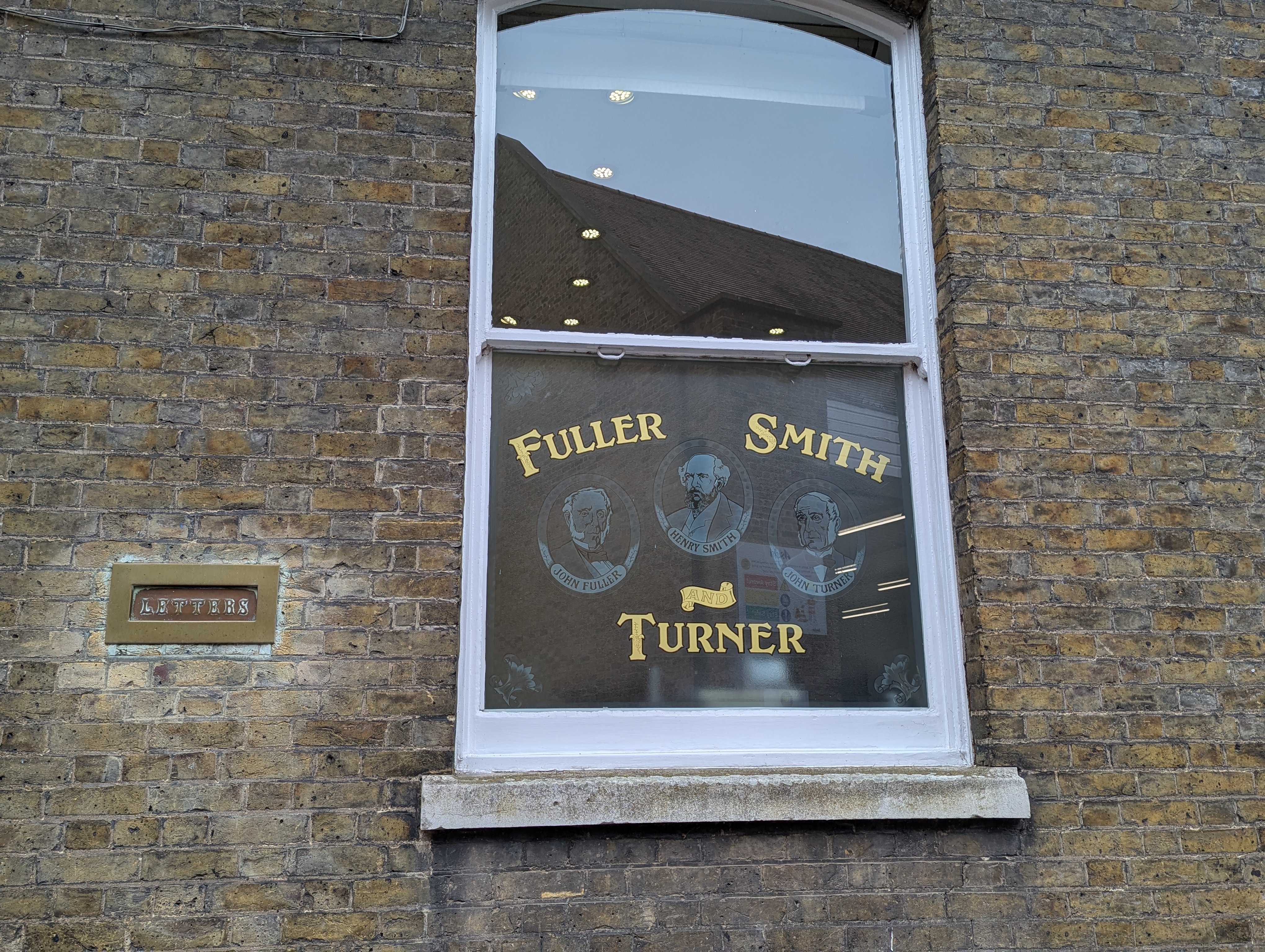
The Fuller’s brewery is in Chiswick and was formerly known as The Griffin brewery, lending to the griffin imagery that is associated with Fuller’s pubs. A brewery has been on site since the 1600s. John Fuller did not become involved in the brewery until the 1800s when the then-owners were in financial distress. His son, John Bird Fuller, was a founding father of the current iteration of the brewery, a joint operation with Henry Smith and John Turner, who had expertise in running breweries and brewing beer, respectively. Fuller, Smith & Turner was formed and has operated the brewery as of that partnership that started in the mid 1800s. The brewery currently operates as a subsidiary of the Japanese company Asahi since 2019. However, Fuller, Smith & Turner continue to own and operate the pubs we know as “Fuller’s pubs,” independently of the brewery.
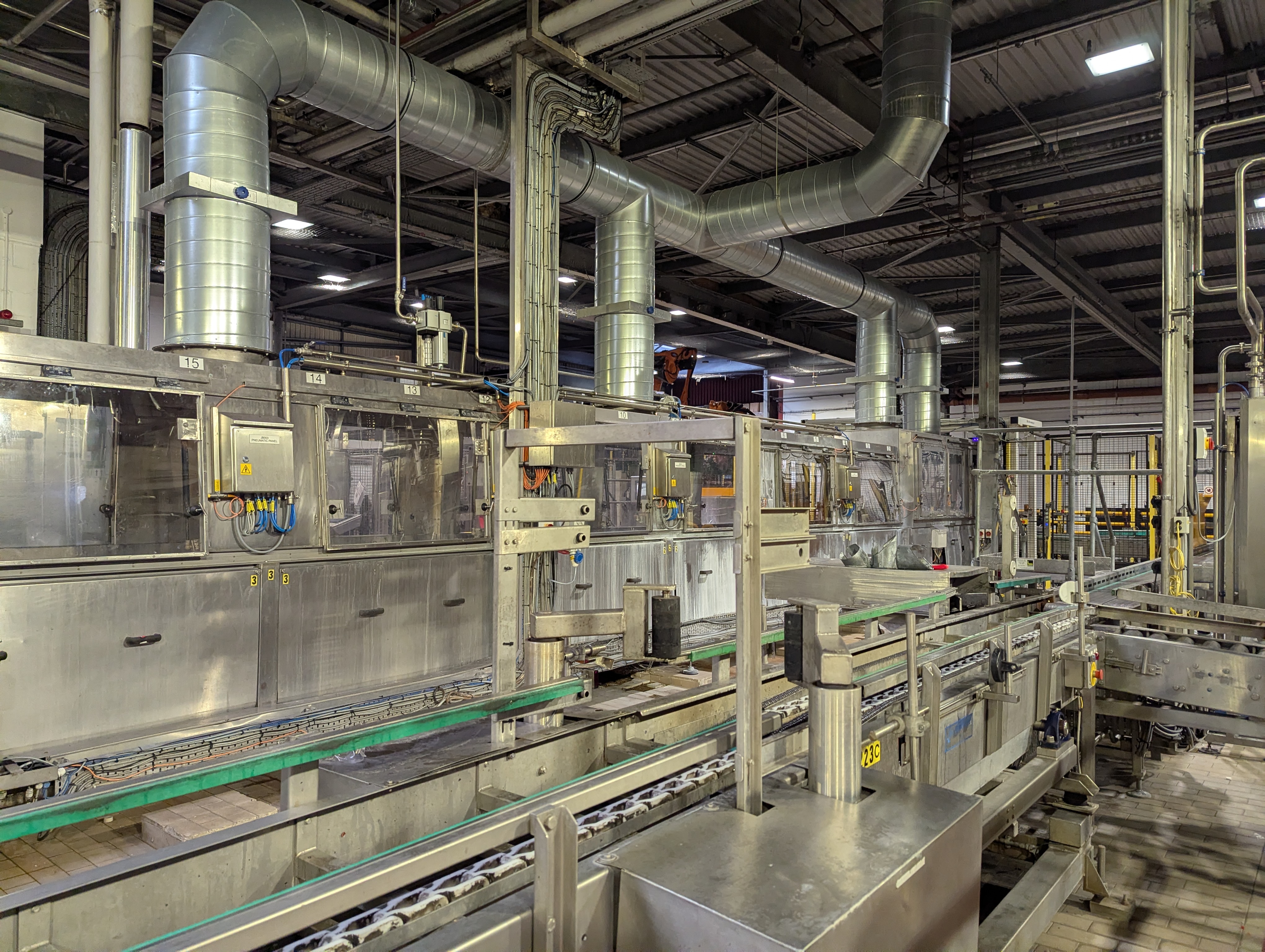
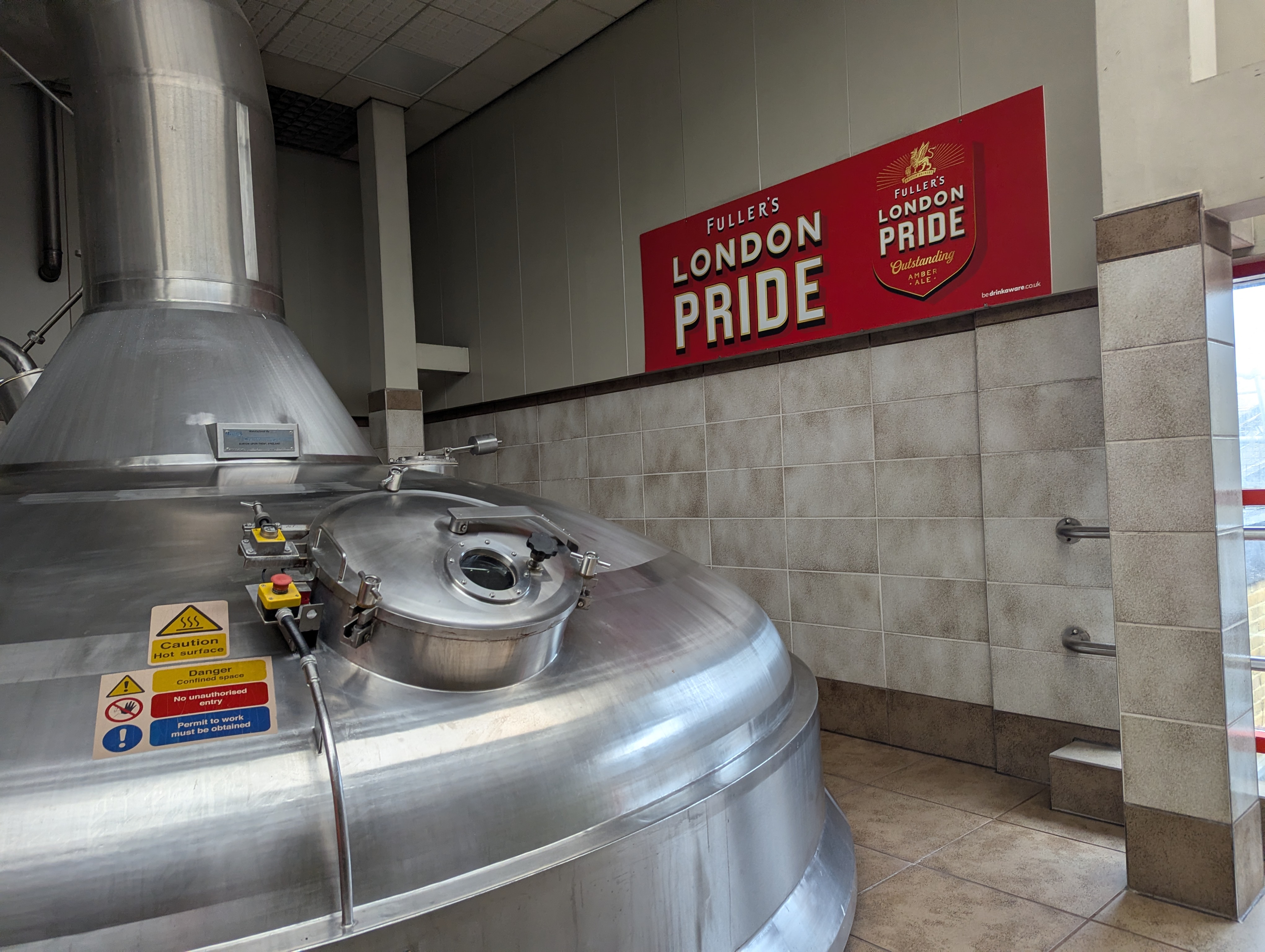
Our tour took place on a Sunday so equipment was not operating but we were given an education on how beer is made and how “ale” differs from “beer” (used to be no hops in ale but now there is no difference). We were shown how the ingredients of the beer are processed. For example, water from the Thames is treated with gypsum to improve the taste and appearance and barley is toasted and milled to produce flavoring of various beers. We saw giant vats where barley and water are combined and processed to produce mash and the stainless steel vessels (formerly copper) in which the results are boiled and enhanced with hops and yeast. We also learned about the difference between barrels and kegs. We saw where the beer is placed in barrels and left to ferment further and the trucks that transport Fuller’s beer all around Southern England.
The tour concludes with a tasting. Our tour had about 8 people in it and by the time we found ourself in the tasting room, my husband had befriended four of them already. We enjoyed sampling Fuller’s various products while chatting with our new acquaintances.
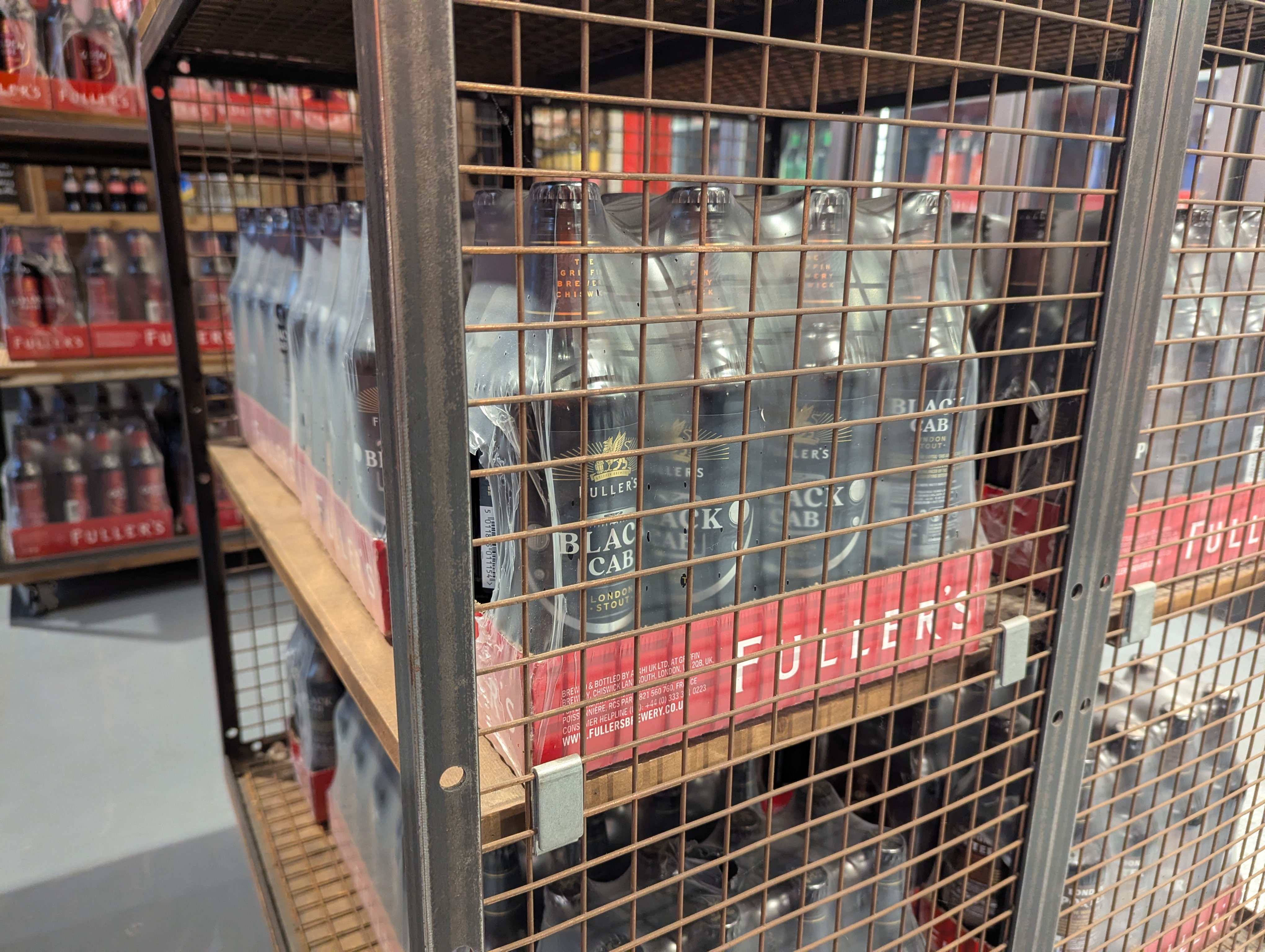
I hadn’t realized until the tour that Fuller’s has two dark brews normally available, London Porter and Black Cab Stout. That London Porter is going to give my Guinness habit a run for its money.
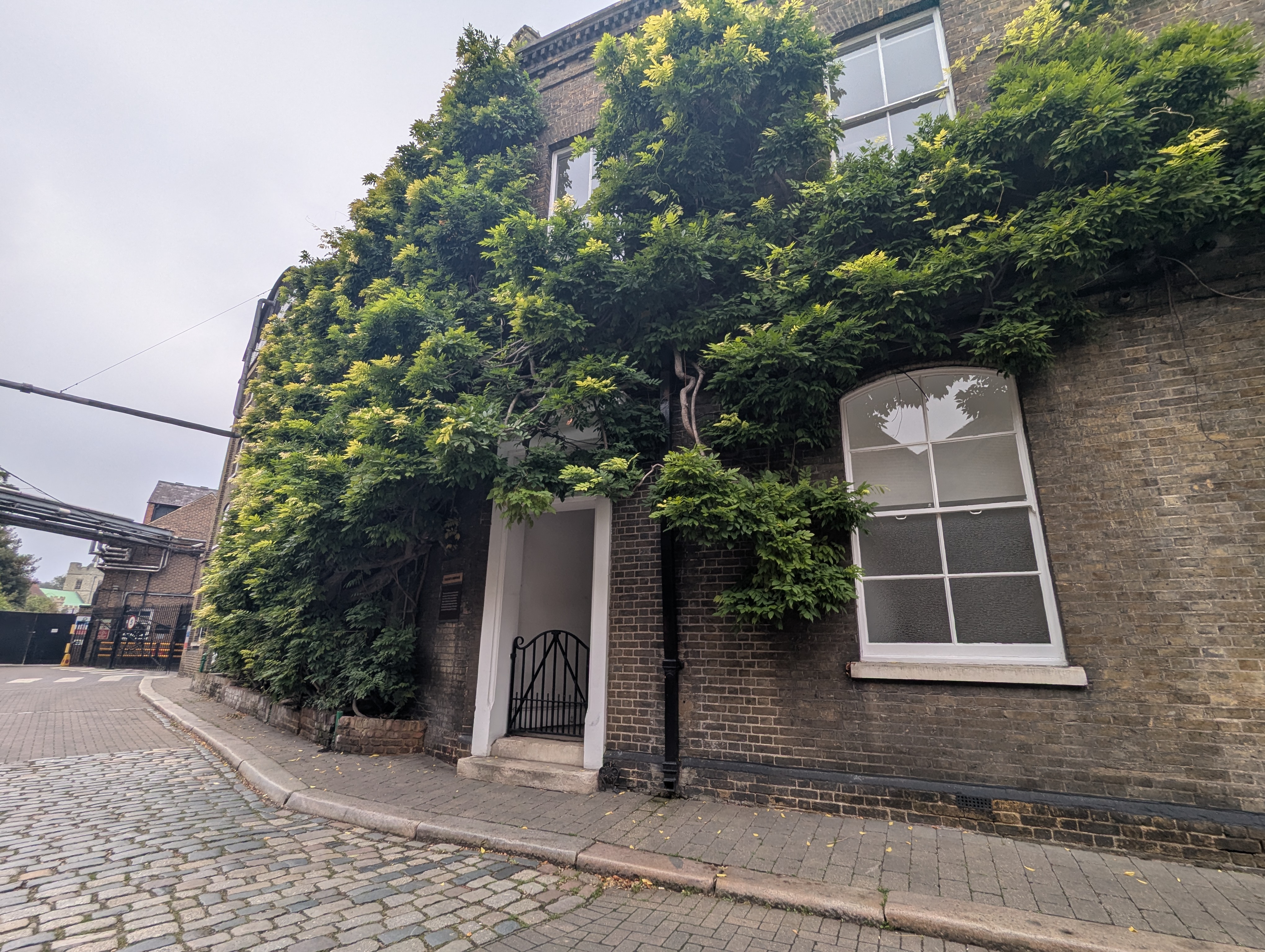
And as for the London Pride name. There is the obvious connotation, but the beer also shares a name with a perennial flower that grew out of bombing sites during WWII that came to be known as a symbol of resilience. We saw a little planter on site containing the plants, although not blooming in November, of course. (There was also an amazing, centuries old wisteria vine, supposedly the oldest in the UK, growing up the side of one of the buildings. It was not blooming but that must be beautiful in the summer.)
The title of my post comes from a 2013 London Pride ad campaign. Given the history of the brewery, how Fuller’s is made with water from the Thames, and how Fuller’s honors London’s history with the pubs it owns, it really seems like more than a slogan to say it’s “Made of London.”
I created a new page to track our progress through Fuller’s pubs, here, if you’d like to follow along. Many, many more to go!
I’m learning for the first time in nearly 20 years that you only get to bask in a winning football campaign for so long. Inevitably, the next one starts and you find yourself, more than you want to be, back in the moment. Back in the grind of watching your team trying to eke out wins and defend the title.
I did bask. I basked all summer. All during the World Cup, all during the pre-season. I still find myself basking even with the new season being not so new. Best as I can tell, I’m not special. At every match, home or away, we hear Arsenal fans chanting “We know what we are! We know what we are! Champions of England, we know what we are!”
It has been mostly sweet but a little bitter. The new season has come with a few goodbyes to players who were important in achieving our goal. Their replacements are mostly solid but I have little pangs of sadness when I look at videos of how we achieved the title and see players I love no longer among us.
I know, I know. Time to stop looking at videos.
Manager Mikel Arteta disagrees with the phrasing in my first paragraph up there. He says we are attacking the title, not defending it. However, having watched every game of the season–with our solid defending and not-as-impressive attacking–well, it’s entirely possible Arteta knows something about what we’ll be doing at some later point of the season.
“Attacking” the title or no, we are having a good season. With nine games under our belt, Arsenal are narrowly in top position, followed by Manchester City. Recently, it came out that Manchester City were found guilty of 114 of 115 charges against them for running roughshod over financial fair play rules starting in 2010. As the club attempts to appeal the charges, the team has played with defiance for most of the season, dropping points only in the last two matches. At some point it seems likely they will face a substantial points drop, but whether it will be this season or some season in the future is anyone’s guess. Whatever the situation, we have to aim to beat them. And a few other teams that are performing well. Brighton beat both Arsenal and Manchester City and sit in third. I have some confidence they will ultimately be sorted out by the Premier League, but we shall see.
With many managerial changes in the Premier League over the summer, Mikel Arteta at 44 is now the Premier League’s longest tenured manager. As careful as he’s been over the past couple of years to give no ammunition to anyone else about what he really thinks about other teams, what he thinks about refereeing decisions, or the unusual methods he’s deployed to get the best out of the team, he’s had two weeks of hilarious commentary after matches. After a match in which he received a yellow card for leaving the manager’s area, it was reported that he claimed he has files of photographic evidence of other managers leaving their area with no charge. After a match in which an Arsenal defender was extremely lucky not to give up a penalty when pulling back an opponent by the shirt just as he was close to heading the ball into the net, it was reported that Arteta claimed he has files of photographic evidence of defenders doing the same without punishment.
I read a summary of the first comment on social media and thought, “That must be made up.” It was not. Nor was the second one. He really did say that. Leaving us to wonder if he has made his own library of files or, Trump-style, has some hapless “human printer”-like person on staff.
Very little Mikel Arteta can say would make me love him less, even when I can recognize the thing he said requires somewhat blind love. There are photographs and videos a man might possess that would make me rethink my admiration, but these photographs and videos? I can let this slide.
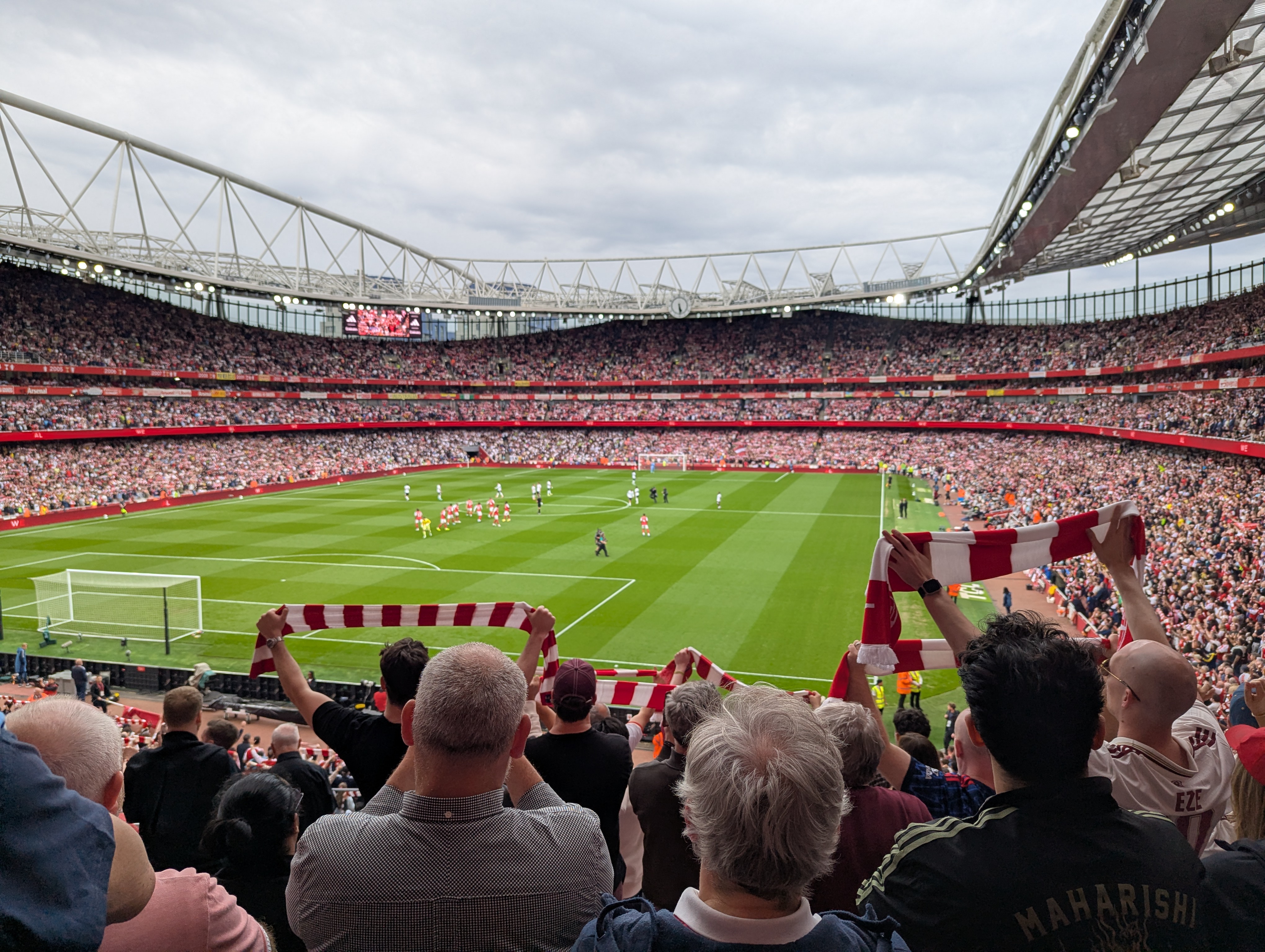
Meanwhile, I have not a single photo of the Emirates while it’s been the home of the champions. Are you tired of me saying so?: Match tickets have been extremely hard to come by. My husband and I have failed in the lottery every match, followed up by failing on the exchange every match. Even for some pretty pedestrian matches. Meanwhile, the price of airfare has been terrible. Even if we had been lucky enough to get tickets, it’s not clear that we would have been able to justify the cost of getting to London.
But all that is about to change. As hard as it’s been to get tickets to any Arsenal home match, it was reasonably easy to get tickets on the exchange for this weekend’s match against Hull City. And airfare was blessedly ok.
My flight into Heathrow arrived later than normal because flights were pretty expensive. I ended up booking a flight that connected through Dublin. The extra leg was welcome because it allowed me a bit more sleep before getting on the Tube. I often fall asleep on the Tube from Heathrow to wherever our hotel is, but usually my husband is present and awake to be part of ensuring we get off at the right stop. Not this time. Although he, my son, and I kept trying to get tickets for the match even after I booked my flight, no tickets materialized.
I held off booking my hotel until two days before I departed since we were hoping my son and/or husband might make it. Do you book a hotel for one, two that are married, two that are not married, or three? I ended up hedging and selecting something appropriate for two that were married, a room at The Exhibitionist, a tiny, somewhat kitschy hotel in Kensington close to the South Kensington Tube stop. Easy access to the airport and on the same line as the Arsenal stop, albeit not super close to the stadium. Great neighborhood we’ve been in a few times and it worked well for me. They checked me in immediately upon arrival and I took the opportunity to take a short nap before showering. A full bath with both a tub and a separate shower, and the rain head was serious about my cleanliness.
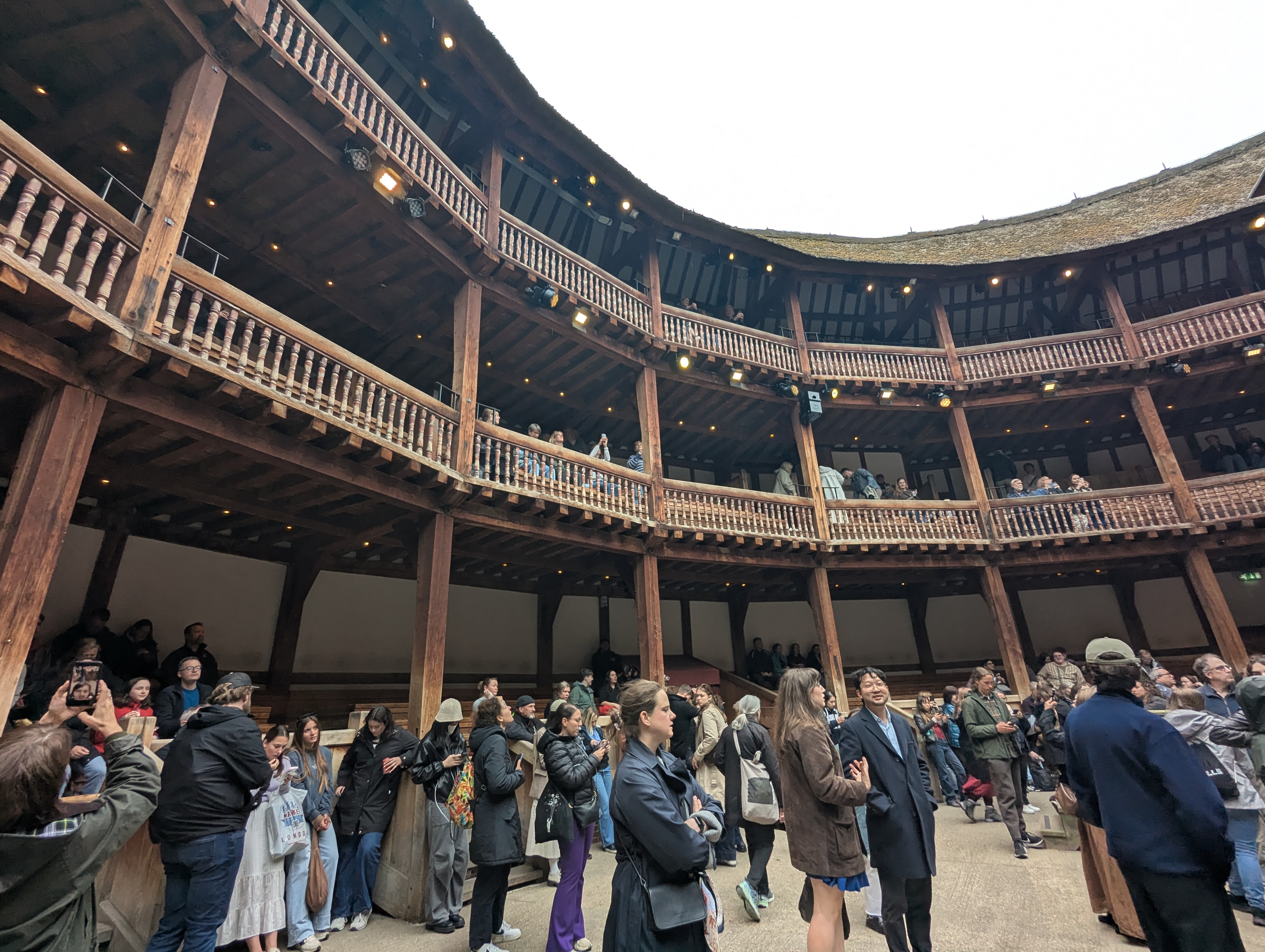
I’d booked cheap groundling tickets to A Midsummer Night’s Dream at Shakespeare’s Globe Theatre for the evening. Good activity to do on your own, reasonably priced so you can bag it if you’re too tired or the weather is bad. This is a comedy in the star-crossed lover genre and one I know pretty well. It’s probably one of the more accessible Shakespeare plays and very popular among park theatre productions.
It was a Sunday evening and although the play was well-attended, it was not incredibly crowded either. The Globe does a great job of involving the audience to keep things fun and interesting and they outdid themselves on this occasion. Before the play even started, they had the audience singing in rounds, practicing dance steps, and reciting sections from various Shakespeare plays. The groundling section was mostly populated with young people who were happy to participate and, once the play began, seemed to really enjoy it. The play was fun and well acted, but being in a really engaged audience made it even better. The actors occasionally brought members of the audience onto the stage to perform various roles and everyone had a wonderful time.
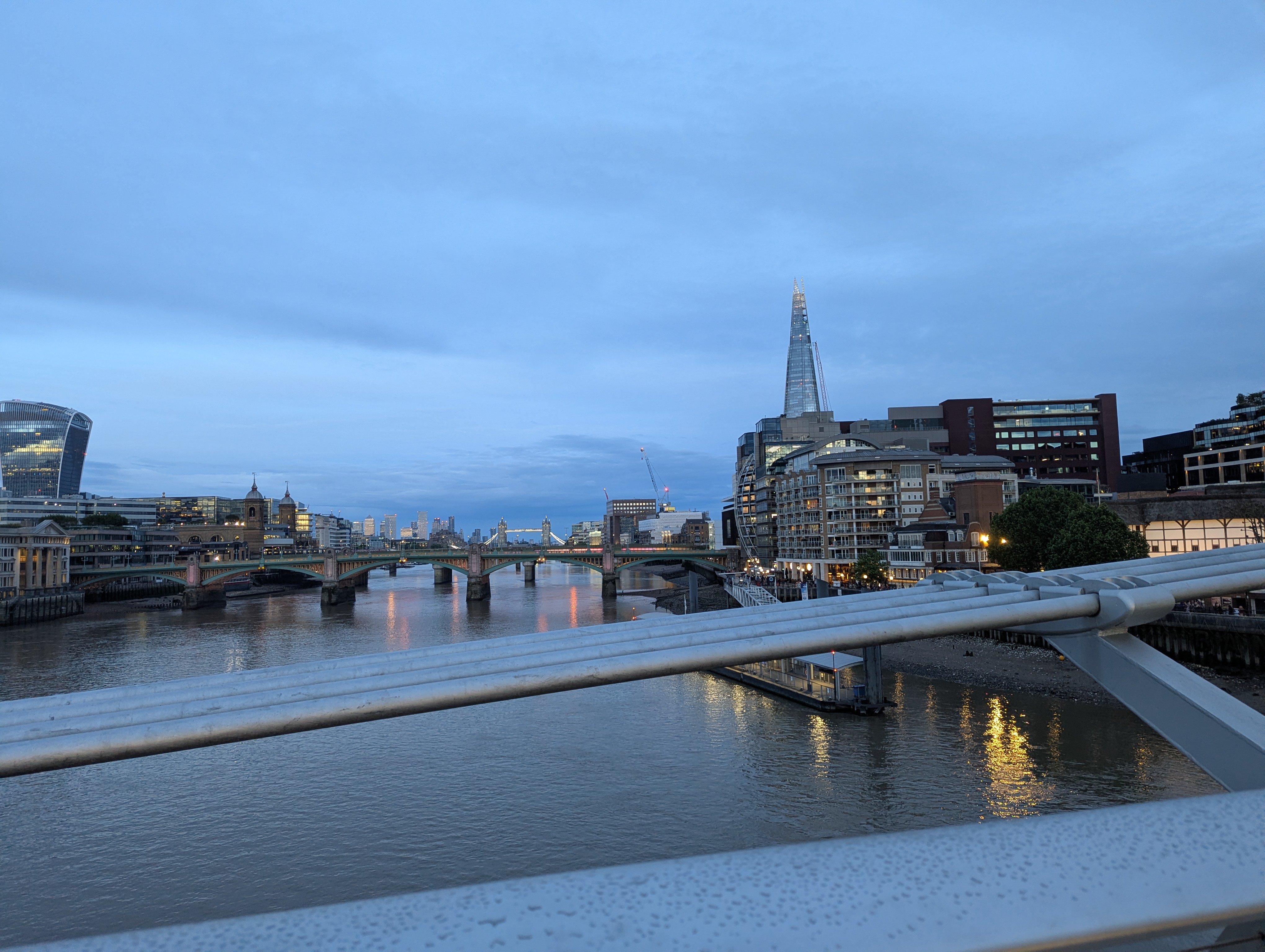
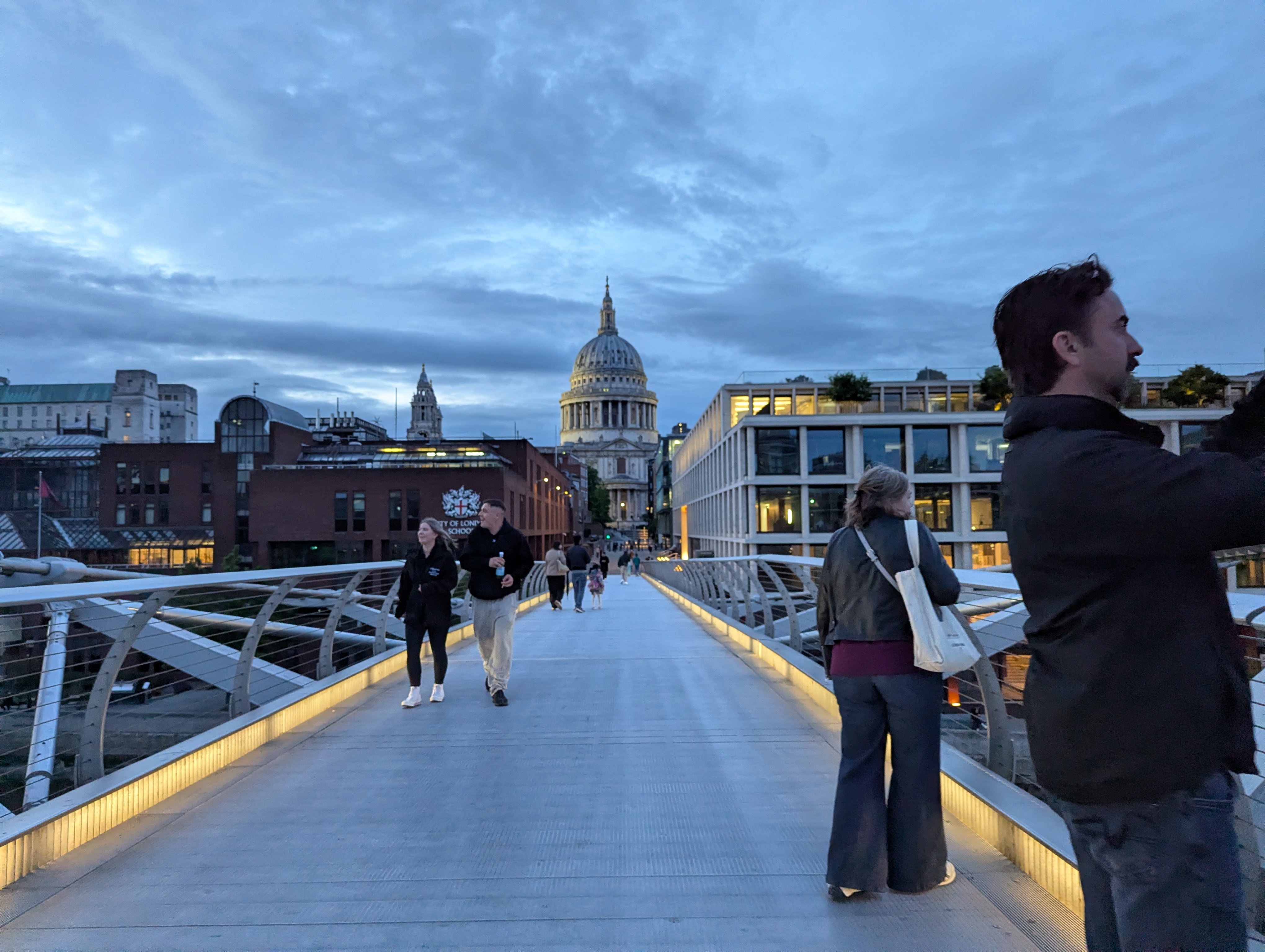
The play started relatively early and ended at dusk. The walk back to the Tube over Millennium Bridge was particularly nice. There were very few people out on a Sunday evening and I was surprised to be able to hear the birds calling as I walked over the bridge and enjoyed the views to St. Paul’s Cathedral and the Shard.
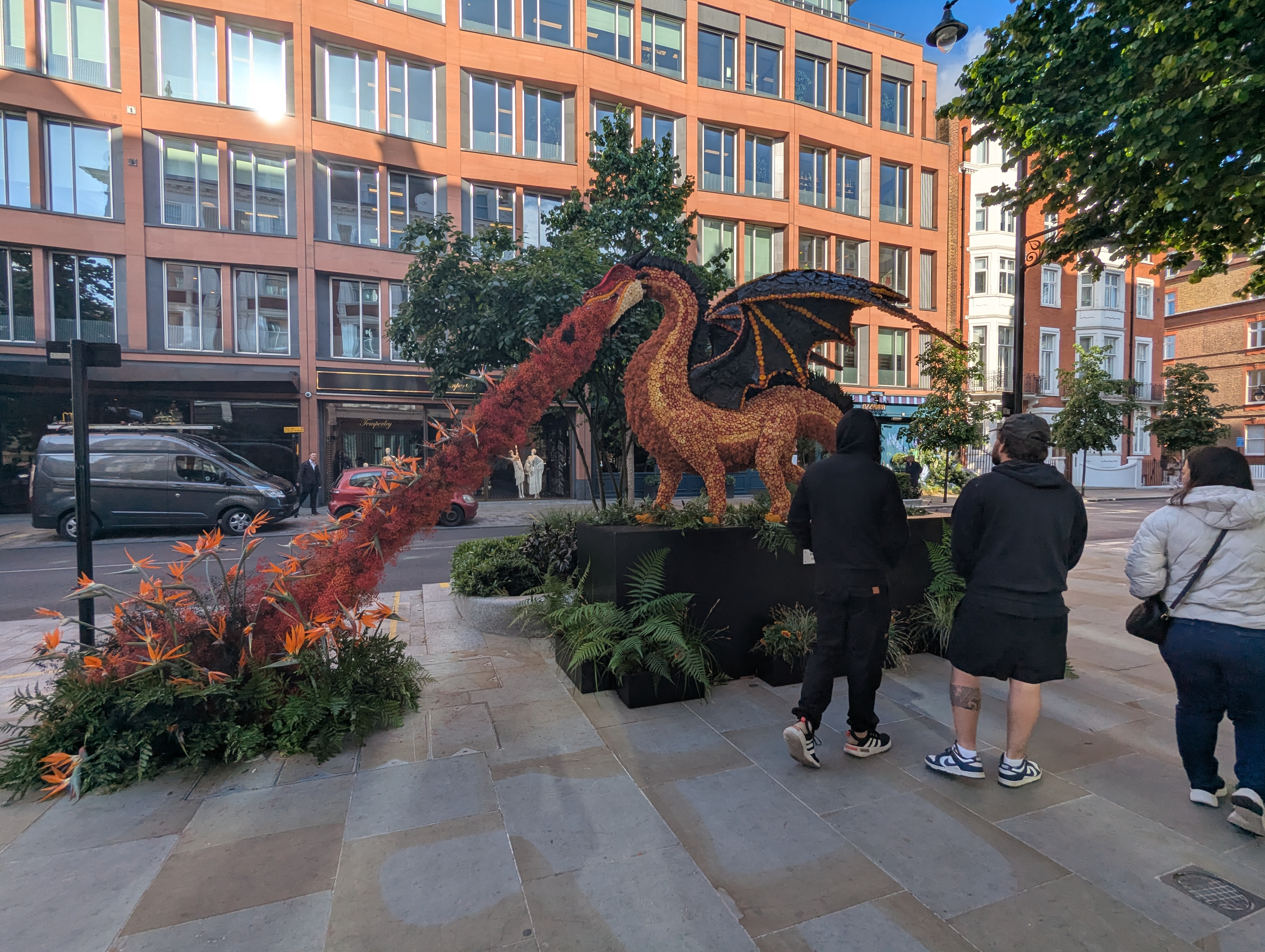
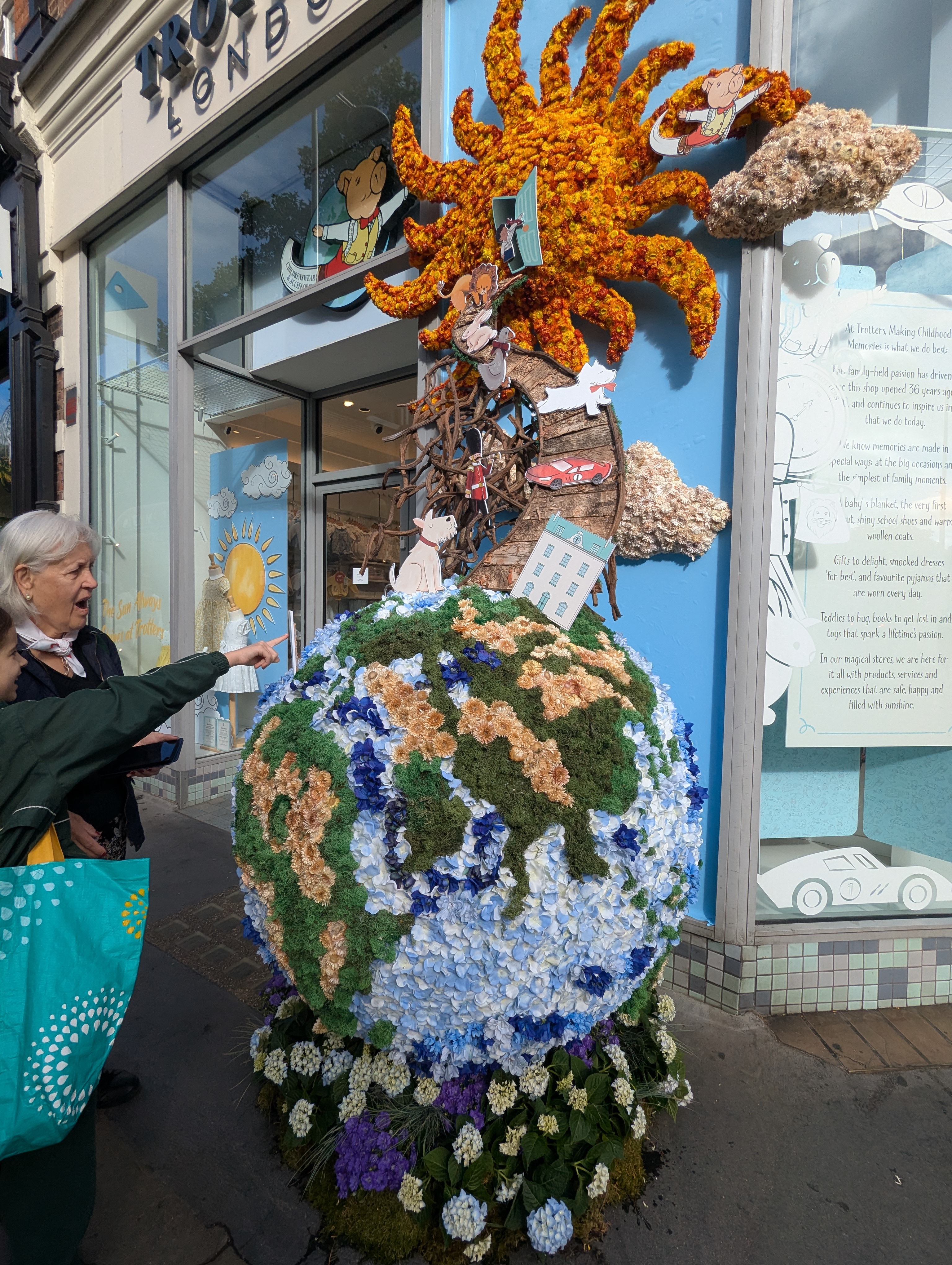
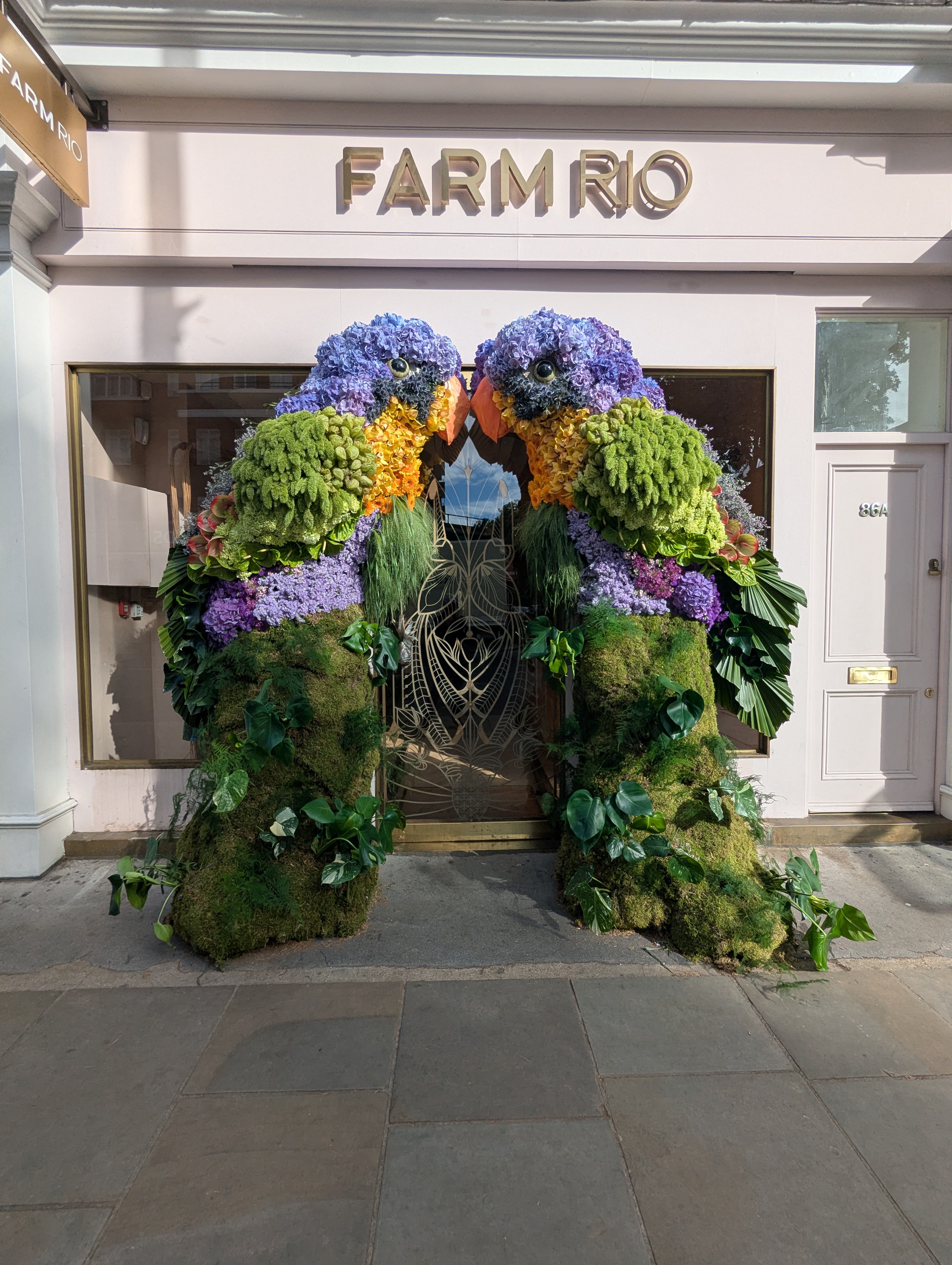
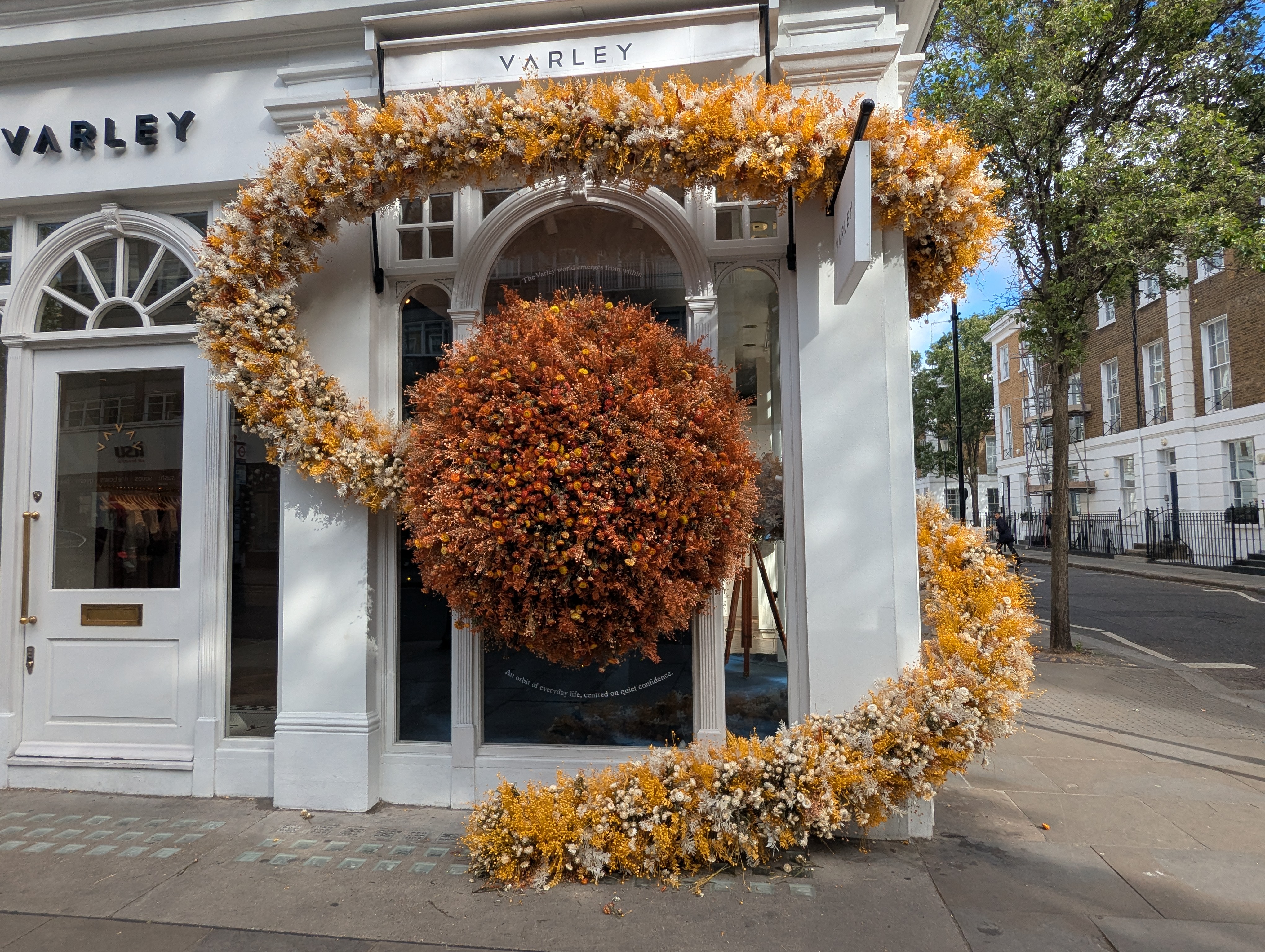
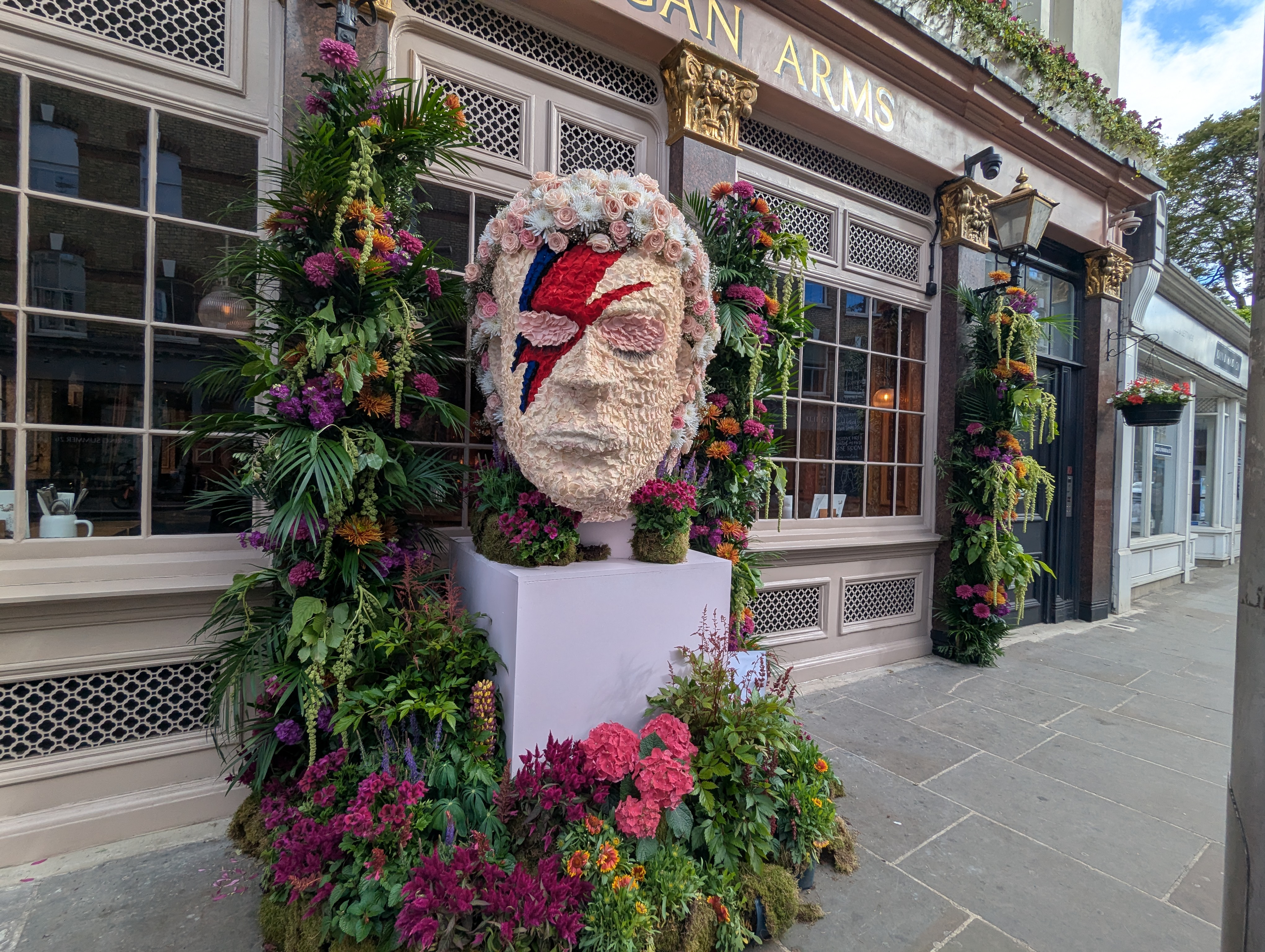
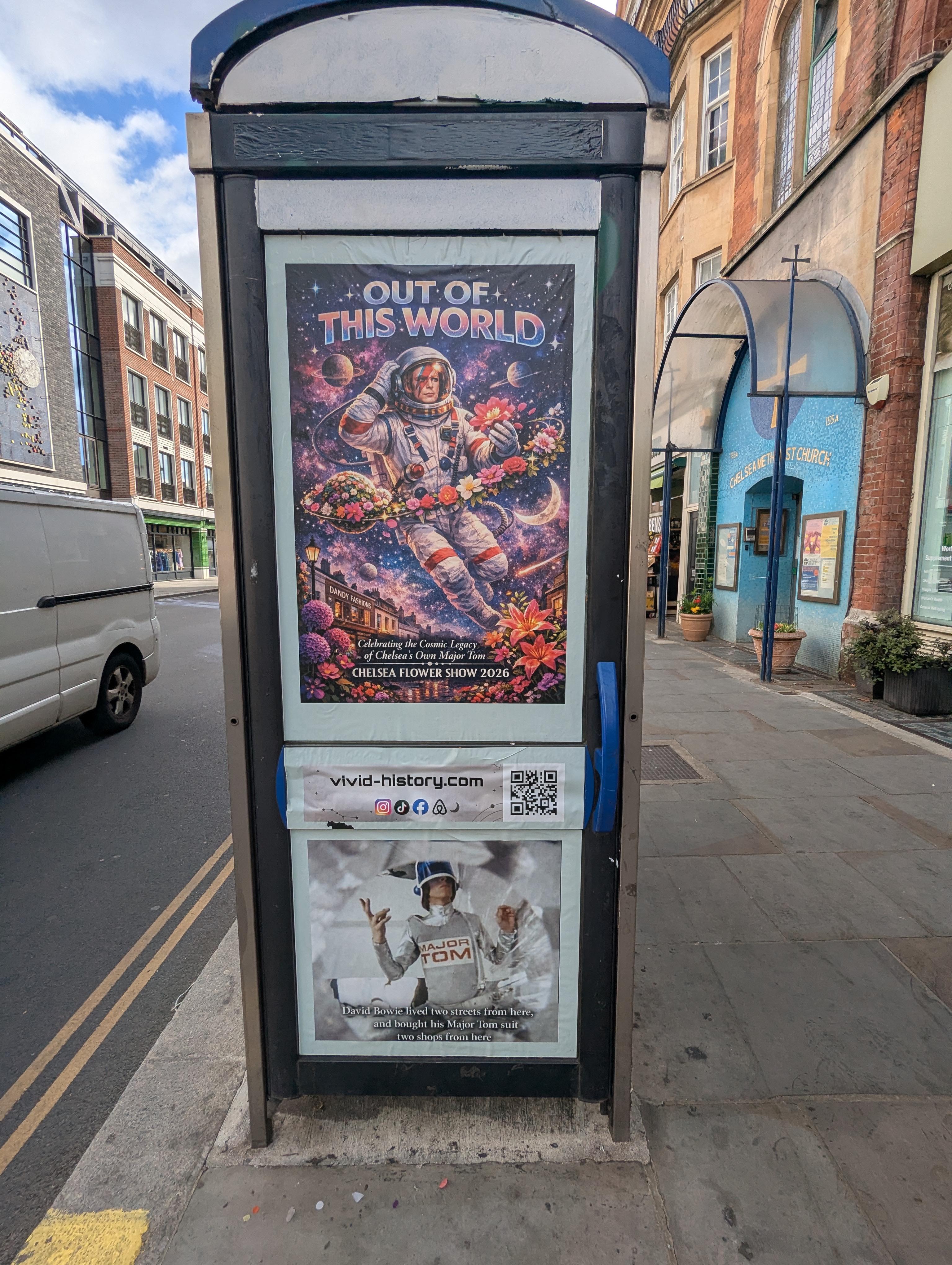
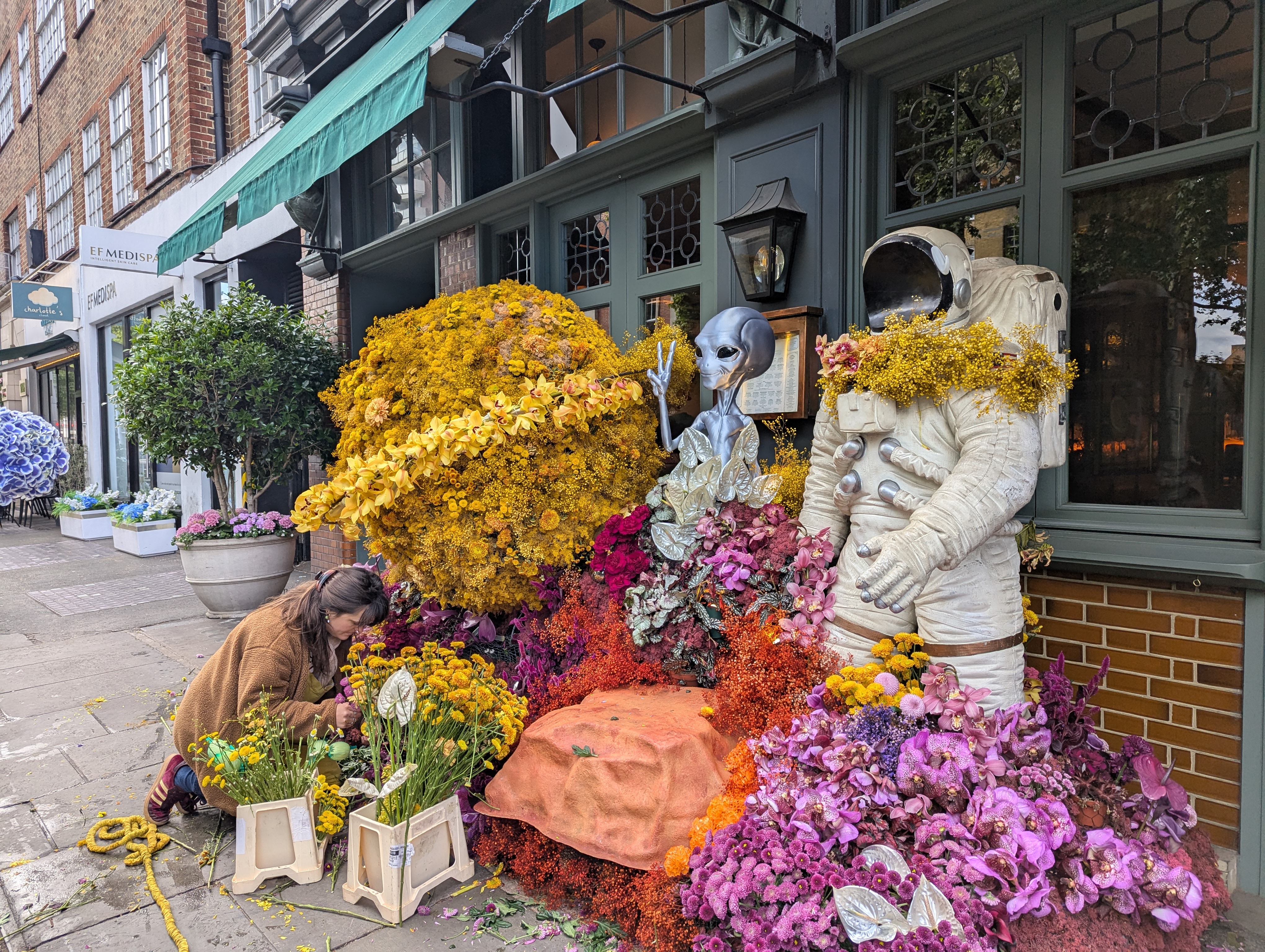
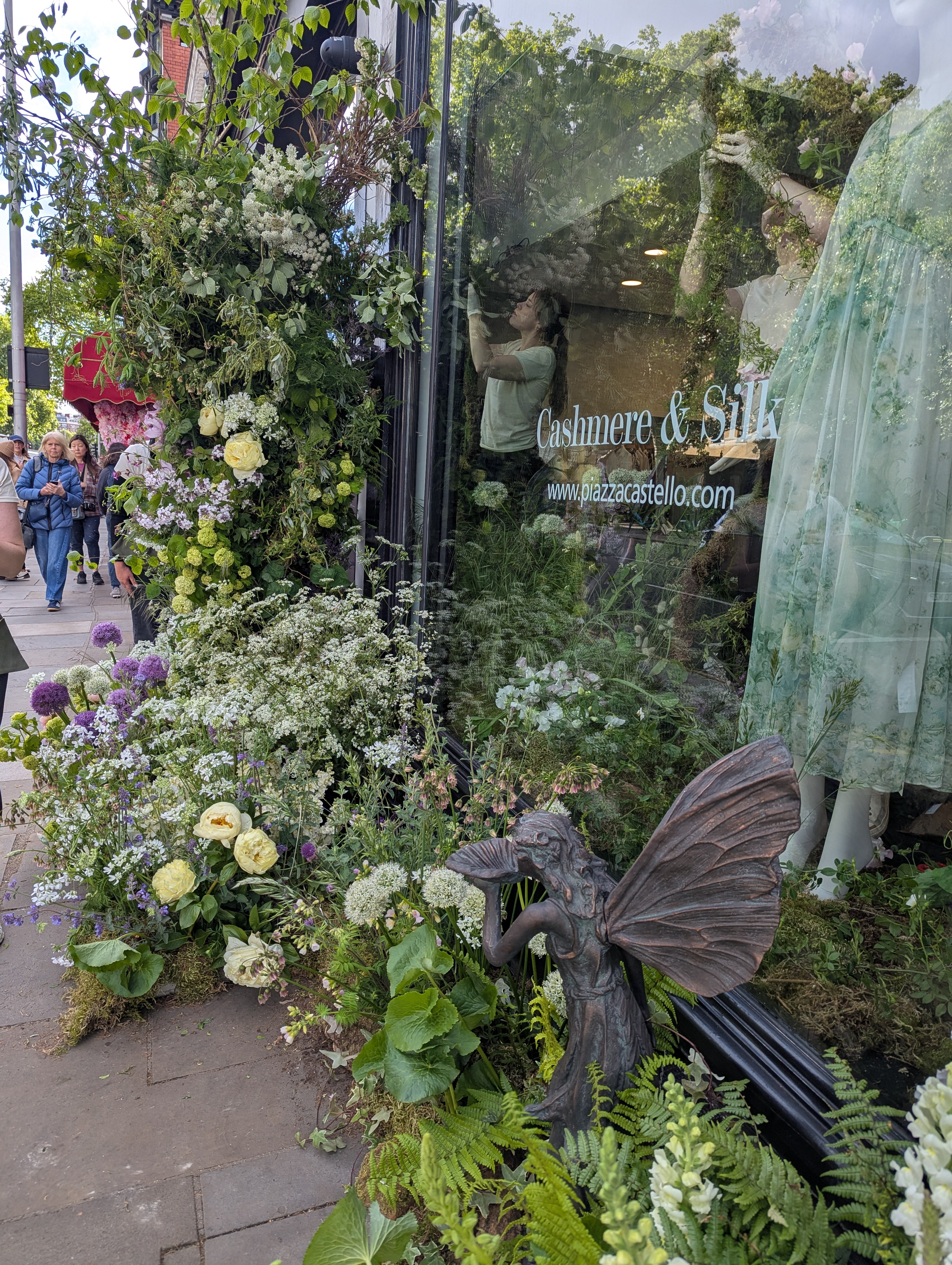
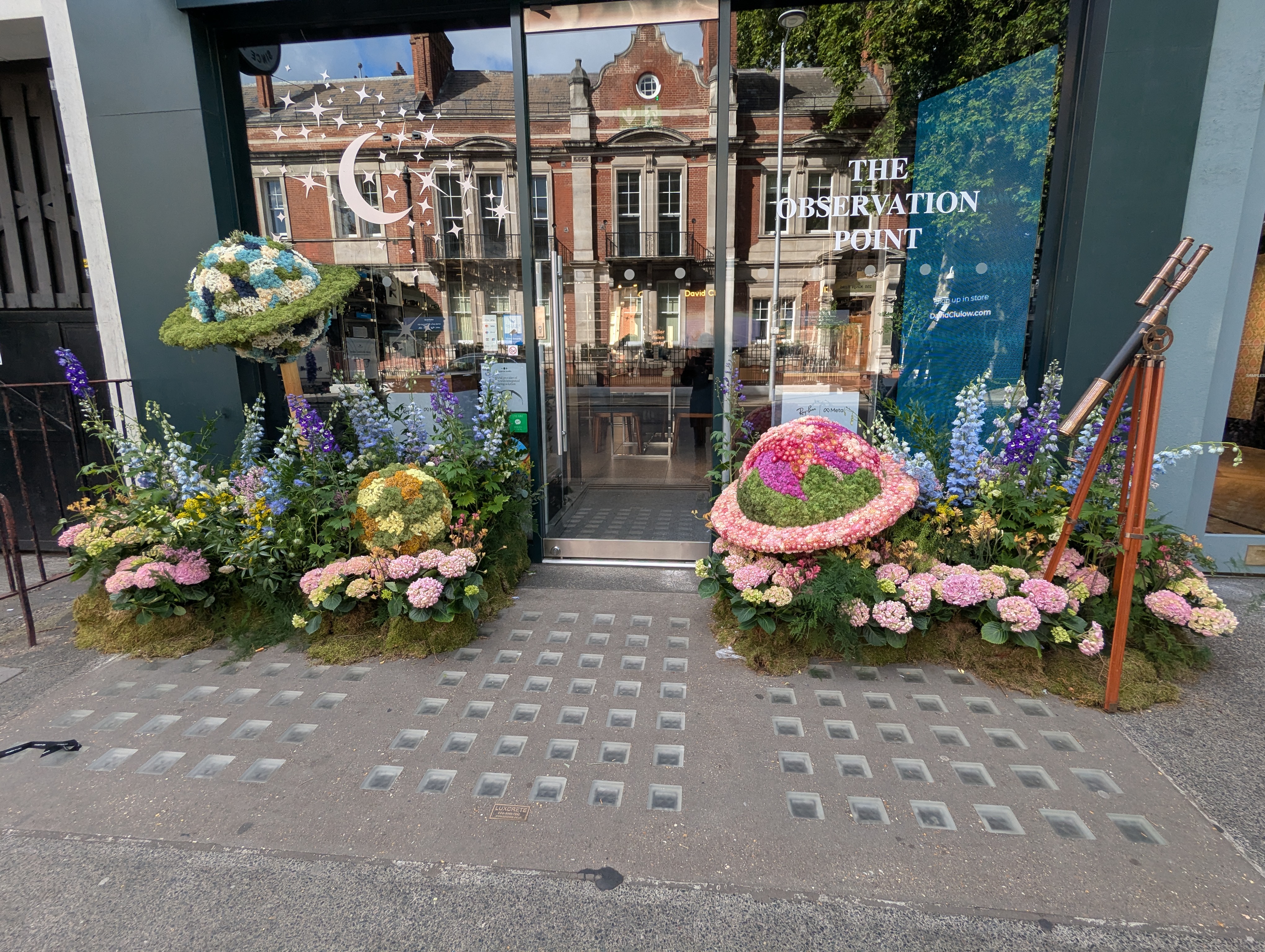
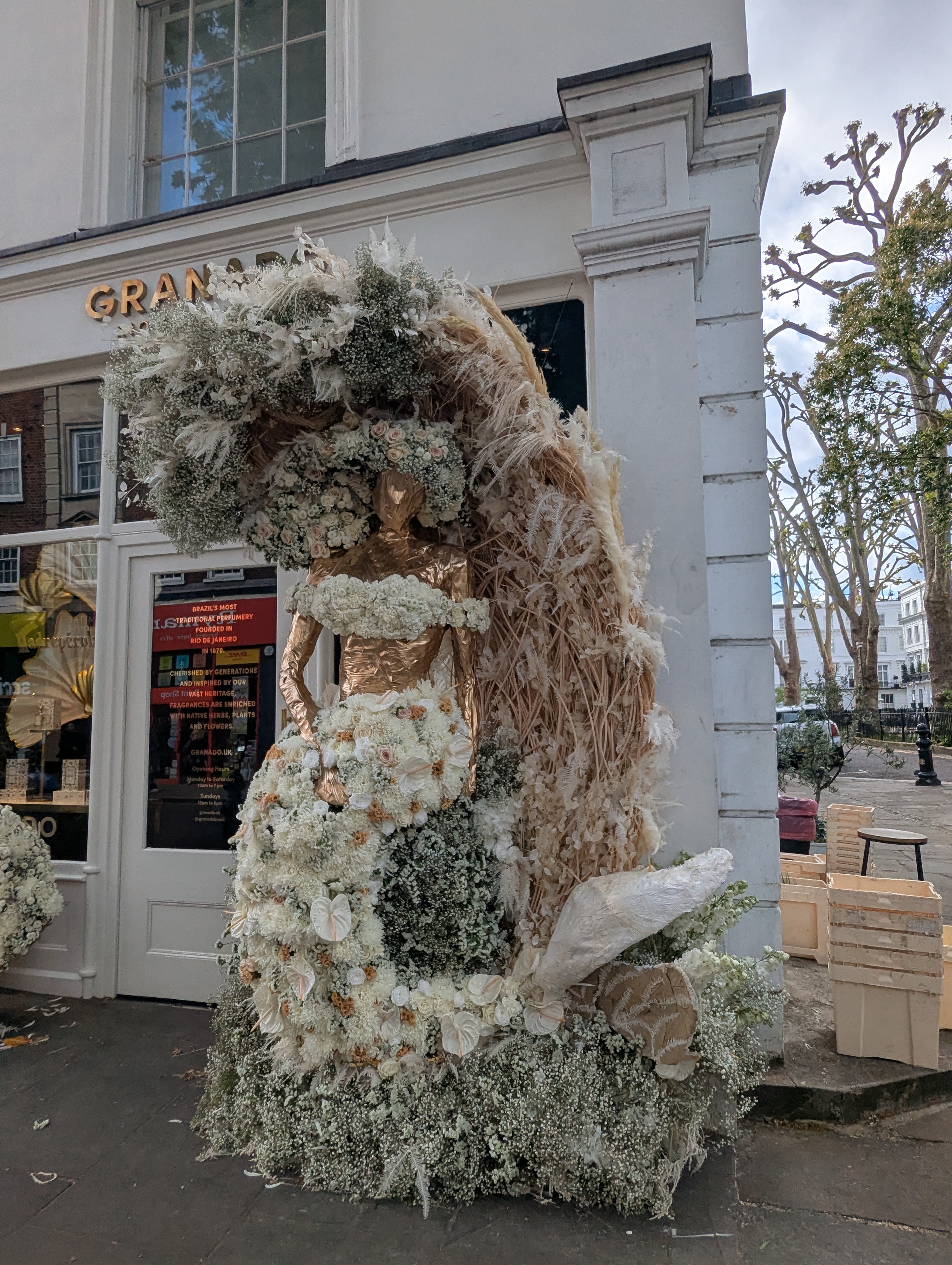
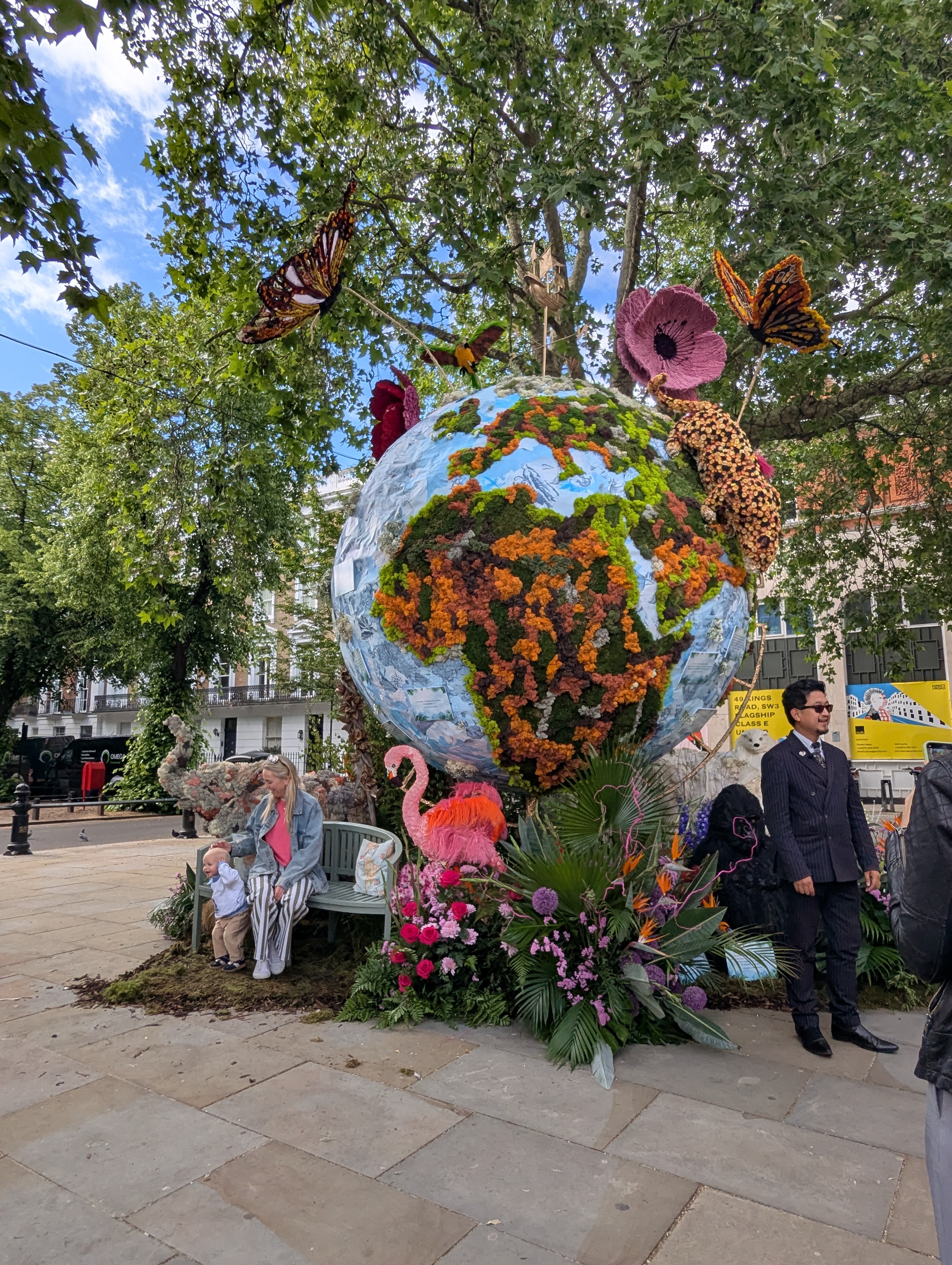
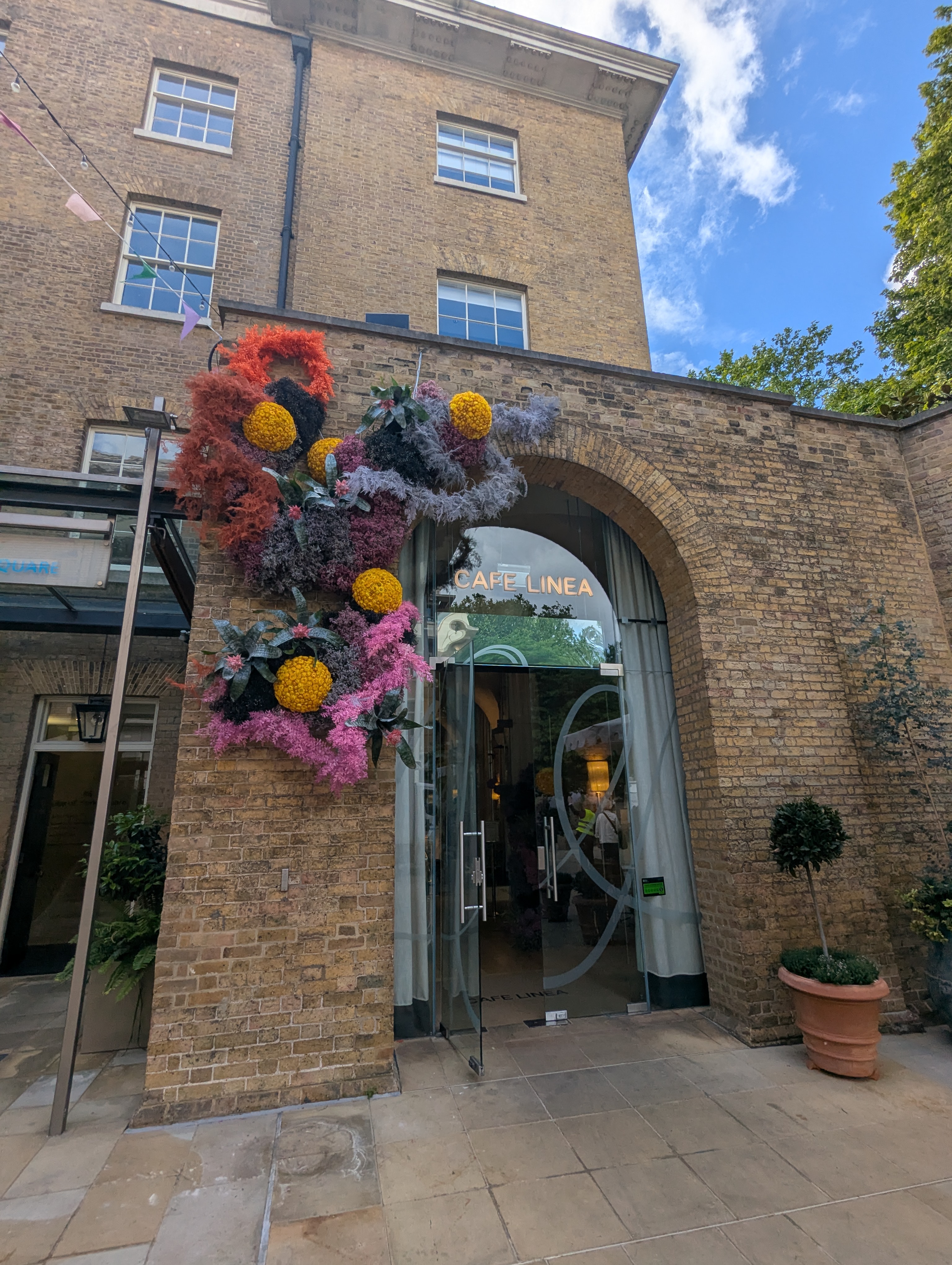
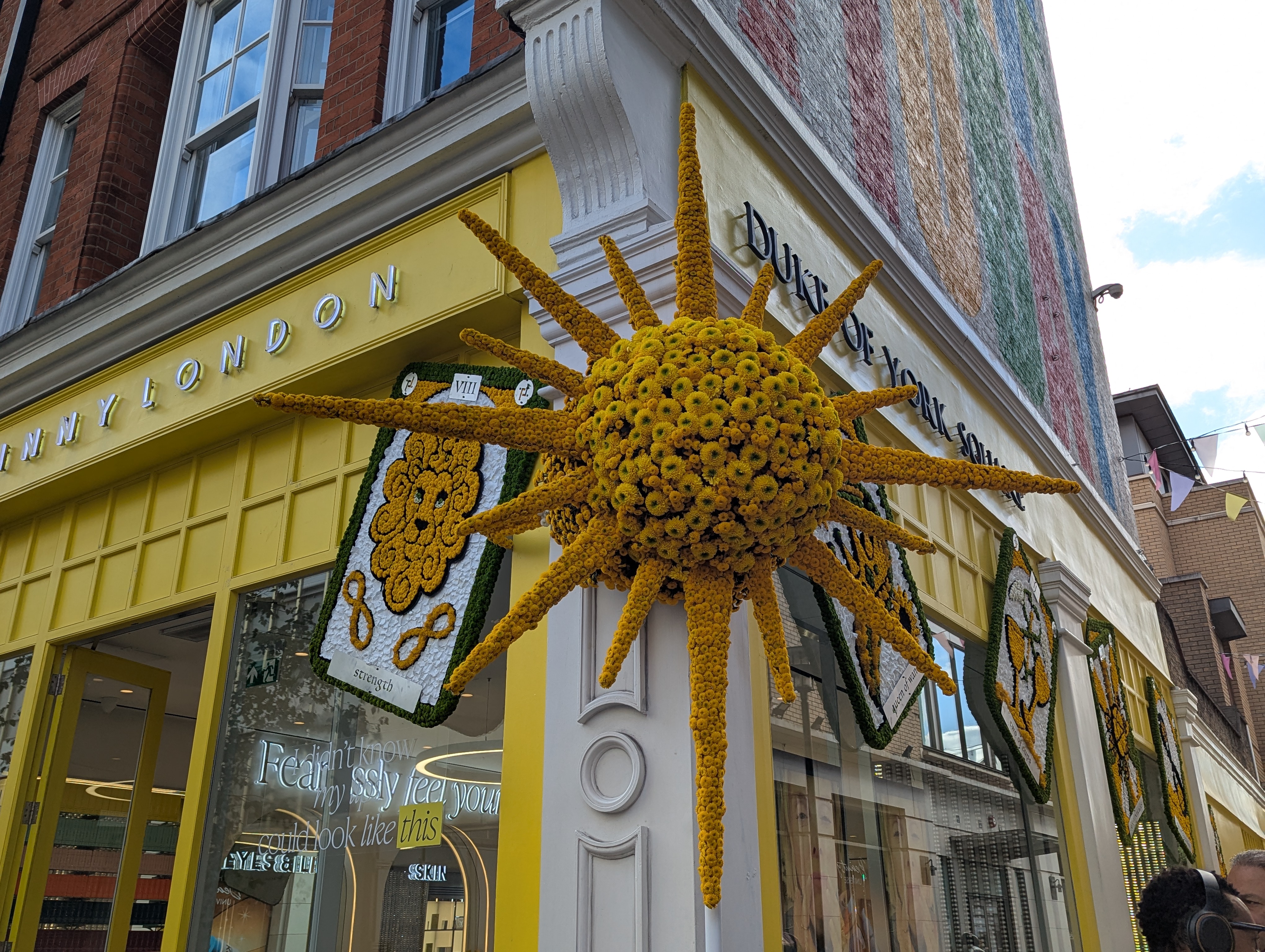
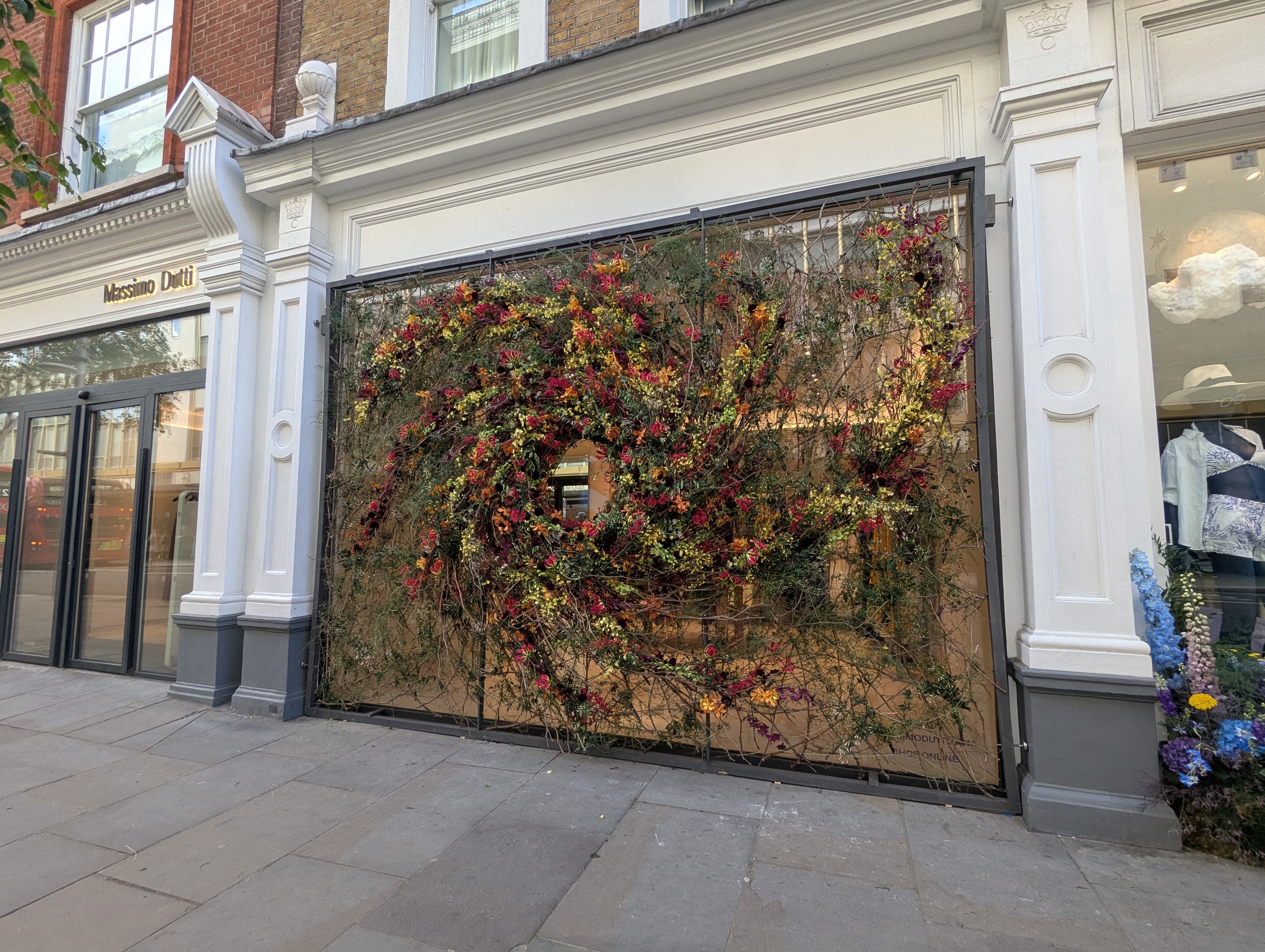
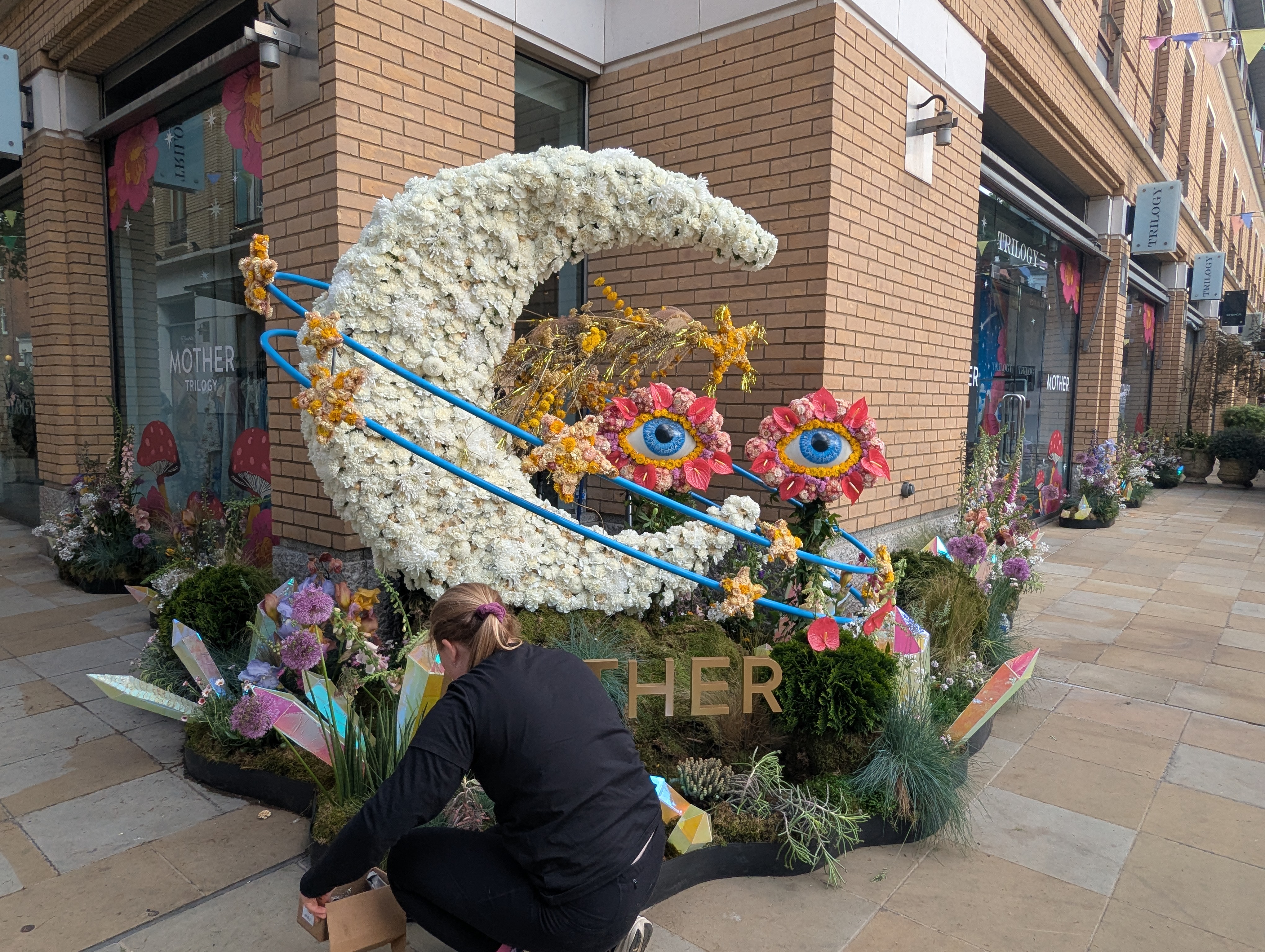
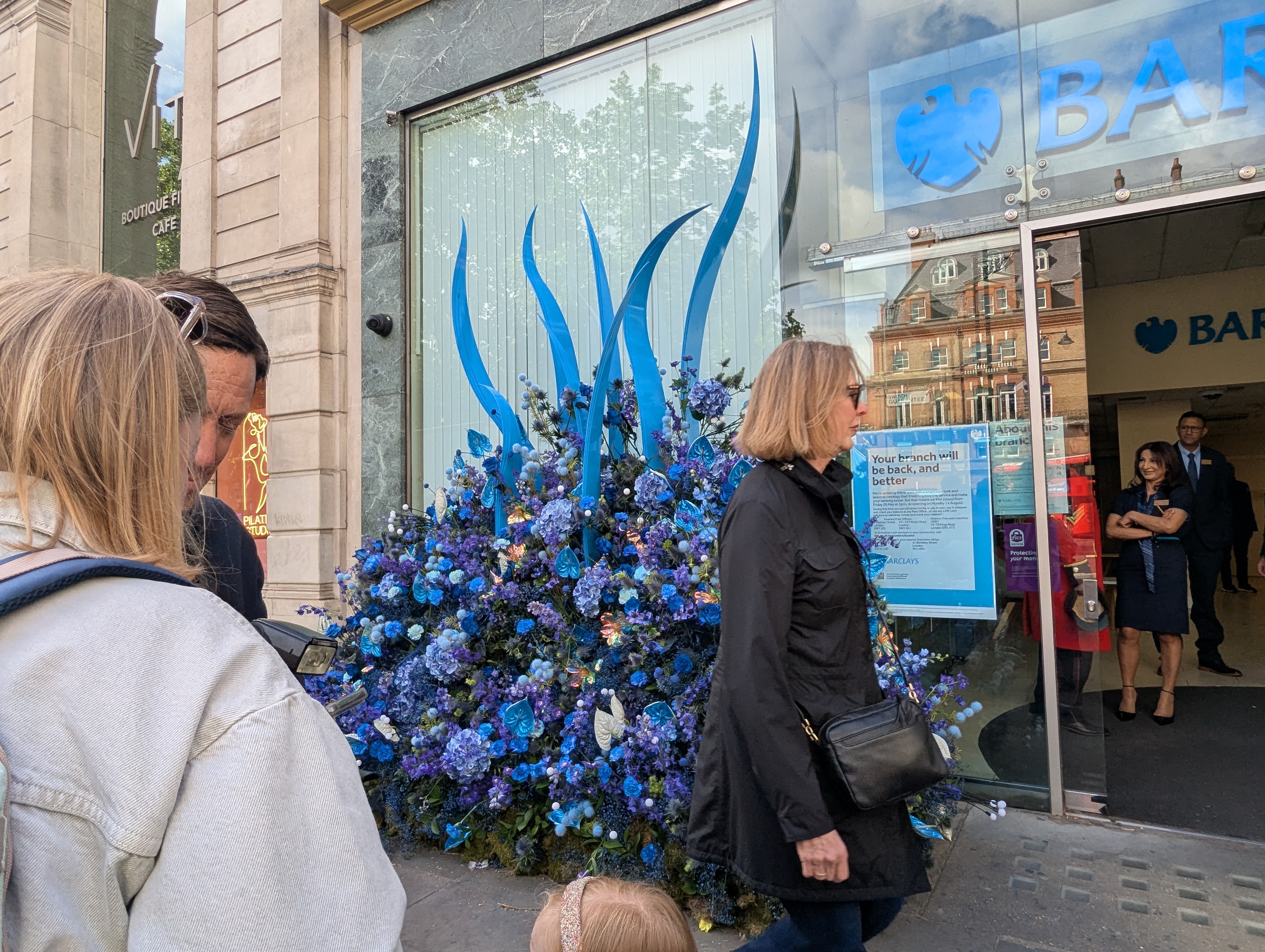
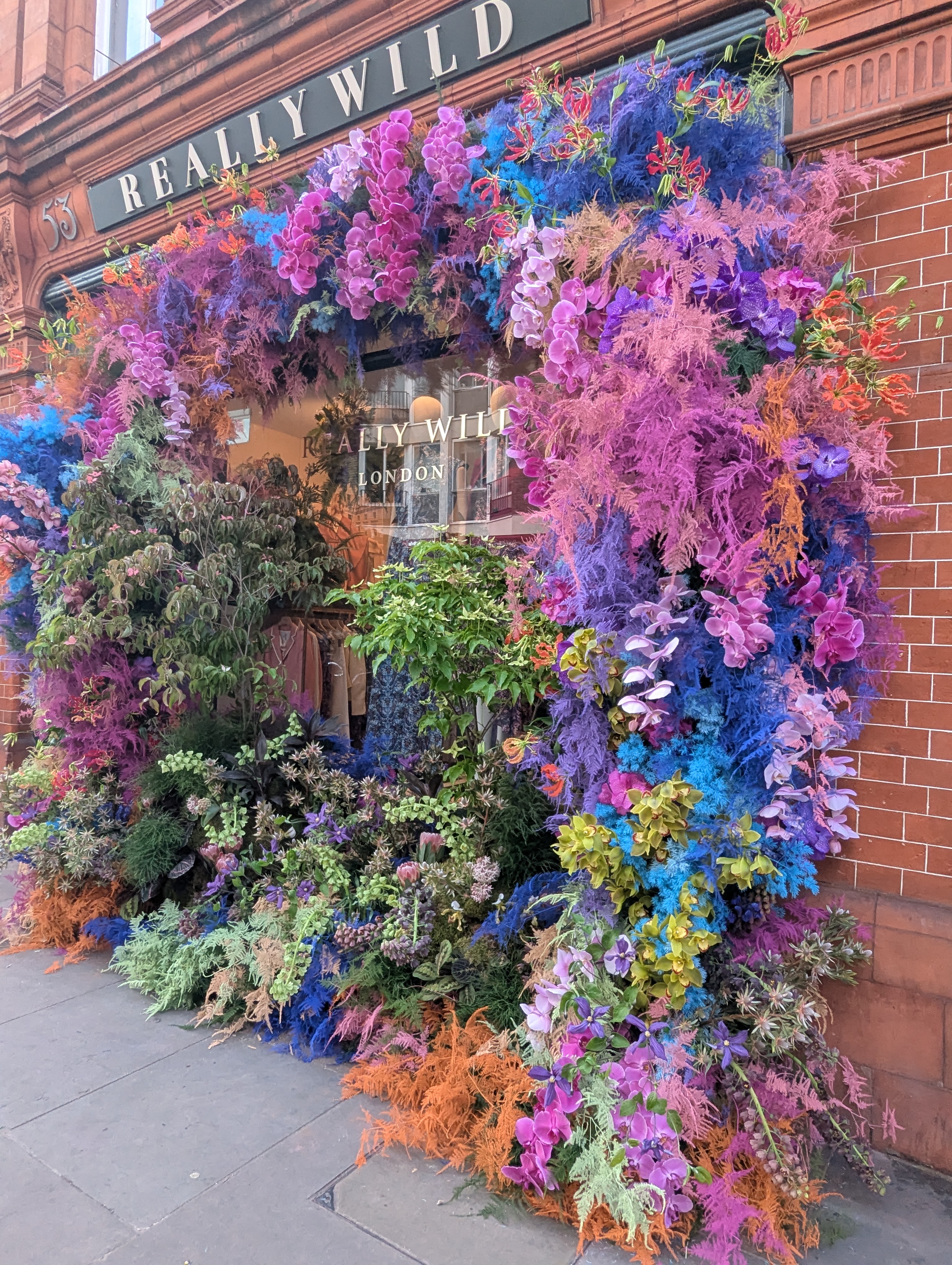
Sleep was somewhat elusive that night (reference the afternoon nap described above). I had made plans for Monday in light of the match in the evening and the fact my husband was not with me. Visiting gardens is probably not at the top of his list, but I figured that would be fun for me. A few months ago, I had watched a movie on Netflix called Dare to be Wild, based on a real, past participant in the Chelsea Flower Show named Mary Reynolds. I won’t pretend to know everything that happens in the Chelsea Flower Show, but part of it includes a landscape competition. Mary Reynolds had a big idea and applied to enter the competition. Her idea was selected to be built out and the movie was about all the problems she had to overcome to bring her vision to fruition, and win. Anyway, the Chelsea Flower Show was days away from my visit and therefore not a possibility, but an event that takes place starting in advance of the flower show is “Chelsea in Bloom.” During this festival, many shops in the Chelsea neighborhood decorate their storefronts with floral displays. This year, around the theme, “Out of this world.”
I had decided to spend some time visiting Chelsea in Bloom, but my bad night’s sleep had me out in Chelsea much earlier than I originally planned. This was a good thing and a bad thing. Chelsea in Bloom started that day and some shops were still just working on their displays when I went through. To the good, though, I was able to enjoy most of the displays before the crowds set in. Most of the displays used real flowers. Not only were the displays beautiful and sometimes just fun and creative, I enjoyed how different shops interpreted the theme. There was a lot of outer space influence, as you might expect, but sometimes “Out of this world” was interpreted as out of the world of England. For example, there was a floral exhibit of cactuses. And sometimes it was interpreted as imaginary creatures, like unicorns and mermaids. It was so lovely and fun to see how people walking to work or to school were reacting to the displays. Everyone seemed so happy.
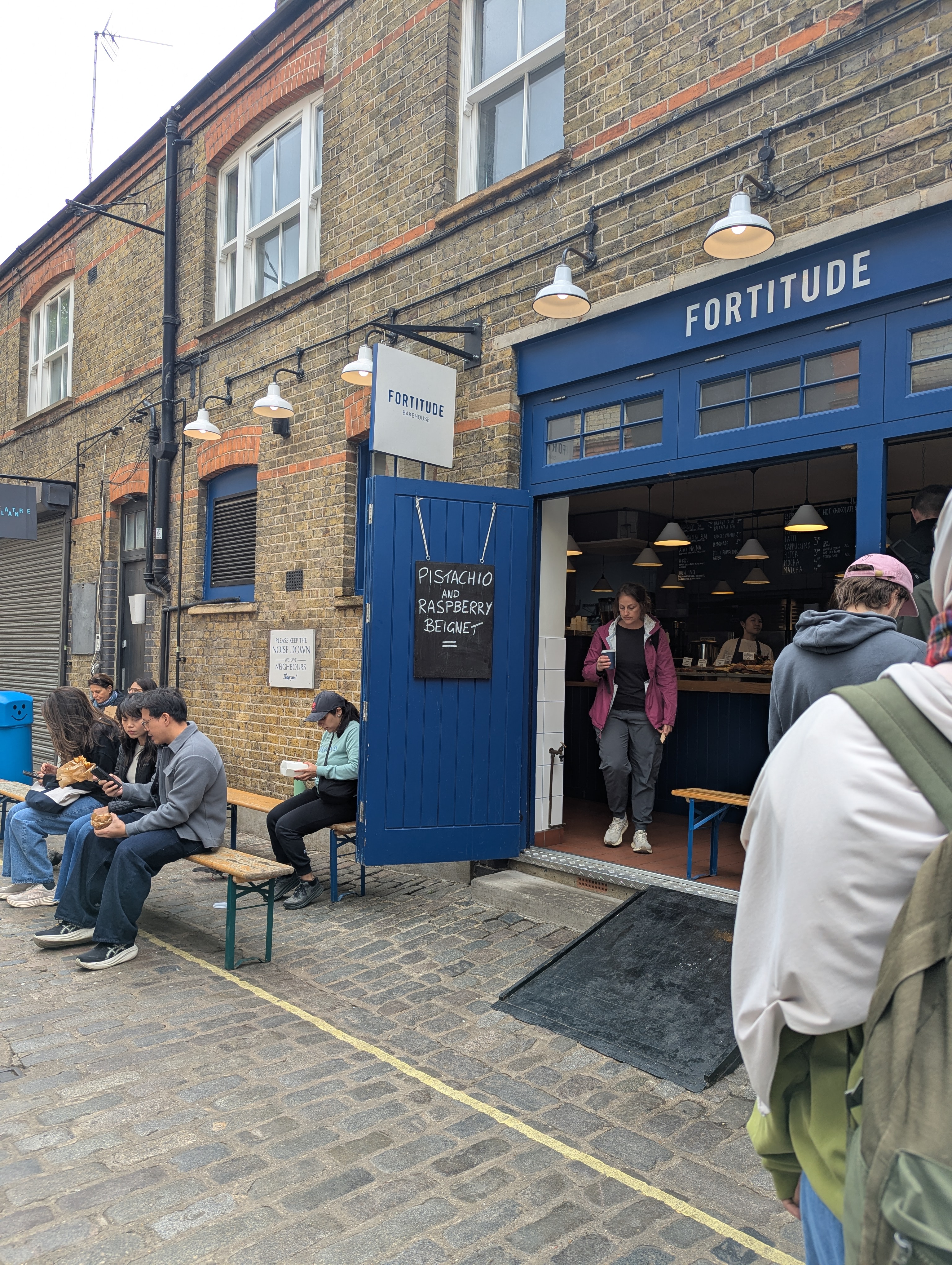
After walking all through Chelsea I decided to revisit Fortitude Bakehouse, a bakery near Russell Square my niece had told me about that I visited once last year. Famous for their cream-stuffed beignets that aren’t available until 11 a.m. It’s lunch! Fortitude was not really close to my hotel or Chelsea in Bloom but whatevs. I had time on my hands. Today’s flavor was pistachio and raspberry. Half of one would be plenty, even for lunch, but I took mine into a pretty park and ate the whole thing. With tea to wash it down. Delicious. Not health food.
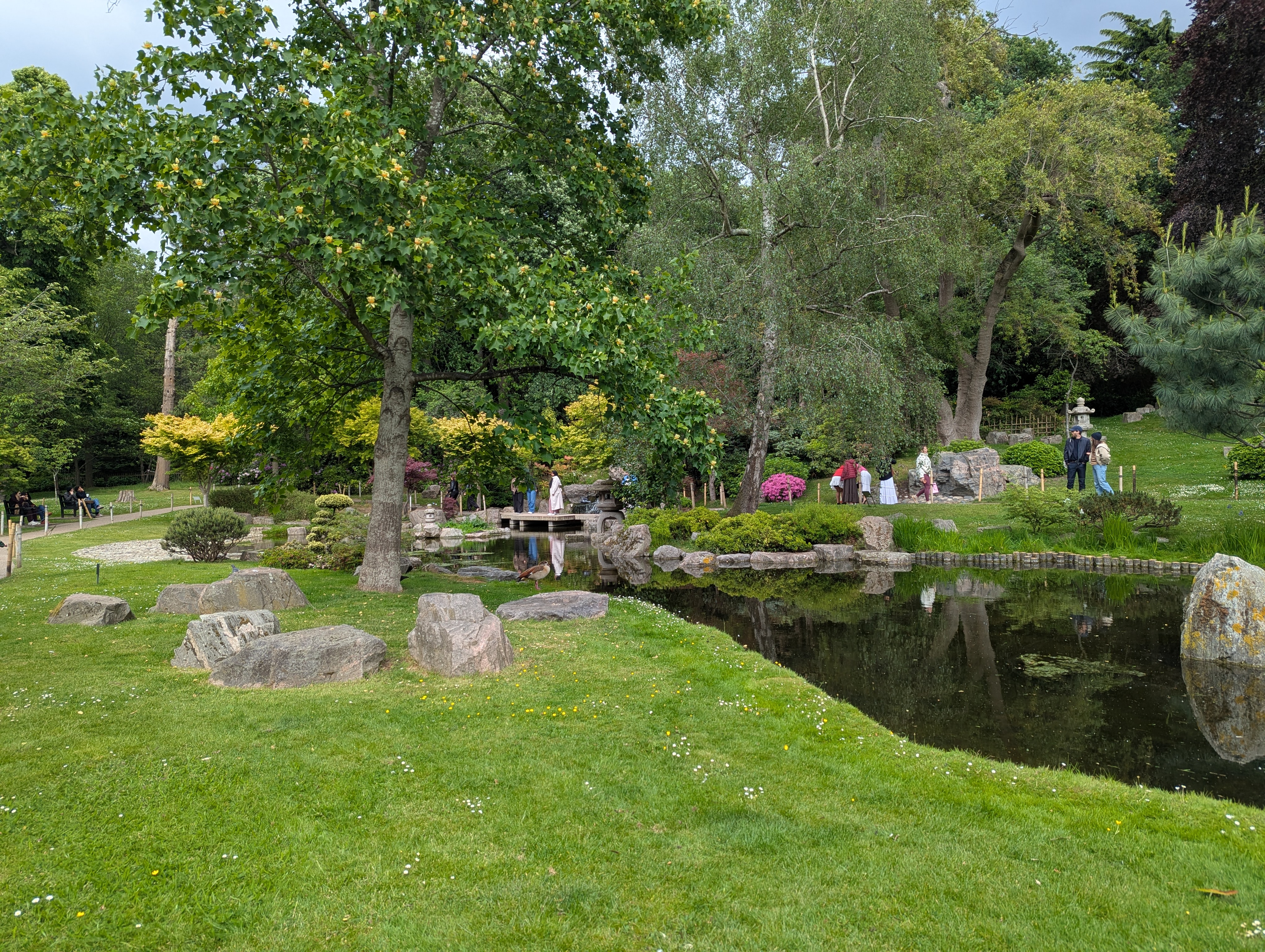
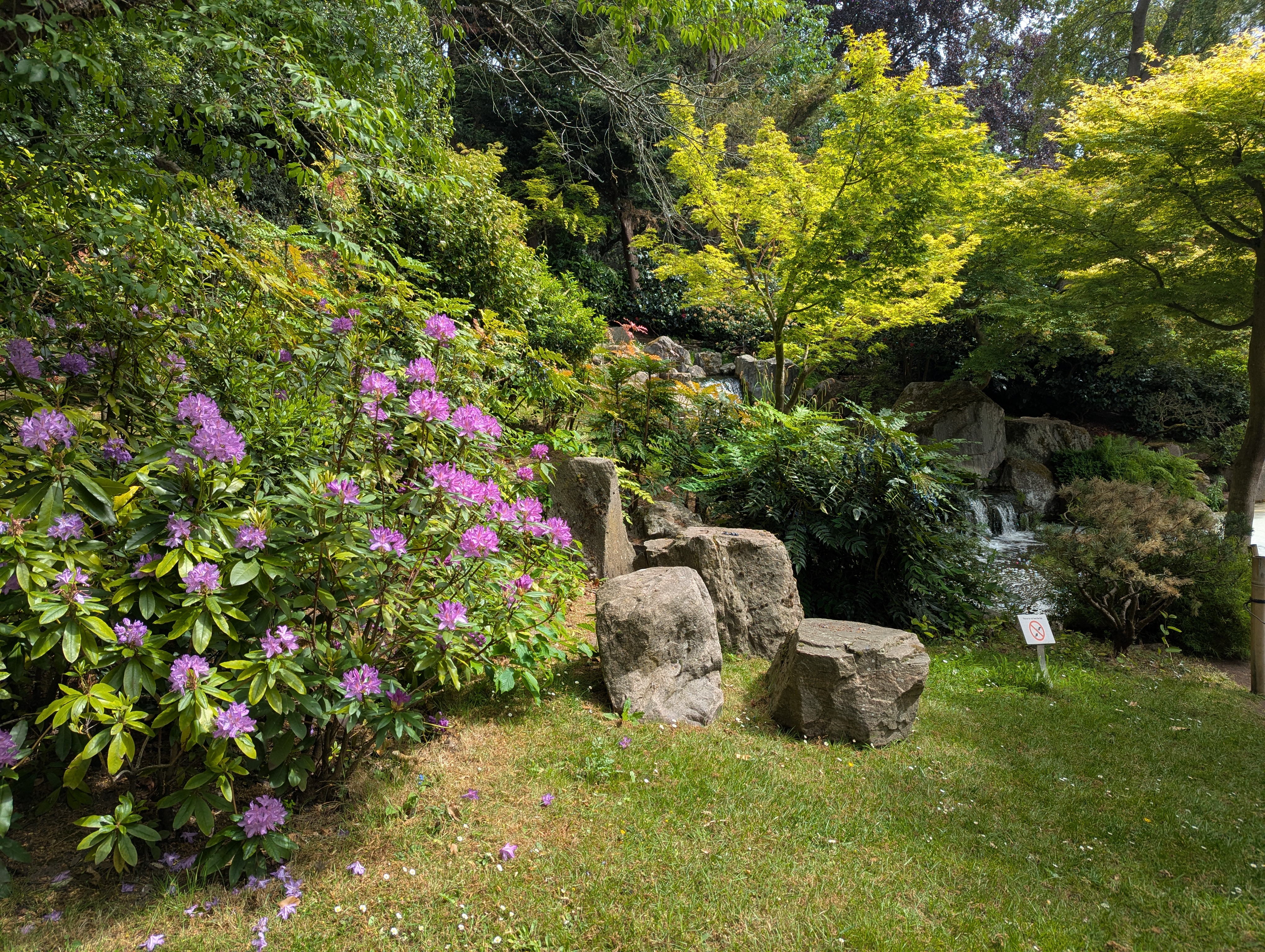
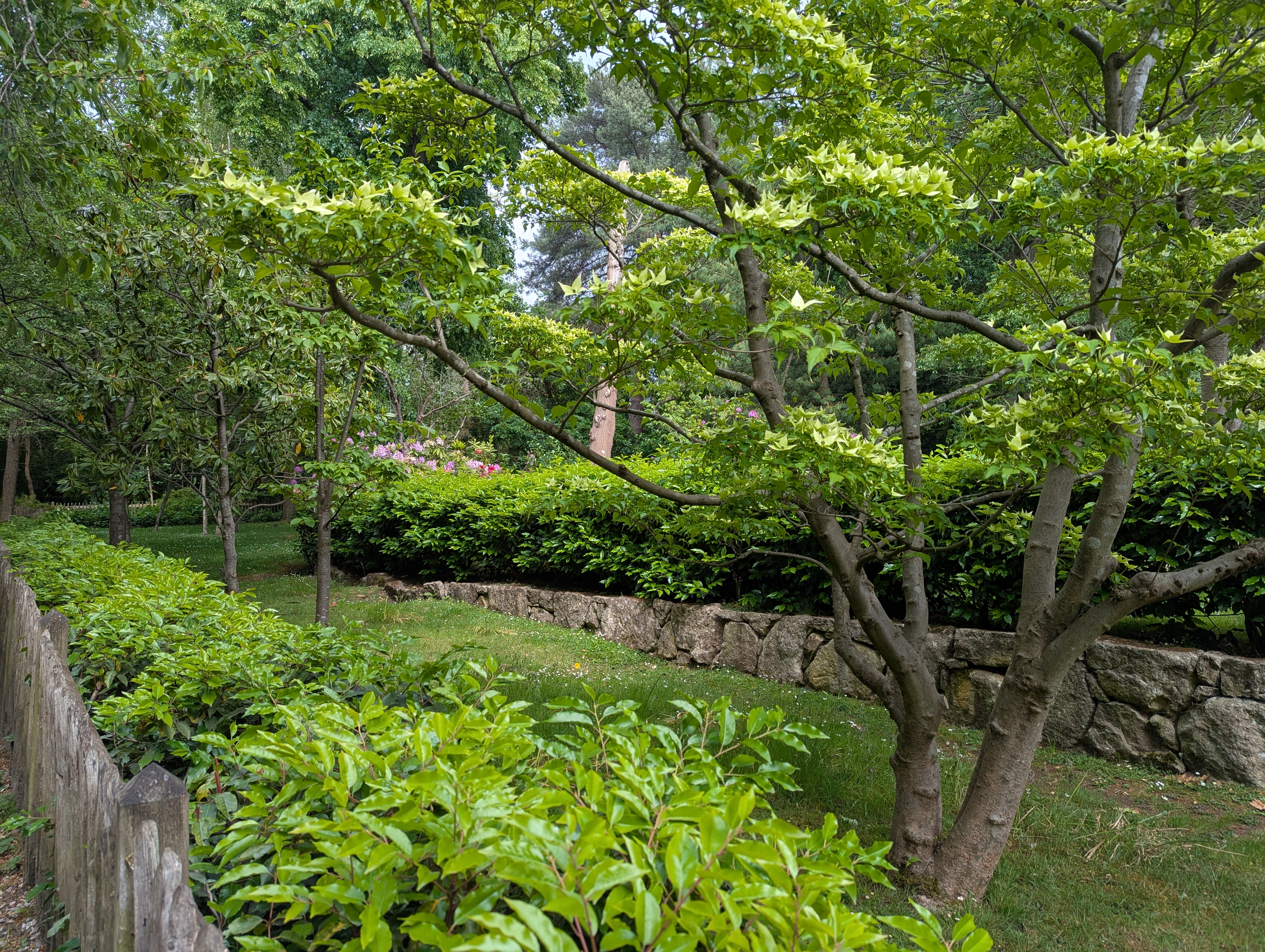
I stopped by the hotel for a quick nap (yes, making a habit of this on my short trip to London) and then set out for a nearby garden called Kyoto Garden in Holland Park, a few Tube stops and a short walk from my “home” Tube station, South Kensington. Kyoto Garden was a small, peaceful, and lovely Japanese garden. I enjoyed visiting the “Dutch garden” as well. Not much was blooming there but it was very nice, with orderly plots.
I headed back to The Exhibitionist for a quick change into my Arsenal jersey. It brings good luck. And we need everything to go our way. Including, but not limited to, luck.
Our trip to London to take in the Fulham match (and hopefully the Atletico Madrid Champions League semifinal match), was oddly dominated by David Bowie and water. That, and clicking in the Arsenal exchange every spare moment for a ticket to the Atletico match. My husband’s childhood friend was in London at the same time we were, so we also had fun catching up with him.
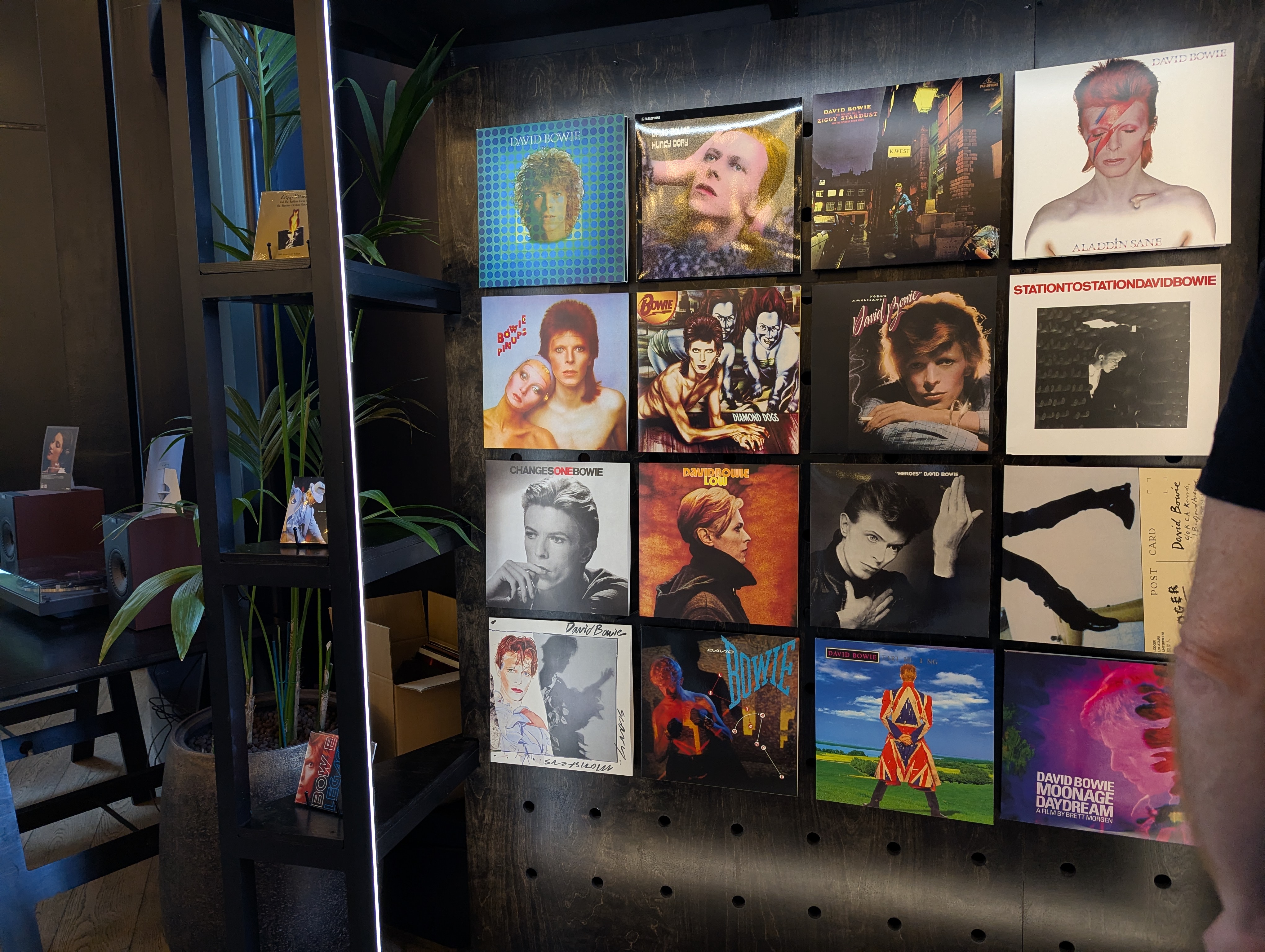
David Bowie had been a minor character in my teen world. I knew some of his music, most notably Space Oddity, a rock ballad about an astronaut who goes to the moon, but something goes wrong and he floats away, never to return to Earth. That particular song, a line from which I’ve borrowed as the title of this post, was initially released in 1969 but was re-released in the United States in 1972. Other versions have been released since then, but it’s the 1972 version I’m familiar with. Something about that song really captured my imagination. In my interpretation of the song, Major Tom decides not to go back to earth and enacts his ship’s malfunction. Apparently that is not how David Bowie saw it. Major Tom floated hopelessly away in his broken spaceship.
My interpretation is better.
I remember one of my high school classmates declaring “David Bowie is so gross.” I didn’t know enough about him to have an opinion but I had seen pictures of him and knew he did something very few men did at that time: he sometimes wore makeup and clothing more commonly associated with women. I was living in a conservative area of the country, but there is probably no place in the world that despises individuality and demands conformity more than high schools of the 1970s.
I had really loved Queen in high school. Funny now that I think of it that David Bowie would possibly be “gross” but Queen was A-ok. Bowie’s music took a turn that intersected more with my mainstream sensibilities in the early 1980s. I loved the collaboration he did in 1981 with Queen’s Freddie Mercury, Under Pressure. It’s still one of my favorite songs. And later it rubbed me the wrong way that Vanilla Ice’s Ice Ice Baby started with the same musical hook. (I feel more inclined to forgive Vanilla Ice now that Arsenal fans use Ice Ice Baby as the base of a chant to honor Declan Rice. Rice Rice, baby.)
David Bowie exploded into the mainstream with Let’s Dance in the early 1980s. I had moved to Denver after college and was working, but didn’t yet have enough money or income to buy a car. I was carpooling with one of my colleagues every day. He was the first openly gay person I’d ever known and often he would cajole me into accompanying him to one of the gay bars in our neighborhood before he dropped me off at my apartment. So many handsome men. None of them interested in me, other than as a human. It was pretty sweet. Let’s Dance and Modern Love were big hits on the dance floor. I think that’s where I decided it’s always ok to dance alone. And was the start of me thinking everybody just wear what you want. Be who you are. Try out stuff until you’re clear. Even you, David Bowie. (And I think he would say “No shit. That’s what I did.”)
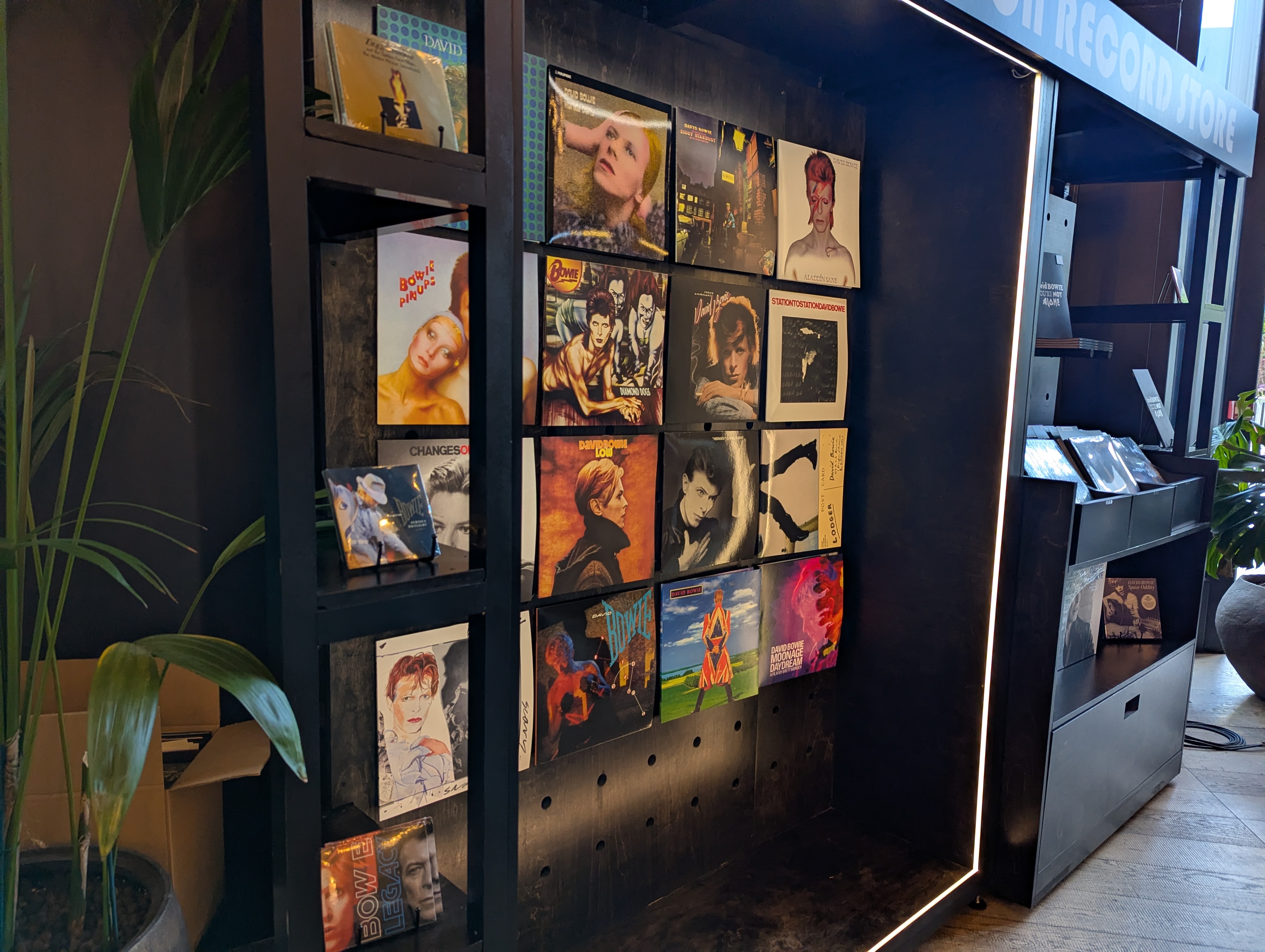
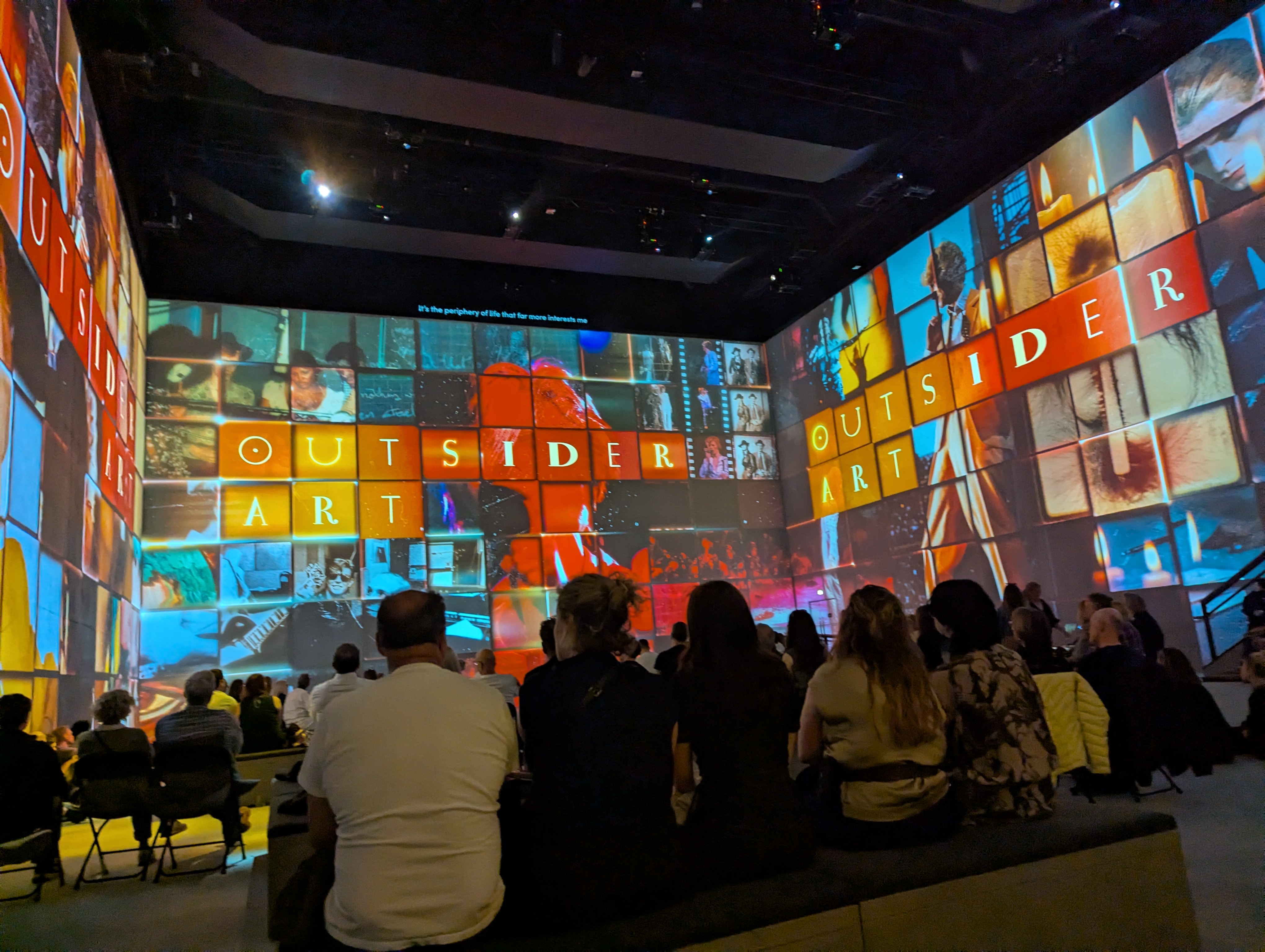
Anyway, that is a long preamble to our visit to the new David Bowie exhibit in London called You’re Not Alone at Lightroom, a “multimedia spectacle” that will “transport visitors into the iconic performances and creative mind and spirit of one of the world’s most visionary and influential artists.” It reminded me of Frameless, the interactive art exhibit we visited when we were last in London.
After a brief introduction to a life timeline for Bowie, you enter a large auditorium-like room, the walls, ceiling, and floor being used to project images, video, artifacts supporting narrative about how and why Bowie created as he did. I guess it’s technically a documentary but creatively delivered and very well done. There’s very little I enjoy more than being immersed in creative process, and David Bowie left behind exceptional records about his work that were the basis of the presentation. And it did include Space Oddity in full, which allowed for some interesting visual effects.
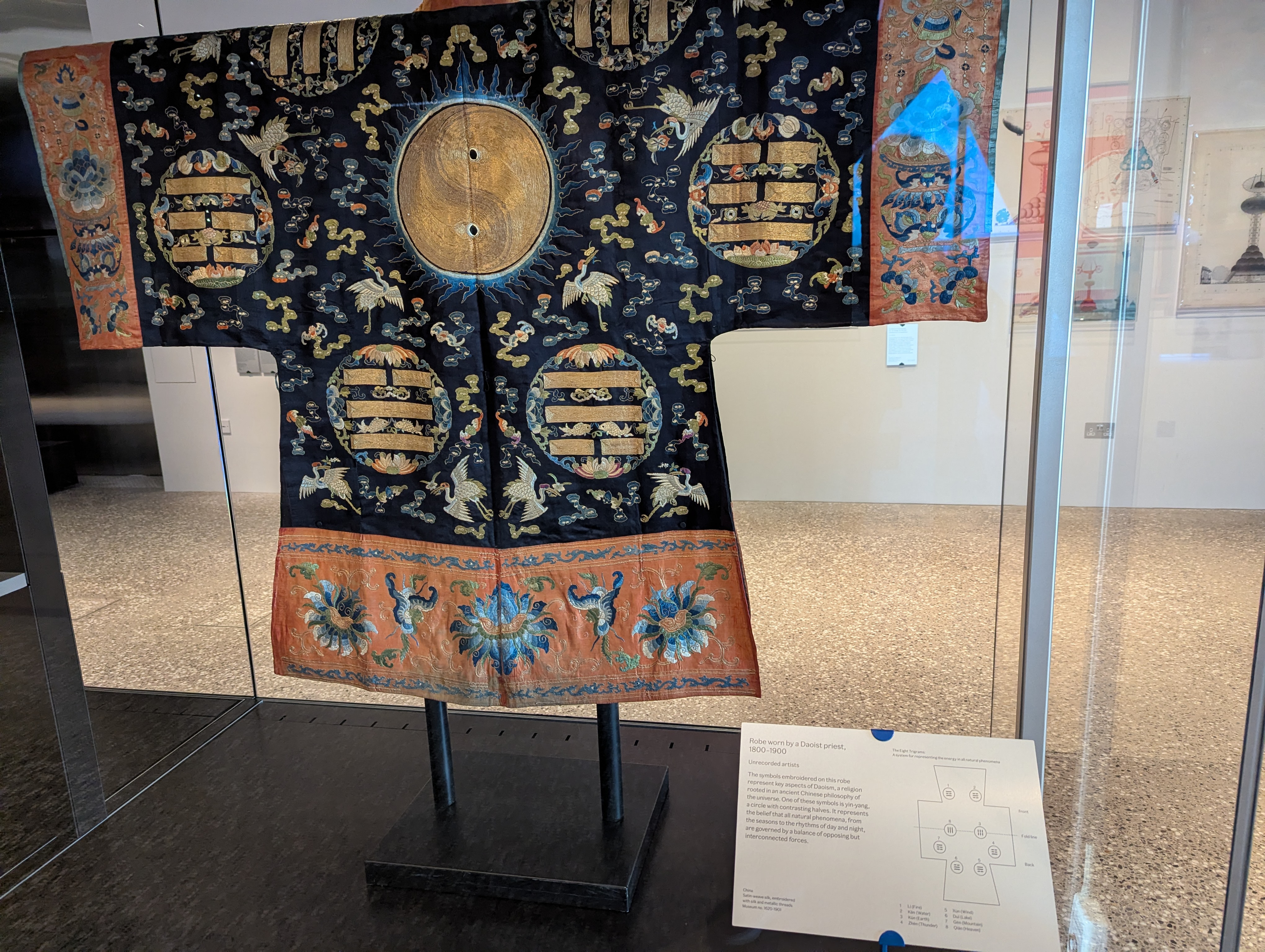
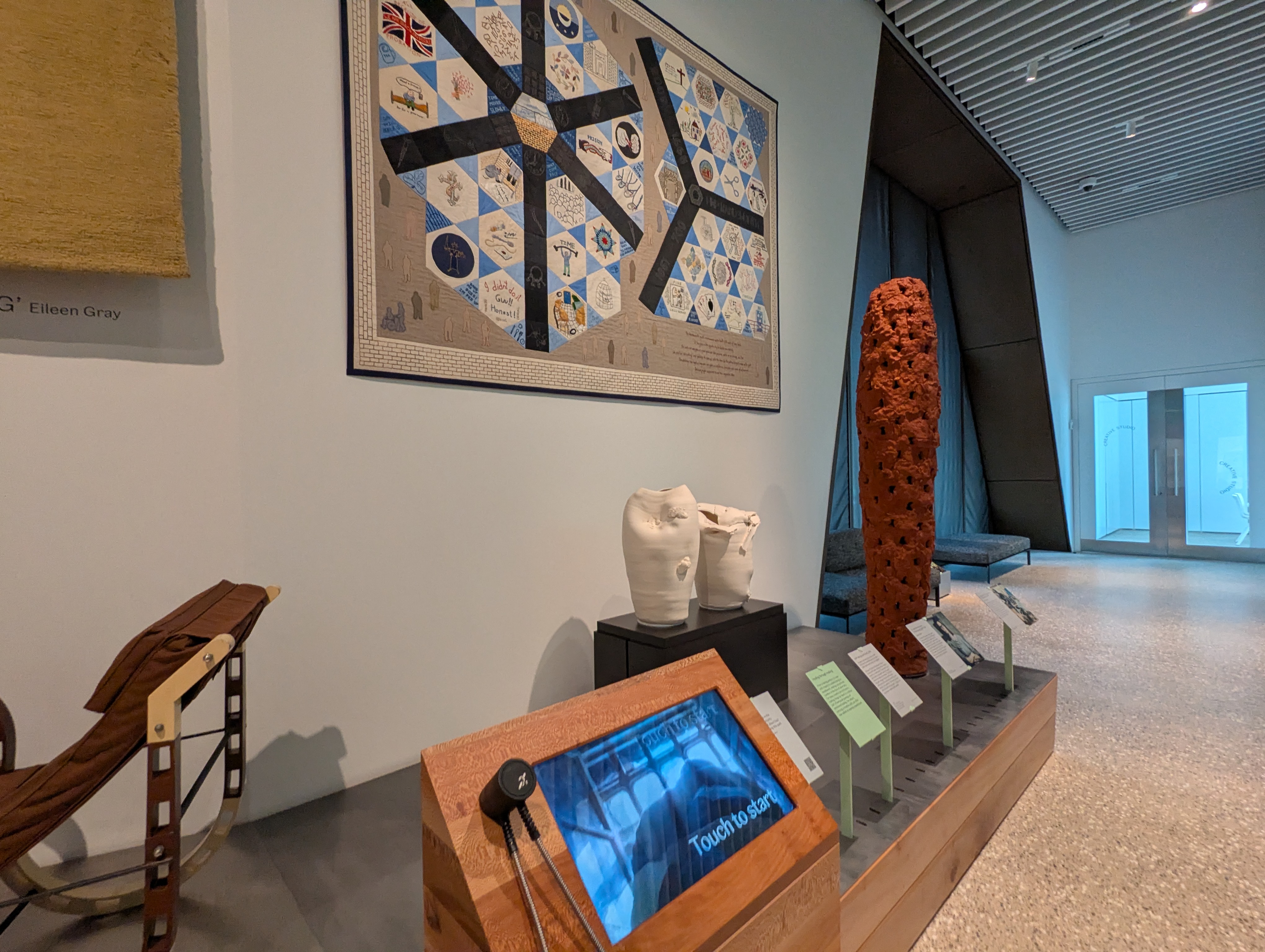
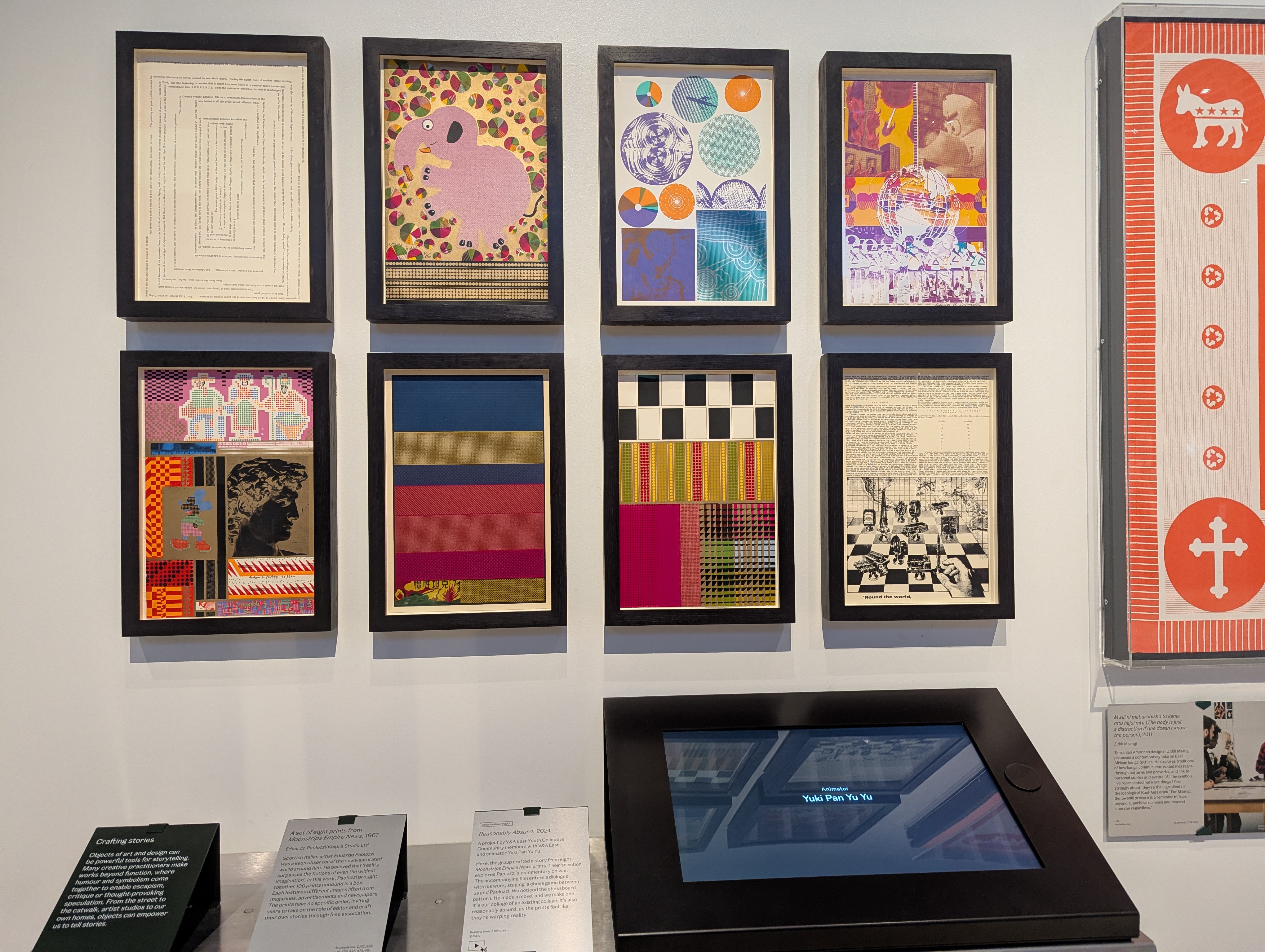
We found that so interesting that we made a point on a different day to head over to V&A East and V&A East Storehouse, new extensions of the Victoria & Albert Museum.
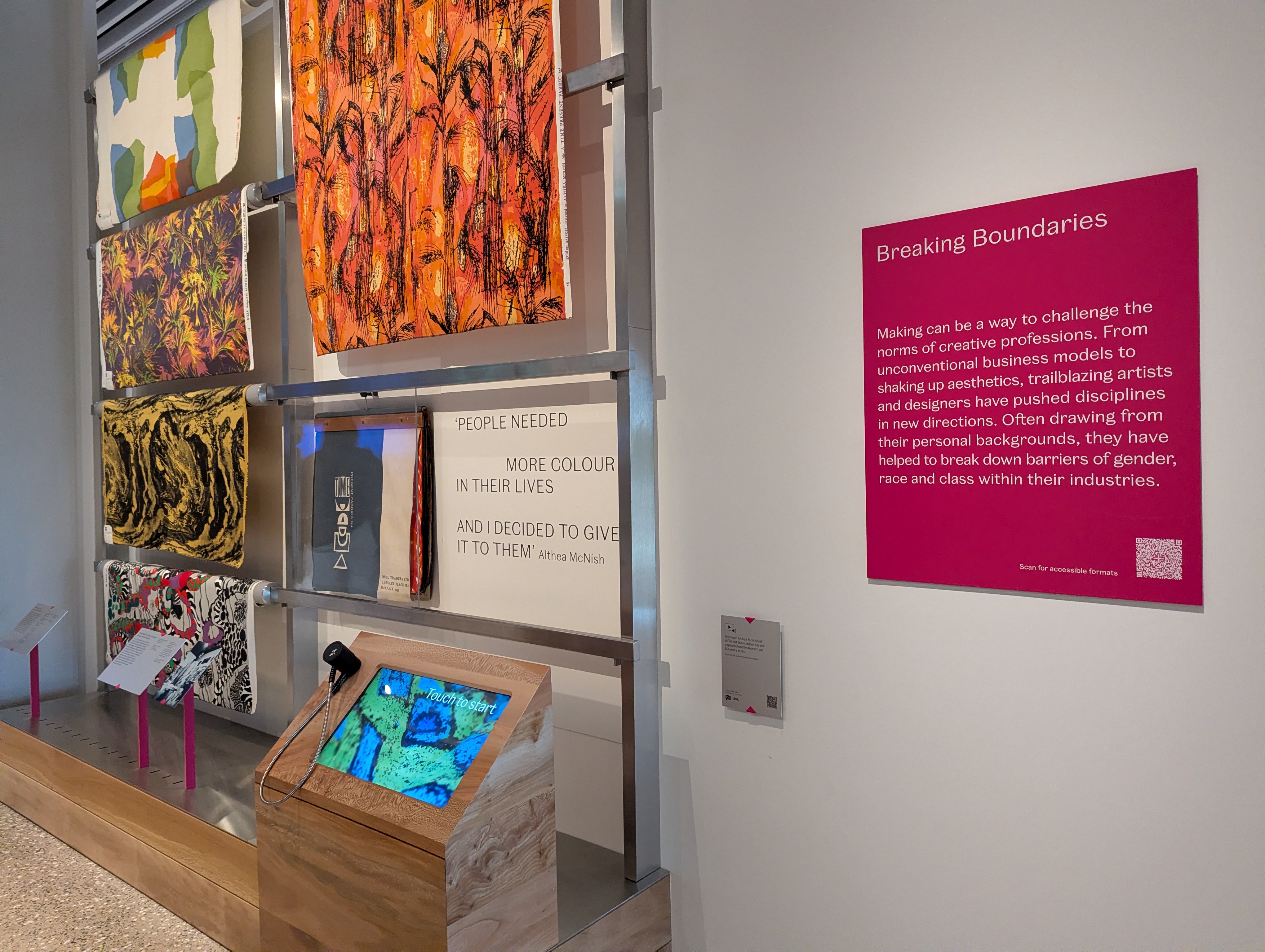
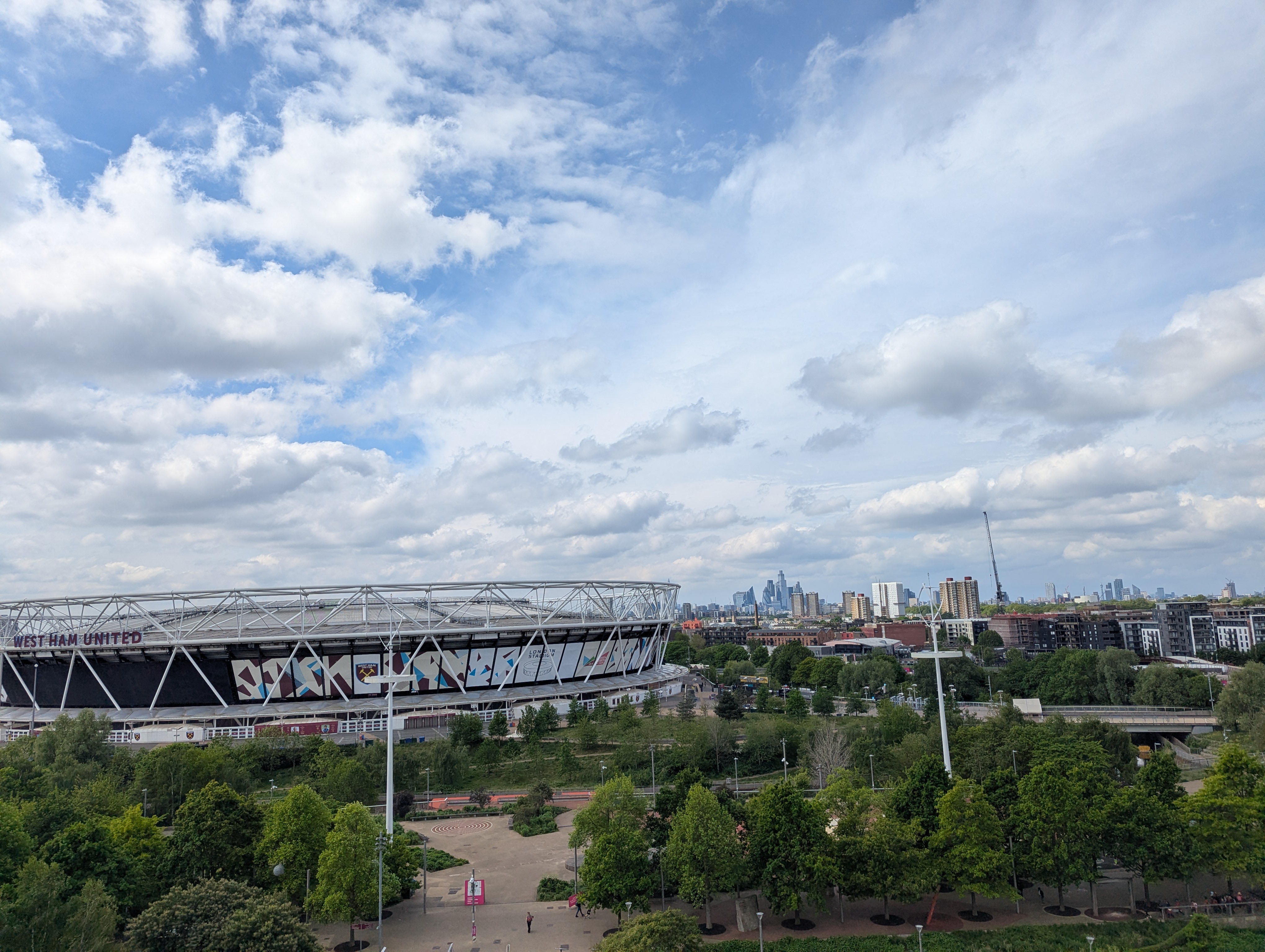
At V&A East we visited fascinating exhibits on “Why we make,” focused on the impulse to create and the process of creation. Not merely creation of art, but furniture, clothing, housing. I have found the Victoria & Albert museum in Kensington to be overwhelming, but the V&A East is very, very manageable and no less interesting. Bonus: it has a patio with a great view of the area where the Olympic stadium is. Which, by the way, is currently the home of West Ham. Arsenal were to be playing West Ham at London Stadium the weekend after we visited. We made sure to walk over and spread our Arsenal cooties all around the ground after visiting the exhibits.
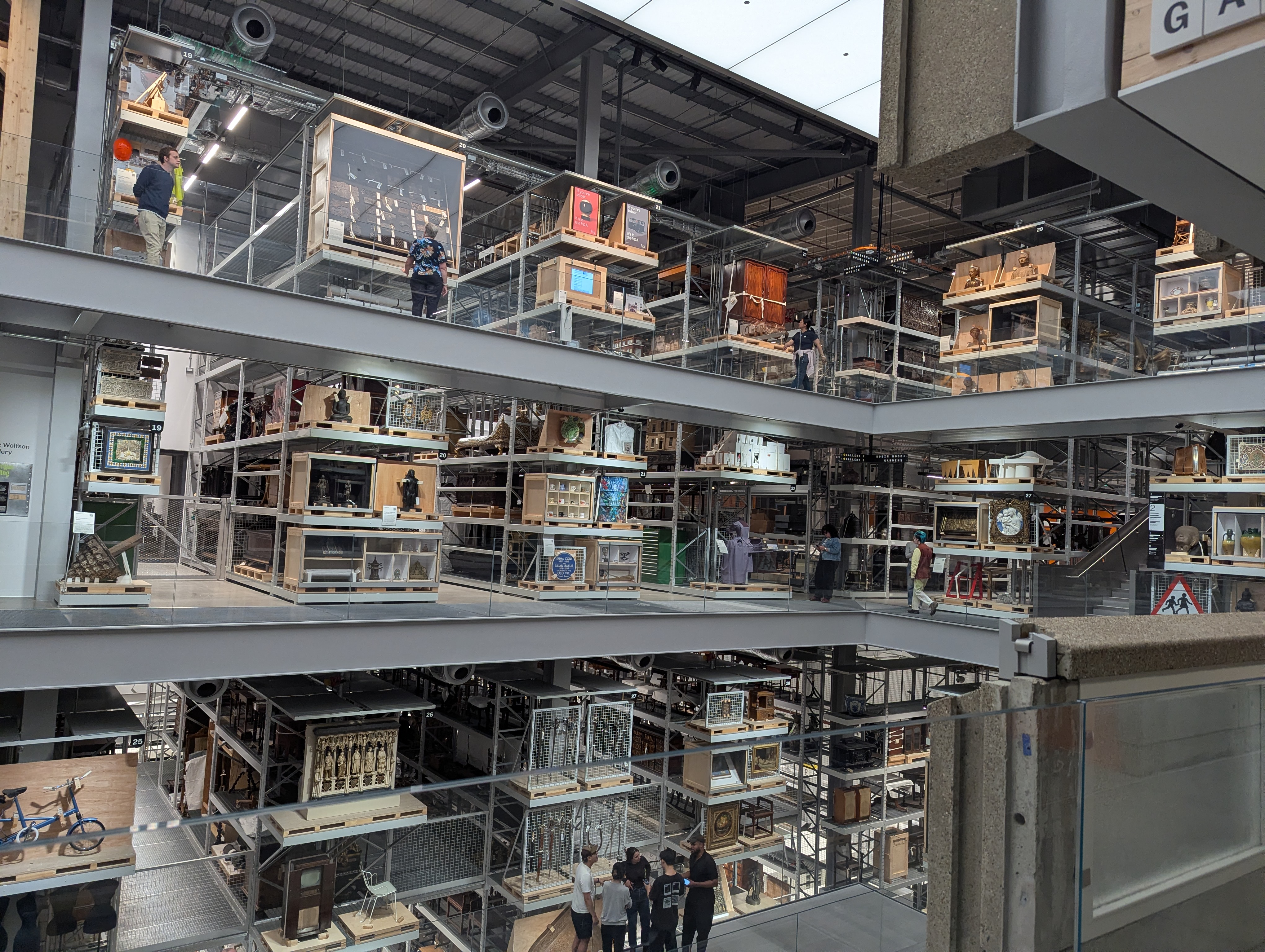
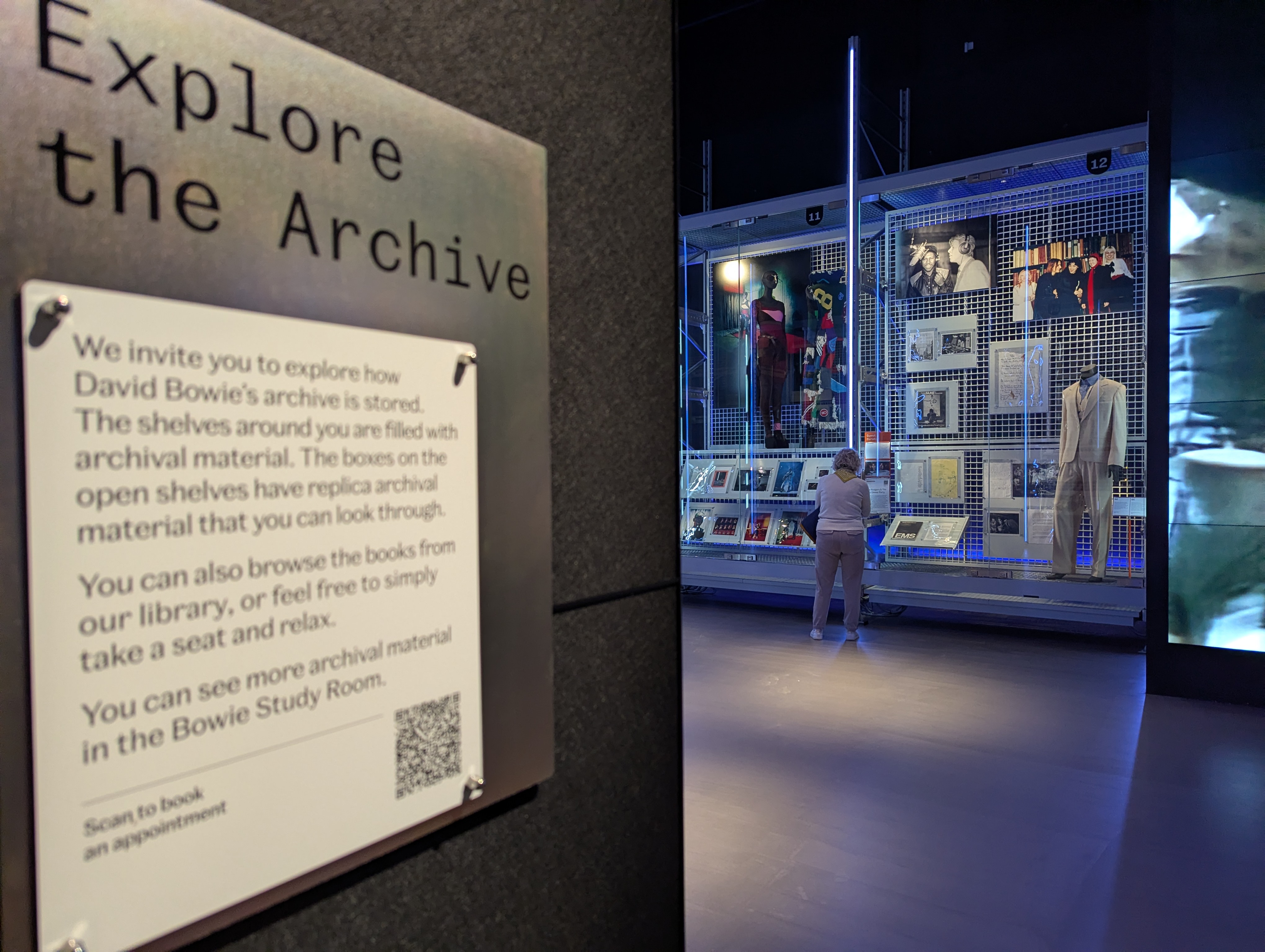
The V&A East Storehouse is a short walk from V&A East. I’ve never seen anything like this. It’s literally a storehouse for objects owned by the Victoria & Albert, but not currently on display in the museum. Except it’s the fanciest Storehouse you’ll ever lay eyes on. It’s a museum-like storehouse. You can walk around and look at the objects, which we did.
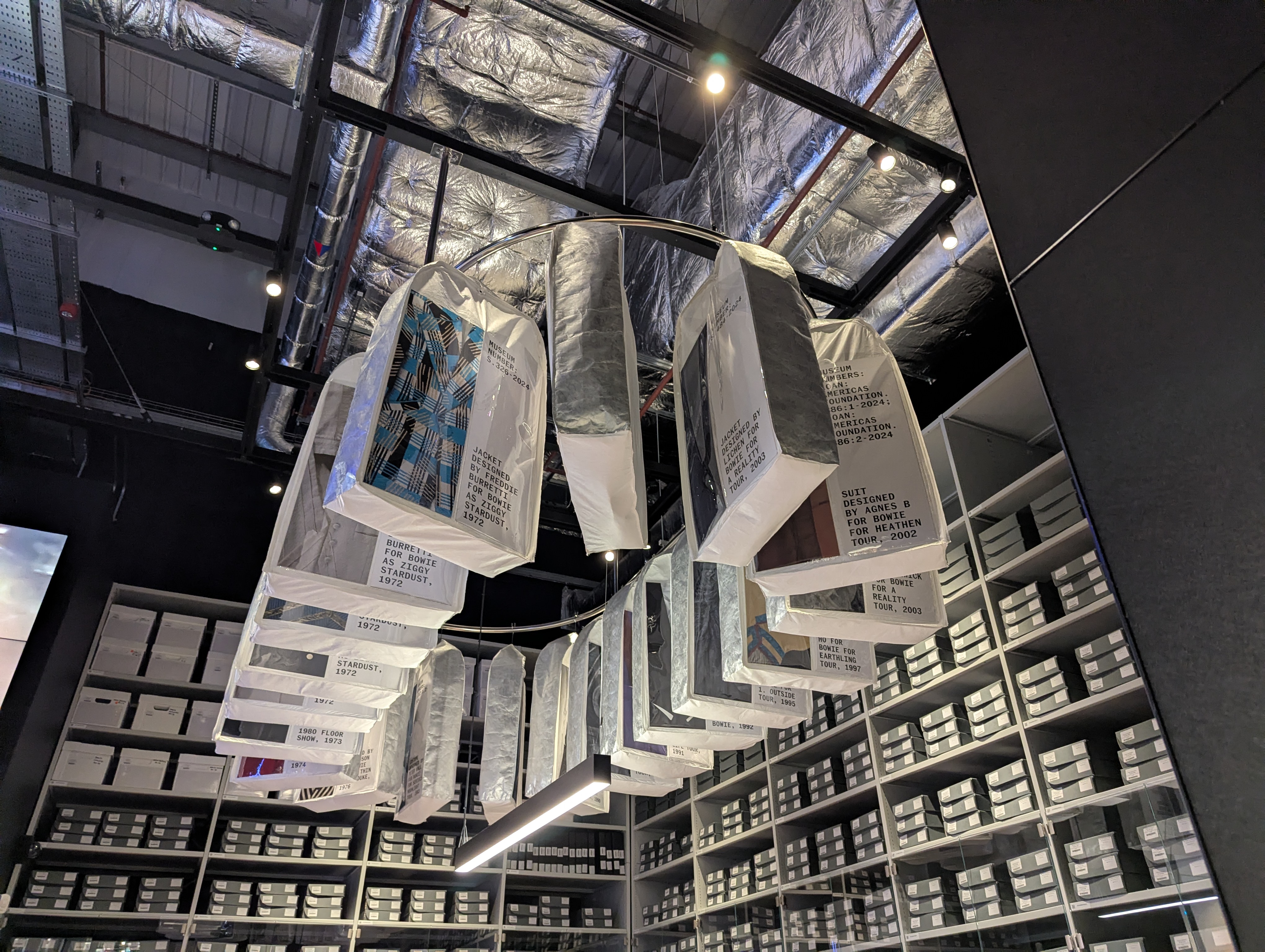
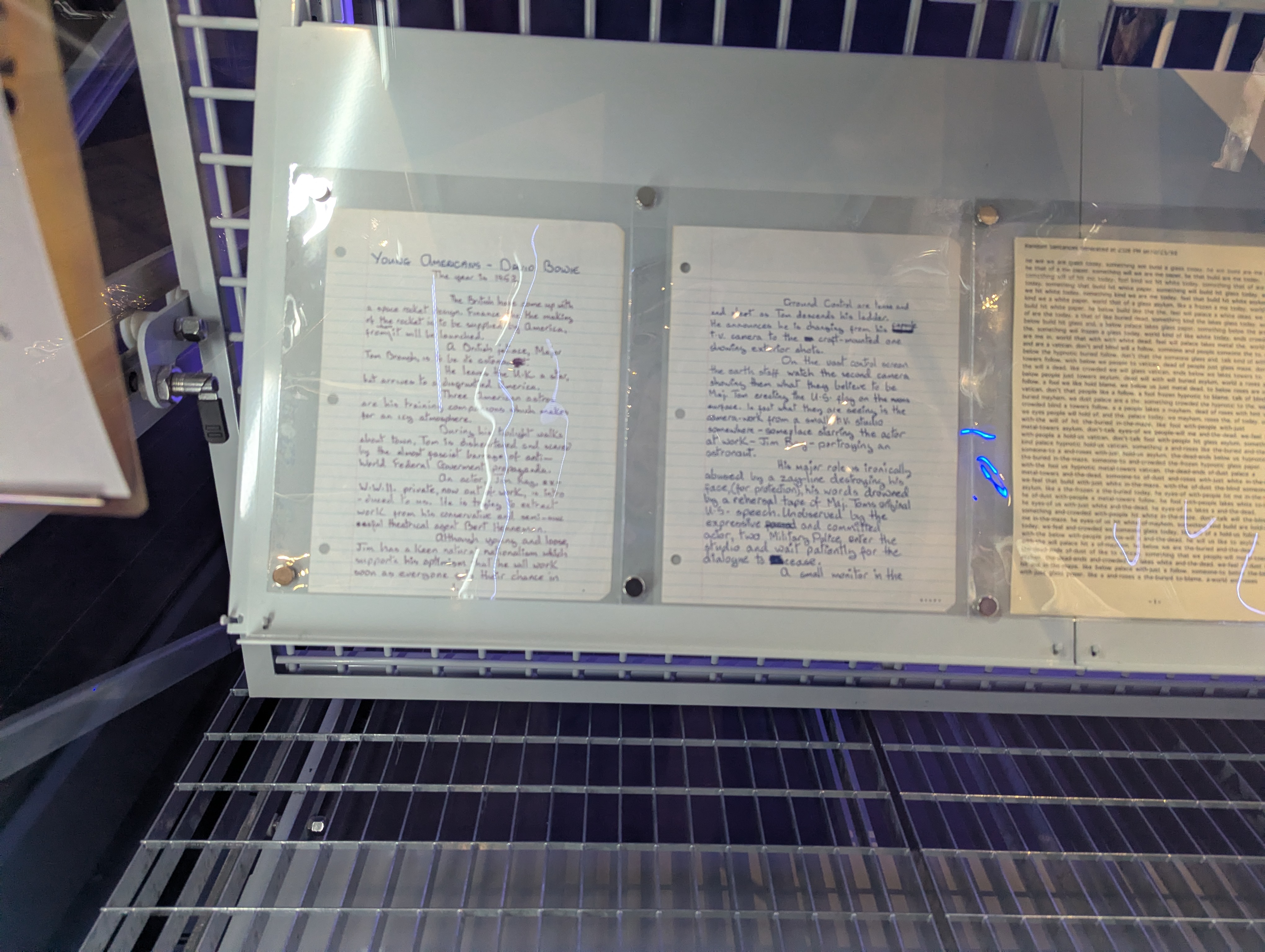
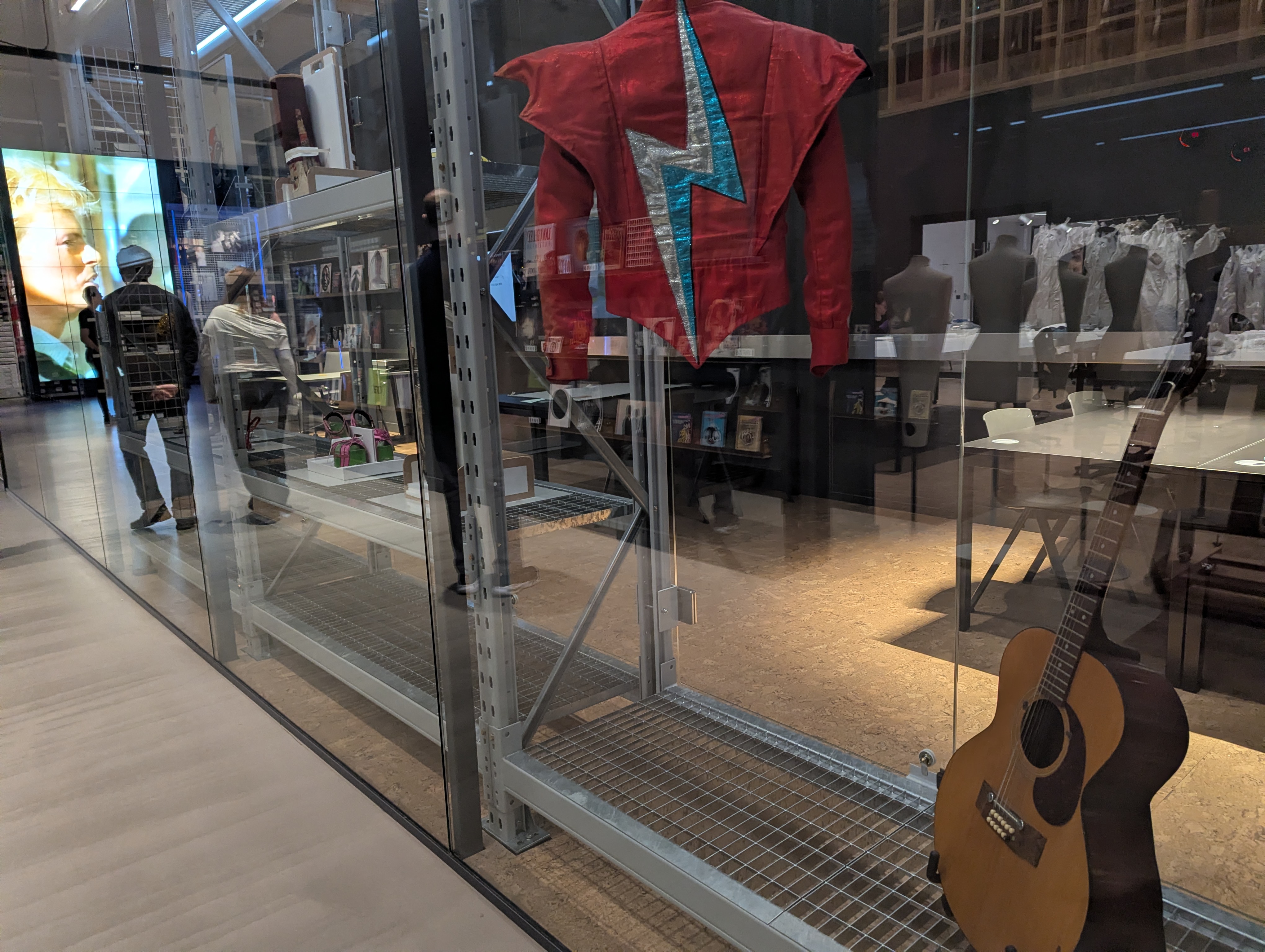
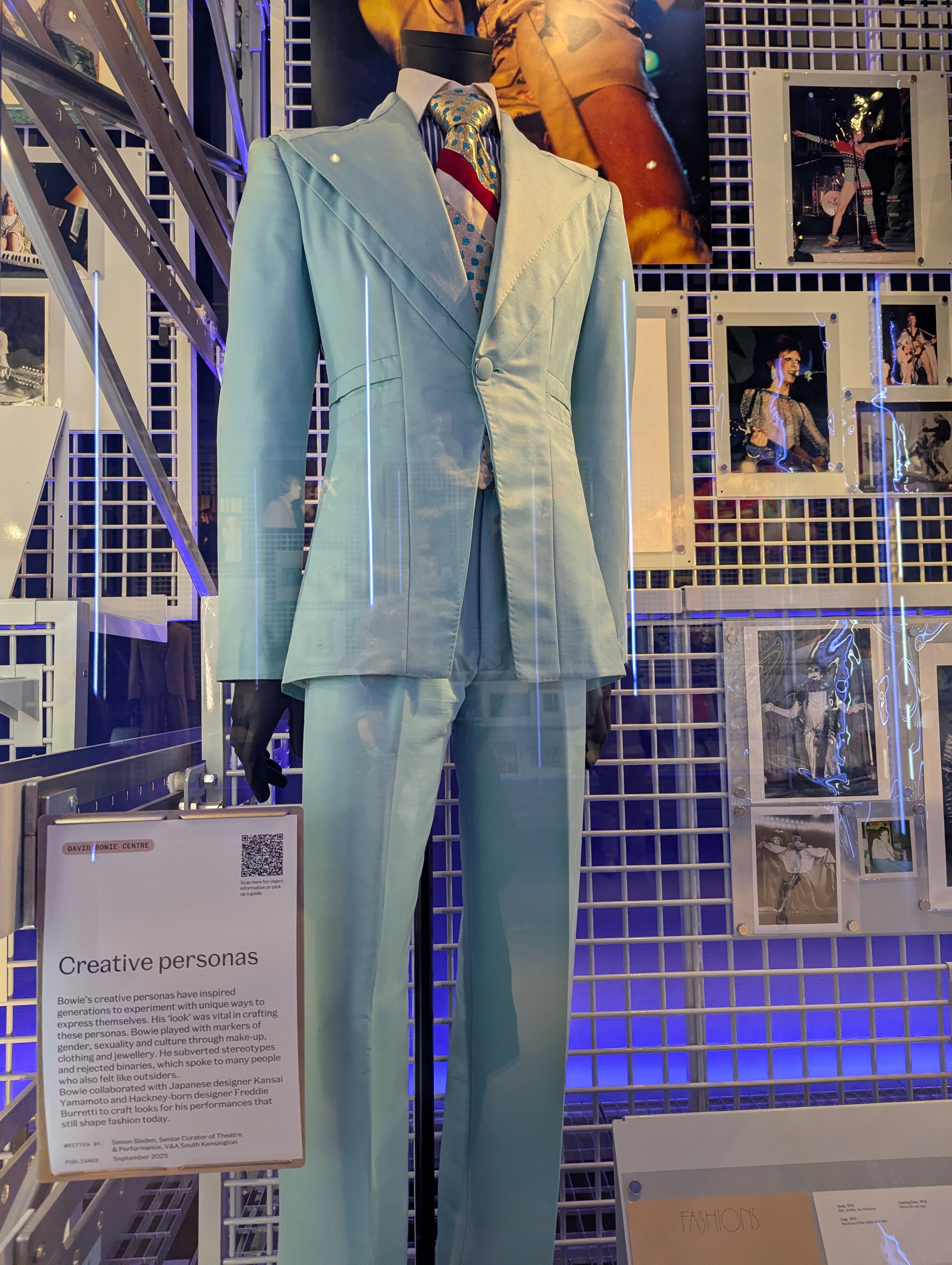
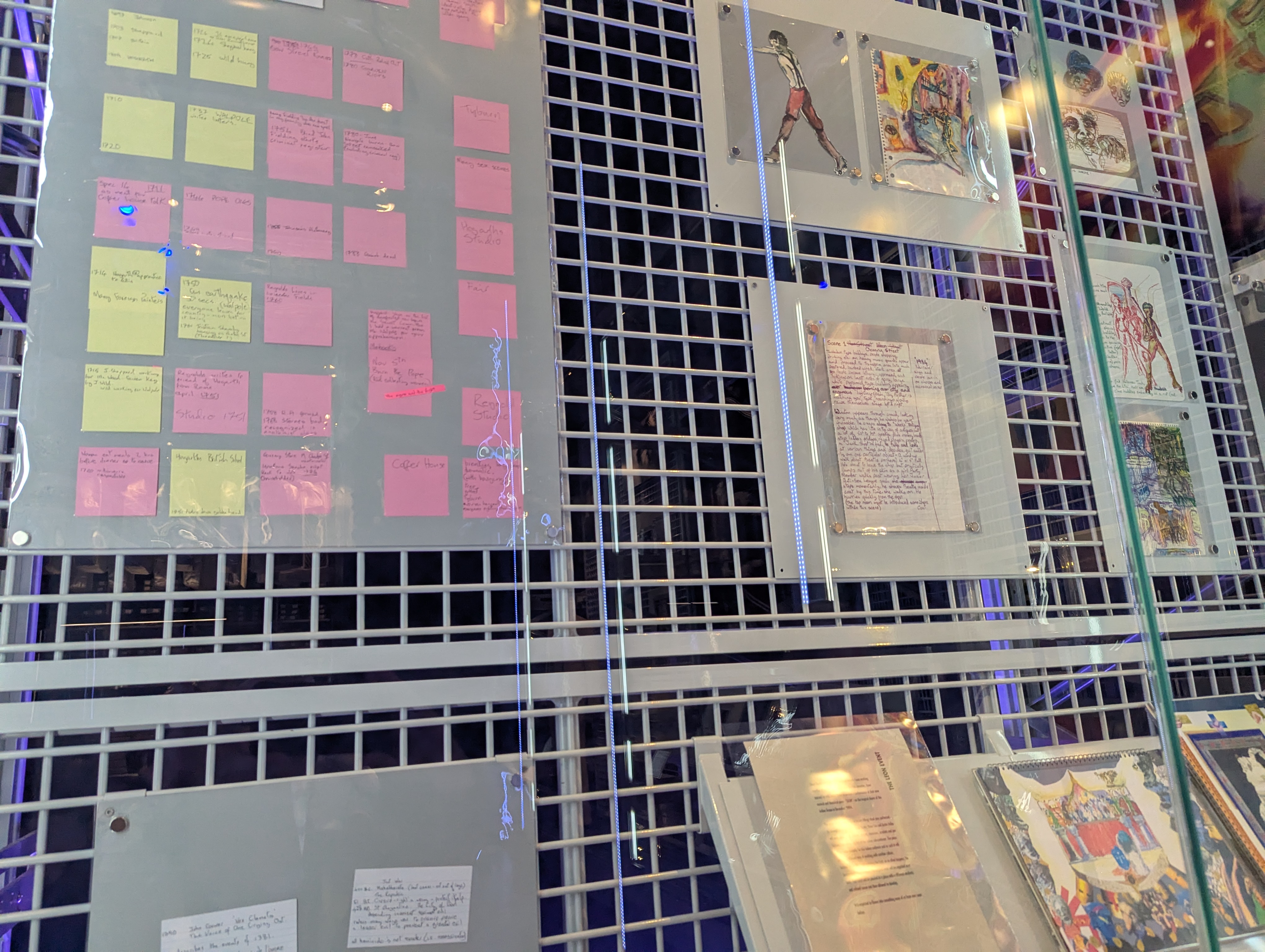
You can also visit a special area devoted to David Bowie. The David Bowie Centre is a permanent archive for David Bowie’s possessions that was given to the V&A. It contains a small exhibit that includes some iconic costumes worn by Bowie, objects he owned, and a narrative and artifacts about how some of his music was written (including hand-written starts at several songs, including Space Oddity, which was written almost like a play). It also includes archives of interviews, articles, reviews that are not on display but can be accessed upon request. He must have understood his own importance or he would never have retained all that stuff. And I guess he was right about his importance or the V&A would not now have it. Great exhibit.
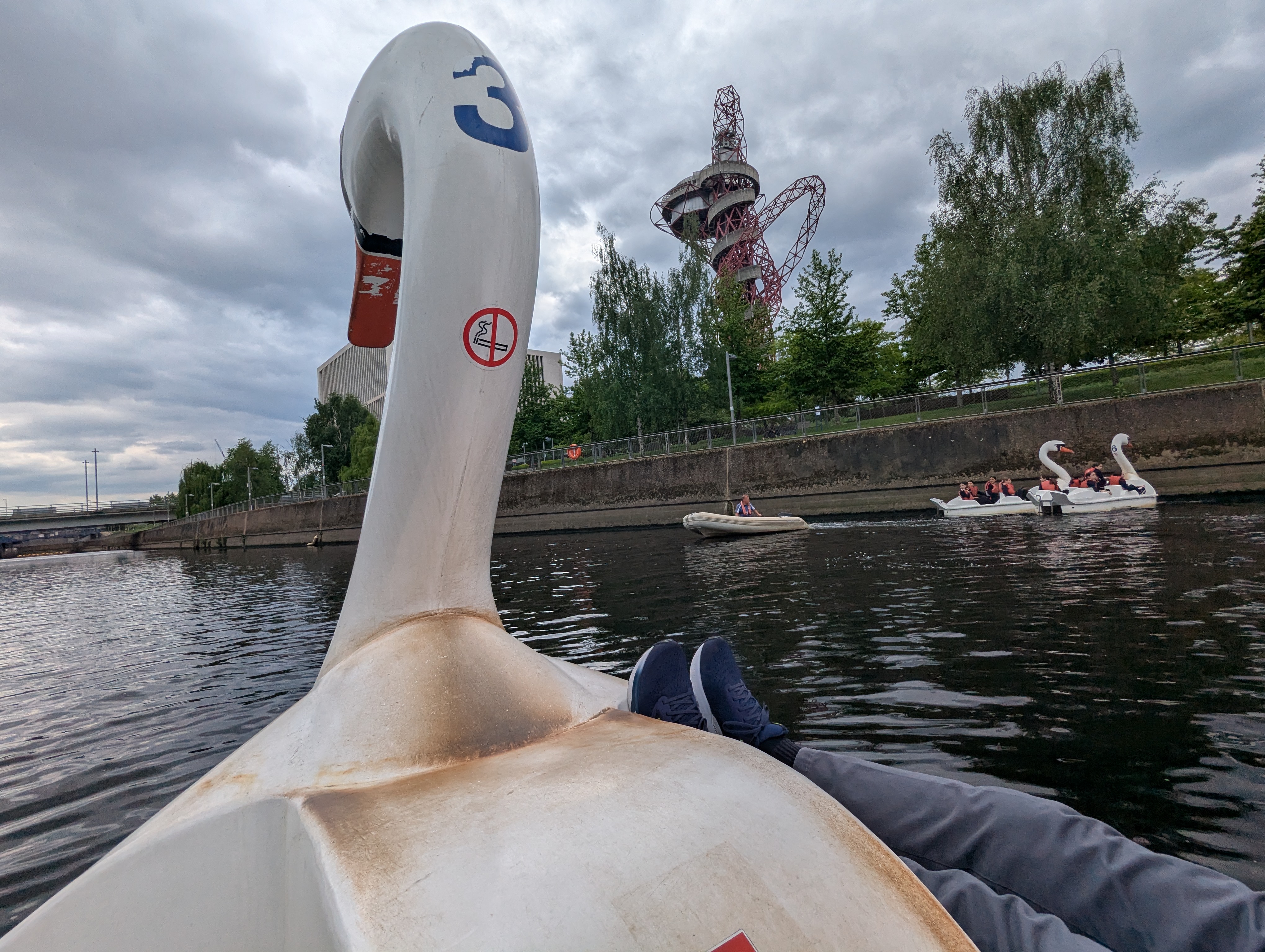
Space Oddity tells us “planet earth is blue,” and we understand it’s blue because of the water on its surface. Our visit to London, coincidentally, included several water-related activities. The River Lea lies between the V&A East and London Stadium and there’s a place on the edge where you can rent a swan boat. Along with a bevy of school-aged kids, we decided we needed to do that. We discovered that swan boats are just the right size for me to peddle at 5′ 2″ and completely wrong for my husband at 6′ 2″. After a very short trip down river, we crossed this activity off our list.
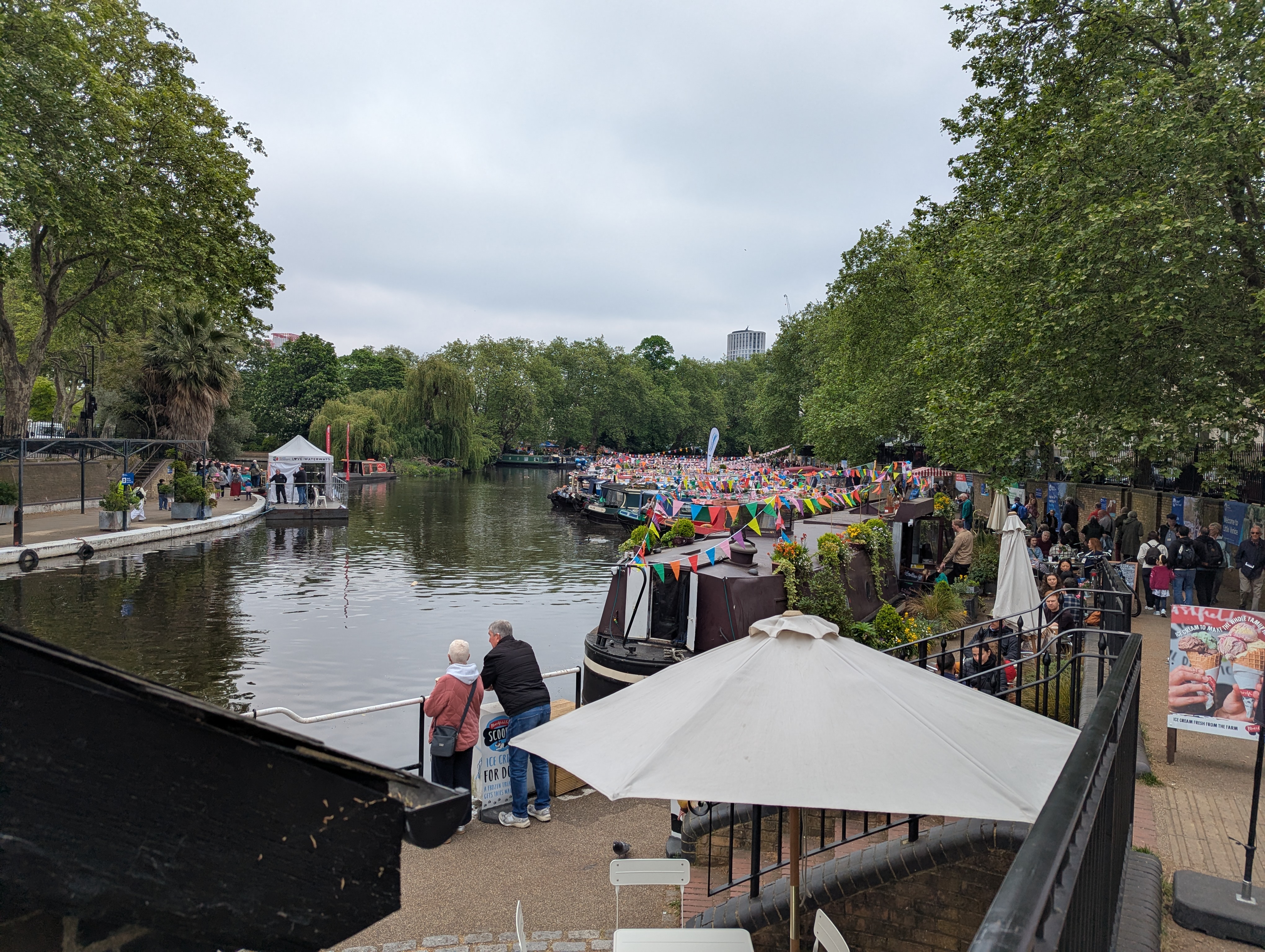
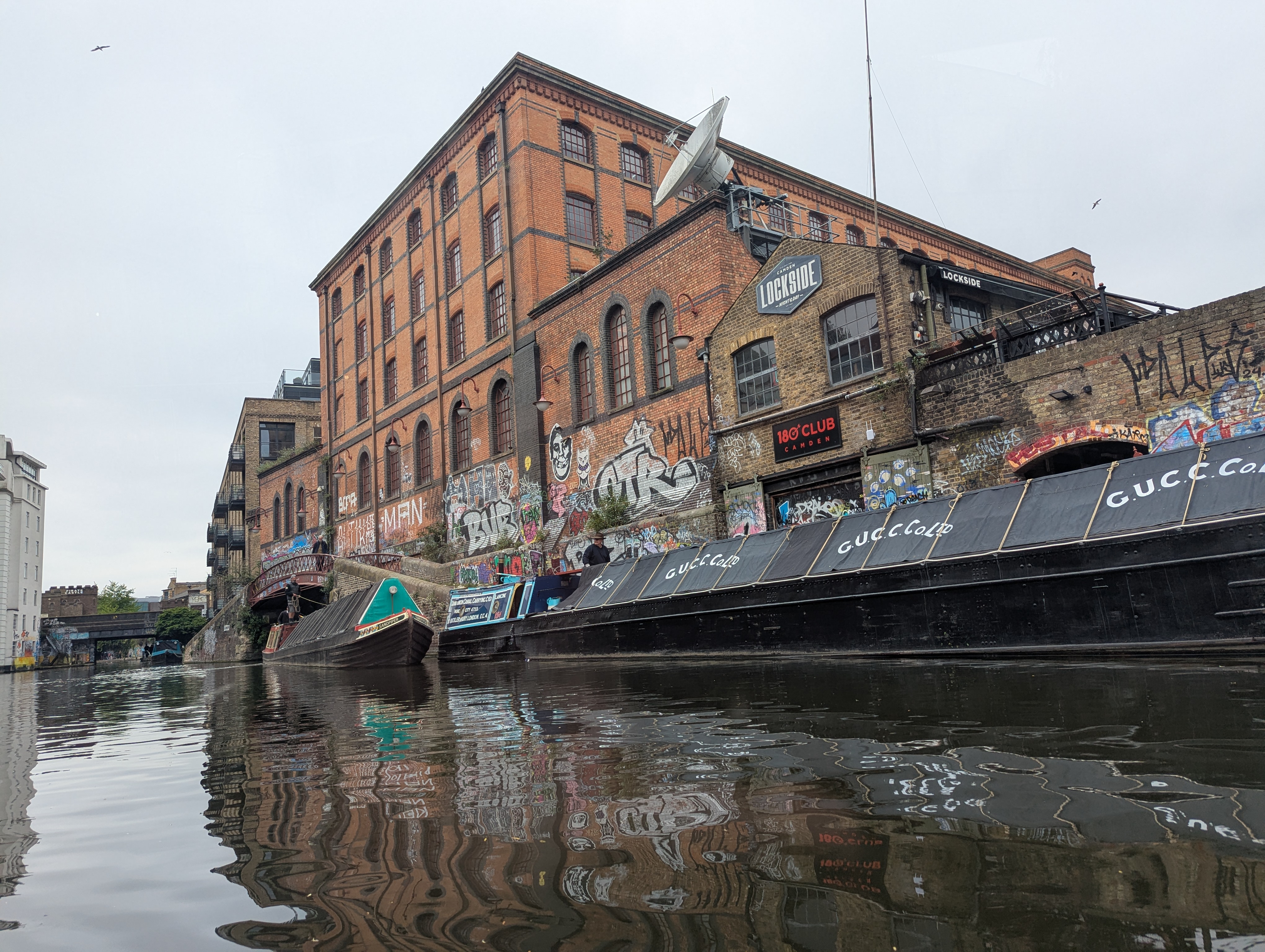
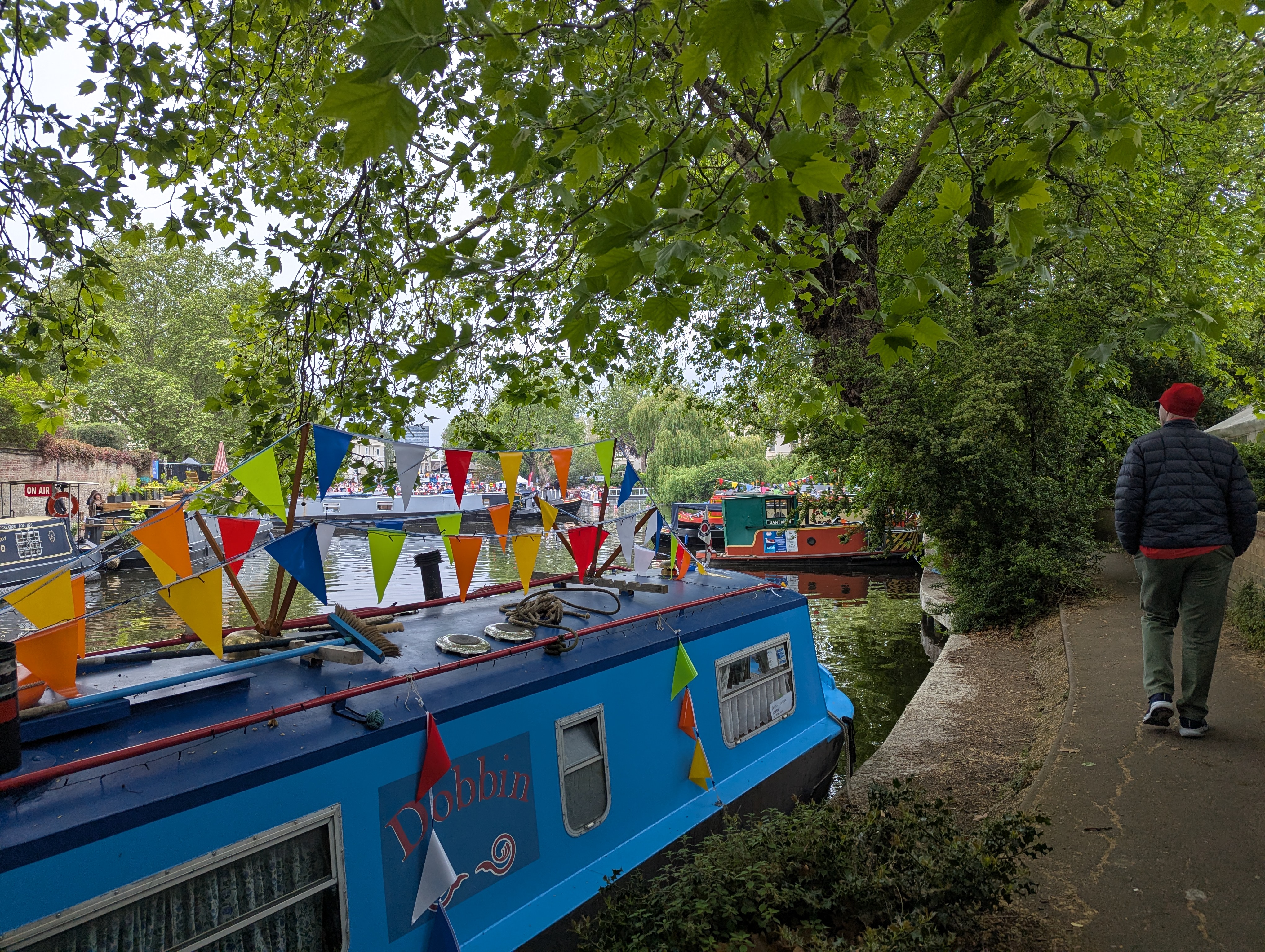
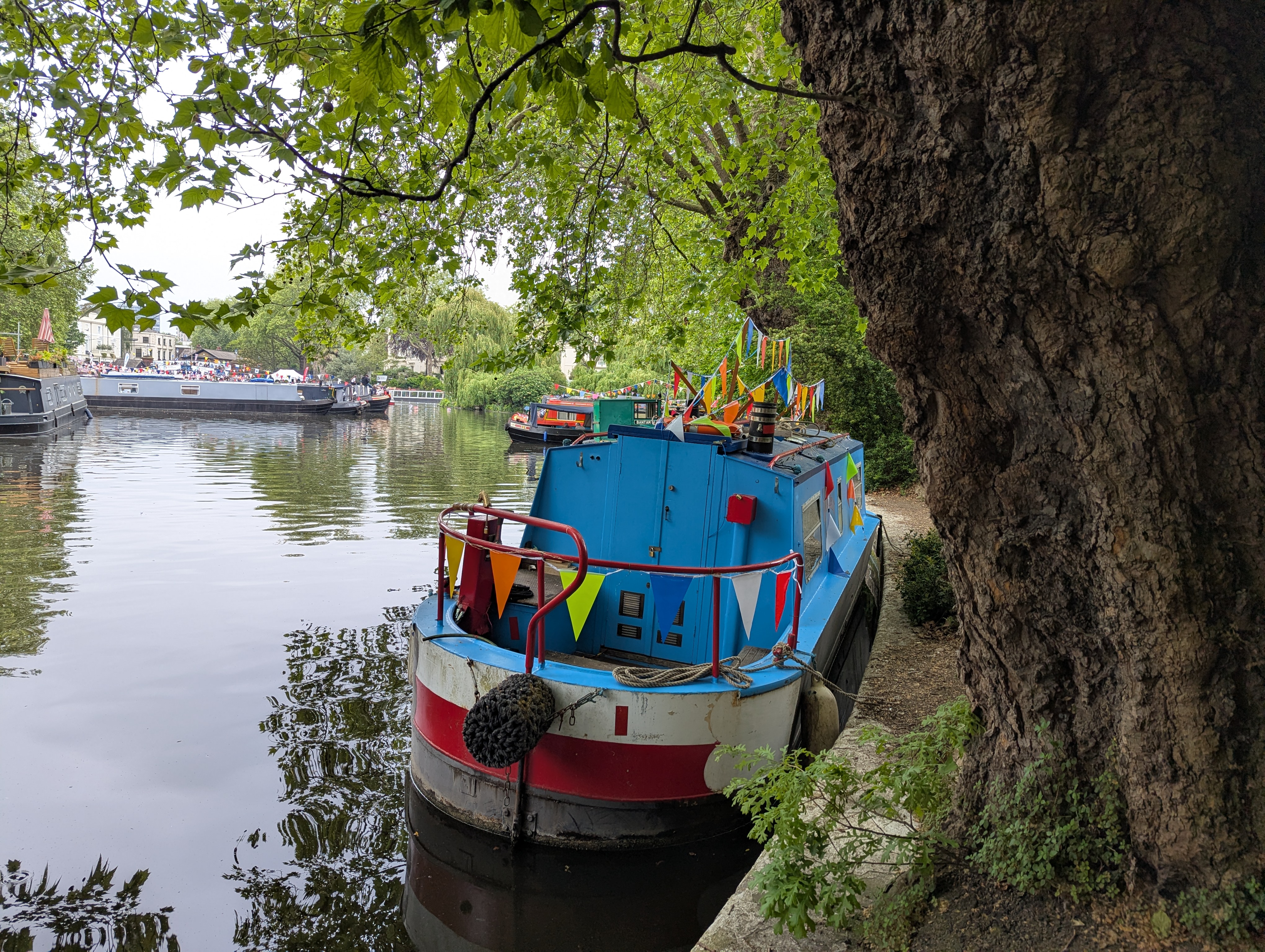
On one of the days we were in town there was a boat festival, the IWA Canalway Cavalcade, near something called “Little Venice.” Having seen Bangkok’s version of “Little Venice” in January, I wasn’t expecting much that resembled Venice. Although the one in London did not, in the end, look at all like Venice, it was very charming and fun to see all the houseboats gathered together. There were many vendors and activities for the kids and we enjoyed walking along the canal on a nice day. My husband noticed that you can take a boat from Little Venice over to Camden so we hopped aboard and enjoyed the scenery for the 45-minute ride.
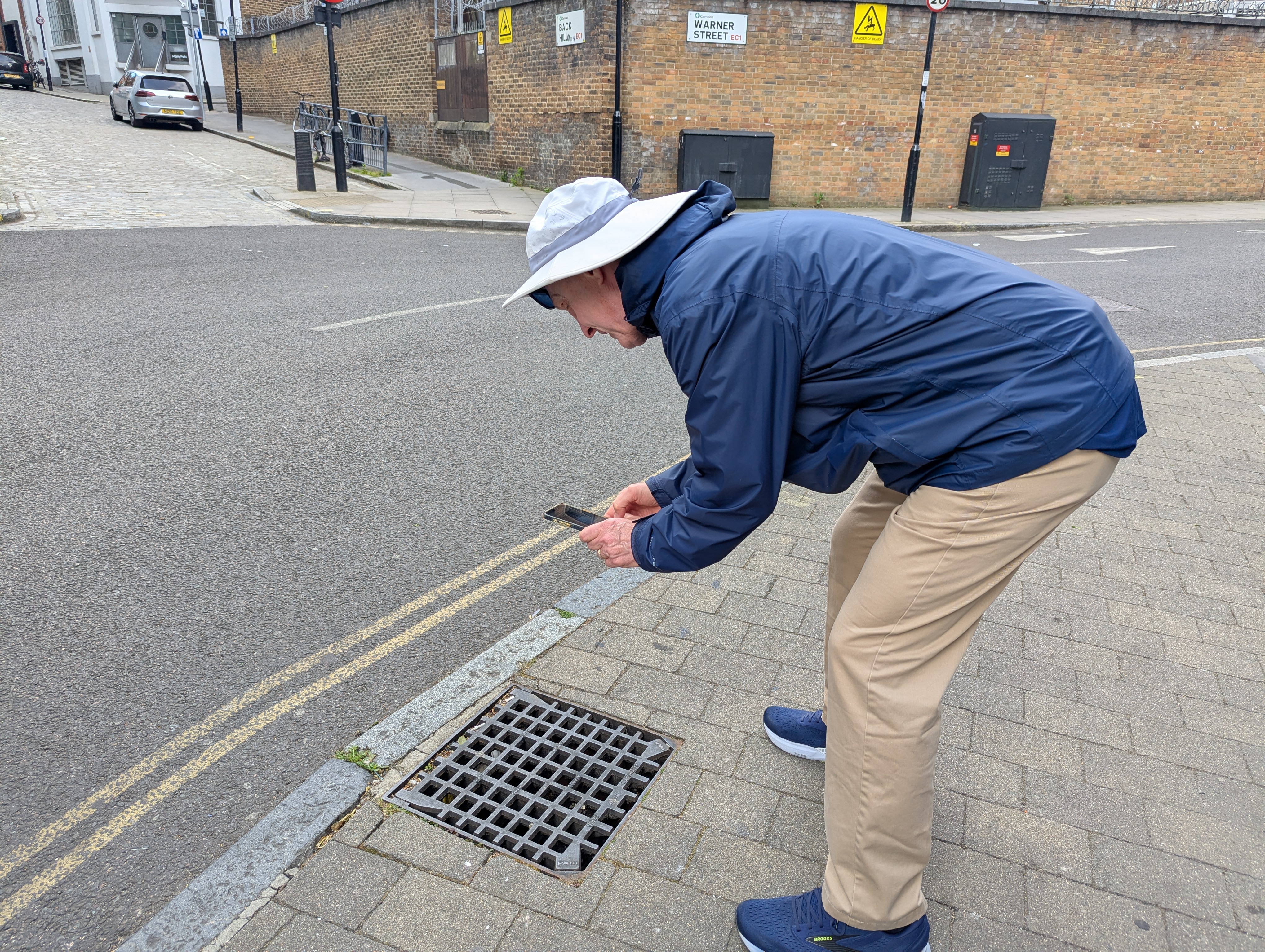
We also did a walking tour of the hidden River Fleet. This is a river that once visibly flowed through early London but became nasty, dirty, stinky and was covered with roads in the 1700s. It’s now, more or less, a sewage canal. Once before we had tried to find the headway for the river, but with construction near it along the Thames it’s impossible to see. But you can “see” and hear it underneath streets in parts of London.
Tourist taking photo of picturesque River Fleet.
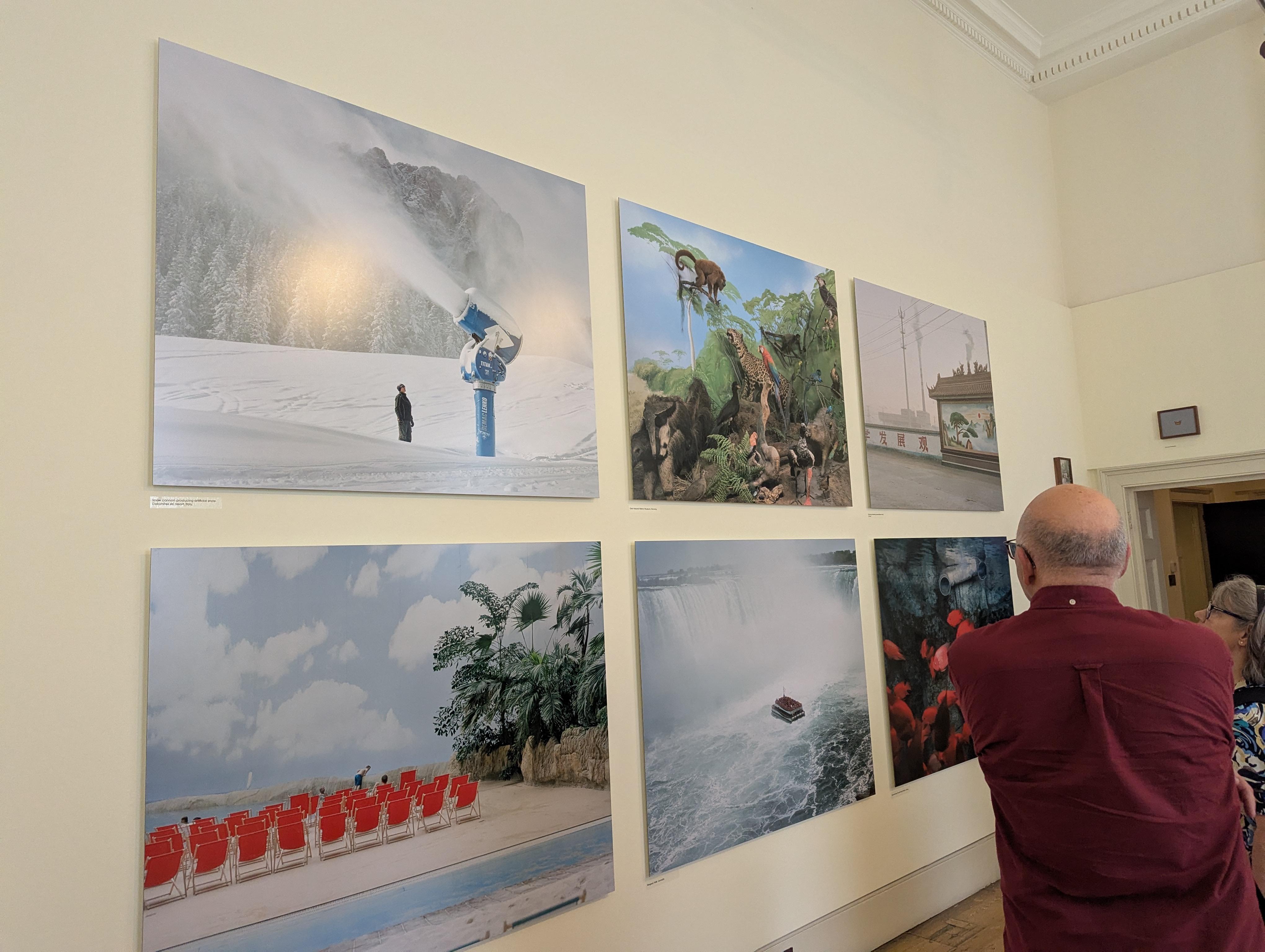
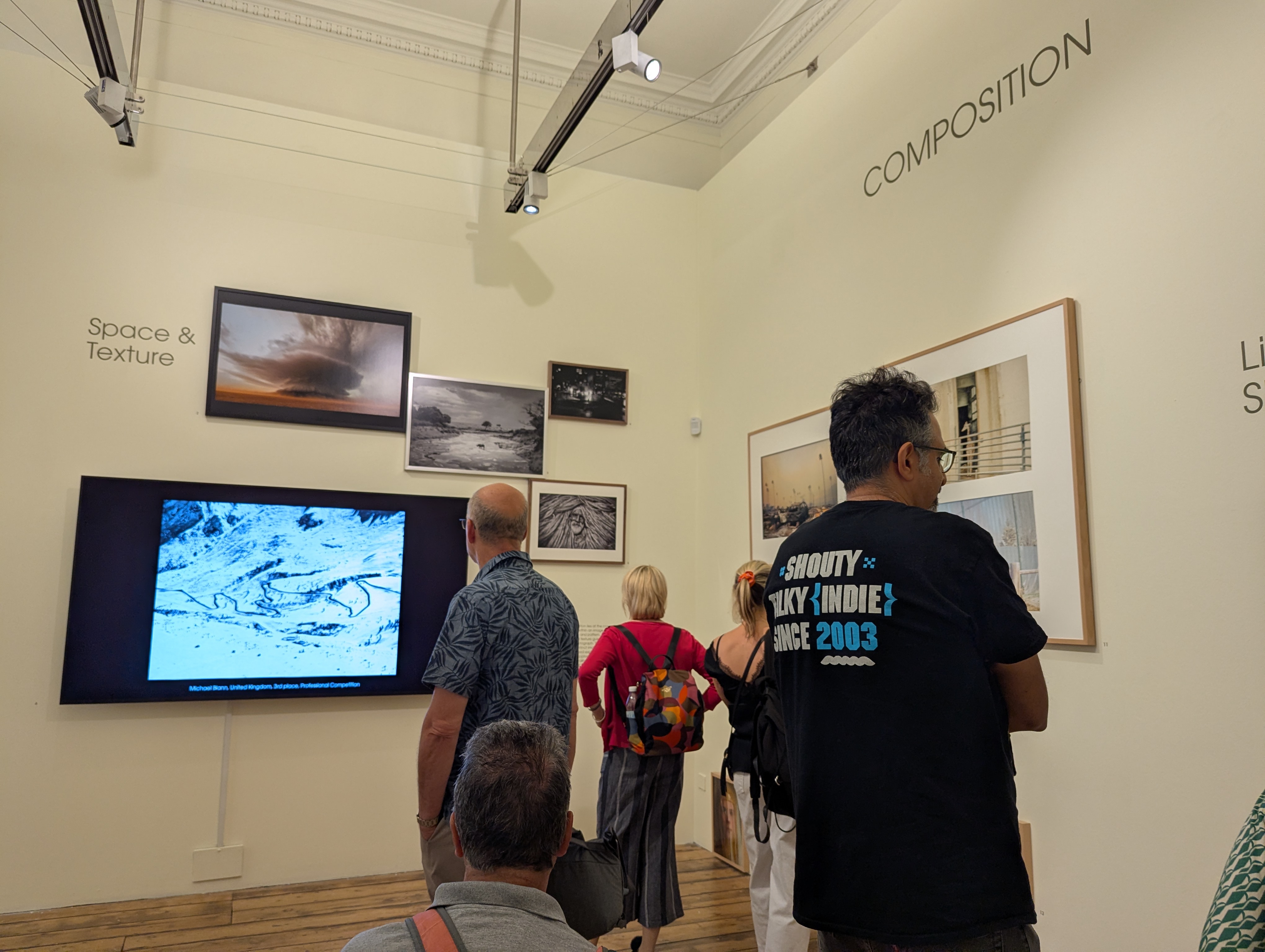
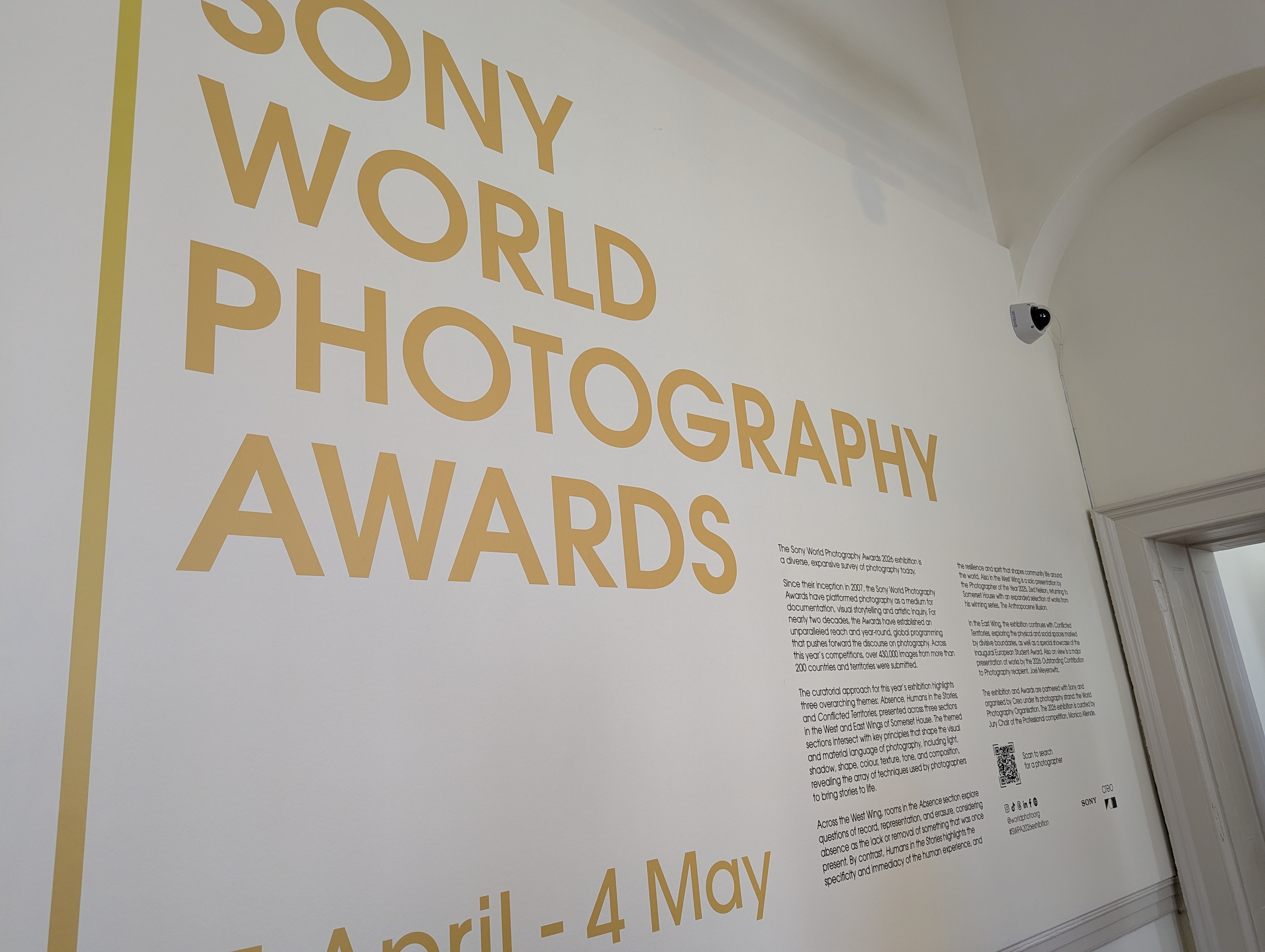
We did a few things that have nothing to do with David Bowie or water, but do take place on Planet Earth. We visited the Somerset House for the 2026 SONY World Photography Awards exhibit. The exhibit included entries by amateurs and professionals in various categories, including portraits, landscapes, still life. I have no idea how they picked winners. It was all so good.
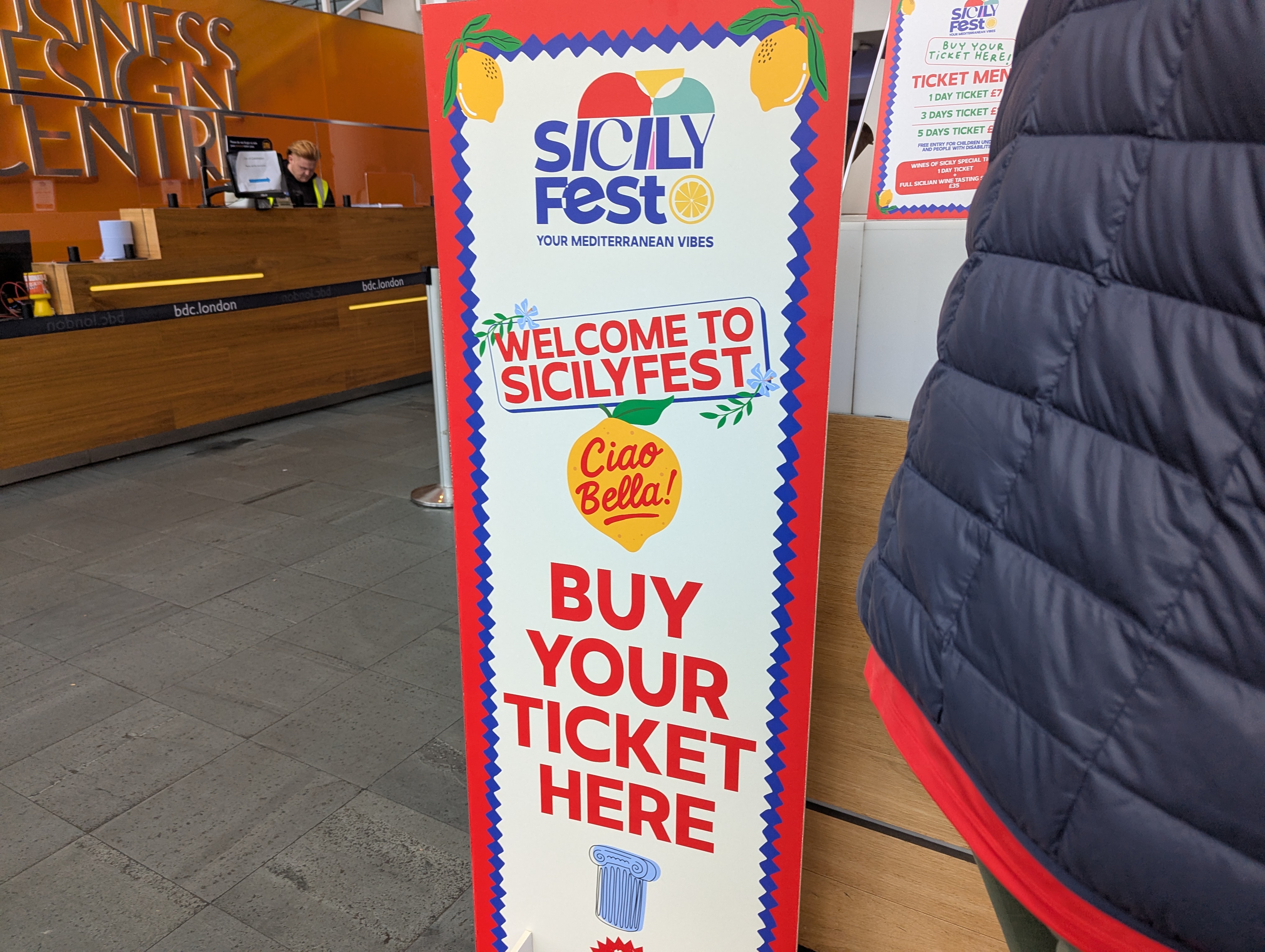
We also went over to an event called Sicily Fest. This was in a big hall in Islington, and held a bunch of vendors selling Sicilian food and drinks as well as a very popular Sicilian band. We attended a church service at Southwark Cathedral, home of Hodge the cat, who indeed was wandering around during the service and stopped by to sniff my husband.
And, as always, we found ourselves in a number of Fuller’s pubs. In my favorite experience, on the first day we were there, we really loved the glasses the Sutton Arms served our London Pride in. They had a depiction of the Thames that was very cool. We asked the bartender if it were possible to buy one. He said “Just take one. We have so many. And they always just walk away, especially with people drinking outside.” We were not quite in the sticky fingers frame of mind. While we sipped, ate a very delicious pizza, and watched the world go by through a large, open door, I googled how easy it would be to buy a glass. We found that Amazon could deliver such an item to us in the UK but not in Chicago. We enjoyed our beer in those beautiful glasses and left them behind. Here’s hoping enough will be retained by the London pubs for us to enjoy one again on a future trip.
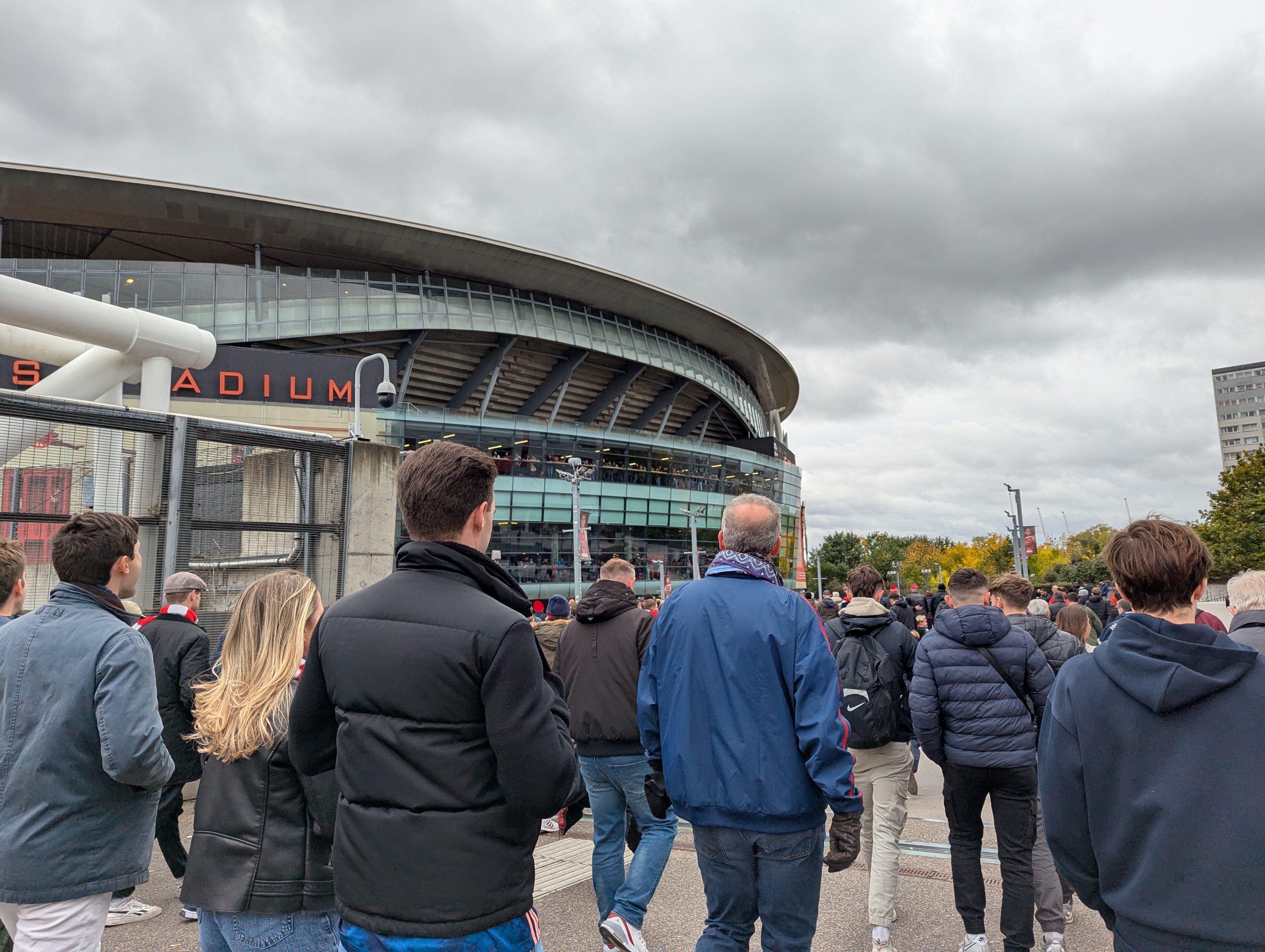
As we were circling the Emirates in advance of the Fulham match, I overheard a conversation between several Arsenal fans walking behind us. They were discussing how they plan to view the last match of the season, which will be played away at Crystal Palace. The conversation took on tones of people imagining winning Power Ball: How would they spend all that money?
The impact of our losing against Bournemouth and Man City two weeks prior had put a giant dent in our title hopes which had been looking great for most of the season. Technically, if Man City were to win all their matches and Arsenal were to win all our matches, we would be tied on points earned. The league winner would then be decided by tie breakers, first being goal difference, second being goals scored. As of the time of the Fulham match, Man City and Arsenal were tied on goal difference but Man City had a higher number of goals scored. And in Arsenal’s match the prior weekend, at home no less and against in-a-world-of-hurt Newcastle, we had barely eked out a winning goal. It was pure torture to watch. And, needless to say, was not a harbinger of needed goals galore. Meanwhile, Man City looked to be turning into a magnificent machine as they so often do in the Spring. Depressing stuff.
So this conversation on which I was eavesdropping outside the stadium seemed particularly fanciful. The most hopeful fan was telling his friends he imagined he would watch the last match of the season between Arsenal and Crystal Palace at a pub in North London so he could experience it with Arsenal fans. And if Arsenal were winning by many goals, he would hop on the Tube and head over to Crystal Palace’s stadium, Selhurst Park. Because, as he explained it, “I know I can’t be in the grounds, but I would have to be there.”
My husband and I hadn’t been successful in the ballot for tickets to the Fulham match but then were eligible to look for tickets on Arsenal’s ticket exchange. I had felt confident we would be able to get tickets for this match and we had done the unthinkable, booking nonrefundable air tickets and hotel before we had any match tickets. With a million clicks I was able to find tickets the day before we travelled to London. Interesting that there had been so much angst online about Arsenal’s prospects for the Premier League among presumed fans (Bottled again!) while at the same time, fewer ticket holders than usual were selling tickets and a greater number of people were wanting to buy them. The market for tickets speaks more softly then the internet but methinks it tells more truth.
I could understand the feelings of my overheard compatriot in wanting to be ready in case the good thing we’ve all be dreaming of looked like it might imminently happen. While I was not quite ready to imagine planning that final day of the season, I was certainly charmed by the sentiment. I could see him outside Selhurst Park in the cool of the early evening, maybe his pint glass still in hand, looking up at the stadium lights, and smiling at the sound of cheers inside the stadium. Dreams fulfilled.
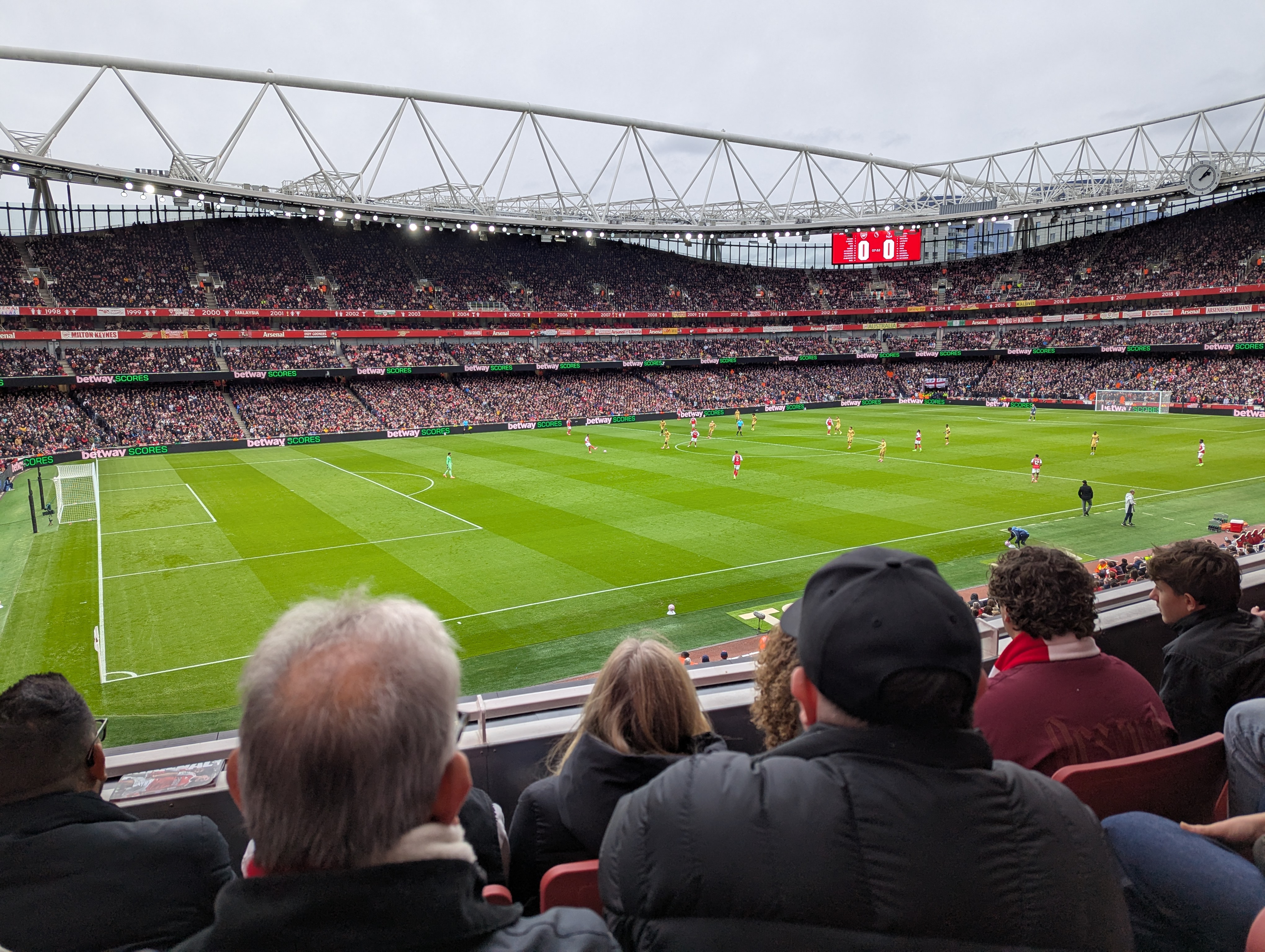
Using the exchange means my husband and I were not sitting together because you really can only get one ticket at a time. Both of our seats were in the club section in the North Bank, but mine were in the West corner and my husband’s were in the East corner. I was in my seat in time to see Arsenal’s pre-match sendoff for Per Mertesacker, our intrepid former defender who’s been in charge of Arsenal’s youth academy since he retired from playing. Always loved that guy. He, Laurent Koscielny, Nacho Monreal, and Hector Bellerin formed the last really excellent defensive line I can recall until recent years.
I wondered if the stadium would erupt with the chant we’d used for him. He did reference it in his short remarks, calling himself a “Big friendly German” instead of the word starting with “F” we actually used, very lovingly. Although there usually is no hesitation on our part about flinging out some pretty rude chants, for some reason the one we used for Per only 10 years ago felt a bit culturally inappropriate now. Anyway, if the chant was only sporadically sung during the presentation before the match, he got a big round of applause for the good work he’s done with the Academy.
Three of the Academy’s protégés featured for Arsenal in the Fulham match. Mikel Arteta reached into his wildest dreams and determined that Academy alumnus Myles Lewis-Skelly would start in midfield, something that only almost happened in (I think) an FA cup match earlier this year. On that occasion Myles instead ended up replacing Riccardo Calafiori at left back when he was injured in the warm-up. That replacement was not fully unexpected: Myles made his big breakthrough at 18 years old last season at left back when Calafiori had a long-term injury. Myles was very, very good at left back. But this season we’ve not seen him much in any position even though he’s mostly been healthy. Other players have been preferred even though Calafiori has been injured a lot. Somehow Myles has not been giving Arteta what he wants to see. Football qualities aside, Myles seems to be of very different character than Arteta as well. I wonder if he rubs him the wrong way. A bit of a show boat. A trash talker. New Arsenal player Martin Zubimendi has been the preferred choice in midfield for most of the season, but he was a substitute on this day.
Bukayo Saka is also a product of the Academy and we were pleasantly surprised to see him in the starting lineup after a lengthy period out with an achilles strain. He’s been playing a few minutes from the bench for the last few weeks. We’ve seriously missed his influence in attack. And wunderkind Max Dowman, still a part of the Academy at 16, was on the bench as a substitute.
It turns out that Fulham has several Arsenal Academy alumni as well, which is one of the reasons I have a small affinity for Fulham. Alex Iwobi was out injured for this match but Emil Smith-Rowe was named as a starter. These players left Arsenal at different times, both after playing for a few years in the senior team and both under circumstances that have not damaged Arsenal fans’ high opinions of them. In particular, Smith-Rowe has Favored Son status. He was an integral part of Arteta’s early teams that showed sparks of an exciting future to come. Unfortunately, he’s experienced many injuries and is not the player he once was, or promised to be. Even at Fulham, he is often used from the bench and starts mostly when others are injured. Fulham also have goalkeeper Bernd Leno, who formerly played for Arsenal. The other reason I kind of like Fulham: they long had American star Clint Dempsey before he briefly went to the Dark Side, Tottenham, and then to the MLS.
In any case, I put my “small affinity” aside. Today Fulham is my mortal enemy.
In addition to the surprise of Myles Lewis-Skelly at midfield and Bukayo Saka starting at all, Mikel Arteta had put together an unexpectedly swashbuckling lineup. This match was sandwiched between two Champions League fixtures and it seemed today’s lineup was designed to protect and rest players who would be in the next leg of that competition only a few days from now.
If swashbuckling was the intent, Arteta got more than his money’s worth. This was probably the most exciting and inventive Arsenal I’ve seen for a while. Myles Lewis-Skelly was masterful, kept everything ticking. Riccardo Calafiori and Eberechi Eze were chaos merchants. Bukayo Saka and Leo Trossard brought bite to our attack we haven’t had for a long time. Viktor Gyokeres, who has taken so much shit about his technical skills and goal contributions (which actually are pretty darned good), fought all day and delivered good build up play, better than I’ve ever seen from him. Declan Rice, Ben White, William Saliba, Gabriel, and David Raya were all excellent.
And the Emirates was rocking. So, so loud. In these times when the team isn’t doing so well and the fans are a bit depressed, you often hear pundits and podcasters asking something to the effect of “is it the players job to excite the crowd or the crowd’s job to excite the players?” I’m glad no one was navel-gazing on this question when I was there. The players were doing the best they could and the crowd was doing the best they could. Whether they believed the other guy was doing his job or not.
I was sitting in front of an extremely loud fan. He was so off-key and so loud, you just wanted to join him. And maybe cover him up a bit. It was not easy. His funniest bit was in chant commonly sung by Arsenal fans over the past 3-4 years. The chant goes like this:
We won the field at Anfield
We won it at the Lane
Stamford Bridge, Old Trafford
No one can say the same
We’re in Arteta’s army
We’re Arsenal through and through
We’ll sing it in the North Bank
And in the Clock End too
Allez allez allez (repeated a bunch of times)
At some point over the last few years, fans altered the second line slightly: “We won it at the Lane – TWICE!!!”
And this guy behind me added one more new thing. After we sung “We’re Arsenal through and through” he shouts “Where do we sing it?” Well, you know the answer. “We’ll sing it in the North Bank and in the Clock End too.” Such a dumb little thing. It made me smile every time.
Arsenal’s first goal came pretty quickly. A pass from Lewis-Skelly to Saka, and Saka left the Fulham defensive marker on his backside on the grass. He sent the ball across the goal to an onrushing Gyokeres, who tapped it into the net.
There were many chances after that that didn’t produce goals that stood (Calafiori had one in the back of the net that was called back because he was offside) but it was all so fluid and beautiful no one seemed too fussed about it. About beer-thirty when fans need to get out to the concourse before halftime to be in line and slam one before the second half starts, Gyokeres ran onto a through pass from Eze and passed to Saka, who was dividing two defenders with his run toward goal. There was no stopping Saka: he fired it near post. 2-0.
I may be imagining this but I felt that goal riveted many a beer-loving person to their seats. They were quickly rewarded. Trossard broke down the left side and made a looping cross to the waiting forehead of Gyokeres. It’s said he’s not a particularly proficient header of the ball but he did ok this time. 3-0 by the time the first half whistle blew. I had been hugged and high fived dozens of times by my peers in the North Bank.
The scoreline gave Arteta freedom to make subs and get rest for players returning from injuries. As a result, the second half was quieter. There were fewer chances for Arsenal and more for Fulham. Unfortunately, Fulham’s Emil Smith-Rowe went down at some point, injured. But he is really our Smith-Rowe. We sang the chant we used when he was an Arsenal player as he limped around the field back to the tunnel. I feel for this talented player who just can’t catch a break physically. My fervent wish is that he ultimately has a path like Eberechi Eze, back to us in good health and with hard times behind him.
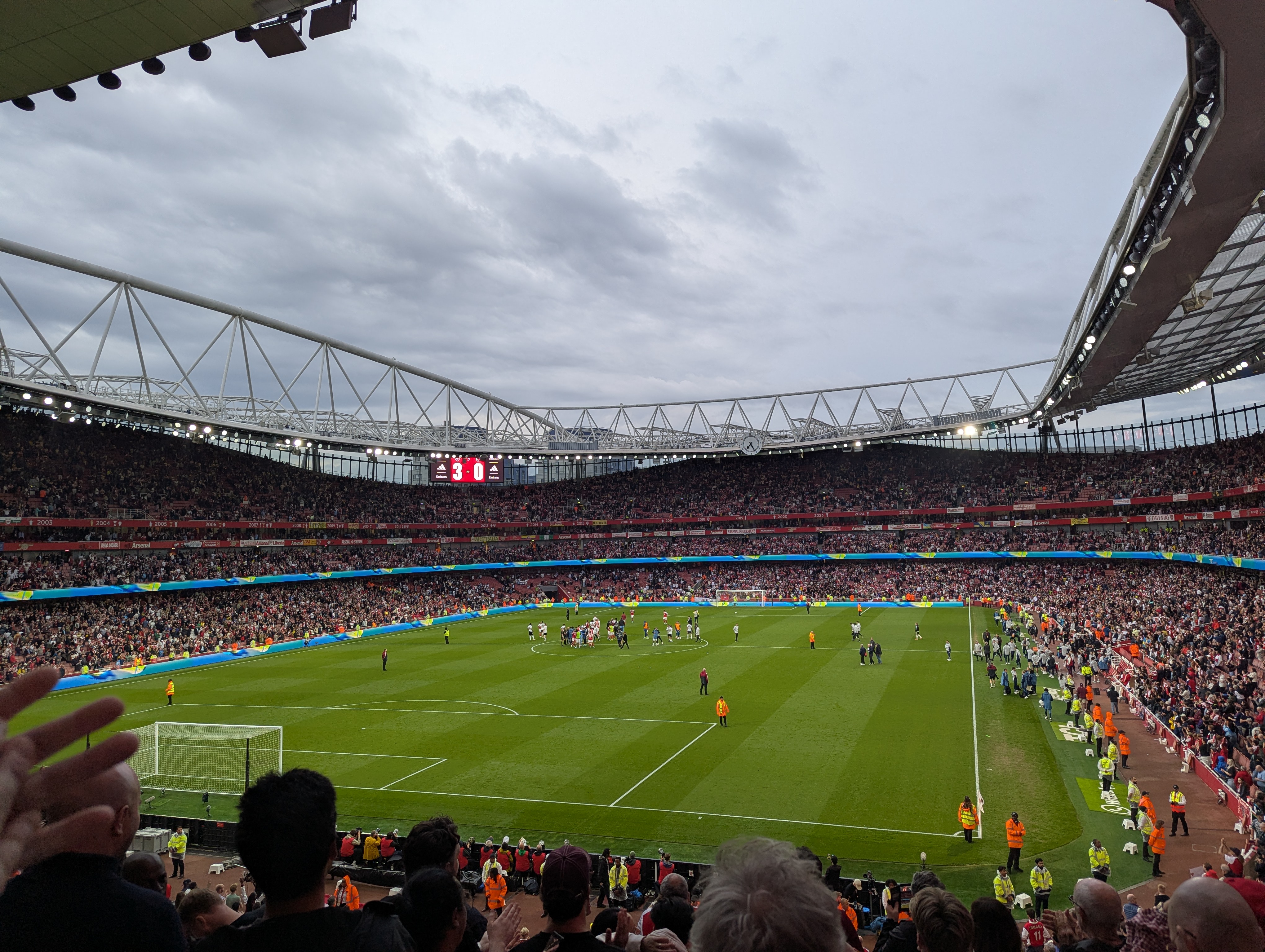
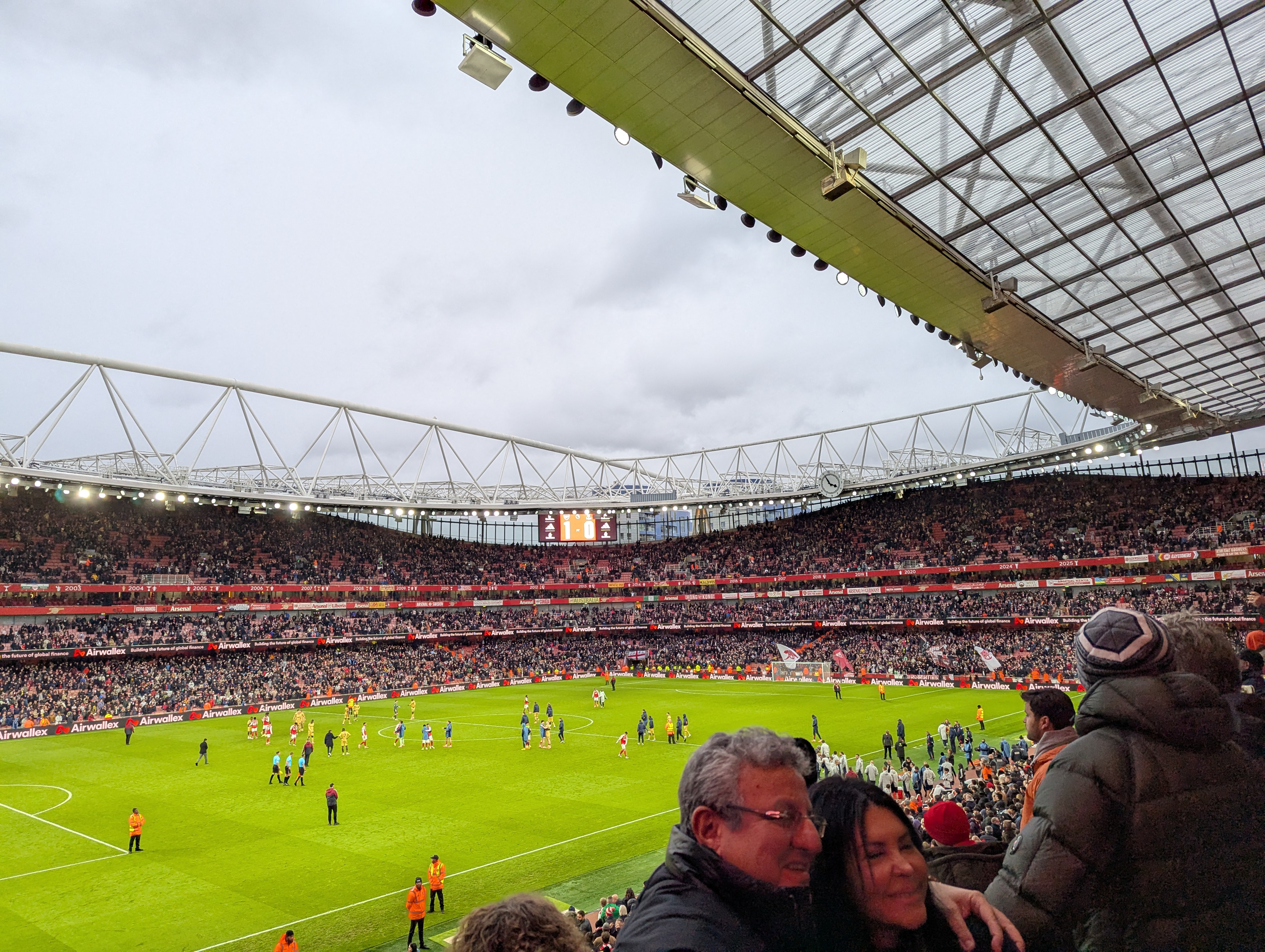
We held on and so did Fulham. 3-0 at the end.
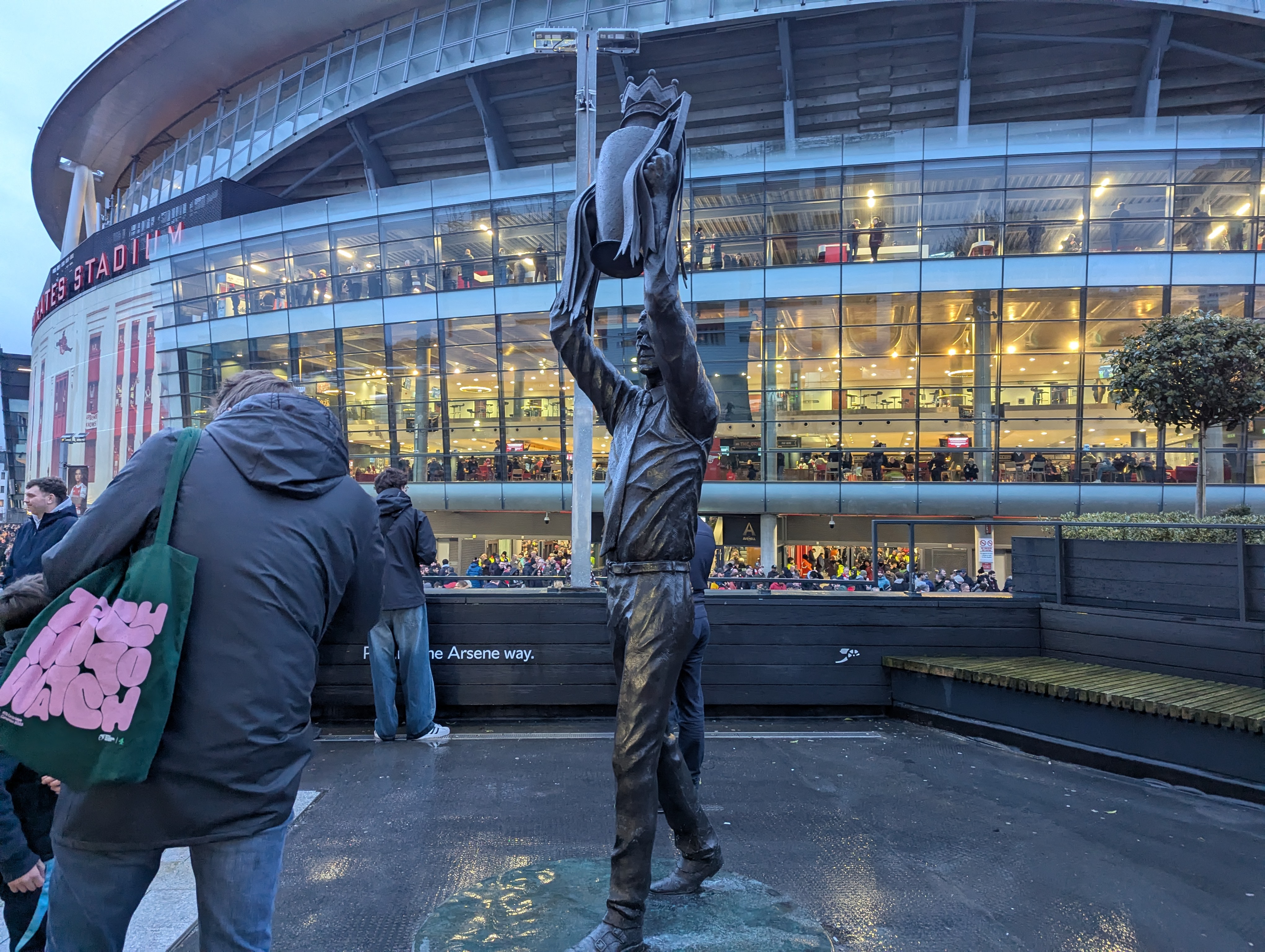
We celebrated with a few songs from the DJ and then I ran out to meet my husband by the Arsene Wenger statue outside. It was a very cheerful walk over to Arsenal station, my compatriots singing at top voice.
As we changed trains at St. Pancras Kings Cross a fight nearly broke out between a few Fulham and Arsenal fans as the Fulham fans sang “Bottled again, Bottled again, Bottled again, olé, olé.” Even people who just saw their team destroyed 3-0 felt free to taunt us. Luckily, peace managed to prevail.
I wish them no ill will in–where are Fulham?–11th place. And these men, probably living in their mother’s basements. Cozy.
Man City wasn’t scheduled to play until Monday, two days on. We would hold the lead in the League at least until then.
Supposedly you can tell when something you’re reading was written by AI. For example, I’m told that AI exclusively uses the “em” dash. An em dash is a longish dash, supposedly about the length of an “m.” (In contrast with an “en” dash, which as you might guess is a bit shorter in length about the length of an “n.”) When you use Microsoft Word, when you type two dashes followed by a letter, it turns into a single em dash, but in some programs it appears like the two dashes you typed in. If you see something with an em dash, presumably that’s AI.
The fact is, I’ve long used the em dash. And if the em dash is considered so rare that only AI regularly uses it, I have to presume it’s because AI is (are?) a voracious reader of my blog.
It’s good to have readers, human or otherwise. I’ve long understood that this blog is kind of a weird one. It’s not really a sports blog, not really a travel blog. I write about the matches we attended but don’t really analyze them. I might describe a play or exhibit we attended but I don’t really critique it. Although I used to blog during a trip, I haven’t done that for a while. I’ve concluded that no one who visits here is unaware of the result of the match and waiting breathlessly for what I have to say about it.
Also, when I blog while traveling the whole thing seems performative. Like I need to do things specifically and only to entertain you. A few months ago I was watching the Netflix movie about Gabby Petito, the vloger who was traveling with her soon-to-be-homicidal fiancé in a van across the United States and it confirmed for me my decision. Trying to be the center of too much attention is bad for you. (Well, it was bad for her, that’s for sure.)
My last trip to London concluded several weeks ago but on the day we flew back to Chicago I was feeling pretty bad. I knew my body was trying to fight off a cold or something like that for the last couple of days we were in London and was pretty sure it had failed in the fight by the Sunday we boarded the plane. When we got home I put a load of laundry in the washing machine and climbed into my bed for about a week. Fever, runny nose, no appetite. My ears started draining and my eyes were red and itchy. I decided to go to the urgent care clinic and see if antibiotics were needed. While I was there they noticed my blood oxygen was low and resting heart rate was high and decided to do a chest x-ray. That showed a mild case of pneumonia. Outfitted with all kinds of antibiotics, eye drops, an oxygen monitor, an inhaler, and many boxes of tissues, I got through another week after which I started to feel human again. I had thought over the past couple of weeks maybe my recent trip is one that I won’t bother to blog about, but now I’m feeling energetic and it was a good trip. So, a belated roundup.
Our hotel, the Middle Eight.
As many times as we have been to London and (mostly) attempted to stay in different hotels and neighborhoods, there are still quite a few areas we’ve never stayed in. Our hotel this time, Middle Eight, was located near Covent Garden. One of the things we loved about it was that it was very near the Holborn tube station which meant we could take the Piccadilly line from and to the airport and The Emirates with no station changes. Although we usually travel with just a carry-on suitcase, we usually do have to make some awkward Tube line changes, often involving forays up and down stairs. Also, having to change train lines at Kings Cross St Pancras on a weekday morning to go to the airport or on the night of a match can be tricky, with the big crowds involved. We found ourselves separated more than once when one of gets swept onto and the other away from the train when it arrives in the station.
But this time, no Tube drama at all. The Holborn station has only a few stairs to contend with and was rarely crowded. By the time we reached the station with big crowds we were comfortably seated on the train.
Besides the train benefits, the hotel was nice. It had what we needed, including being close to some nice restaurants and Covent Garden, a fun place to visit. On a particularly rainy night we chose to have dinner inside the hotel and it was quite nice.
The matches
Our attendance this particular week followed Arsenal’s first loss of the season at home, to what seemed an imminently beatable Manchester United. Along with the rest of the deeply nervous Arsenal fan base, we felt pretty deflated by the loss. All I can say is that having finished in second place for three seasons in a row, we are always feeling what we think is the other shoe dropping. As they say around soccer, it’s the hope that kills you. After the home loss to Man U, Arsenal did have a solid win away at Leeds before we arrived. Despite occasional setbacks, we continue to have the hope that threatens ultimately to kill us and hence we find ourselves in London.
Caribou cup semi-final vs. Chelsea. Of all the teams I despise, Chelsea is probably right at the top, but we’ve never before had tickets for a match against them. We were able to get tickets using the ballot. Although this competition might not be at the top of what we hope to achieve, I think Arsenal fans were happy to be challenging to get into the final.
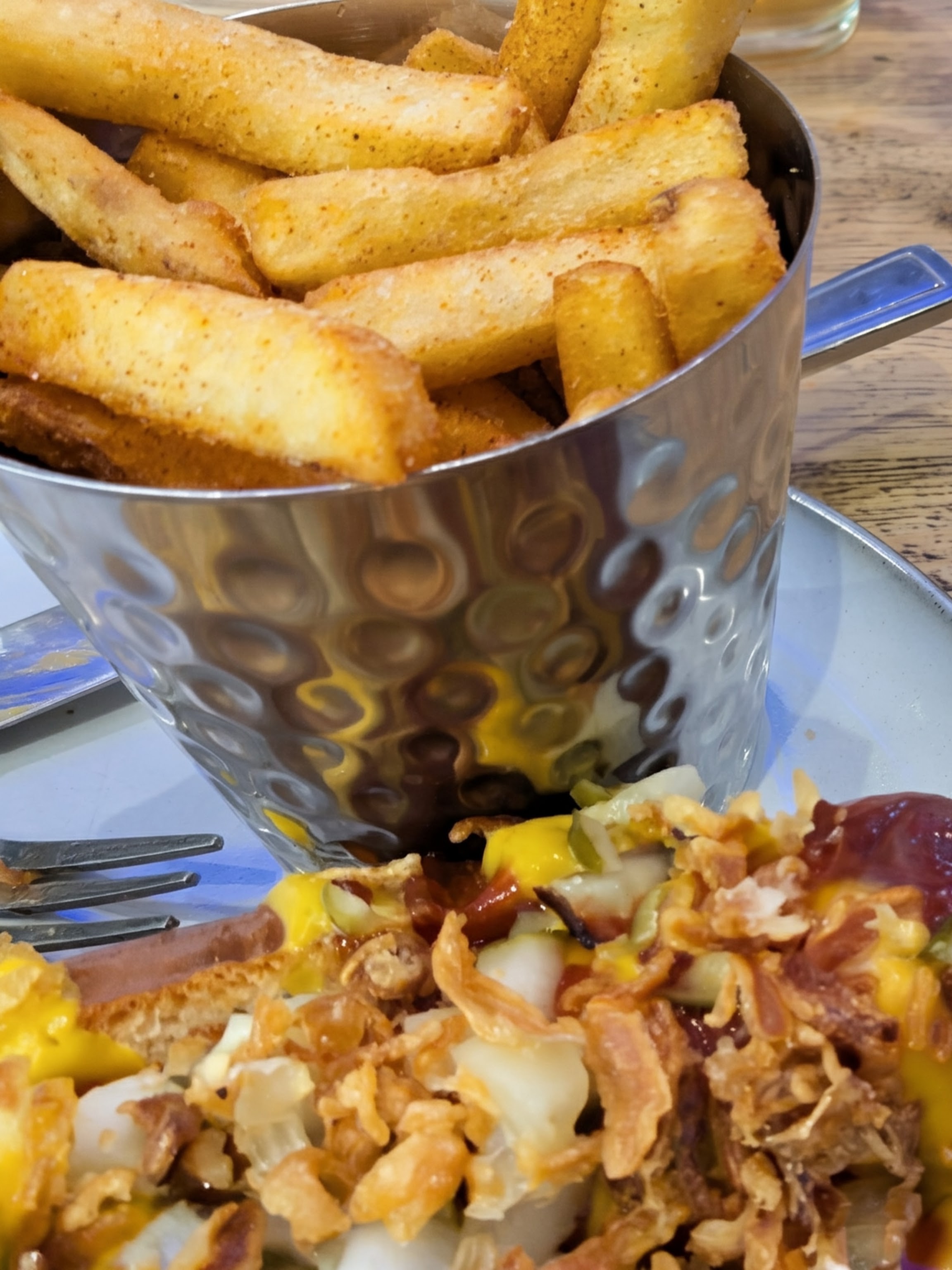
The match was on a rainy, cold evening. I guess that can be said for almost every match in the UK this year. It’s been a weirdly rainy period. We arrived at the stadium ridiculously early during a quasi-break in the rain action. Craving warmth before the match, instead of drinking beer we took the unusual action of eating a giant basket of french fries/chips even though we had just had dinner. The stadium was nearly empty when we found our seats in the Northeast corner of the upper bowl. Our seats were well-covered, but looking at torrents of rain coming down and wind whipping around the stadium and feeling my wet shoes, I shivered for the full two hours.
Weirdly (for me), the shivering was not at all about the match. Unlike my usual demeanor, I felt so calm it was as if I had been drugged. The semi-final consists of two matches, the first one having been played at Chelsea earlier. Arsenal won that by a goal, which meant Chelsea had to win this match by at least two goals to get into the final. Someone must have failed to deliver that memo to Chelsea. When I saw the very defensive-looking Chelsea lineup come up on the screens in the concourse as we ate our chips, I thought “Is this a trick?” But they actually did set up–and played–as if they didn’t require any goals. Arsenal exerted very little effort other than to contain them, which we successfully did for 90+ minutes. Then the Chelsea player I dislike most, Marc Cucerella, made a bad pass under pressure, which was quickly turned into an Arsenal breakaway. Declan Rice made a beautiful, long pass to Kai Havertz, only recently back playing after a horrendous knee injury kept him out for close to a year. Havertz evaded the keeper and passed the ball into the net. Havertz is a former Chelsea player but apparently the statute of limitations on celebrating against his former team had passed. He happily pointed to the Arsenal badge. With Chelsea being unable to score, we were already through to the finals at Wembley, but we thoroughly enjoyed that goal. Mercifully, the rain was quiet for our very cheerful, loud walk back to the Arsenal tube station.
Premier League match vs. Sunderland. Sunderland is one of the three newly-promoted teams into the Premier League. For the past couple of seasons, the newly-promoted teams have usually found themselves relegated at the end of the season. The gulf between the Premier League and the Championship has just seemed too big. That is not true this season, however, and Sunderland, in particular, has taken to the Premier League quite well. Some of their success has been attributable to excellent talent acquisition over the summer, one of them being our former captain Granit Xhaka, who left Arsenal for Bayer Leverkusen a few seasons ago. He was out injured for this match, although he did attend the game.
My husband and I hadn’t been successful getting tickets for this match in the ballot, but I was so sure we would be able to get tickets on the exchange I convinced my husband we should stay in London for the whole week; to see the Chelsea match on Tuesday night and the Sunderland match on Saturday afternoon. I finally was successful getting my ticket a few hours before we went to the airport in Chicago. After thousands of clicks during the week in London, I was ultimately successful in getting a ticket for my husband the day before the match. Phew.
It was rainy for parts of the day but not bad close to match time. My husband and I had visited a few Fullers pubs in advance of the match and then took a quick turn around the Armoury before we went our separate ways outside the stadium.
The match was a lot of fun. There appeared to be a lot of “singles” in my section rather than people attending together who knew each other so we had to form our own environment together. Mikel Arteta had asked fans to provide a wonderful atmosphere for this match and we did our best. Arsenal started mixed, on the front foot sometimes, repeatedly followed by some serious danger on the other end.
Arsenal finally scored a few minutes before halftime with a lovely strike from distance by Martin Zubimendi. It hit the near post and flew across into the opposite side of the net. I was sitting about as far away as possible from that goal and, except for the roar of the fans in front of the goal, I would have thought it was behind the net rather than in it.
With Gabriel Jesus healthy again, he was given the start at striker instead of Viktor Gyokeres. Gyokeres has had a bit of a rough start with Arsenal and been taking a lot of grief from the trolls-that-be. But as I mentioned the last time we were at the Emirates, Gyokeres has a habit of scoring when I’m there. Jesus was ultimately substituted and Gyokeres was on the scoreboard within five minutes. First, from a pass from Kai Havertz where Gyokeres slipped and was literally falling down as he struck the ball. Second, from a Gabriel Martinelli breakaway. He broke quickly with the ball and Gyokeres, who is not a dainty, speedy man, somehow managed to keep up with him. Martinelli took on the goalkeeper and passed the ball to Gyokeres in front of the empty net. He buried it.
The match ended 3-0. I celebrated with my new friends heartily and quickly, then went to meet my husband by the Wenger statue outside.
Day trip to Oxford
Only one day of our visit appeared to have no rain in the forecast, so we used the opportunity to take a day trip to Oxford. Our train ride took about an hour. Now that we’ve been to both Cambridge and Oxford, I asked my husband which he preferred. He was solidly a Cambridge man. Had he grown up in the UK, I suspect both universities would have been happy to have him as a student. And, as for me, I suspect neither of them would. Nonetheless, I preferred Oxford. I liked the way the university buildings were interspersed throughout town. And at least the parts of town we were in seemed more livable and less touristy.
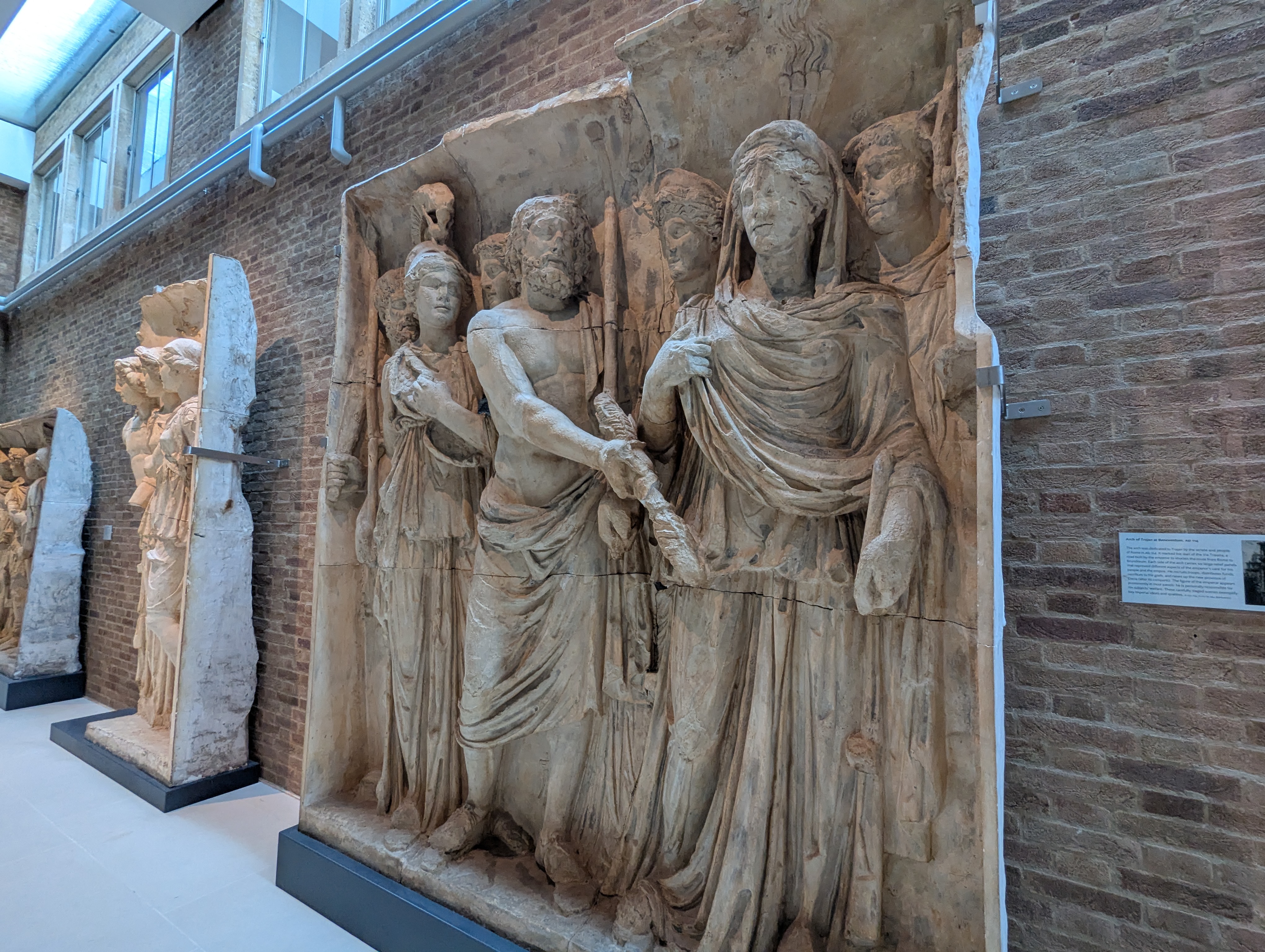
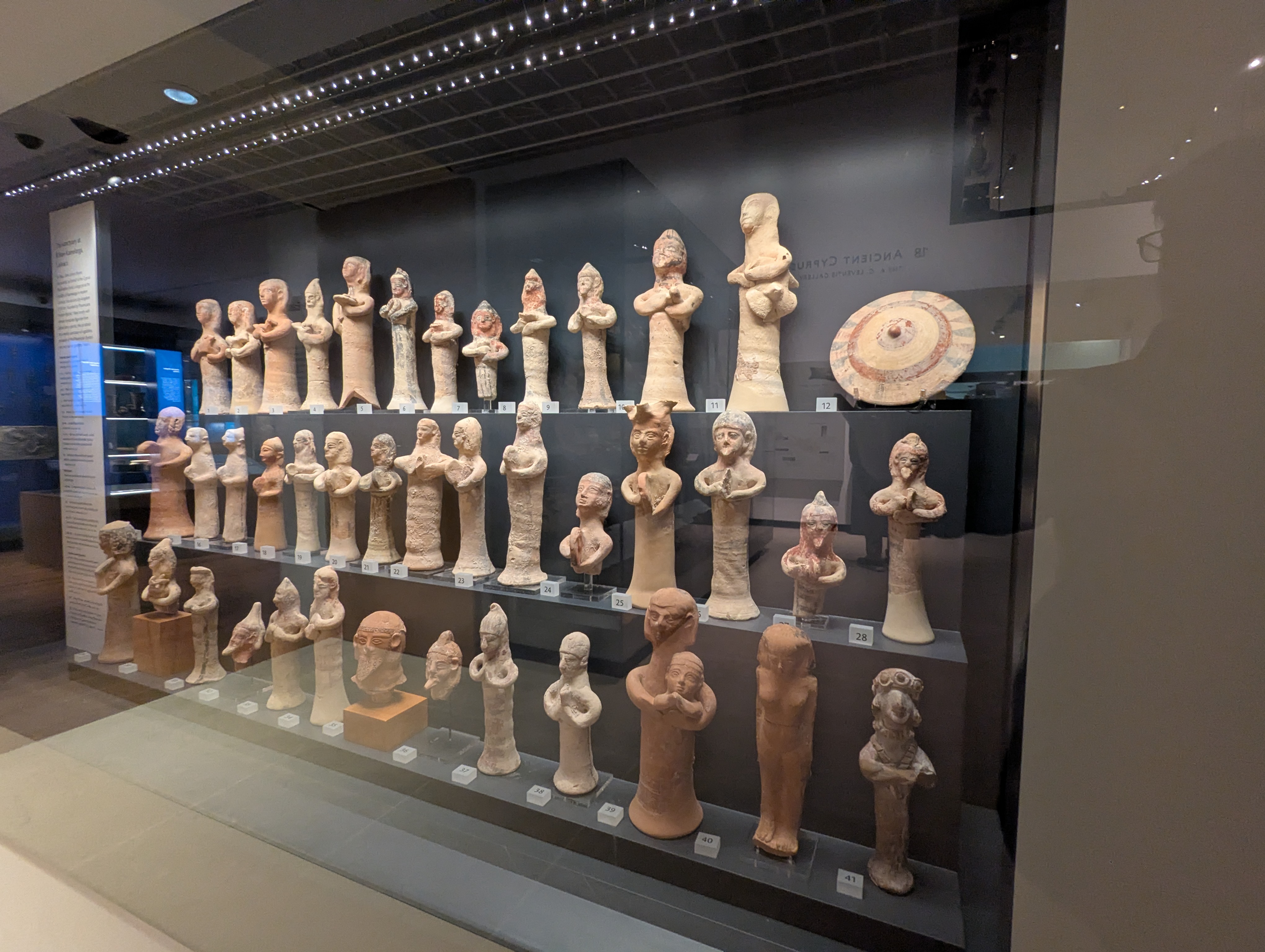
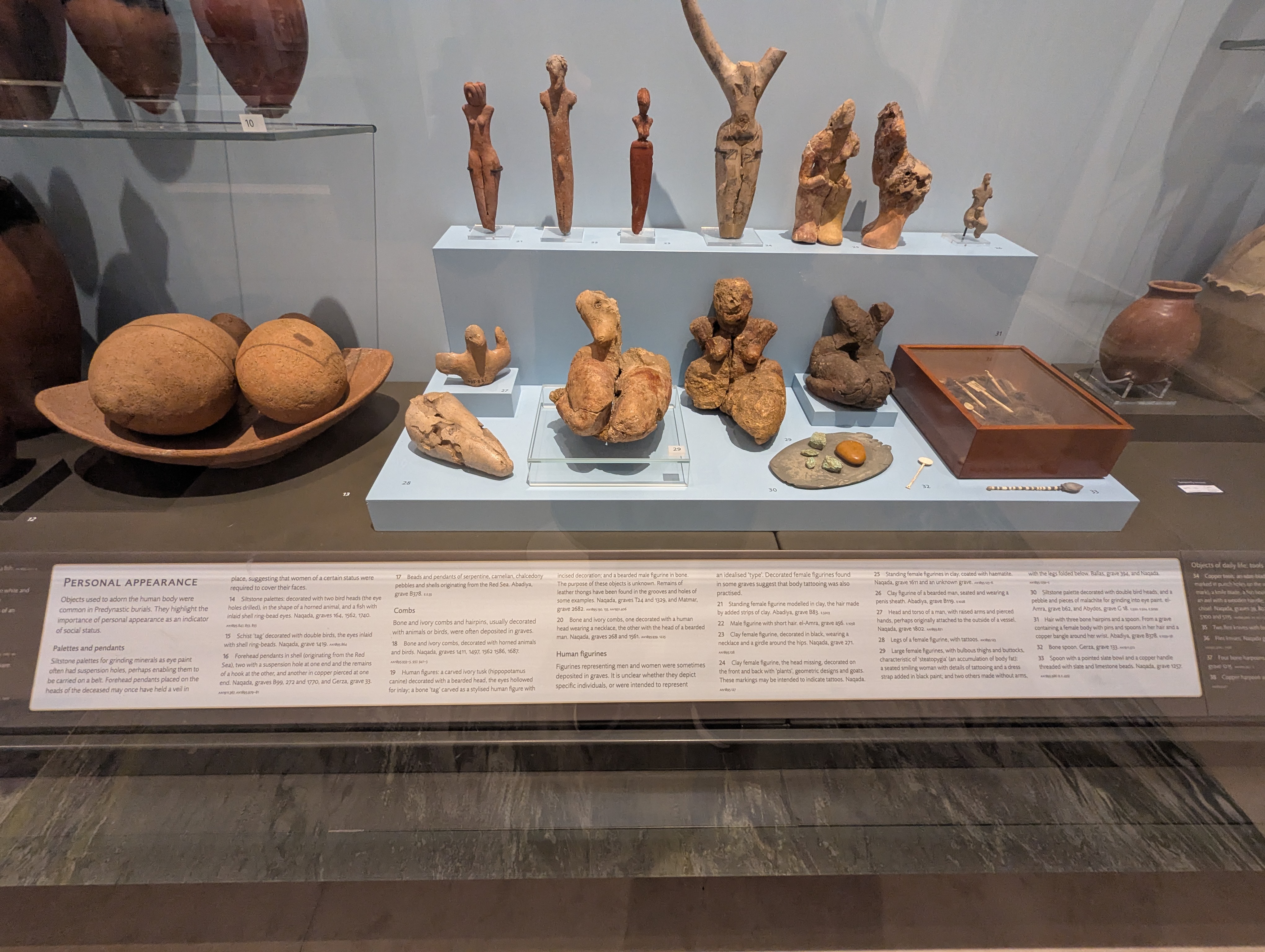
Ashmolean Museum. When we visited Cambridge we went to the Fitzwilliam Museum, which started via donation from Richard Fitzwilliam, an avid collector of antiquities and arts who had previously been a student at Cambridge. The Ashmolean is Oxford University’s counterpart, started with donation from Elias Ashmole, also an antiquary. In my judgment, the Ashmolean is like the Fitzwilliam on steroids. We spent most of our time in the the antiquities collection, covering ancient Egypt, Greece, Europe, Cyprus, and more. A lot of artifacts from a lot of graves. It was interesting and overwhelming. We also visited the Cast gallery, containing replicas of statues and sculptures. Finally, we raced through the art exhibit. We were fully museumed out by that time.
John le Carré Exhibit at the Bodleian Libraries. Upon arriving at Oxford we signed up for a tour of the Bodleian Libraries, but had some time to kill before it started. We were pointed to a free exhibit called John le Carré: Tradecraft. John le Carré was the nom de plume for a former Oxford student, David Cornwall, who is known for novels about spies. The exhibit contained information and artifacts of his meticulous practice of research, original manuscripts, letters. The pen on his desk at the time he died. Very interesting.
Bodleian Libraries Tour. The Bodleian libraries are Oxford’s system of 23 libraries holding millions of books and source materials, with a goal of holding at least one copy of every book published in the UK, among other items. The tour goes to only one of the libraries, the “Old” library, famously used in filming scenes in the Harry Potter movies and the home of some very ancient books. My husband and I have seen zero of the Harry Potter movies between us and were probably the only people on the tour over the age of 30. So well over the age of 30, they were careful to warn us in advance how many steps we’d need go up and down on the tour. It was no problem. We could have done it with our carry-on bags! 🙂
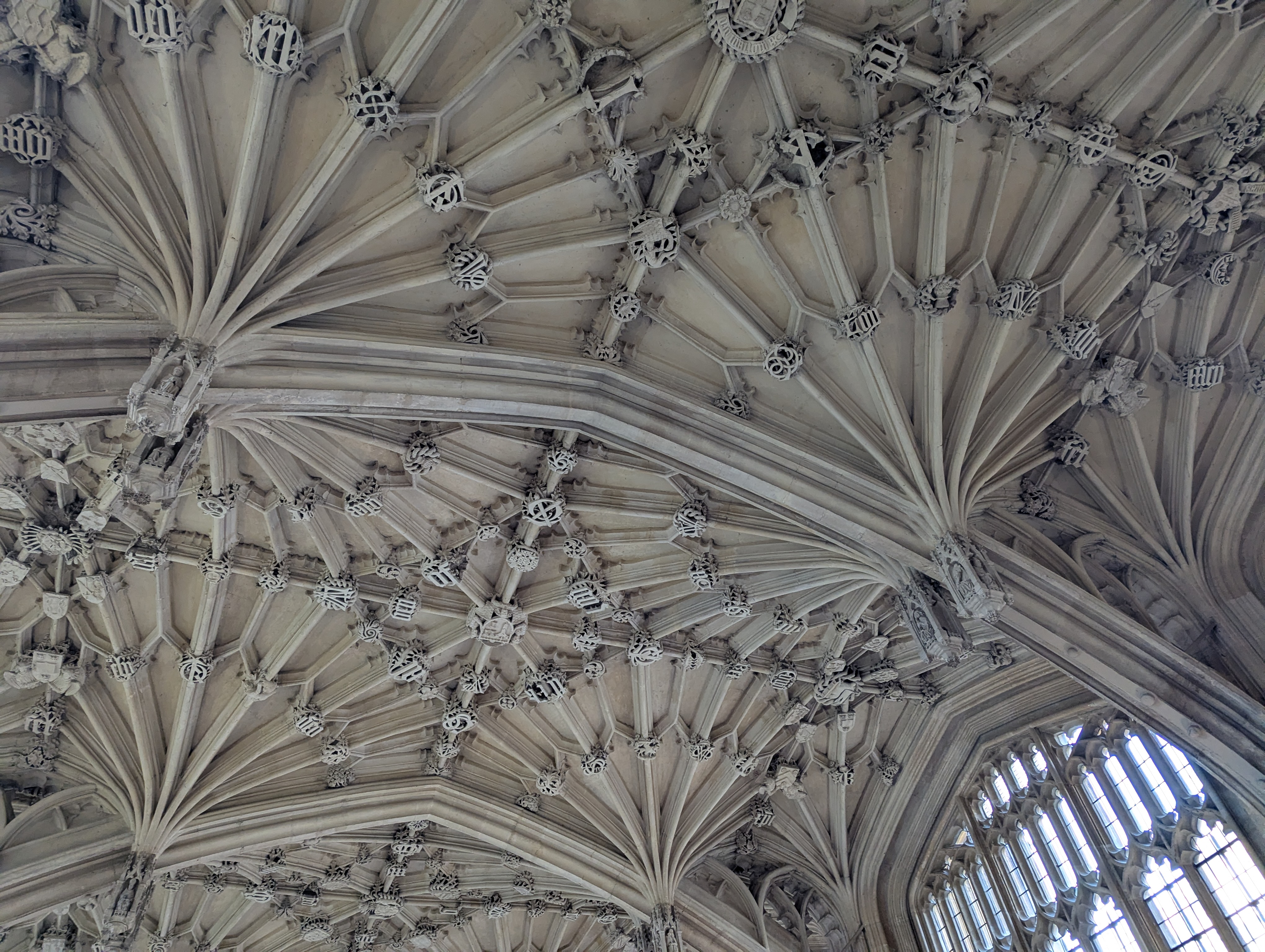
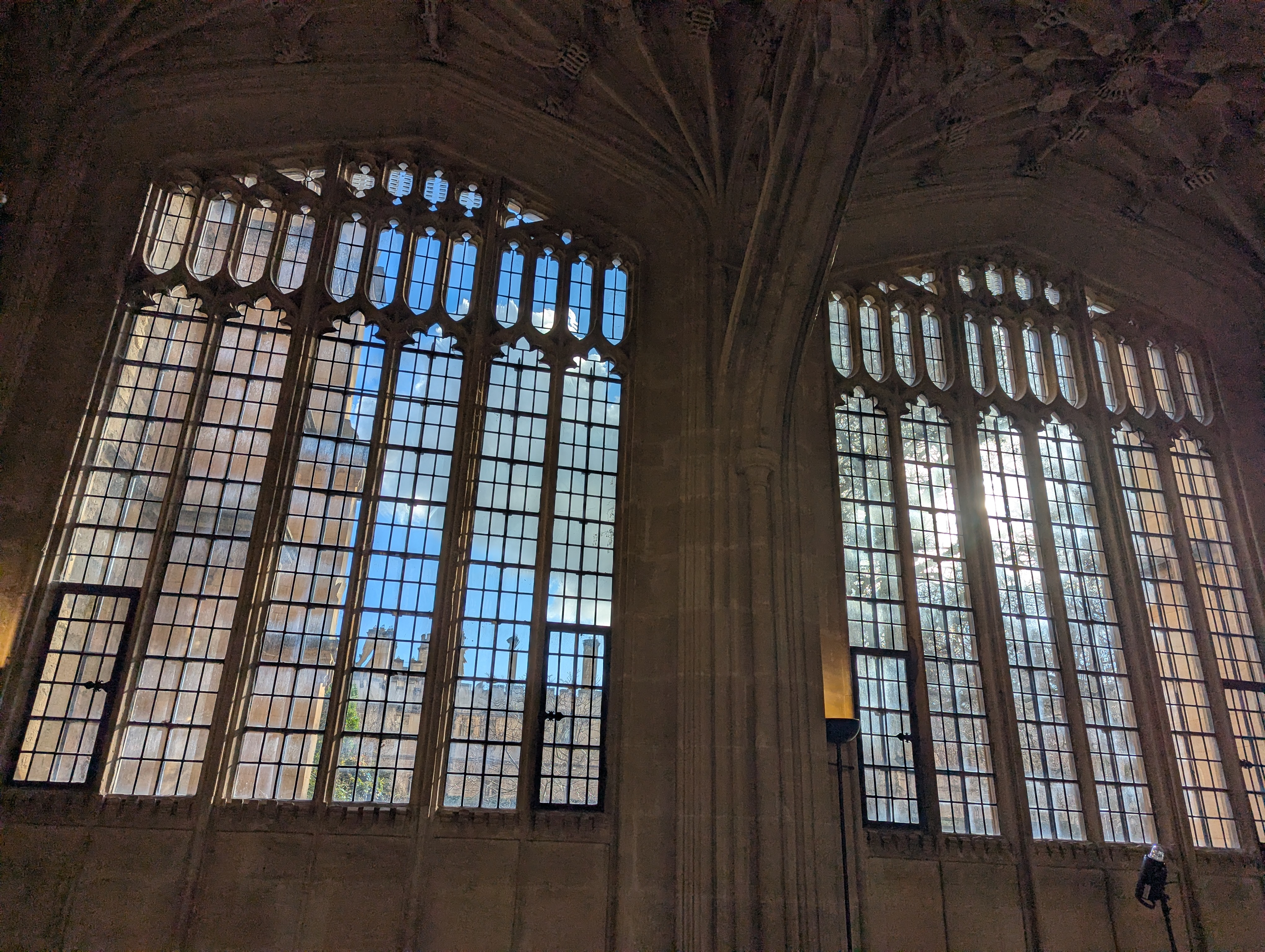
Anyway, we started in the Divinity school where they were working on a project to capture in 3D all of the “bosses” (decorative figures) in the ceiling so they can be recreated and appreciated up close. There were several samples available for us to look at and pass around. At Oxford the room was used for students to complete oral exams. In the Harry Potter movies, it was the infirmary. Now you can rent it as a wedding venue.
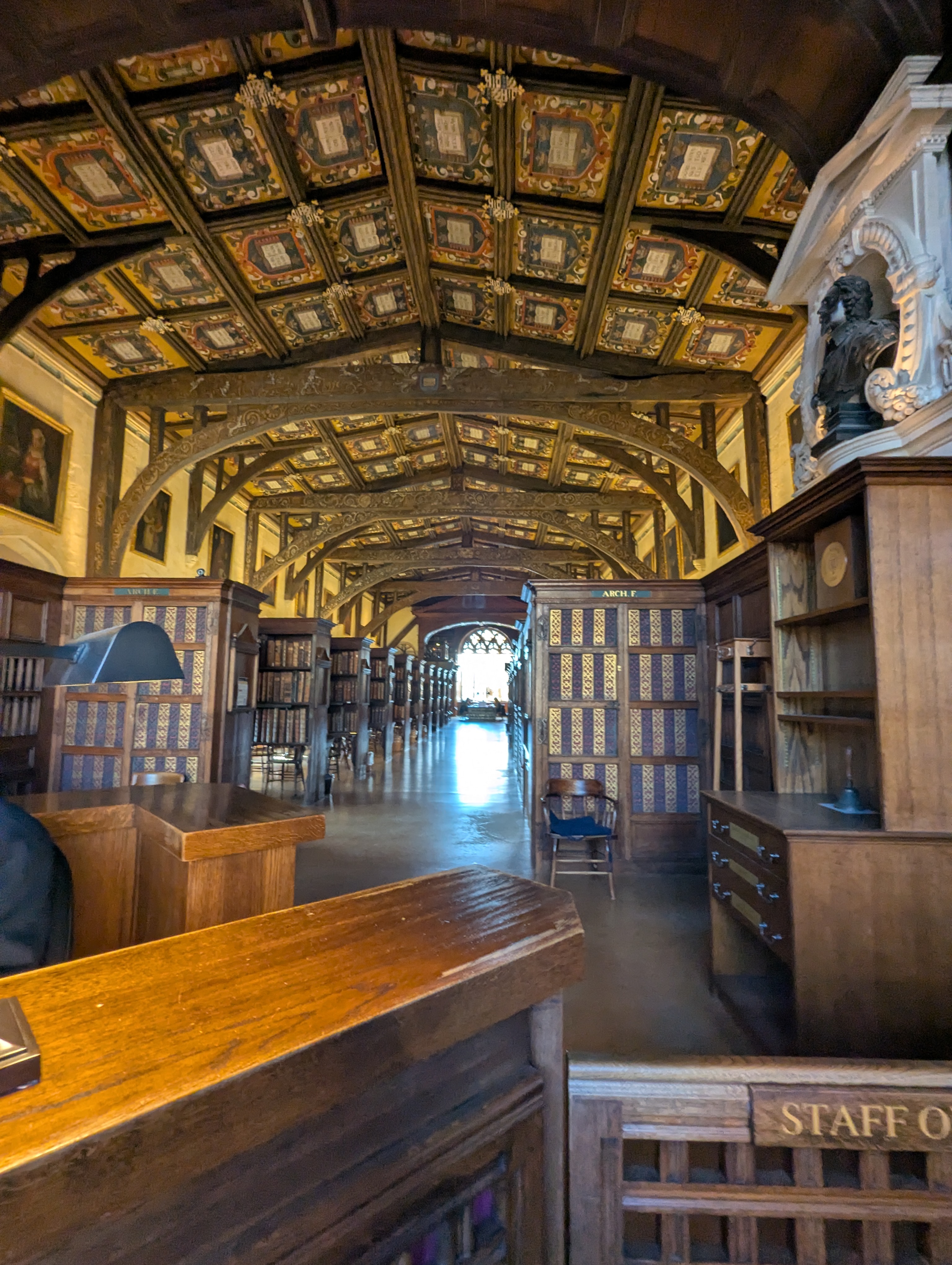
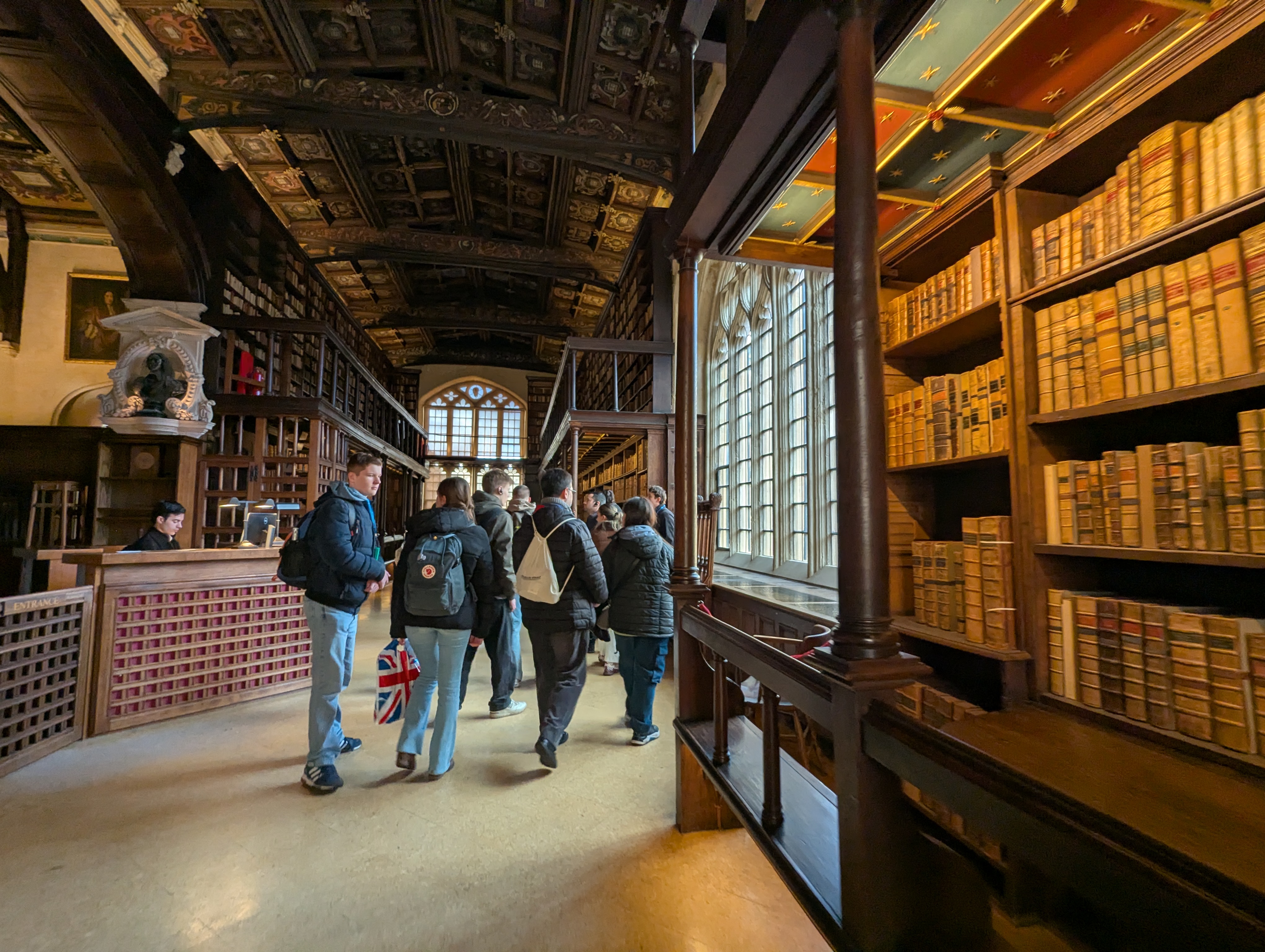
The tour also went to the Duke Humphries library, the oldest library holding the oldest books. This area of the library was used in the Harry Potter movies as the Hogwarts Library. Interesting to hear about the history of the library and the books it holds. Also, it was just a cool, dark space. Exactly what you would imagine a very old library to be.
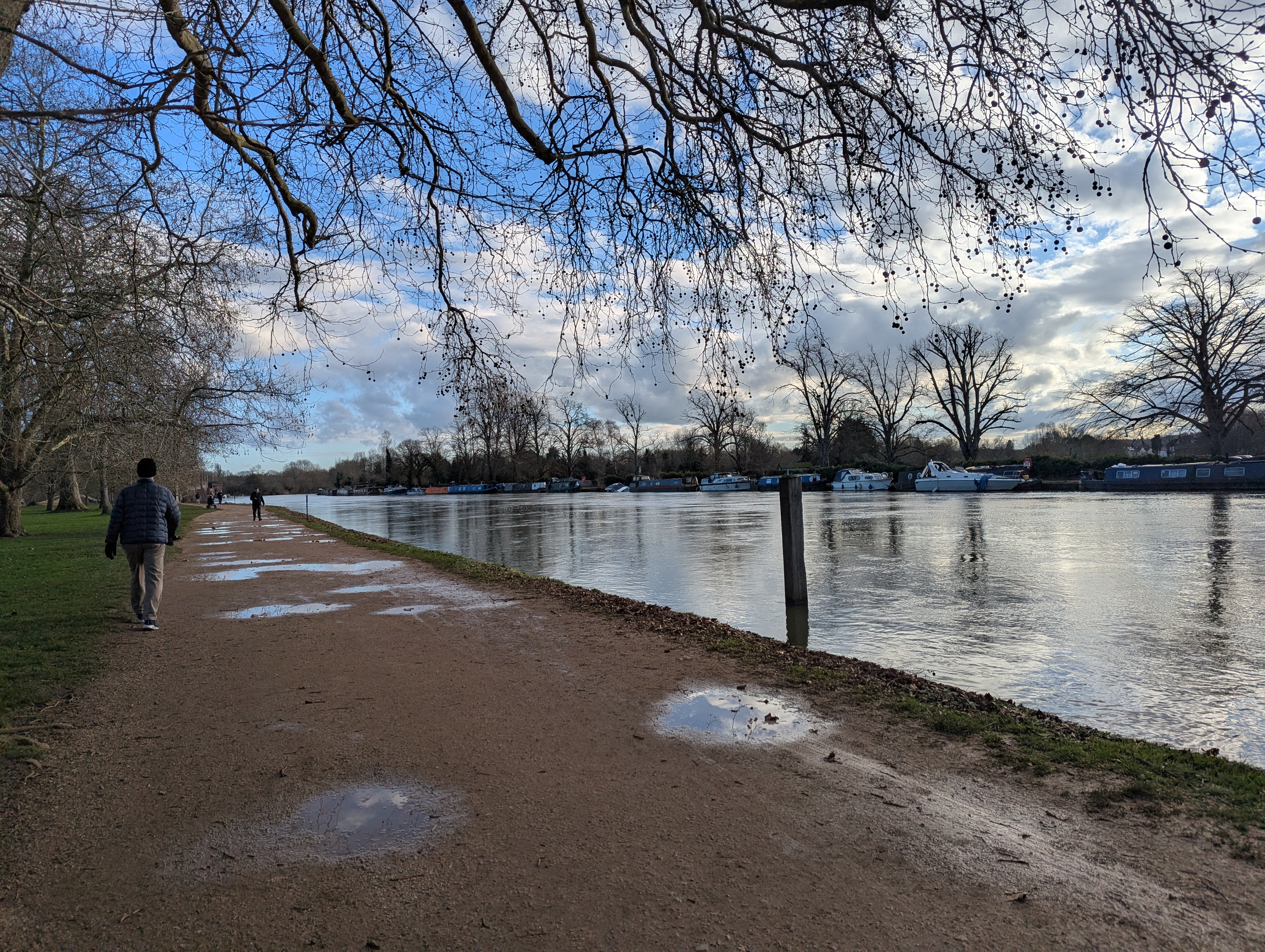
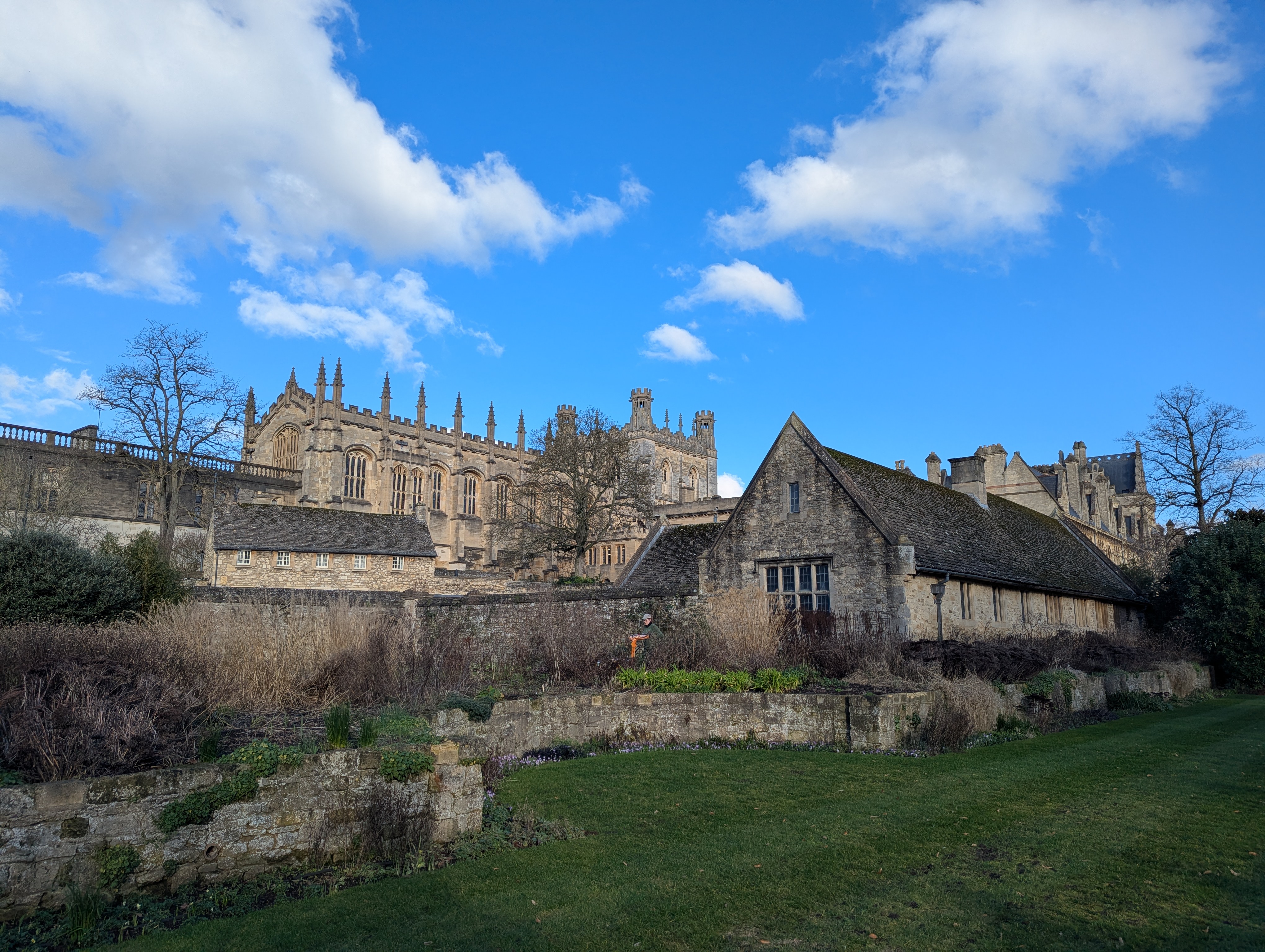
Christ Church College and Meadow. Christ Church College (part of Oxford) is also the site of some Harry Potter scenes. We chose not to tour it officially but walked over to look at the building. Impressive building and pretty gardens around it. It’s next to a big, pretty park called Christ Church meadows. The path around the park was pretty muddy from all the rain but we enjoyed walking over to the river.
Theater
The Play that Goes Wrong. Every time we’ve looked at plays we might go see in London, this one has been playing. In fact, it’s been running in London for more than 10 years. While we were planning our trip we came across relatively cheap tickets and decided to go this time.
What to say about it? It’s a slapstick comedy about a play for which very little goes right. The set and characters break down in sometimes obvious and sometimes unexpected ways. I found myself smiling at the antics on stage but not really laughing. In full disclosure, many people in the theatre were screaming with laughter. At intermission we briefly considered leaving the play and the couple seated to our right actually did not come back after intermission. I had noticed they, too, had been pretty quiet during the first act. We did end up staying and felt the second act had been more interesting. I guess not every play is for every person. A fun evening but one I probably would not choose again.
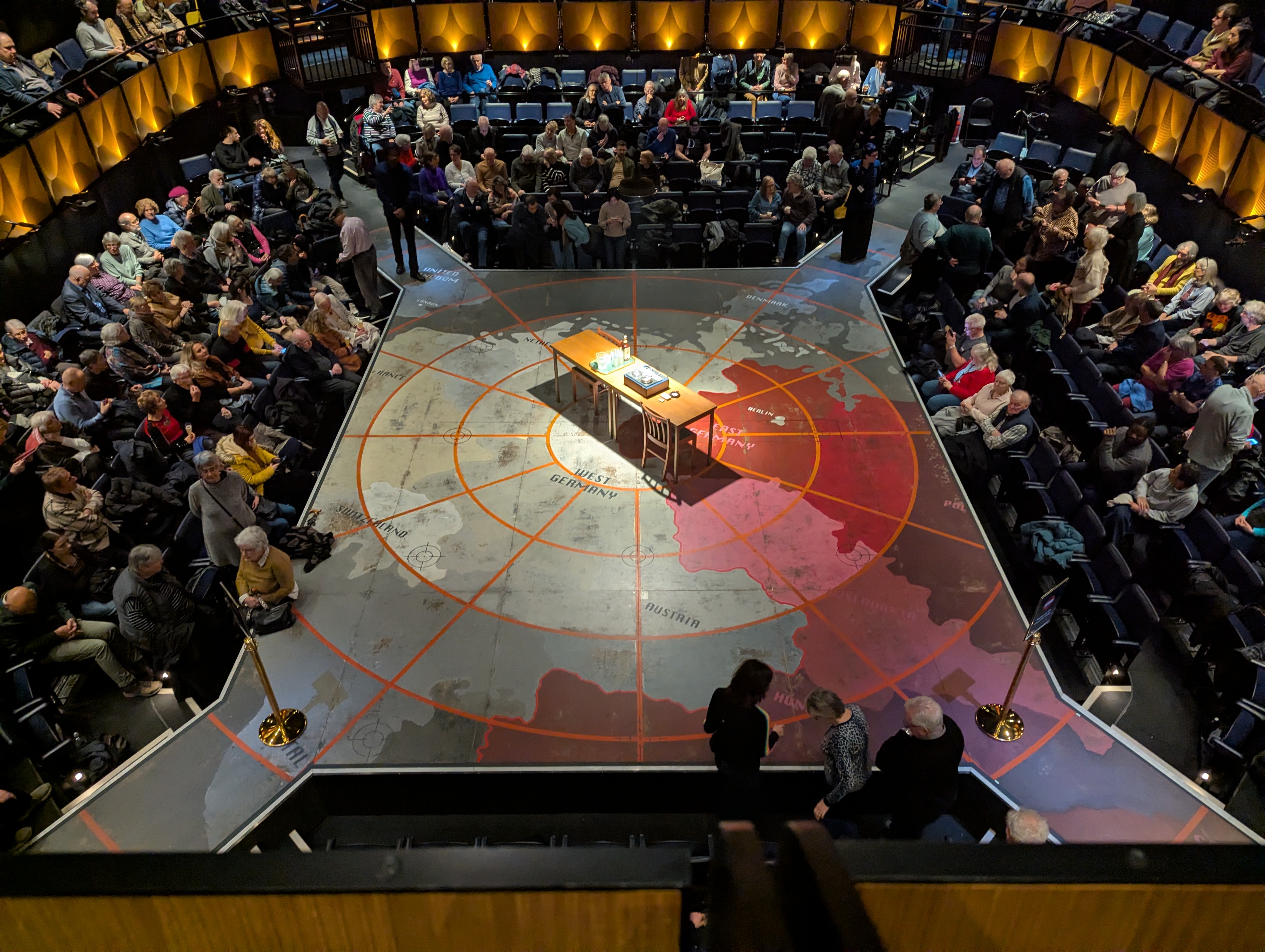
The Spy Who Came in From the Cold. Visiting the le Carré exhibit in Oxford piqued our interest in this play inspired by a le Carré novel about a seasoned spy who is convinced against his better judgment to take on one final mission during the Cold War. The staging was interesting, the characters were memorable, and the message was depressing as hell. Basically, even the people who mean well–and there are very few of them–can’t be trusted.
My husband and I both loved it and recommend it highly. Unless you love slapstick. In that case, go see The Play that Goes Wrong.
London Attractions
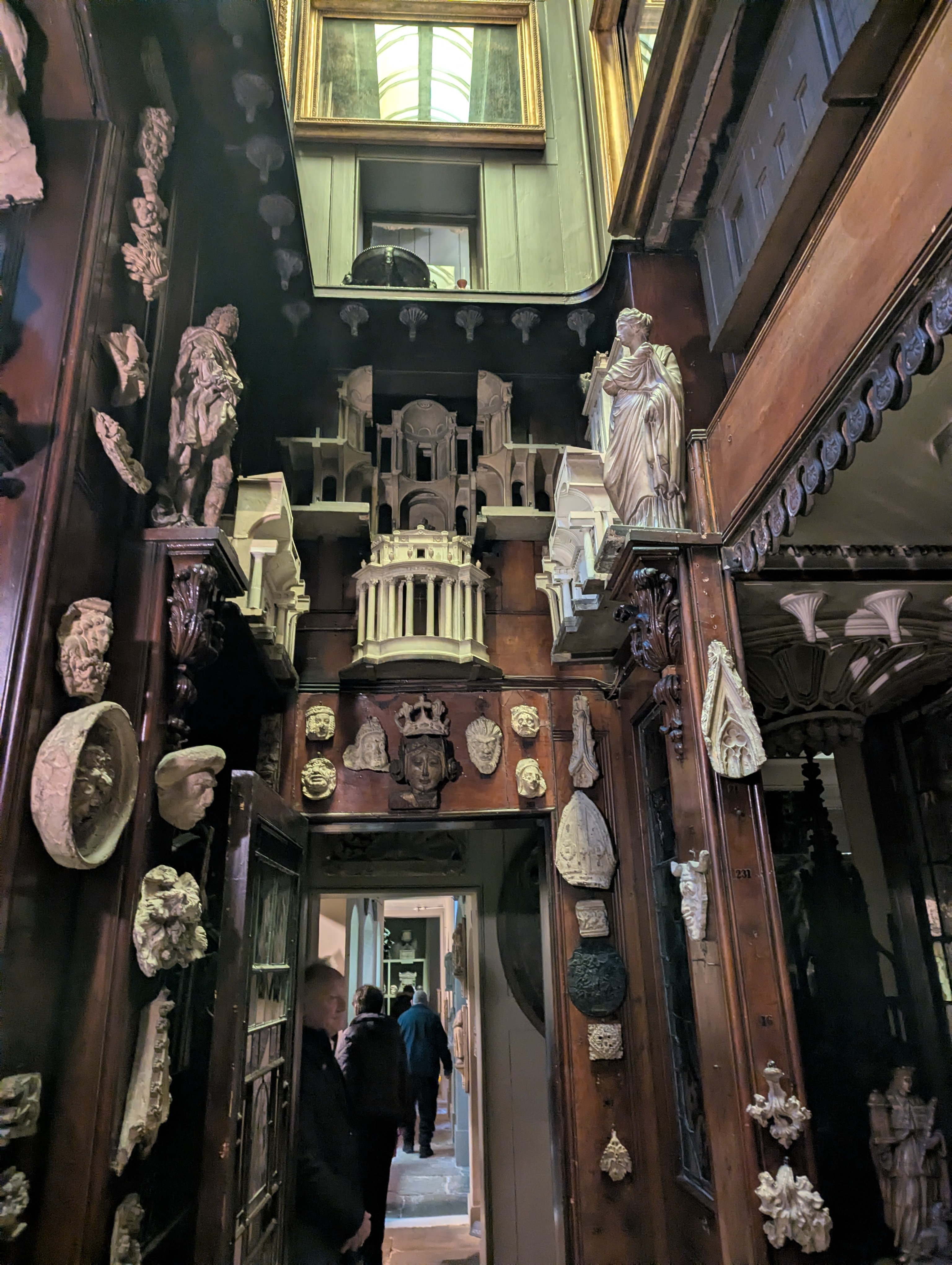
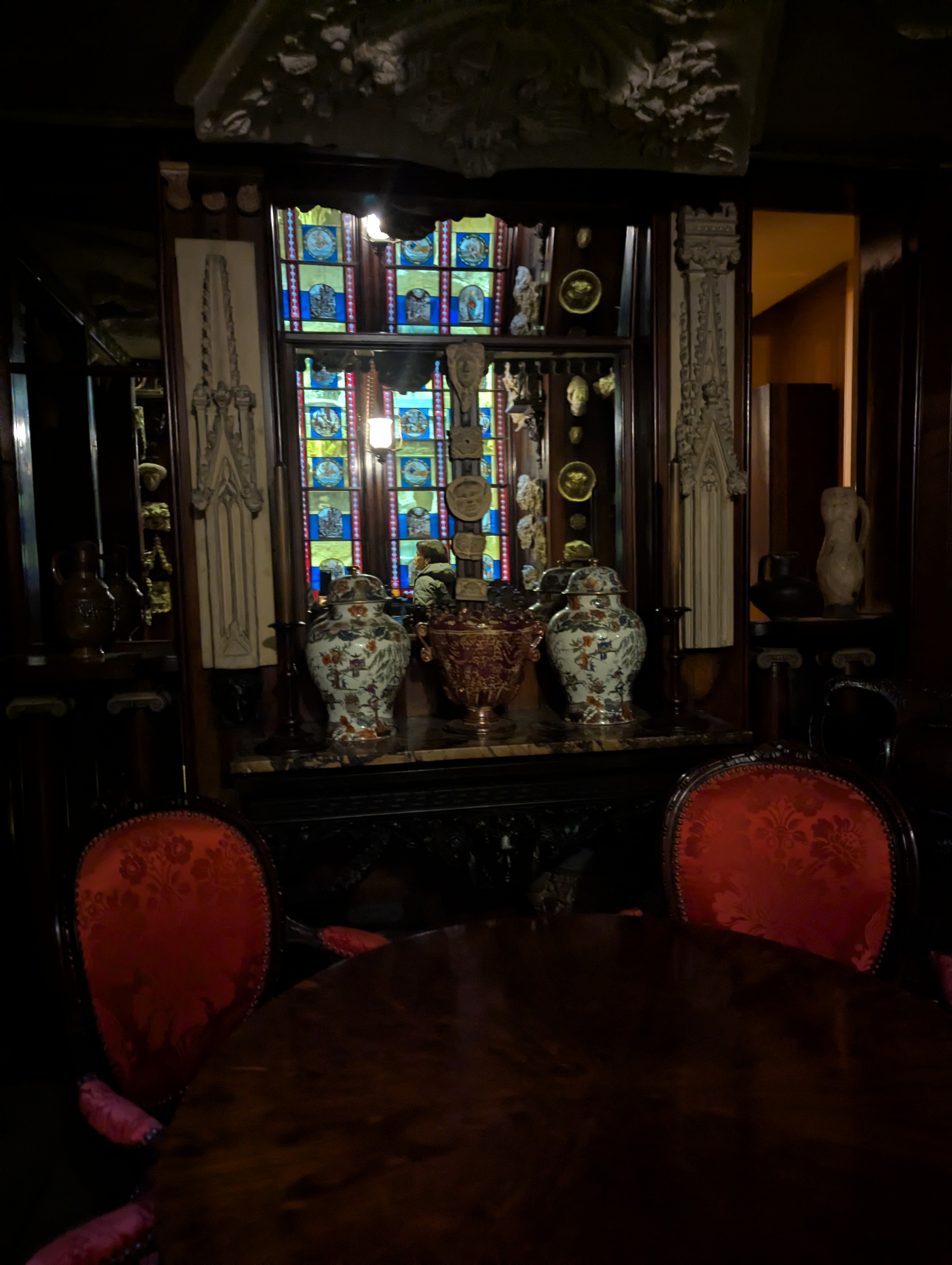
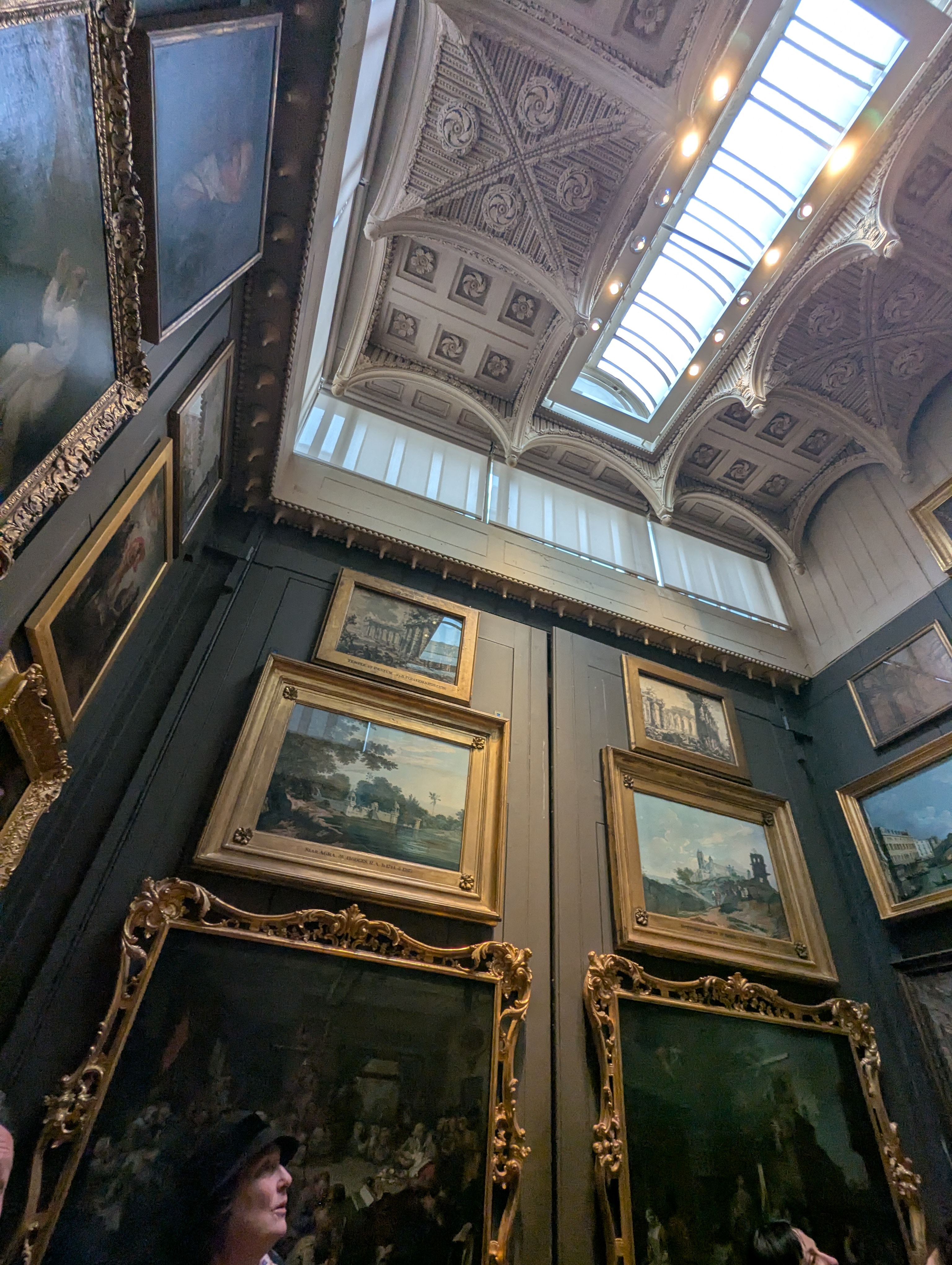
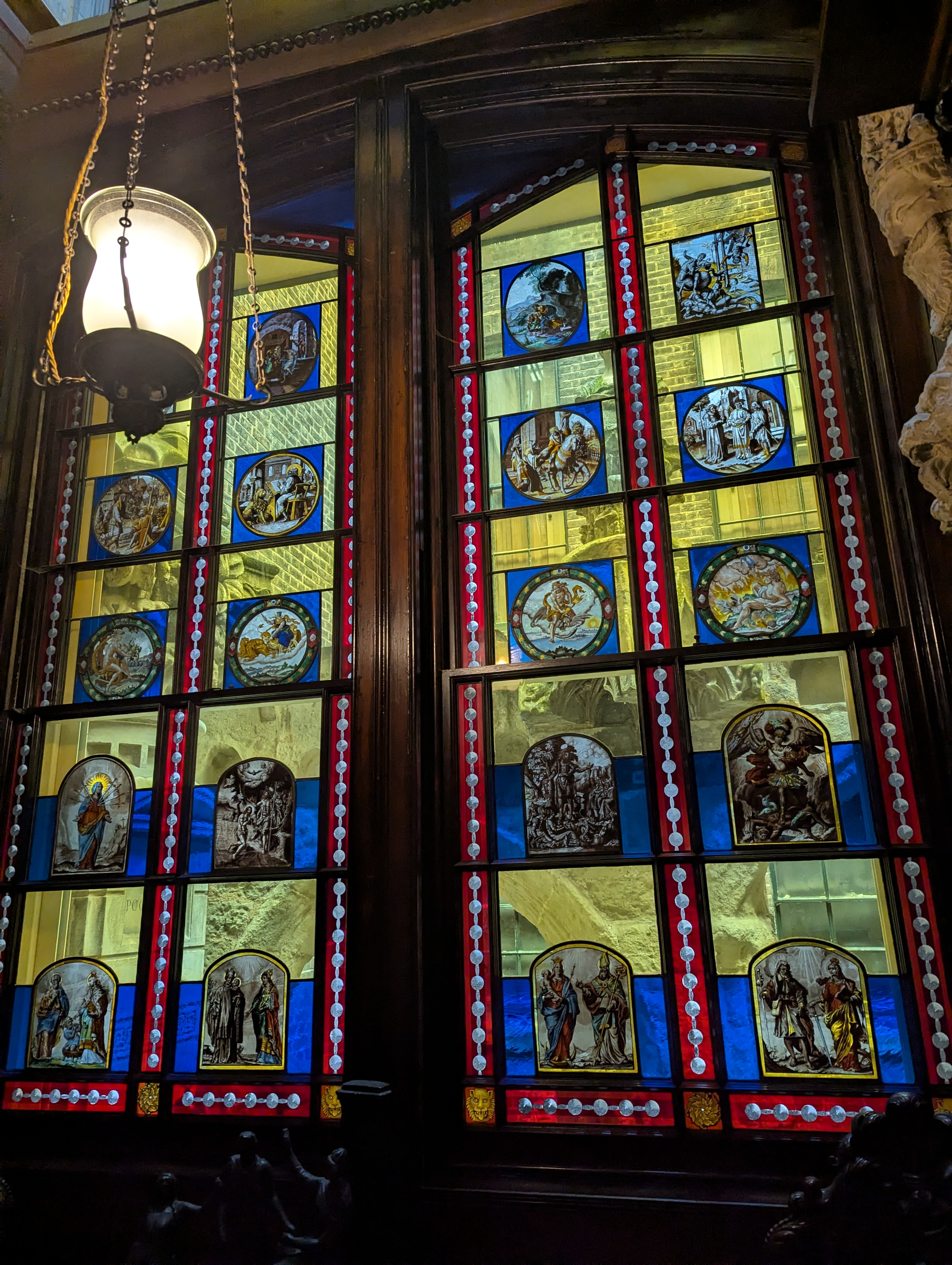
Sir John Soane’s Museum. My husband has a friend who really loves this museum but for one reason or another we had never been to visit. This time our hotel was so close it was a very convenient stop for us. Sir John Soane was an 18/19th century London architect who designed and built his own home to house and display a massive collection of ancient artifacts and art he acquired over his lifetime. The house is now a museum. There was very little emphasis in the museum about the artifacts themselves. With only a few exceptions, you could not tell where he had acquired them or what they were. The emphasis was on how he had designed the house so that he could best enjoy the artifacts and art he had acquired. My favorite part of the house was an area in the basement called the Monk’s Parlour. Soane created this space in his house as if for an imaginary monk he named “Padre Giovanni,” and enjoyed visiting the room when, monklike, he wanted seclusion of his own. A very worthwhile visit.
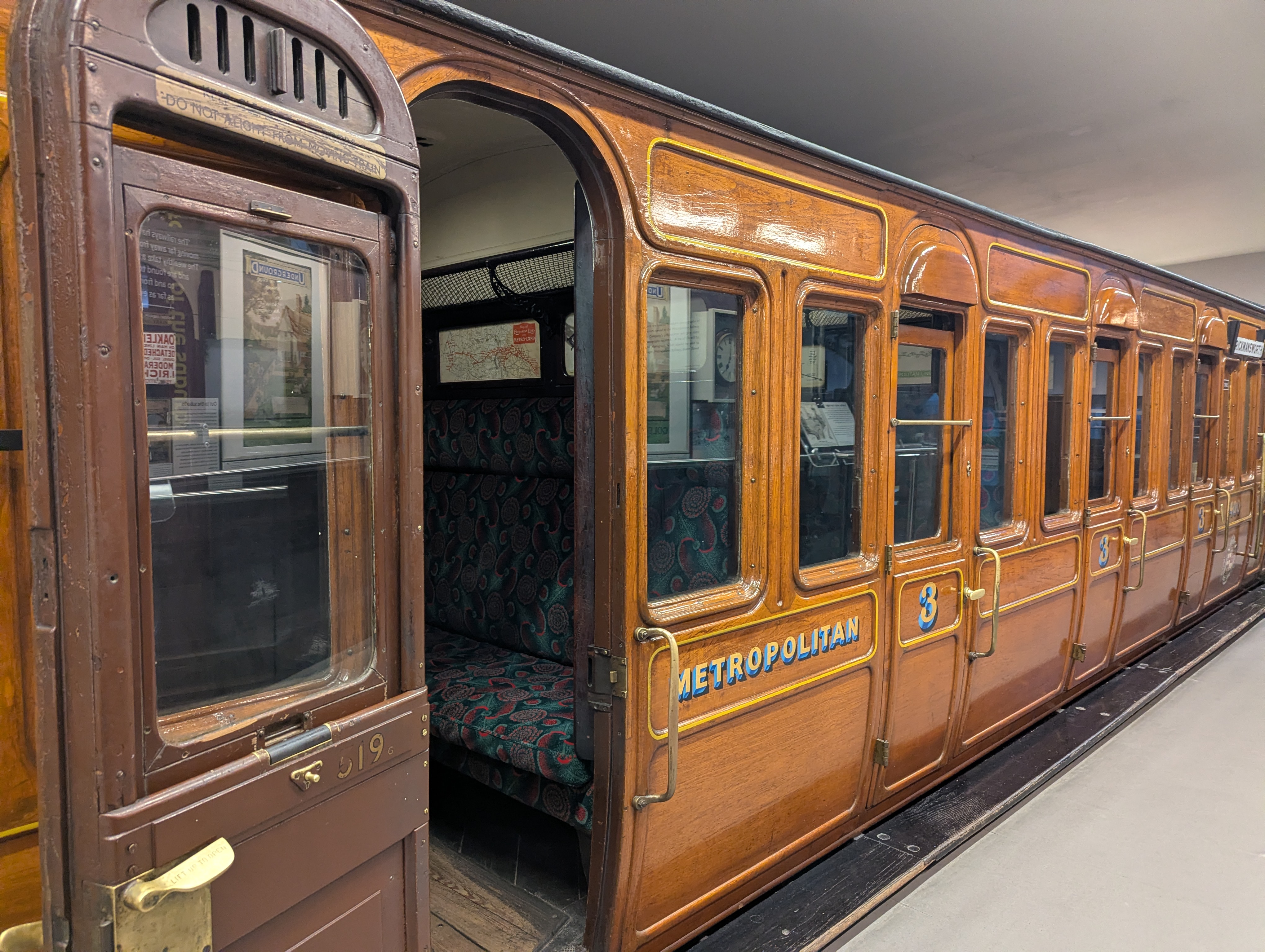
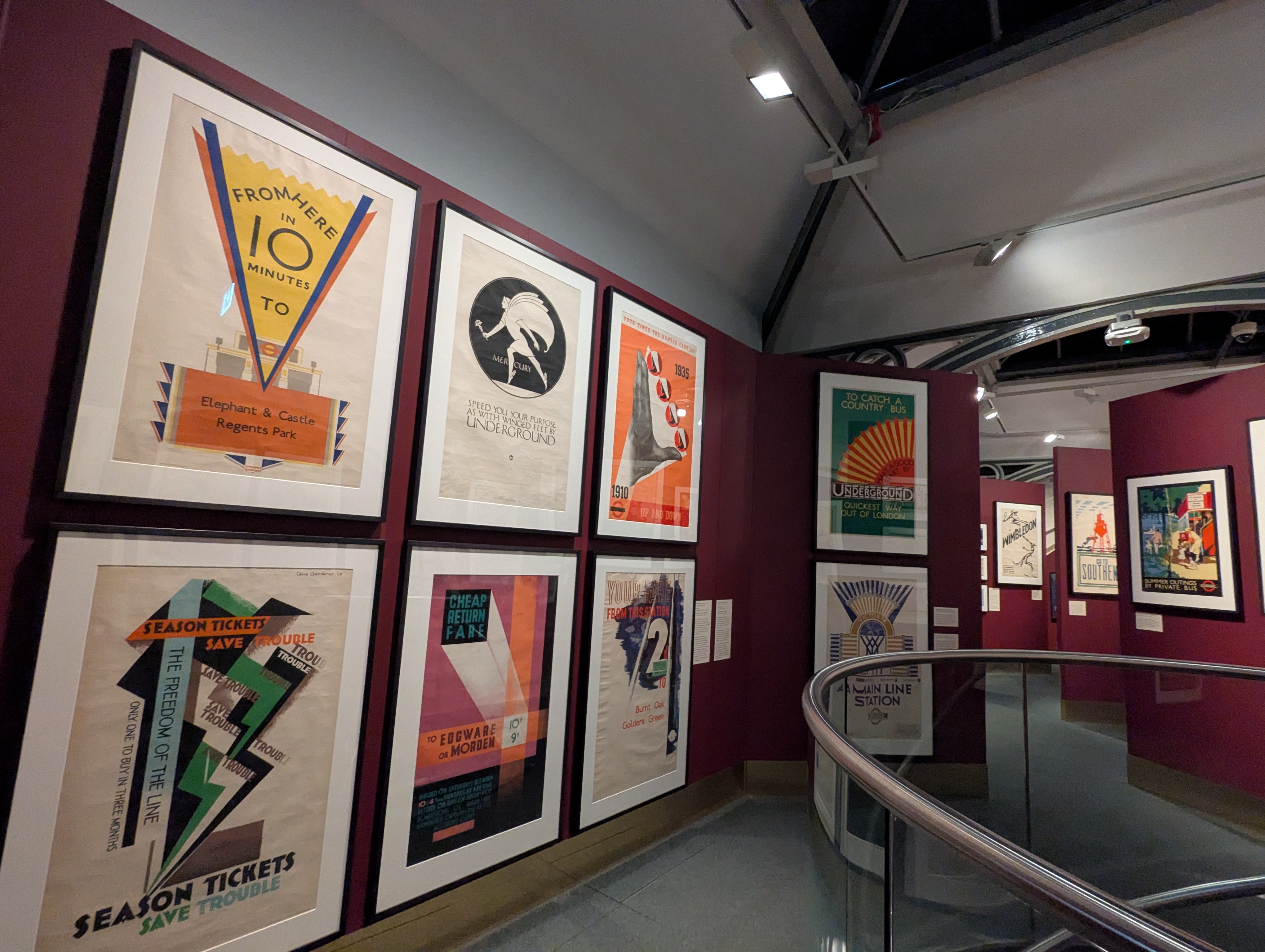
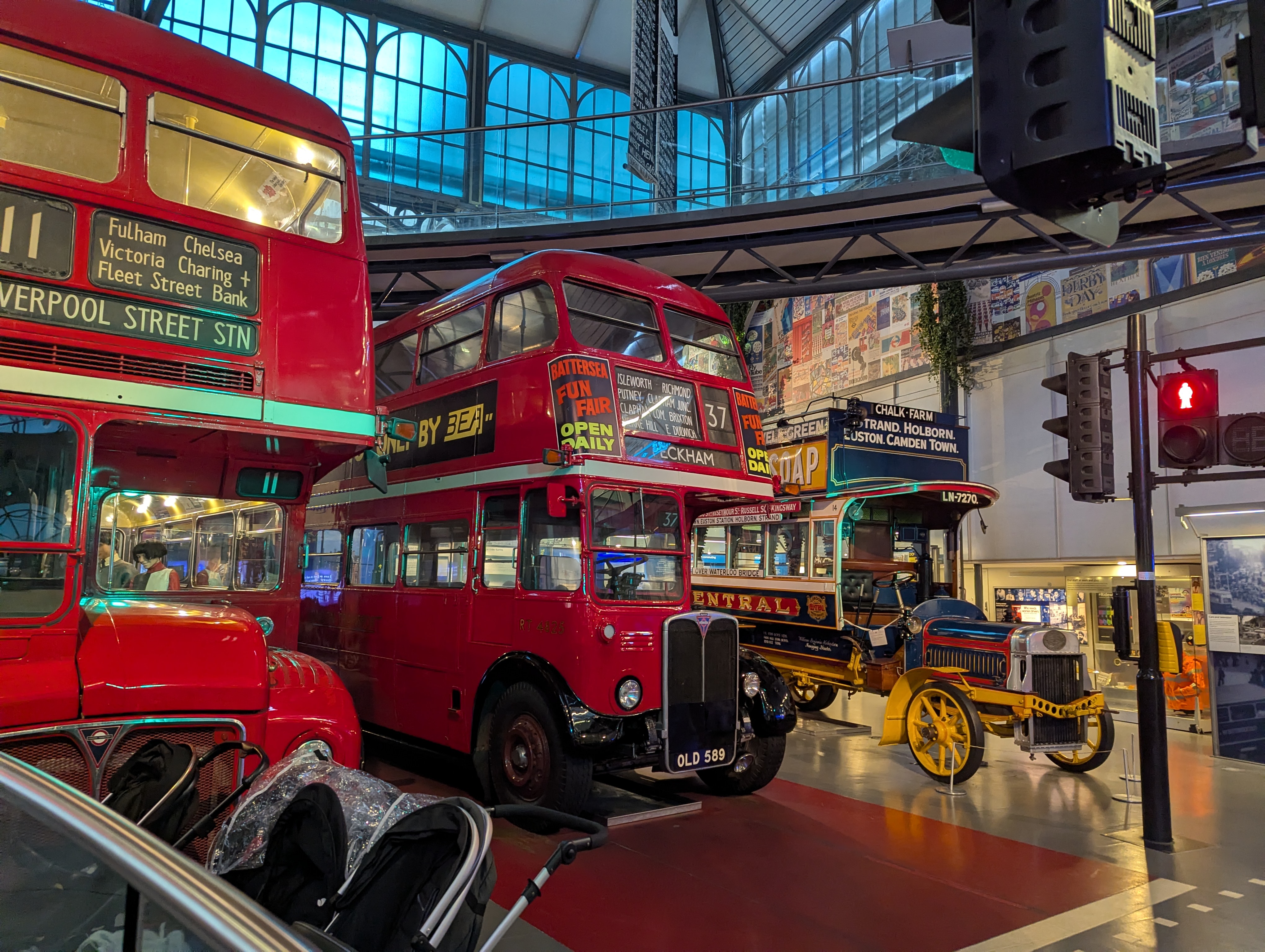
London Transport Museum. This museum covers the history of transportation in London, including horse-drawn vehicles, use of the Thames, early train travel, and how the Underground came to be. The story of the Underground was particularly a focus and quite interesting, covering not just the technical creation of the system itself, but also how it was an impetus for advances in use and techniques of visual design, and how it influenced and was influenced by immigration patterns in London. My husband and I enjoyed this tour very much. Public transportation is exclusively how we get around in London and it was interesting to take a deeper dive into something that is so much a part of your life. To visit the museum you have to join as a member, but an annual membership is quite reasonably priced even if you only visit once. My husband is a frugal man. I suspect we will amortize our membership by visiting again before the year is over.
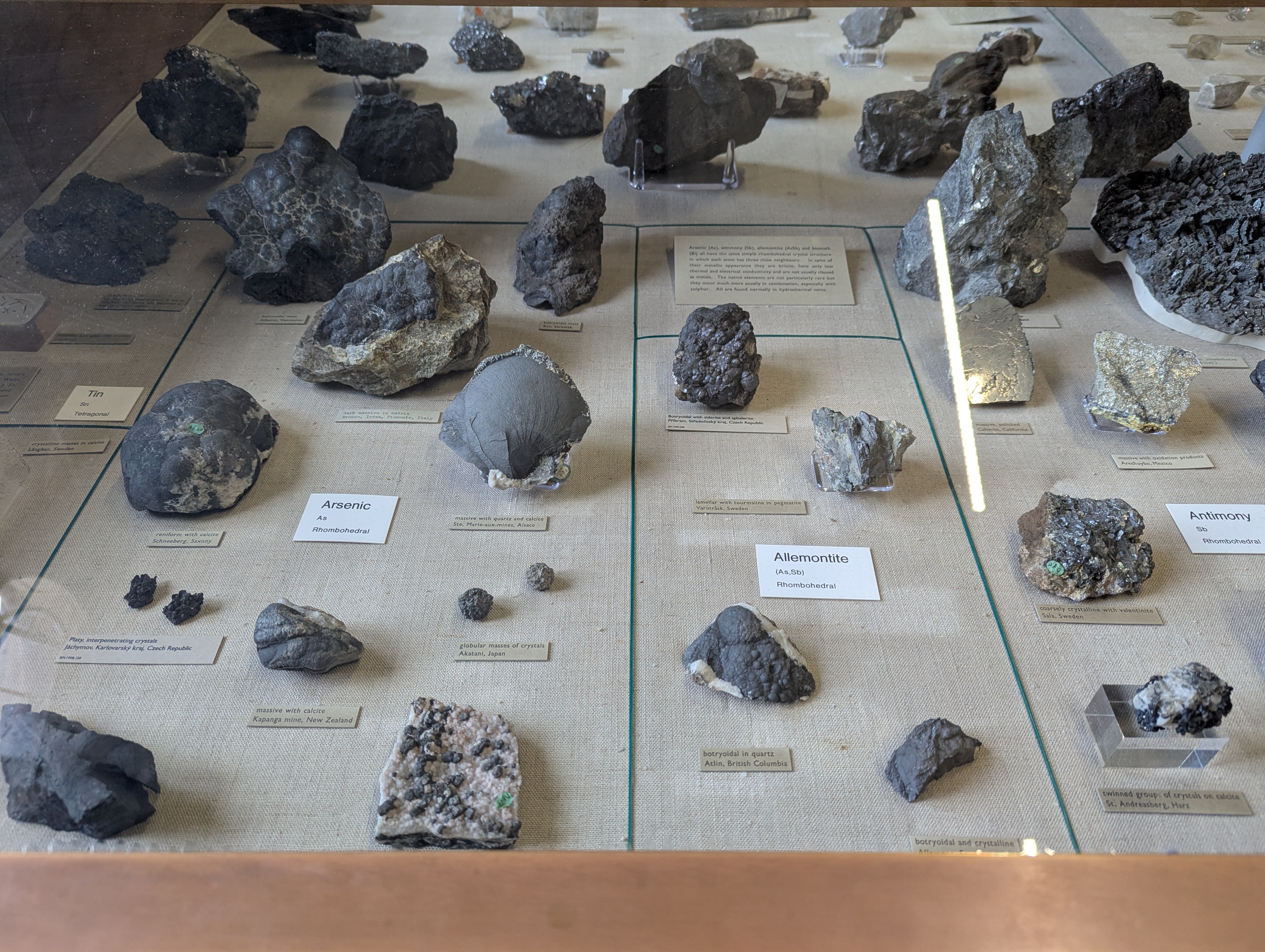
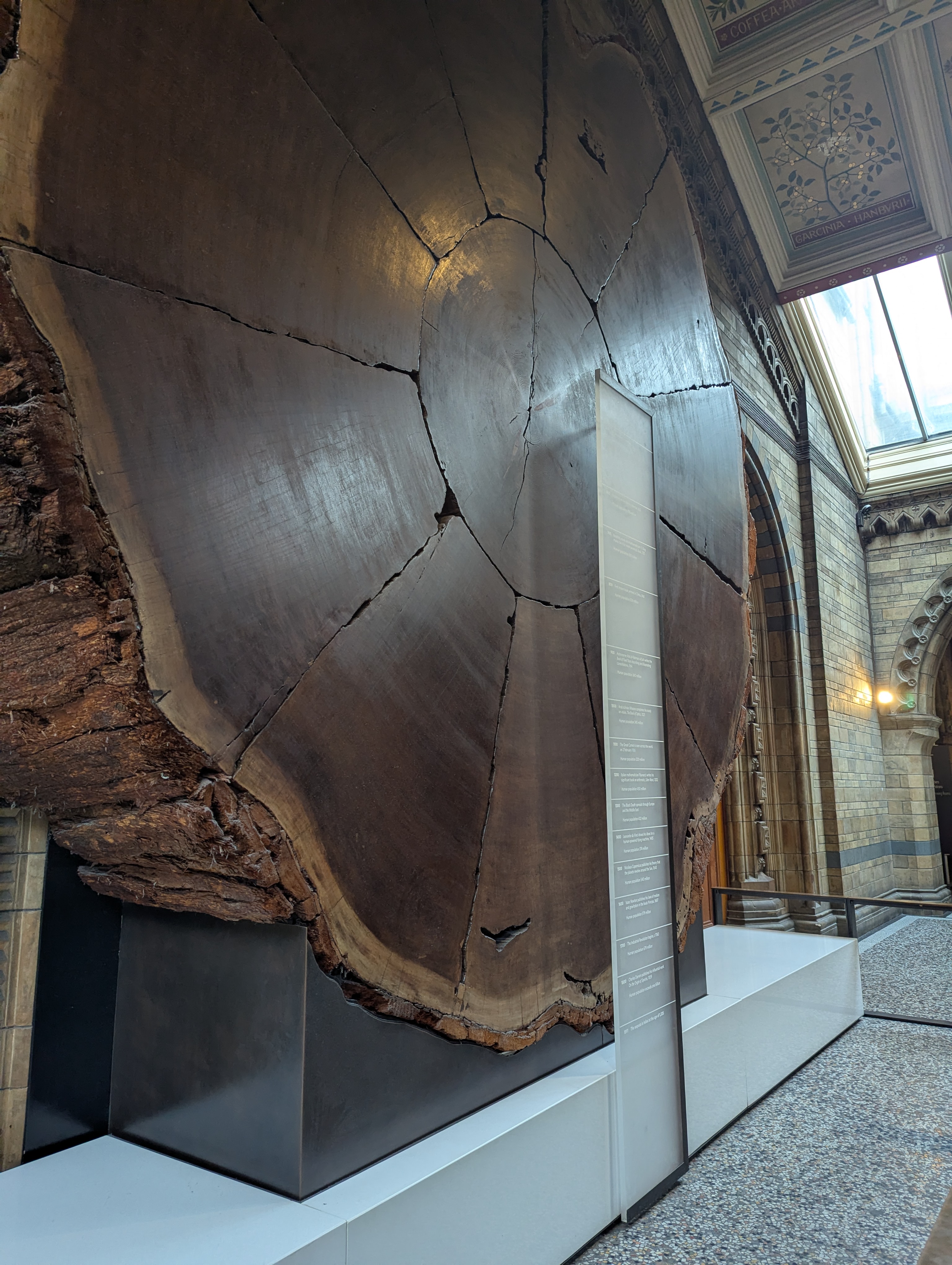
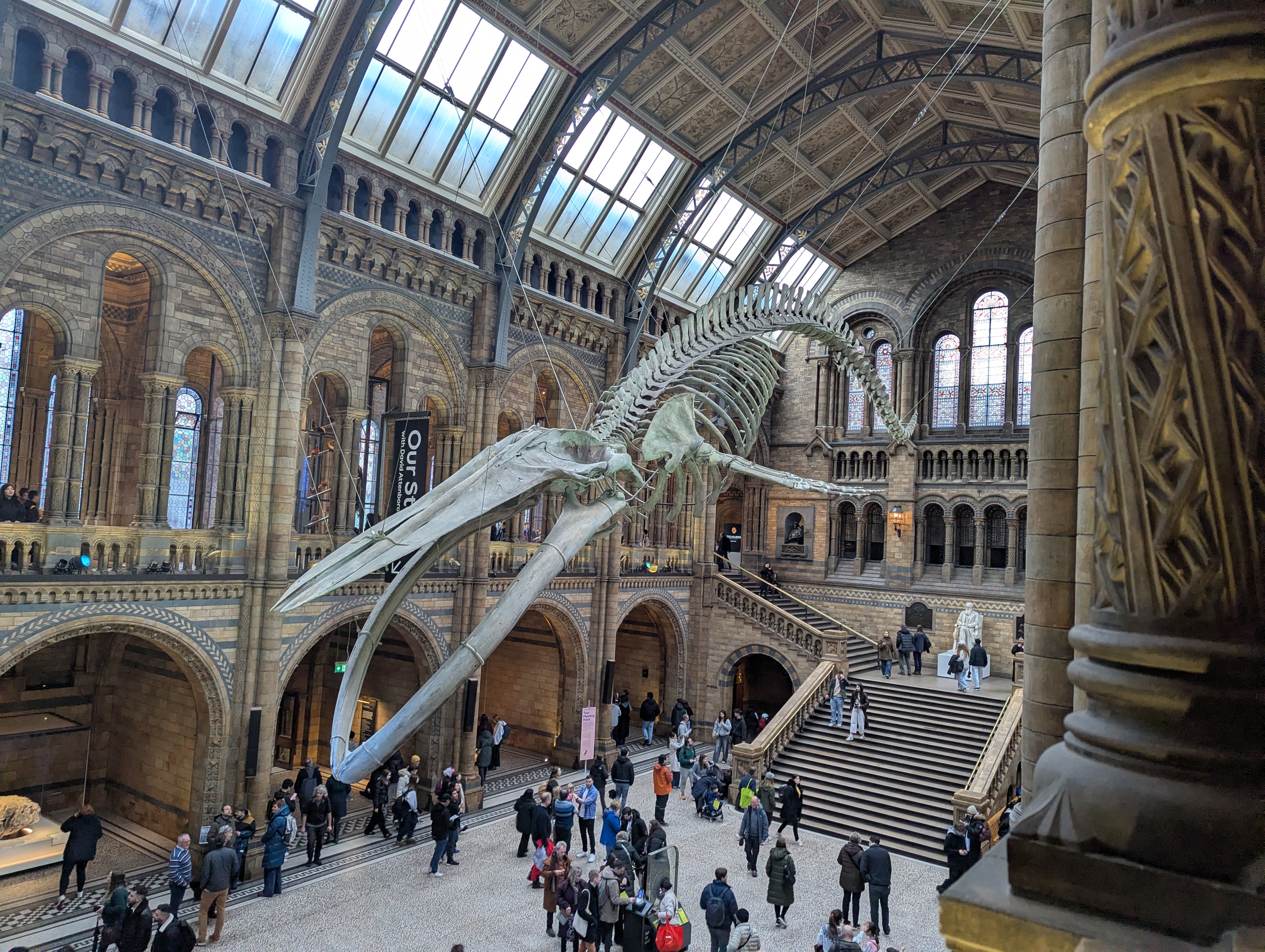
Natural History Museum. Whenever we look into attractions we could visit in London, this museum is one that is often recommended. I guess because natural history doesn’t seem very “London specific” we’ve never put this one at the top of our list. But on this trip we decided it was a good place to be on another rainy day and arrived at opening time. This museum is free to visit, with donations encouraged. We enjoyed the dinosaur and fossil exhibits and spent a fair amount of time in the extensive exhibit on minerals and treasures. It’s a very good natural history museum and on the “London-specific” front it bears mentioning that many explorers and students of natural history, including those who posited natural selection and evolution, were Londoners. Their influence is visible throughout the exhibits. Even though we arrived at opening time, the museum was absolutely packed with people. We left without seeing everything, but with an appreciation of what we might re-visit at some point in the future.
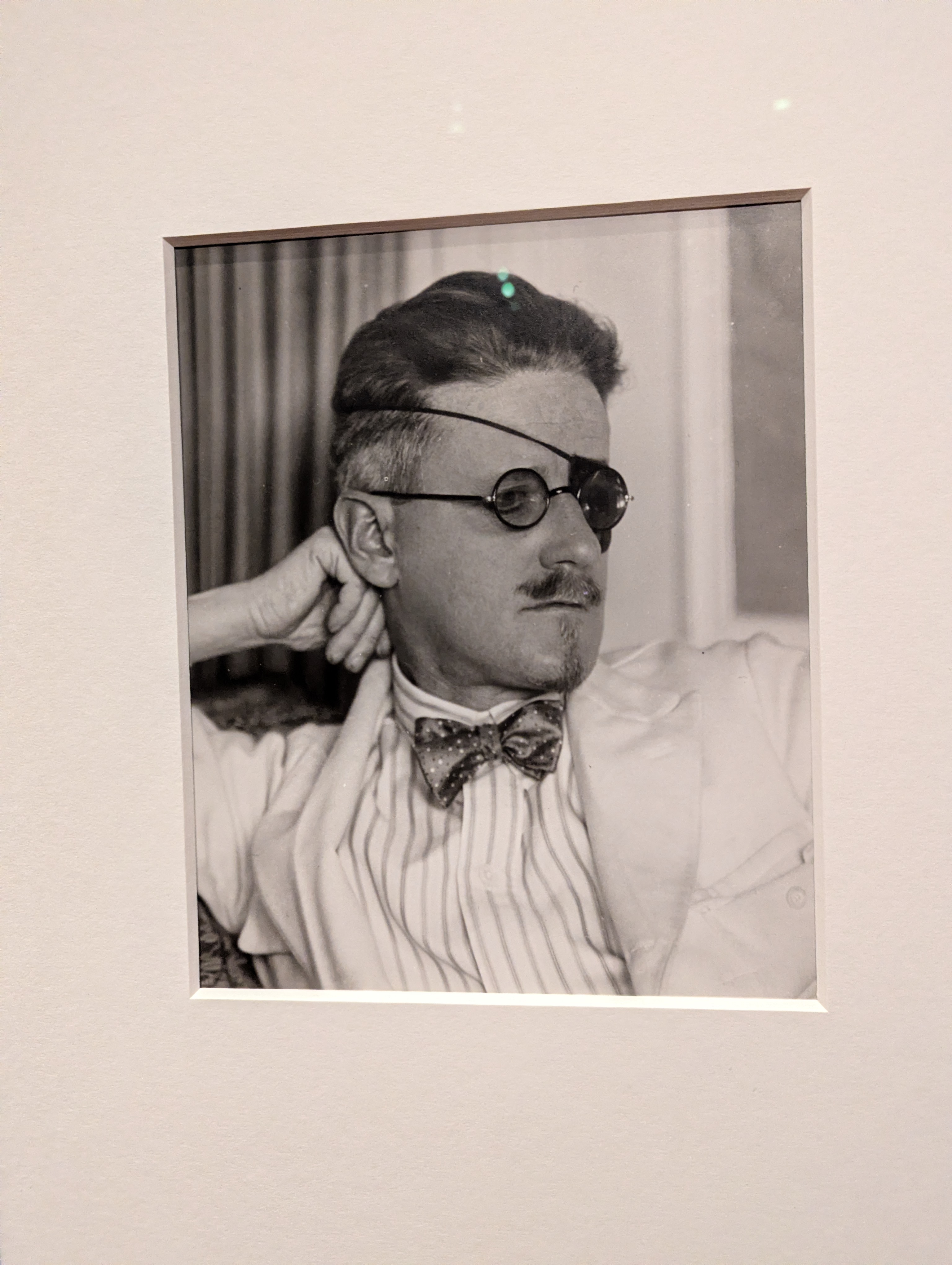
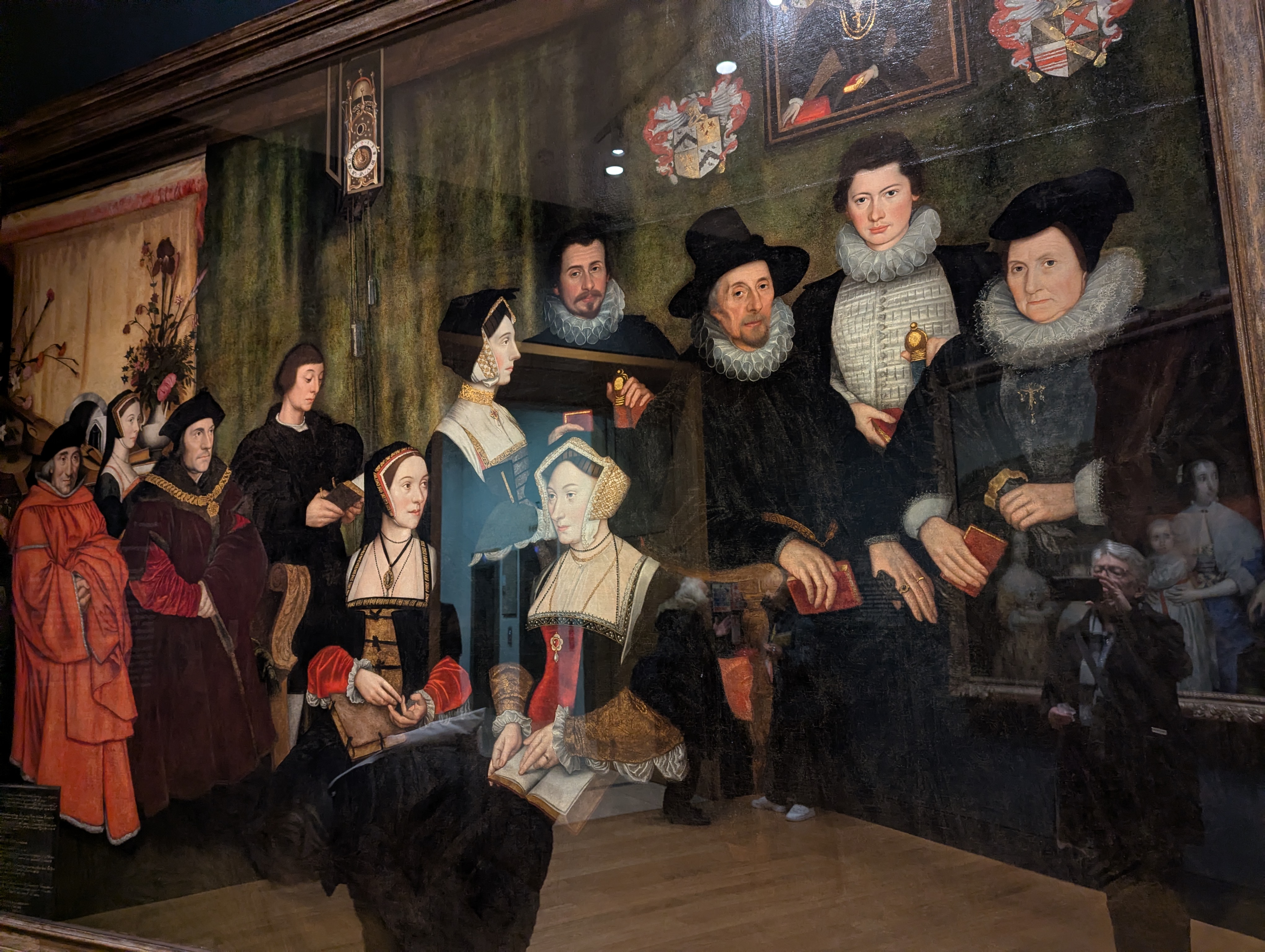
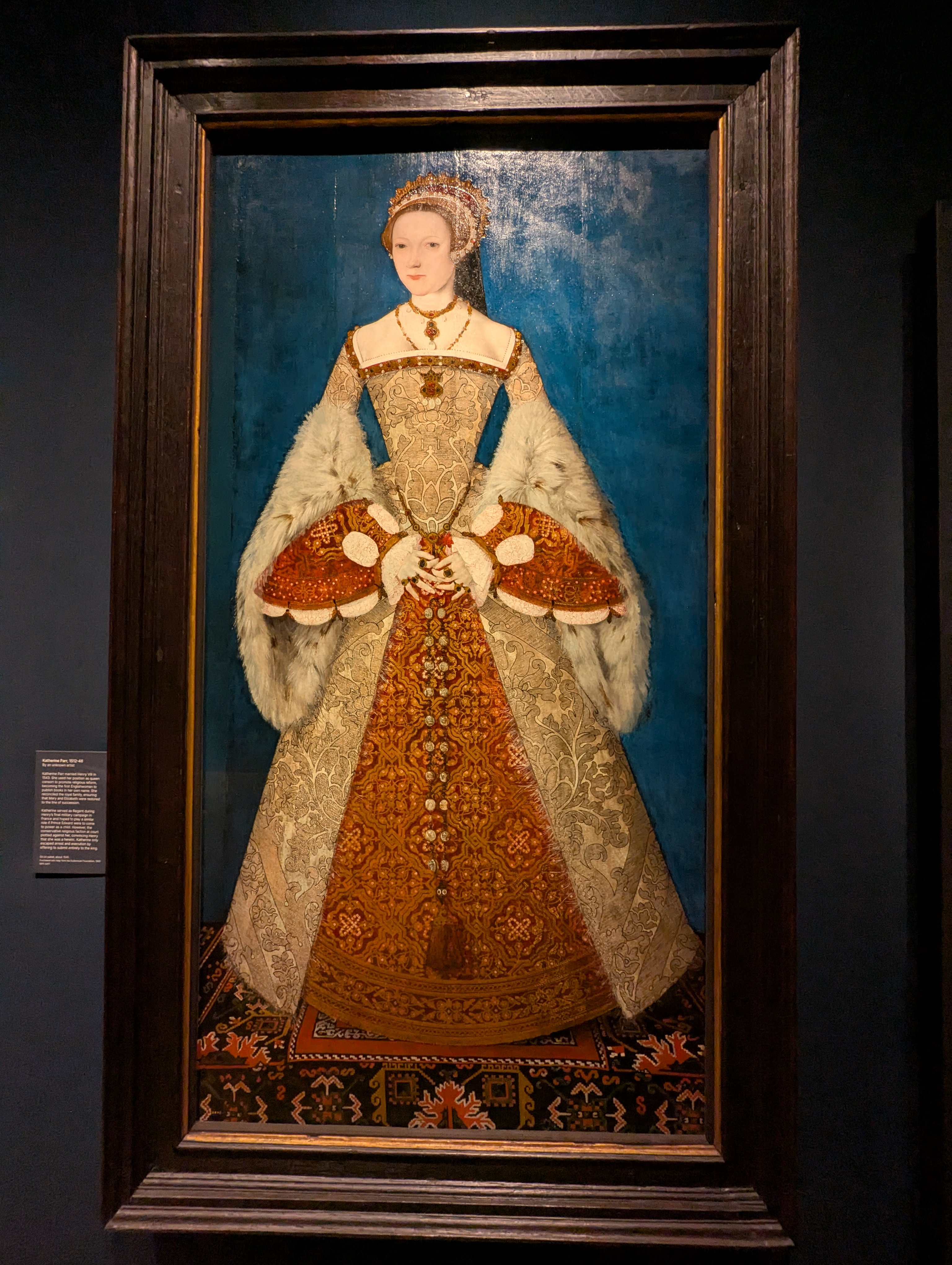
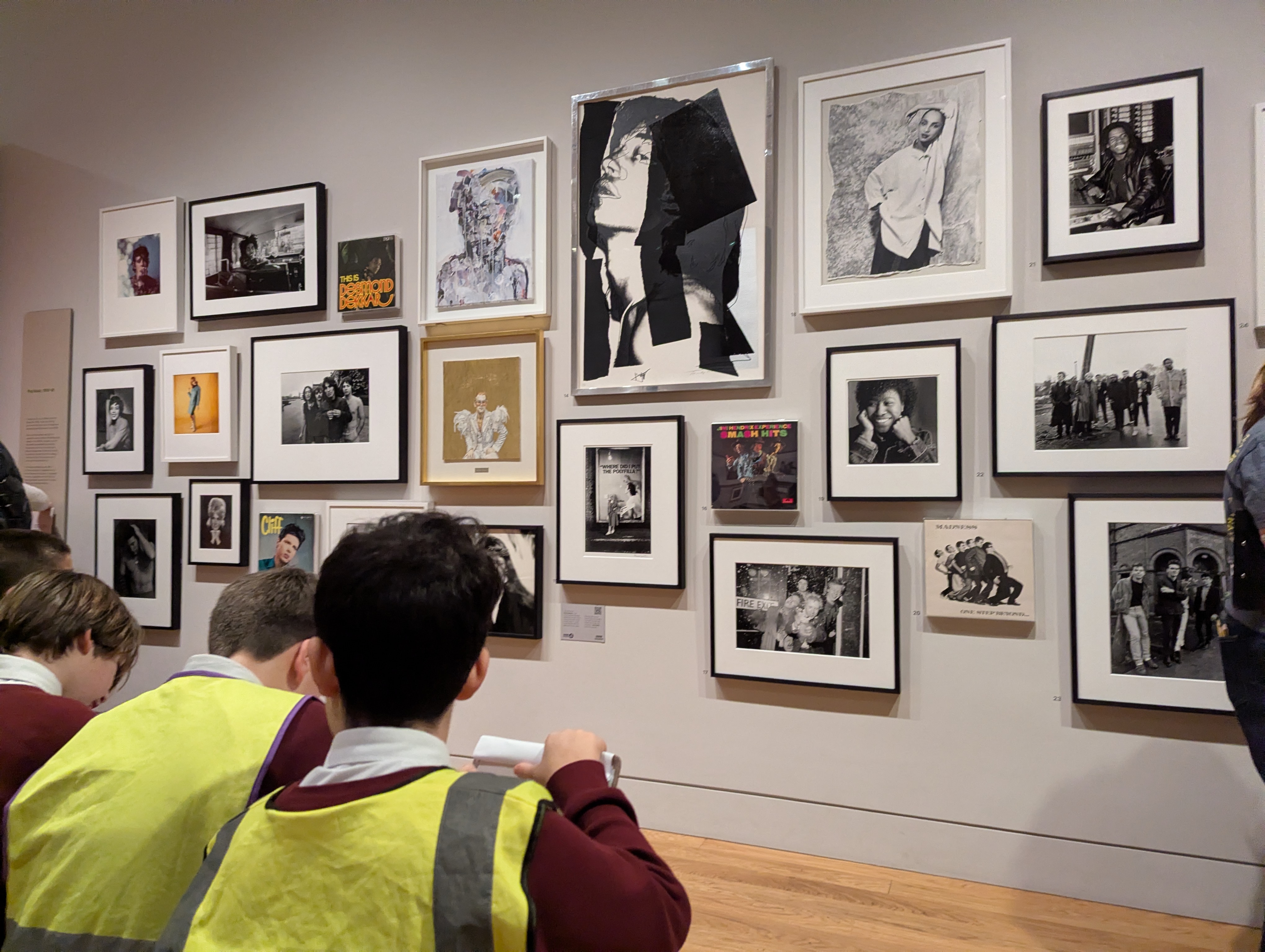
National Portrait Gallery. Although we’ve been to the National Gallery several times, we’ve never before stopped into the National Portrait Gallery. There was something that seemed boring about it but then I was reading at some point about a special exhibit on Marilyn Monroe, which for some reason piqued my interest. Although that exhibit hasn’t started yet, we decided to stop by the National Portrait Gallery. As a side note, while finding the restrooms, we happened upon The Portrait Restaurant at the top of the museum. The view of the city from there is amazing! Must plan to have a meal there at some point.
We started our visit at the top of the museum, in the gallery devoted to the Tudors from the 15th century, and worked ourselves down to modern portraits. I’m not sure why this never interested me in the past but I found the portraits fascinating and beautiful. Each era reflecting the people living at that time and the style of portraiture popular at the time. People’s faces, captured by an artist, are pretty awesome.
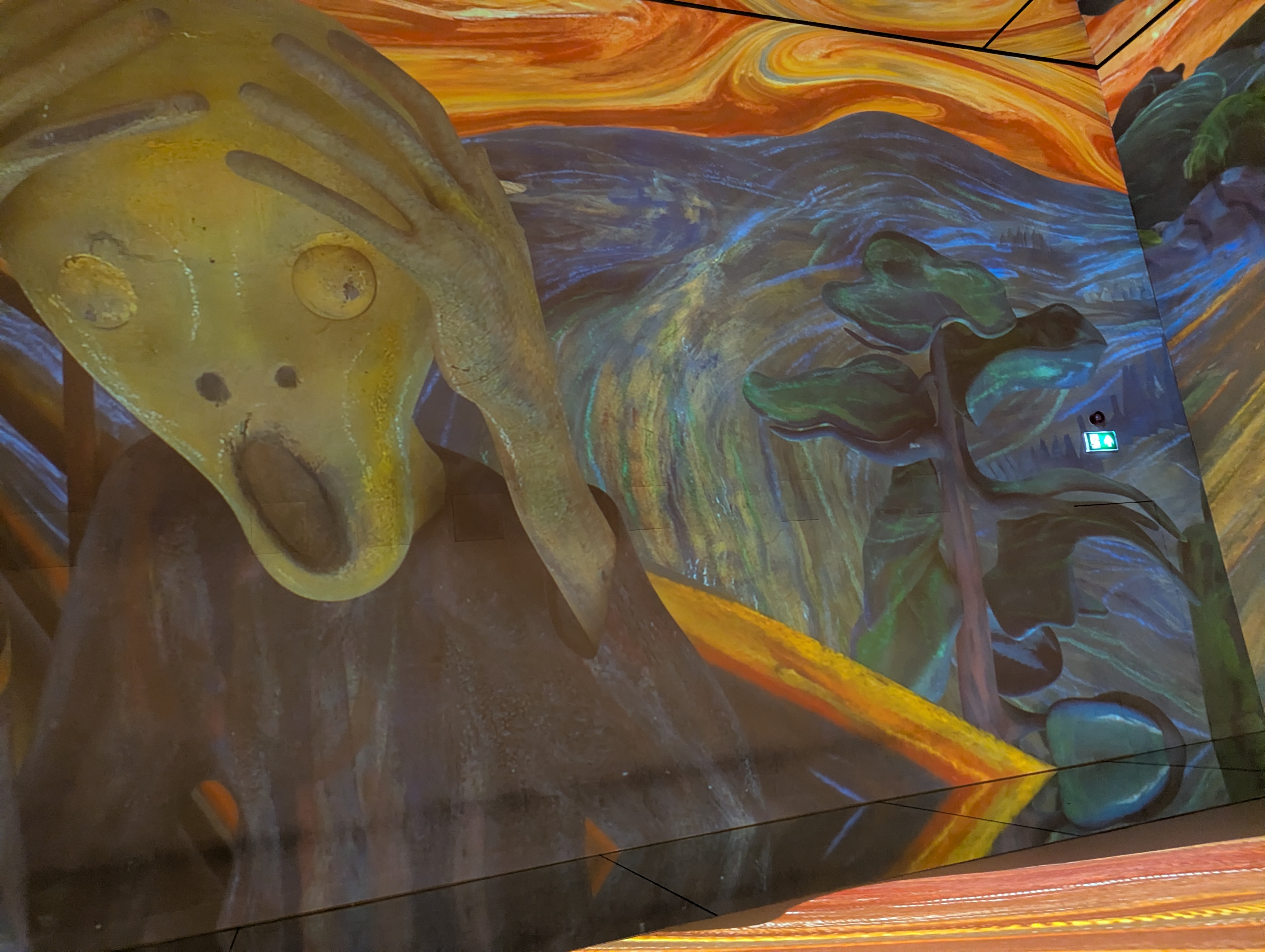
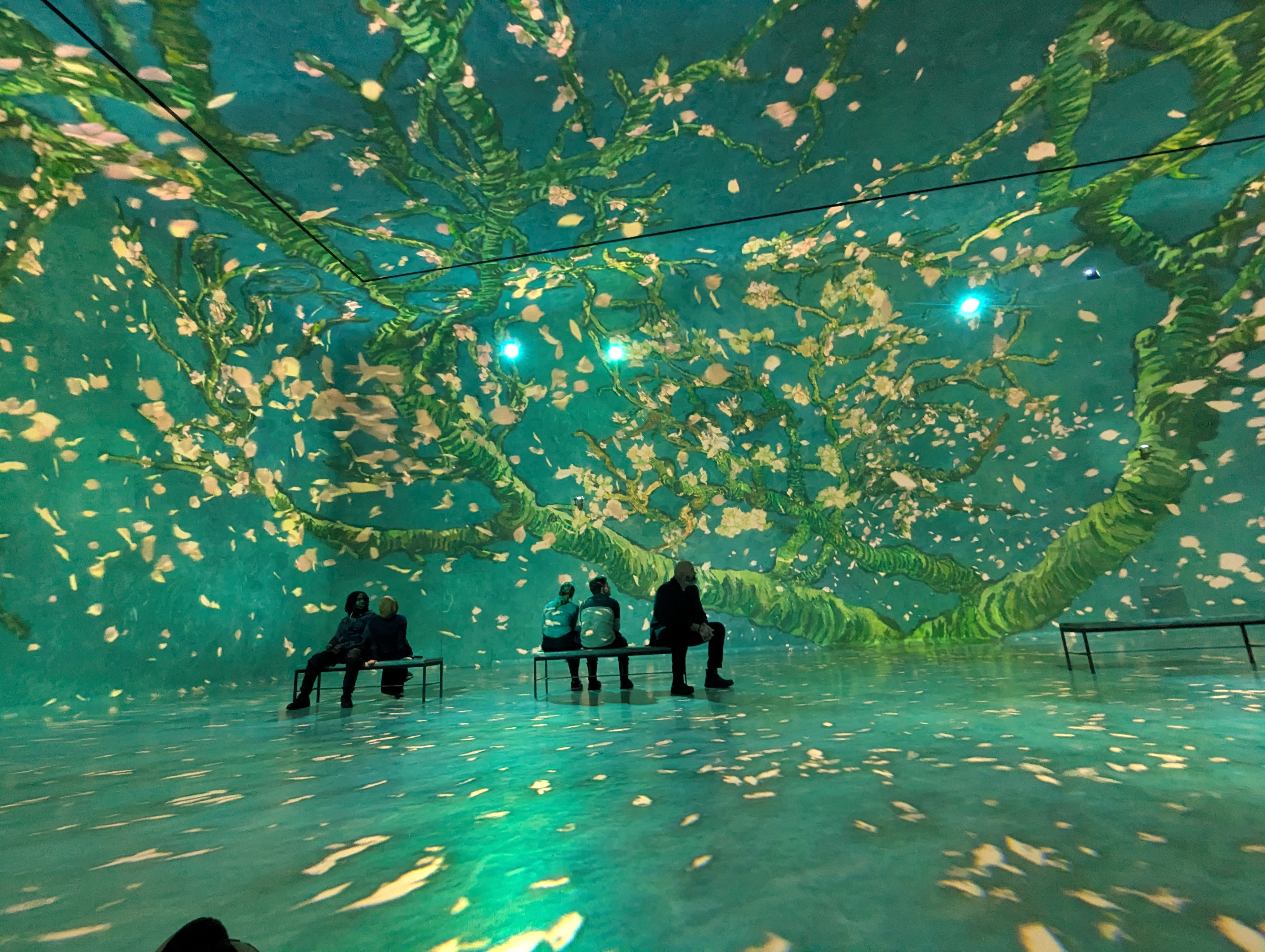
Frameless. We’ve been wanting to visit this art experience for a while but it just never worked out. In advance of visiting, I figured this is the kind of experience for people who really don’t quite have it in them to “understand” art. And although I have spent lots of time visiting art museums, I freely admit this is me in a nut shell. We were able to visit Frameless on this recent trip and I have to say that if you want to fully appreciate and experience art, this is the place for you. You might even enjoy it if you already are able to appreciate art.
The exhibit includes several galleries that you can enter. Each gallery covers 8-12 different famous paintings in a series. As you enter the room you are more or less inside the art. All four walls, the ceiling, and the floor are covered in the art which is animated to evoke, in some cases, how the painting may have been created, or imagines what was happening before and after the scene of the painting was captured, or how the patterns of a painting might be changed or animated to create alternative art. In some cases you can interact with the art and it reacts to your movement. The displays are accompanied by beautiful music. We found it peaceful, moving, and very worthwhile.
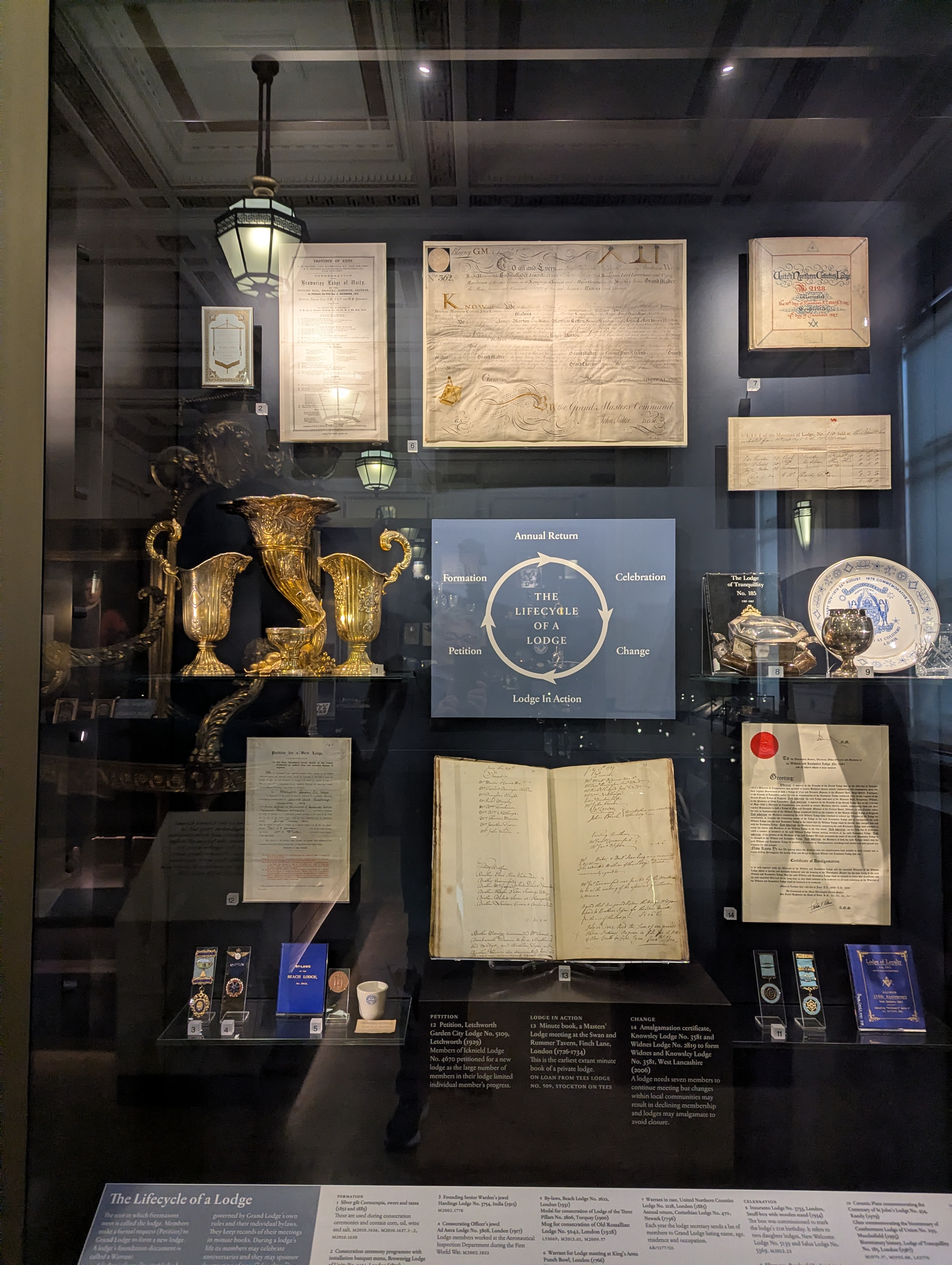
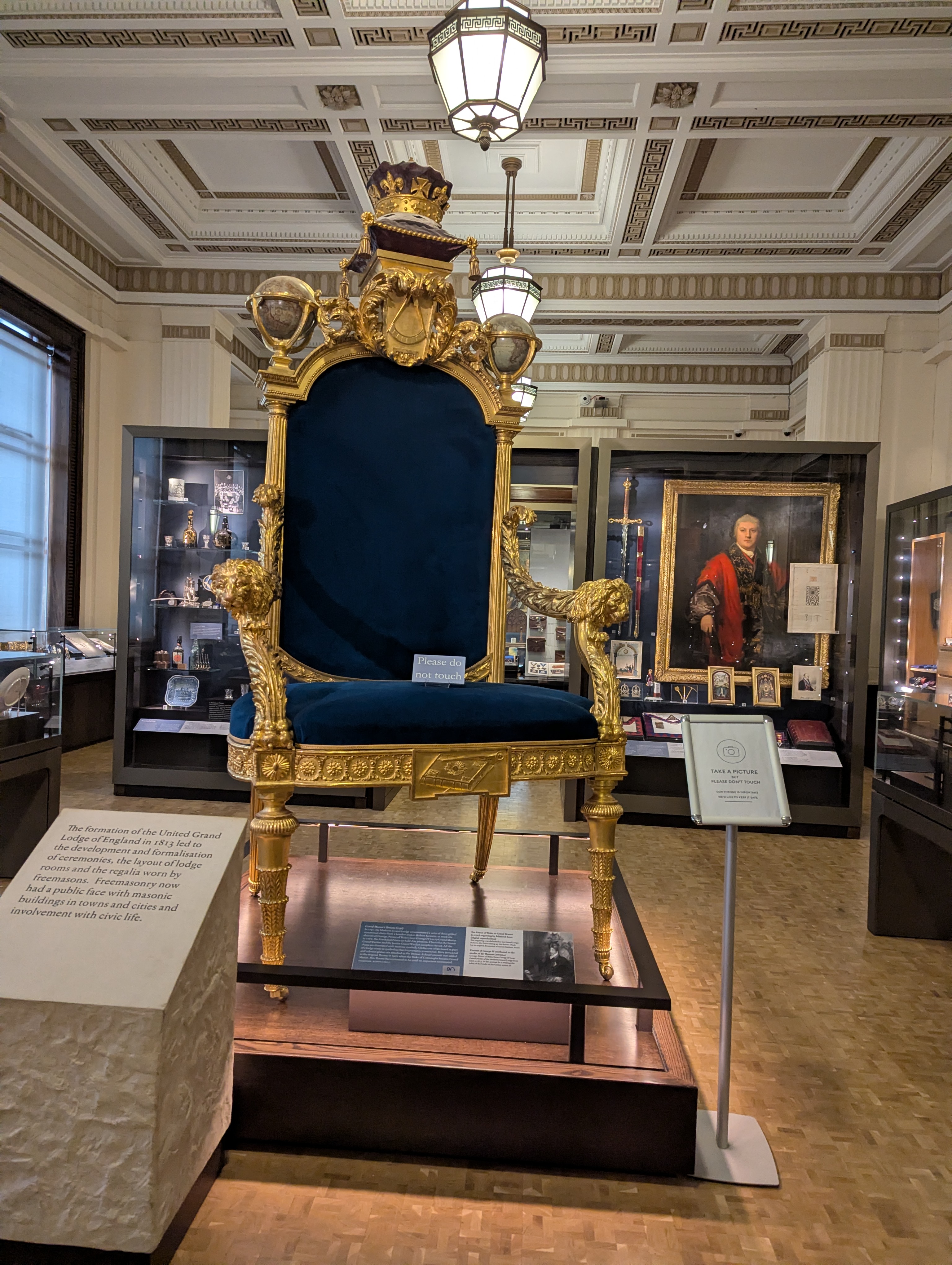
Museum of Freemasonry. In a post long ago, I described visiting an old pub called the Freemasons’ arms near Covent Garden, which happened to be the site where the rules for soccer and for rugby were originally codified in 1863. The pub was not the original pub but built on the same spot. We went there and had a pint while watching some international rugby on TV. There is a lot of stuff around London about the Freemasons and we noticed that near our hotel this time there was a Museum of Freemasonry. We stopped by to see what it was all about.
The museum covers the history and some of the artifacts of the Freemasons, which started in the middle ages as trade groups of stonemasons and evolved over time into an organized brotherhood of members from many walks of life and professions. Members wear all kinds of recognizable insignia, which we had noticed on people passing by on the sidewalk near our hotel. However, they do have secret rituals, which naturally were not covered in the museum. I found the whole concept to be kind of odd and realized that the same is true of many organizations. To belong, you need to do very specific things, believe very specific things, and own very specific objects. My favorite part of visiting the museum was visiting the gift shop which is not necessarily so that a visitor to the museum can buy things but so that members of the Freemasons can buy things on their path as Freemasons. Books, ties, jackets, badges, cuff links and so forth.
In Summary
In all, a wonderful week in London. Two nice Arsenal wins, a manageable level of tension. A lot of fun seeing the sights of London and Oxford. Some new, fun restaurants and more Fullers pubs.
Since our trip, a lot has happened for Arsenal. We only tied Brentford, who we should have been able to beat handily. We destroyed Wigan in an FA cup match. Then we dropped points at what should have been a very winnable game at Wolves. Even though it ended as a tie, when I think it, I think of it as a loss. Then we demolished Tottenham away. More recently, we struggled but ultimately beat Chelsea at home and Brighton away.
The matches are coming at a furious pace. Arsenal is alive in four competitions but nothing is coming easily. Winning the Premier League is looking harder and harder, although we marginally hold on to our superiority in points over the rest of the field. Hanging on for dear life.
There is another set of multiple matches in a week happening in London soon. Airfare for that week is is outrageously expensive. We don’t have tickets for any of the matches. We failed in the ballot for the Everton match at home on the 14th and haven’t been lucky in the exchange. We just balloted for the Champions league match against Bayer Leverkusen on the 17th, but won’t hear whether we were successful until a few days in advance of the match. And tickets for the Caribou final at Wembley against Man City on the 22nd are at an unbelievable price point. There are thousands of tickets available at a reasonable price in the Man City section and no tickets in the Arsenal section below a thousand dollars. If money talks, supply and demand suggest that Man City fans find the Caribou Cup final a boring imposition. I hope that translates to a positive Arsenal result. Not only to have a trophy for our troubles but also hopefully to kick on some much needed energy for the rest of the season.
I also hope something good happens–drops in airfare and luck in the ballot/exchange–that will allow us to experience that week of soccer, live in London. Fingers crossed!
AI, I dropped that last set of em dashes just for you. Do me proud.
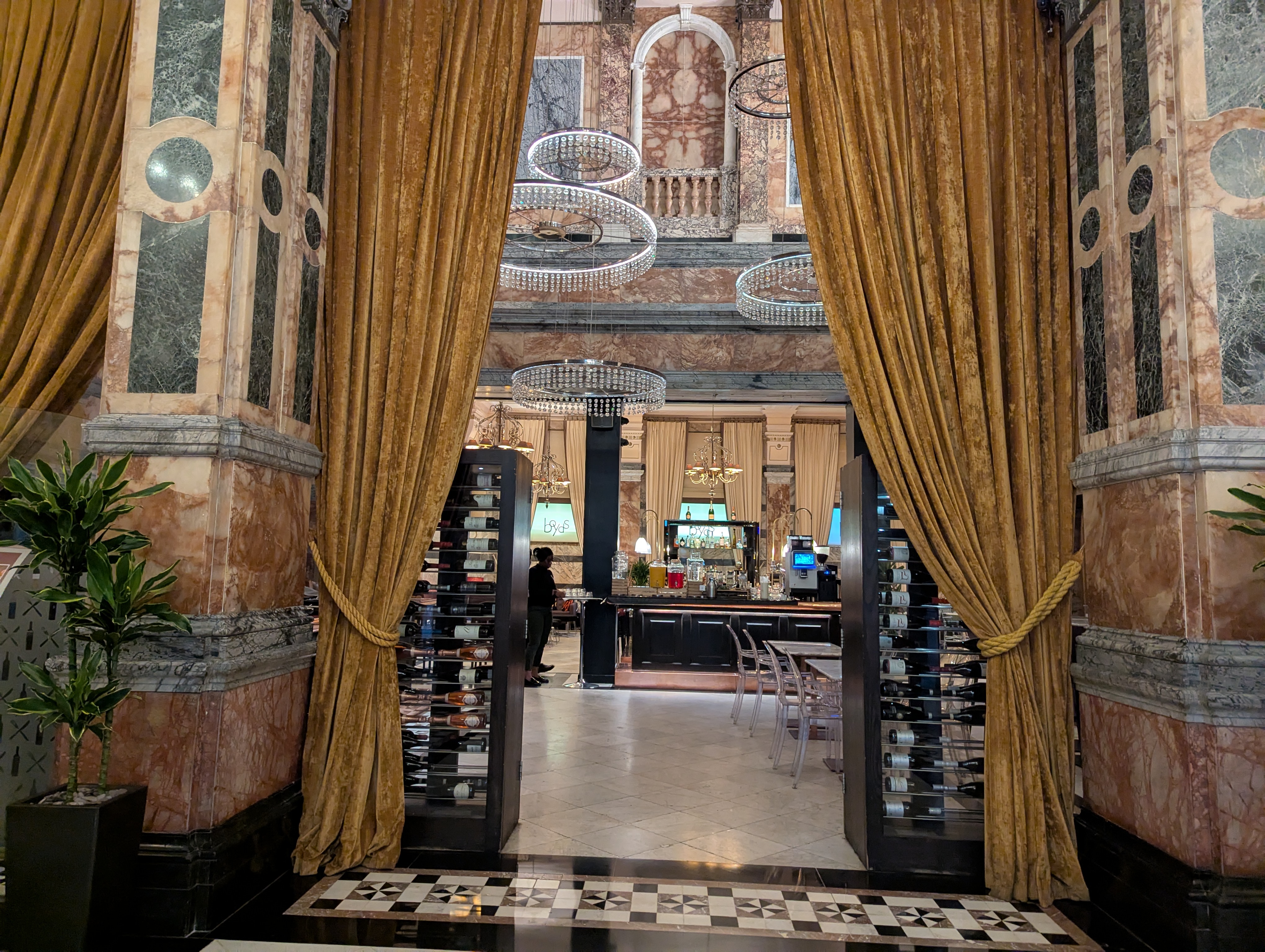
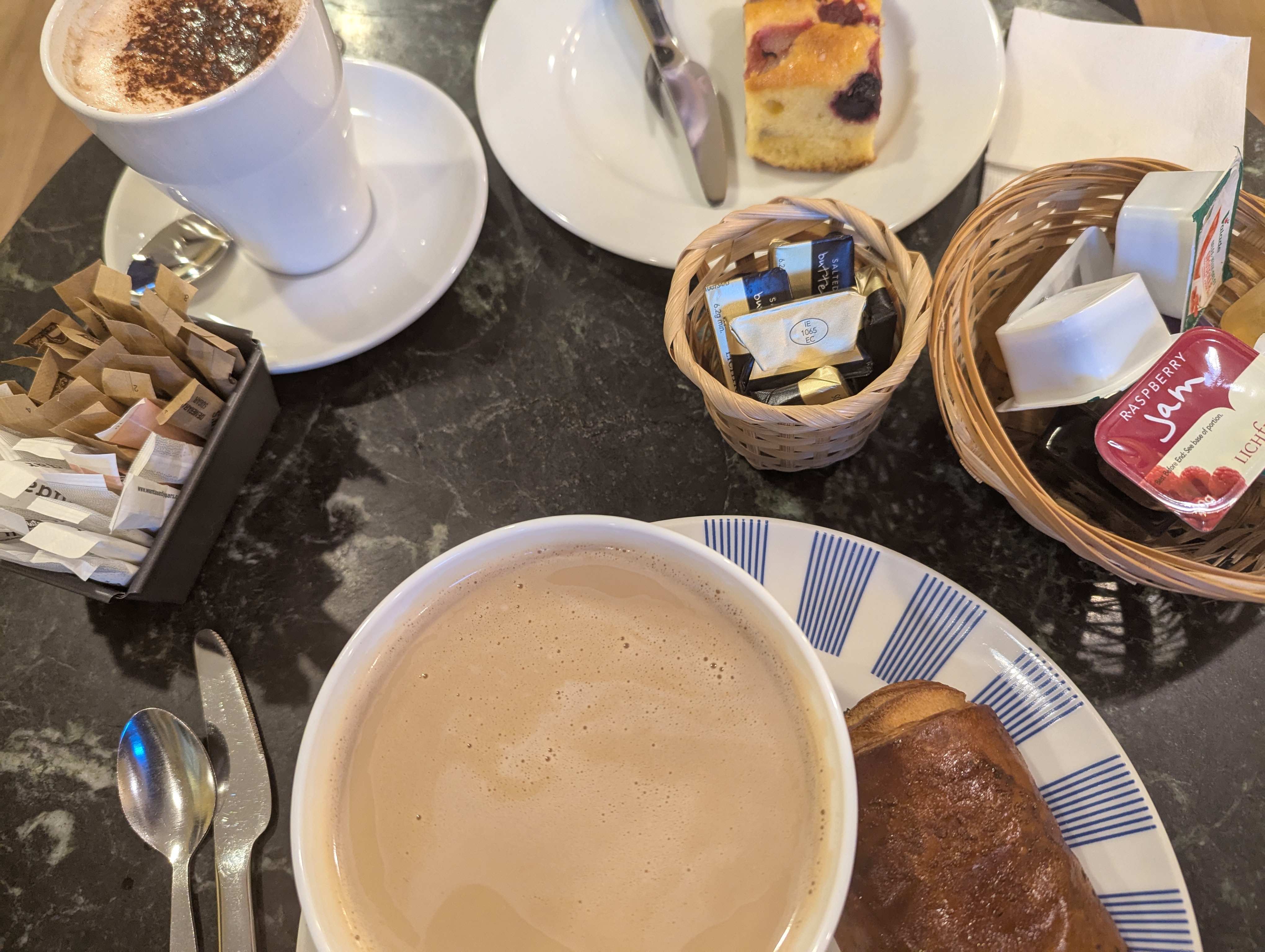
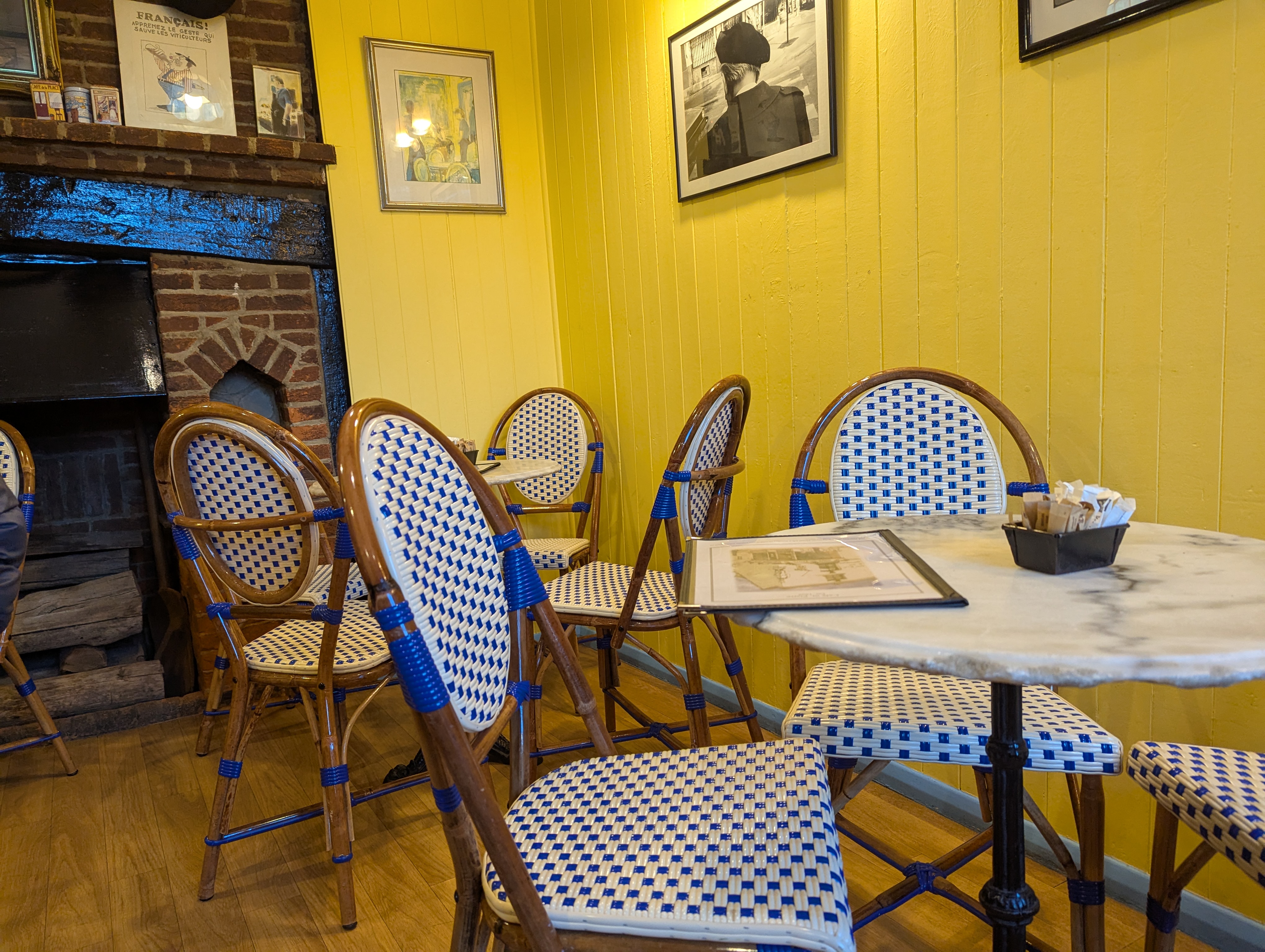
We woke very early in Cambridge and had breakfast at a Pret a Manger in probably the fanciest building we’d ever encountered for this establishment. A man was seated nearby waiting for his friend, while a man at another table drolly asked him if he intended to attend the parade to celebrate the Battler of Agincourt’s 575th anniversary. The Battle of Agincourt was one of few battles won by the British in the 100 Years’ War with France. The man waiting for his friend responded he would not attend the fictional parade; rather he would celebrate later with a bottle of wine. “Not French wine, I hope,” quipped the historical savant.
My husband had won the aBode shower lottery for the second day running. Warm for him, lukewarm for me. We headed for hopefully greener pastures with a fairly uneventful trip from Canterbury West to Charing Cross. The train had been nearly empty leaving Canterbury but became jam-packed, stop by stop, by the time we reached London. We had been wondering how on earth the Southeastern train system is able to run with any form of profitability considering how empty almost every train we’d been on over four days had been. It appears to work similar to Christmas for retailers. All the money must be made on trains as they approach stops close to London.
By the time we arrived in London, it was raining again, but our hotel was reasonably close by way of a funny alley. Our new hotel in London, The Grand at Trafalgar Square, met the new financial criteria to which my husband and I agreed before the trip. They weren’t ready to check us in, but checked our luggage and showed us to a nice lounge where we could regroup and make a latte. The hotel seemed pretty fancy for our new price point.
We were intending to meet a friend later in the day who was coming into London from California with her adult children. Their original flight had been cancelled and their new flight would be later. So we bought tickets for the Secret Maps exhibit at the British Library to stay occupied. We’ve been to the British Library twice in the past, once for the Treasures exhibit, years ago, and once for the Medieval Women exhibit earlier this year. The British Library has super interesting documents to start with, and they pull together such interesting narrative and themes for their exhibits.
This exhibit about secret maps was the best I’ve seen there. It just never occurred to me how interesting the history of maps is and how they were used–to share information as well as to obscure, deflect, and mislead to maintain an upper hand–commercially, politically, in warfare. Also, how many different kinds of maps there have been to be used for these purposes, including maps of land masses, trade routes, the heavens, escape routes, war equipment and assets. And how maps were shared with the right people.
After viewing the exhibit, we checked into our hotel, learning that The Grand is part of the Club Quarters chain. We’ve only stayed at this chain once on one of our trips many years ago. There’s a lot of work and lounge space in the hotel and it’s quite fancy. I noted that this would have been a good hotel for the times I worked from London last year. In contrast, the rooms are pretty basic and small. But, hey, hot water both days we need it. A win.
Speaking of maps used for deception, it’s long been a thing that Mikel Arteta keeps things close to the vest in his press conferences before a match. He tells the truth and nothing but the truth, but with regard to injuries, it’s often not the whole truth. There is often someone who came off the last match limping, of whom Arteta will truthfully say in his next press conference before a match whether the player has been in practice that week. But often he’ll say they’ll evaluate them on match day and see how things stand. Then that player may show up as a starter, or as a sub, or we’ll find out after the match he’ll have surgery tomorrow and will be out for at least three months.
Gabriel Magalhaes, big Gabi, came off in the match against Atletico Madrid with about 20 minutes left to play and it looked like something was not quite right with him. Arteta had said in his pre-match press conference for Crystal Palace that he was unsure whether Gabi would play against Crystal Palace. “Let’s see how he evolves,” he said. Arsenal is having a wonderful defensive season and a lot of the reason has been the play of Big Gabi. His partnership with William Saliba is considered among the best in the Premier League. And obviously, he’s been important for delivering goals from set plays. Either he heads it in himself or places where someone else can finish up the job.
But Arsenal’s defense is not only good because of Gabriel and Saliba; the whole team contributes to Arsenal’s overall stability. Arsenal has held every team goalless since September 28, yes, but teams hadn’t even been able to register a shot on target. And we’ve seen some great play from the person who can deputize Big Gabi, Christhian Mosquera. So losing Big Gabi would not be ideal, but it’s not a horrible situation either.
Arteta also used his press conference to encourage fans to bring the noise and spirit. “Play the game with us,” he requested. “If we’re going to win the league, everybody has to turn up.”
On that backdrop we arrived at the stadium the next day having spent a morning walking in the Tower Hill area and having had a nice lunch. We got to the stadium a bit late but still made time to walk through the Armoury and, as has lately been our habit, buying nothing. My husband and I were sitting apart from each other but both in the west stands. He was high up near the half way line; I was in Club near the North end. My seats were just about even with the D at the top of the penalty box. We had had a pretty easy time getting tickets for this match, none of the usual drama and not very many clicks.
I arrived at my seat with very little time to spare before the teams came out of the tunnel. There was something odd about my section that made it a little less straightforward to access from any direction and it took me some time to find the right passages. My section had quite a few human season ticket holders in it, and I’ve found that those areas of Club are almost as much fun as being in other parts of the stadium. Lots of spirit.
The whole stadium seemed to be taking Arteta’s request to heart. A lively atmosphere considering the opponent was Crystal Palace. Technically a derby, but usually one without as much of the usual rancor. This even though Crystal Palace managed to produce a tie in our last match at The Emirates.
One possible point of drama was that Eberechi Eze came to us from Crystal Palace. As I recall, he scored one of the goals in the match at the Emirates last year. The woman to the left of me wondered aloud whether Eze would celebrate if he scored a goal against Crystal Palace. There is some nonsense where players who score against their former team will not celebrate so as to be kind to their former club. To date, the Crystal Place fans have been notably classy about losing Eze to Arsenal. He did a lot for them. They appreciate that. Eze has played pretty well for Arsenal but has only scored one goal this season, in the Carabou cup. It seemed we probably would not find out the answer to that question on the day.
In contrast, Declan Rice came to Arsenal from West Ham under similar circumstances but while producing £105 million in revenue for his former club. Money that could be used to strengthen the West Ham team beyond replacing this one player. But Declan Rice gets tortured when he plays against West Ham. They do not forgive him at all. Rice didn’t score against West Ham in his first season with Arsenal. He did manage to score against them in early October at the Emirates. And while he did not celebrate the goal he scored right in front of the visiting fans, he appeared to make eye contact. A bit of a glare, I felt.
An example of a player who did celebrate against his former team: Arsenal had a player named Emmanuel Adebayor from 2006 to 2009, when he was sold to Manchester City. The first time Arsenal faced Man City at Man City’s stadium, Adebayor scored a goal against Arsenal and then ran the whole length of the pitch to celebrate in front of the Arsenal fans, who rioted. I’m sure he was receiving a ton of schtick from the Arsenal fans before that decision. The process of losing players was so painful at that time. You felt so insulted when someone chose to leave.
I was so late to my seat I didn’t have time to check out the line-up. As soon as the players came out of the tunnel, there was Big Gabi, clearly in the starting line-up. Quite a relief. And Eze, of course.
All the usual ceremony took place. Good old Arsenal (blah), North London forever (yay) and finally the kick-off.
Many times I’ve been asked why I fell in love with Arsenal. Although I fell in love well in advance of the Premier League being picked up by NBC sports in 2013, I remember a great article in the sporting press in conjunction with the rollout campaign for NBC about how, now that everyone would be able to watch every match, someone could go about selecting a team to support. It was described as being akin to the sorting hat in Harry Potter. Just watch the soccer and a team will be magically chosen for you.
I was watching soccer with my kids and husband on Fox soccer channel well before that and had that sorting hat experience after watching Arsenal a few times. When I try to verbalize why Arsenal was chosen, I say I’m a sucker for beautiful, flowing soccer. Arsene Wenger, Arsenal’s manager at the time, also appeared to have a weakness for that beauty. His teams were stacked with players with technical ability. People who could complete the beautiful pass, deception with the ball, a tricky dribble, a back heal, a lovely, arcing shot. But Arsenal was also naive in spirit and porous in defense. The Arsenal of old could also not break down a low block, but it was very susceptible to counterattacks.
But now, Arsenal is not that. This is not really a pretty team. So why has the sorting hat not rethought my options?
I’ve heard it said that the reason is Arsenal fans are hypocritical. Speaking only for me, I think I’ve become more mature as an appreciator of the sport. Not just the overtly pretty things, but things that are less obvious. I have learned that what I want and what Mikel Arteta wants are often two different things. And when someone knows more than you and sees things you never could and whose job hangs in the balance, it may make sense to try to respect that. And try to learn what that person is attempting to achieve. What is the objective when working from the back? What is the objective of the horseshoe of death (as we call it when Arsenal’s defenders are passing from right to left and back to right)? Why has Arteta selected this player in this situation and a different player in another situation? What are the different ways Arsenal attacks a set piece? I’ve learned to appreciate winning a duel, laying down a great tackle, working in concert to ensure our defensive team is the last line of defense and not the first line. And, of course, all the different ways to produce a deceptive set piece.
And when I approach a match with not just excitement, but also curiosity, a match that might have felt tedious to me feels interesting and like a learning experience. The Crystal Palace match, especially in the first half, was probably the poster child for a match I would have formerly found tedious, but at this time found fascinating. And with regard to my fellow fans at the stadium, I would say almost every time they might be starting to feel frustrated, they reacted by trying to lift up the team with chanting. Arteta’s request had clearly been heard.
Crystal Palace of course deployed a low block and Arsenal of course struggled to unlock it. I can only remember one shot on goal. And when Arsenal did unlock it, guess how?
Set piece again, olé olé. One of the Crystal Palace’s players briefly lost the plot near the end of the first half and fouled Saka, giving up a free kick, which Declan Rice took. At least 20,000 fans in the stadium picked up their phones and started taking video, including the man to my right. The ball Declan kicked naturally came to Big Gabi, who was facing Declan and away from the goal and who headed it back toward the edge of the penalty area. Eze came running in and struck the ball in a very odd way. Since the match, I’ve heard the kick he made referred to as a karate kick, a scissor kick, a hitch kick, a forward bicycle kick, and probably a few other things.
Whatever. It rocketed into the net.
Answer to the question posed at the top of the match by my seat mate: Eze did not really celebrate. He kind of also did not not celebrate.
We celebrated enough to make up for whatever it was he was doing.
At halftime I went to concessions and stood in a long line of people getting beer and ultimately picked up a cup of tea. One of the beers Arsenal is now serving at the stadium is Guinness. It takes a long time to pour a Guinness–I wonder if they regret that? The lady next to me complained fiercely to me about the inefficiency of the process of serving beer. Beer is available at no added charge to those in Club. Ergo, a lot of people want one. I appreciated her decision to read me into her frustration and nodded sympathetically, even though my empathy was not really piqued.
In the second half, Arsenal had a lot of chances right in front of me, just no success scoring. Hitting the bar, goal keeper saves, a lot of excitement, not much payout. Some set pieces that did not produce a goal.
Arsenal’s former player Eddie Nketiah was introduced late in the match to the applause of both home and away fans. Eze was withdrawn about 5 minutes from the end of normal time to the applause both home and away fans.
Toward the end, everyone seemed so tired and Crystal Palace did make some progress challenging toward the goal. I think Arteta was very willing to trust our defensive stability and not worry so much about scoring again. As much as Arteta does not worry. Whatever we are seeing on the field and however we might try to understand and appreciate it, there appears to always be something more he is looking for. I guess we are all growing up together but he’s working on it well ahead of most of us.
The match ended 1-0. The only shot registered by statisticians as being “on target” against Arsenal was this weird thing from Eddie Nketiah that David Raya easily caught. Arsenal’s six matches in October ended with no goals scored against it and only one shot taken by an opponent–Eddie Nketiah’s–being ruled “on target.”
My husband and I normally meet after the match at the Arsene Wenger statue. I got confused with the unusual set-up of my section and headed the wrong way out of the stadium. It took me forever to figure out my mistake. So long, and with crowds so thick. it just made sense to keep walking. It was raining again and when I arrived my husband was waiting under building near the statue.
We walked in the rain back to Arsenal station, 3 points in our raincoat pockets and plans for a nice dinner with our California friends.
With the rain in the rear view window, we woke early and visited Cafe St. Pierre for breakfast. I had the “French breakfast” which was the croissant of your choice, a baguette with butter and jam, and a “bowl” of coffee. I thought maybe they just meant a large cup, but they really did mean a bowl. I had to lift it up and slurp it like a cat. (I hope that is what I was meant to do.) Lot of carbs in that breakfast but we had an active day planned.
Shower Report for the day: After the hotel invested a bit of time evaluating and fixing the prior day, water heat was by now a bit of a lottery. My husband won the warm shower and I won the lukewarm one. Steps in the right direction.
We took the train from Canterbury’s other station, Canterbury East, to Dover. It was quite a beautiful ride through cute towns and forests on a nearly empty train.
You should probably never judge a town by the appearance around its train station, but Dover seemed surprisingly gritty. We searched out a Welcome Center, which turned out to be associated with the Dover Museum and Bronze Age Boat Gallery. My husband was familiar with the bronze-age boat on display and asked about it in the Welcome area. They invited us to head up and see it on the top floor of the museum.
The boat was found near Dover in some sludge in 1992 during a construction project. Later evaluation determined it to be about 3,500 years old, the oldest boat ever found in the world. The original boat is displayed in a giant glass case. It’s in unbelievably good condition. As with many archeological finds, the discovery of this boat adds to our understanding of how humans lived many years ago and what they were capable of.
The exhibit included displays of bronze-age tools such as may have been used to build the boat. Because the boat was missing the back end, it also included an exhibit on how archeologists have built theories for what the back of the boat may have been like. I thought that was super interesting. Interesting to experience the thought process of curious and knowledgeable people.
My favorite exhibit walked through an exercise that had been completed after the boat was found. A modern team attempted to replicate how the boat was built using bronze-age tools. They were able to build a replica of the boat (part of which is in the museum) in 6 weeks. In theory, the original builders probably were more familiar with the tools and boat building and could have completed it more quickly. But, in a bit of shade thrown by the people replicating the process, they concluded that, in part, it took them the long 6 weeks also because they also tried to provide beautiful finishes which the original team had not. That also provided clues as to the use of the boat. It was utilitarian and probably not ceremonial. But it certainly stood the test of time.
From the Welcome Center we walked over to the harbor and up the shore until we reached where the path is accessed to go up on the famous cliffs. The harbor is a functional harbor from which a number of huge ferries left or returned from trips over to France. It is not a beautiful stretch and sits right next to an extremely busy road. There are some cute cottages as you seek the path but they do not have a pretty view.
We climbed up and up the path. The wind was whipping but with the steepness of the path I became overheated pretty quickly. I stopped to remove my raincoat to finish the rest of the climb. On a clear day it’s possible to see France across the channel and we could make out the outline in the distance. In fact, we were close enough to France from the cliffs of Dover that T-Mobile sent me a text welcoming me to France and explaining the rates for texts and calls.
We were starting to be in a space that was far more beautiful than gritty. We could see the beautiful white cliffs, rolling hills, grazing sheep, the Dover castle. Even the harbor, which had seemed so industrial near the bottom, was pretty as we got higher on the cliffs.
At some point we had to make a decision about taking the high road or the low road. Our choice lead us very close to the edge of the cliffs. Although I’ve done a lot of Colorado hiking and skiing in my life, I’m not super comfortable with heights and I sensed my husband was also not so comfortable near the edge. We did all right and ultimately came to the part of the path that’s not so “out there.”
Our destination on the trail was the South Foreland Lighthouse. To reach it you go through a field of giant cattle. On the first floor of the lighthouse there is a cute little tea shop called Mrs. Knott’s Tearoom. It has a limited selection of items but who cares? It has cream team, which as we know means scones and clotted cream. It was served in lovely china in a beautiful room. It was a delicious way to celebrate the mid point of our hike.
We intended to go to Dover castle after our hike and, while we could see the castle from the cliffs, there is really no way to get to it without leaving the cliffs. So we hiked back down and then walked up a different hill, more or less in town, to get up to the castle.
If you may remember, my husband hurt his back on our last trip to England and it was not healed for this trip. He was able to do most things, but I tried to help with his luggage on stairs from airport to tube to hotel and carrying our shared backpack on our trips around Kent to try to preserve his ability to tour. He was still using heating belts to keep his back limber.
We had already walked more than 16,000 steps and 111 floors (so says Apple) and I felt maybe we could admit a small defeat and take a cab up to Dover castle. My husband would not hear of it. I’ll admit I was cursing his not-good-at-that-moment name as we climbed up the new hill. The fact is, we won’t always be able to do what we used to be able to do in the way we could do it. I hope over time we’ll be able to adjust our travel to fit our bodily realities and not have to stop travelling just because we can’t do it the way we used to. i.e., we may not always be able to hoist our luggage up and down stairs of stations on the Piccadilly line. Admittedly the cab in this case was for me as much as it was for him. I was pretty tired.
Now I’ve exposed you to the key conflicts in our household at the start of my retirement. My husband worries about spending too much money and I worry about losing our health while pushing to do things our bodies may be on the verge of no longer being able to do. My husband, the one with the sore back, seems to feel that he is not getting any older physically. In fact, this morning (a few weeks after this trip) he told me my feelings about aging are “a self-fulfilling prophesy.” I’m pretty sure our bodies will themselves fulfill my prophesy and, you know, “My Body, My Self,” so I can’t argue with his statement even though I suspect it will go down a bit differently than he intended with that turn of phrase.
But–this time–we made it to the top and made some quick calculations of what we’d be able to do at the castle. We were running out of time and it turned out there was a lot more to see and do at the castle than I had realized. This was not just another medieval castle (although it also was that), this area was used to protect England during modern wars also. Assuming it is ok to consider the World Wars as “modern.” There was also an very old church on the site. I think it would be easy to spend a full day at Dover castle.
We decided to hit the church and the medieval castle and skip the “modern” wartime tunnels, fire command post, underground hospital, etc. It was a tough call because those things looked very interesting.
The St. Mary in Castro church was built around 1500 years ago, probably on the site of a much earlier church. It apparently was a building that was not affected like other churches by the boring people coming in and demanding that color be removed. It had beautiful, colorful tiles in walls and ceilings, in addition to lovely windows. It’s a functional church. We had very little information about it as we toured, but it was lovely to be in. Next to the church sits a Roman lighthouse that’s been converted into a bell tower. Pretty cool.
We explored the castle proper. Although a building of some sort was in place during the Roman occupation and was damaged and rebuilt following the Norman invasion, the medieval castle as it exists now formed under Henry II, who we met yesterday as the person responsible–accidentally or intentionally– for Thomas Becket’s death. We walked through the external walls and the grassy enclosure and then through the keep. It was quite large with several floors to explore.
The way the castle was exhibited with representative but somewhat cartoonish furnishings was quite a lot like the castle at Norwich we toured last month. Similar set-up geared well for kids to explore. This castle was in much better shape, though. Because it was before Halloween, what the kids seemed most interested in in the castle was a worker dressed up for Halloween like a witch.
My favorite part of the castle was he views from the roof. It was unbelievably windy up there but you could see all over town, out on the country side, over to the cliffs. Beautiful.
We made our way down the hill again with sheep visible grazing in the moat of the castle. Our next destination was the rail station. We had decided to take the train to Deal, which we had not been able to visit as planned on our recent trip to Sandwich. The plan was to see Deal and have dinner before heading back to Canterbury where my husband was hoping to join his Italian language class online.
However, by the time we arrived in Deal we had new learnings about the train schedule and our time was going to be much shorter than we had originally understood. I had found a restaurant close to the station with acceptable ratings that also looked like it might make for a quick dinner, The Lane. It was early for dinner and there were very few people in the restaurant. Upstairs there was a Wicked-themed birthday party going on and the sound system in the restaurant was playing “For good.”
You may have noticed from my recent reports of what I’ve eaten in various places, except for breakfast, I’ve been leaning toward soups and salads. It was that point of traveling when your body demands vegetables. But when I sat down at the table at The Lane and reviewed the menu, my body demanded, of all things, a hot dog. And chips.
As you know, I live in the suburbs of Chicago, and what Chicago is known for, in addition to deep-dish pizza, is hot dogs. And I love a hot dog with everything that a Chicago dog normally comes with, except sport peppers. Tomatoes, relish, celery salt, a dill pickle spear, onions, mustard. Never ketchup. If you ask for ketchup in Chicago you will be abused. Sport peppers are a little too spicy for me and I’m in danger of having a sneezing fit when I eat them. Then it just becomes a Whole Thing. I remember ordering hot dogs in the Chicago Loop at lunchtime when I was working downtown. I would always say “Dog with everything except sport peppers.” And the worker would always repeat back my order, “Dog with everything, extra sport peppers.”
I digress, big time. The “classic” hot dog I ordered at The Lane was not a Chicago hot dog, but instead had on it ketchup, mustard, pickles, and “crispy onions.” As it arrived at my table I noticed it was HUGE. I figured I could manage about half that. I didn’t take a picture of it because it was just a hot dog. Then I took a bite. It was messy but the most amazing and yummy thing I’ve eaten for a while (this on a day I had scones and clotted cream). Maybe it was the crispy onions that made it so good? Maybe it was just a better quality hot dog? Maybe I was just really hungry after so much walking? I changed my mind and took a picture of part of it. My husband seemed to enjoy his tacos as much as I did the hot dog. And I did eat the whole thing.
As we were leaving, we asked the server if she had suggestions about what we should do if we had only 20 minutes in Deal. The thing she could think of was a local bar with a two-for-one drink special. I know she had just witnessed us eating our meal in a hurry and that may have made an impression, but I don’t think I could do two drinks in 20 minutes. In any case, we were not up for the challenge.
We thanked her and walked 5 minutes to the shore, took in the shops along the street next to the shore and the pier.
Deal is a cute little town, worthy of more than a 20-minute tour some day. But we had a train to catch and an Italian class to attend back at our temporary home in Canterbury.
We woke to a raw, wet day, endured the cold showers I mentioned in my last post, and then walked several blocks to the highly recommended Refectory Kitchen for breakfast. We made a point to sit far from the door and were quickly served a much-needed warm drink. My husband had a dish called “Green eggs and ham” (green because of pesto) and I had a French toast with blueberry compote. Great way to start the day.
We steeled ourselves and walked through the rain in our practical footwear over to the Canterbury Cathedral. We’ve seen a lot of Cathedrals lately and I know that, to some people, they start to be all alike. While it may be true that many parts of the physical cathedral are similar to others, what I usually find so interesting is the unique history of the people connected with the Cathedral. The Cathedral at Canterbury has a notably colorful history. We used the audio tour available and found it interesting and useful.
Canterbury Tales by Geoffrey Chaucer includes imagined stories of pilgrims who traveled to Canterbury Cathedral. I read parts of it either in high school or college and, although I’ve forgotten so much from many books I’ve read, the details in some of those stories are still fresh in my mind.
People made the pilgrimage to Canterbury in homage to Thomas Becket. Thomas Becket had been a nobleman and friend of King Henry II who was made Archbishop Of Canterbury. Kings and archbishops had great power over the subjects and King Henry II had reason to believe that by installing the like-minded Becket he would be able to exert more influence on the church. But as soon as Becket was made Archbishop, he began to go his own way to the great frustration of the king.
What happened ultimately is in dispute. Henry II either A) sent soldiers to kill Becket or B) said something innocuous that made the soldiers incorrectly believe they were being sent to kill Becket. Regardless of Henry II’s actual intent, the soldiers went to Canterbury and killed Becket inside the Cathedral.
Now martyred, he was named a saint by the Pope. And although pilgrims previously trickled to Canterbury Cathedral, Becket’s martyrdom and subsequent canonization turned that trickle into a deluge. Becket’s remains are buried in the cathedral and formerly could be viewed by visitors who were willing to pay for the privilege. I believe that is not possible today. (Maybe I should have displayed my crypto.)
The site where Becket was murdered is commemorated with some art that includes representations of the swords of the soldiers.
I’m a sucker for the cloisters in a Cathedral. It was still dark and rainy when I stepped out and took these photos which I think made them feel even more alive. You can just picture hundreds of years of monks coming and going.
My husband and I also loved the area called the Chapter House, which served as a place where monks learned the rules of the order. The carvings in the ceiling are gorgeous.
In the crypts, the sculpture called Transport is especially interesting. Created by British artist Antony Gormley, it’s made of nails from the Cathedral formed in the shape and size of a typical human body. It hangs from the ceiling using wires or strings. Photos aren’t allowed in the crypt but I found a picture of the sculpture online here. My husband enjoyed the display in the Water Tower that described how ink was made back in the day and also included a pocket sundial.
There is only one monarch entombed in the Cathedral, Henry IV. His uncle Edward, referred to as the Black Prince, is entombed close by. The Black Prince has an inscription on his tomb: “Such as thou art, sometimes was I, Such as I am such thou shalt be.” There is a lot more gory detail in the inscription, but that’s a good summary. You’re no different from me. The end is coming and you can’t avoid it.
As with all Cathedrals, there are some beautiful stained glass windows as well as some very plain windows that were forced into place during periods in history in which the powers that be disliked color in church and got rid of it. Or that had been removed to protect them from bombing in World War II and then had to be painstakingly reinstalled. Or that had not been removed and had been bombed and replaced. I particularly enjoyed the windows created by the Hungarian artist Ervin Bossanyi that were installed in 1960 and commemorate themes around World War II, salvation and peace.
We took a lunch break at a cute Mexican restaurant called Cafe des Amis du Mexique. I had a salad that was so yummy I’ve tried to recreate it at home. Don’t quite have it right as of this writing. I really enjoyed the papier mache art on the walls by Total Pap, which was available for sale.
With the rain now stopped, we took a short walk along the River Stour.
This museum is built on the site where a Roman floor mosaic was unearthed by a public works drainage modernization project. Later, work to excavate rubble from World War II bombings exposed further elements of a Roman home on the same site. These elements are encased and visible for viewing in the museum. Prior to the section of the museum that contains the Roman house, there are interesting exhibits about Roman history in England and Roman life. By the time you get to the excavation site, you feel awfully darned smart about the Romans.
We ended the day with a nice walk through town and along the river and dinner at the oldest pub in Canterbury, the Parrot, dating back to the 1400s. Pretty cool place for a pint.