
A lot has happened in our world since our last visit to London. My dear mother-in-law passed away recently, not long after she moved into assisted living. She was such a lovely person, it’s hard to think about her not being among us. My husband has been busy, visiting with his mom in her final days, helping my father-in-law with financial stuff, researching and writing an obituary, and so forth. My husband has also some challenges with joint pain and is in the process of commencing physical therapy. And, right before our last trip to London, I was diagnosed with noninvasive breast cancer. My 2024 has included a lot of doctor visits and two surgeries, with radiation treatment to come in a few weeks. And every time I get together with friends lately, the subject has come up, “When are you planning to retire?”
The sum of all this addition has produced at our home a lot of what my son refers to as “old people talk.” I’ve been especially exploring the idea of what makes for a good retirement, or more to the point, what kind of retirement doesn’t feel like you are just waiting around to finally die? I’ve seen examples of people in retirement who’ve look like death would be a serious interruption of some great living, and examples where it seems death already came–they just haven’t realized it yet.
A few weeks ago, I was in the office of one of the financial planners who works for my firm. I help build software for our financial planners and was visiting to get his impression of a new feature we are building. I noticed he had a Post-it note attached to his bookcase and asked him about it. He told me one of his clients had quoted it to him and he wrote it down. A good life, so the client said, requires:
- Something to do
- Someone to love
- Something to believe in
- Something to look forward to
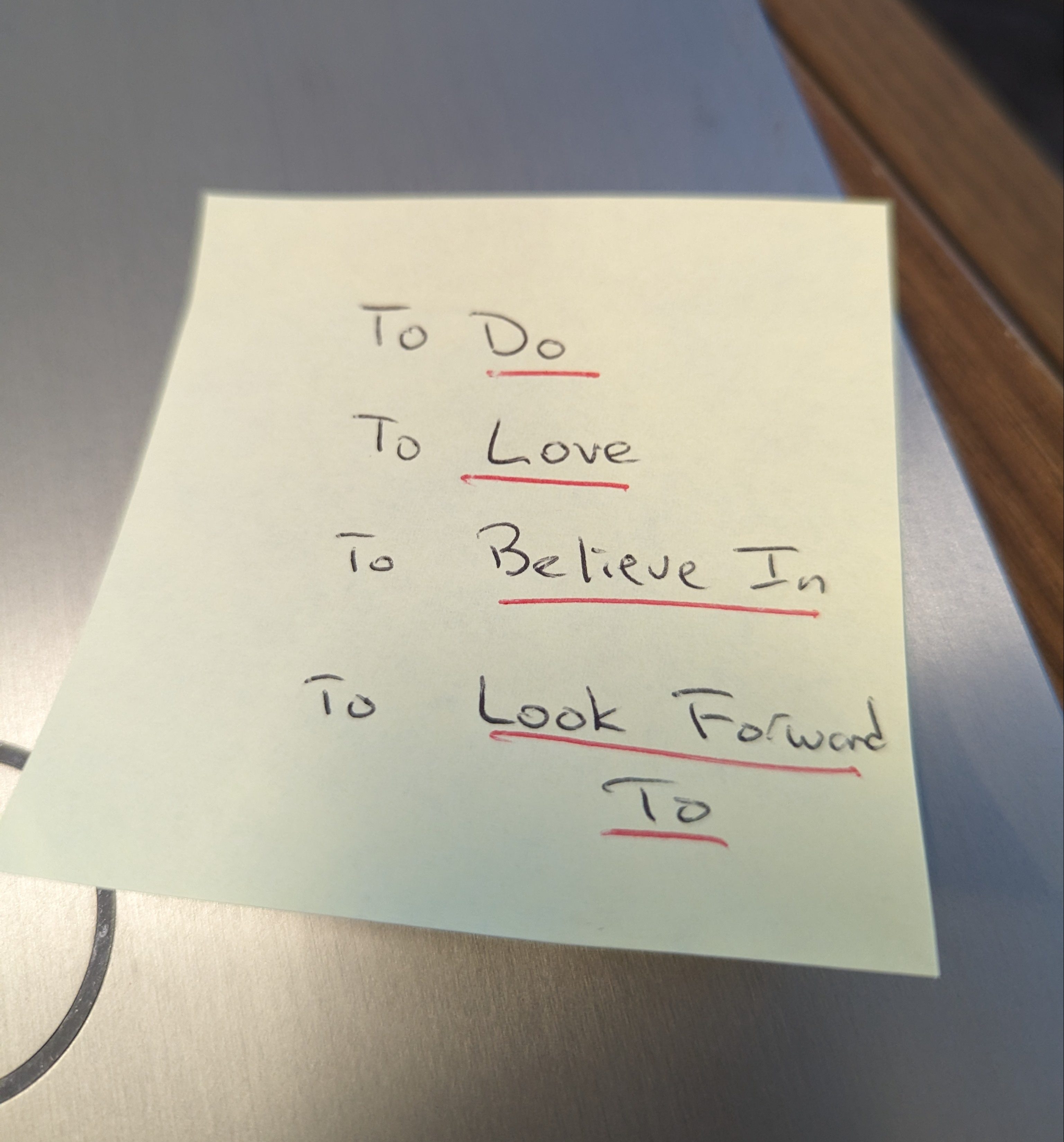
Note that the planner is quoting a client who is quoting someone, but in googling I’m unable to come up with a definitive source to attribute. In any case, I find this simplistic list to be compelling. The people who look like they are living out a good life all seem to have those things. And the ones who have a life I do not wish to emulate are missing some or all of those things.
That’s Message 1 from the universe.
Message 2: as I navigate the cancer diagnosis, for better or for worse, I’m working with physicians in a medical group associated with a particular hospital. It has made taking each “next step” relatively easy. Dr. A’s office says “make an appointment with Dr. X.” I have barely entered my house after leaving Dr. A’s office when Dr. X’s scheduling person is on the phone to set up an appointment.
This particular group has a prior association with a particular religious order. So at the end of the endless collection of data in every visit about my health history and the history of every family member, they always ask four kind of strange questions.
- Do you have someone in your life who loves you?
- Do you have something you look forward to?
- Do you have something in your life that brings you joy?
- Are you at peace today?
The first time I was asked those questions, I asked, “Is someone doing a research project?” Now I wonder if it’s not just a more disarming way to ask people about how they are really doing. Yes, they already asked me if I live with someone because they need to make sure I can get by without heavy lifting after surgery. But does that person love me? We are at a different level now. I don’t know what they would do differently if ever I answered “no” to the questions but so far, with clean conscience, I have always been able to answer “yes.”
I say “with clean conscience” because I’ve been surprised sometimes how much my inclination has been to not be fully honest. When my husband is with me during the medical questioning, he serves as a truth meter. Once before an MRI I was asked by a medical professional how I function in tight spaces. Naturally, I behaved as though this would not be a problem at all. But my husband was present and he said, “uh, really?” In the end, it was agreed that this procedure was best completed under anti-anxiety medication. My husband is not usually present at my appointments so the truth is sometimes, let us say, under-examined.
The way I choose to look at those four questions is they must be asking because those things are medically important to quality of life. Looking at the people who seem like they are living well, I have to agree that they would usually be able to answer these four questions in the affirmative.
If we were to do a Venn diagram of the two messages from the universe, we are easily able to note that one of the overlapping ideas is to have something to look forward to.
And that is the one that would be a bit of a struggle, if not for one essential fact: We’ve been lucky enough to score two tickets to the Champions League match against Porto next Tuesday and are leaving for London tonight. As unlucky as it was to have to have a second surgery when we had thought it would only be one, it re-set the clock a bit on radiation treatment which allows the perfect window for travel.

And so, I depart for London after weeks of looking forward to the trip, with someone I love (who I have every reason to believe also loves me), to do a bunch of fun things that will bring us joy, in the hope & belief that Arsenal can make it to the next round of the Champions League. And hopefully, return to Chicago at great peace.
It’s practice for the future.
 WholeArsed
That post-it really says it all. Condolences on your loss, and all-the-best wishes for a speedy recovery from your medical issue. On our recent doctor visits, those “probing” questions came up as what obviously is now a part on our primary care office to “zero in” on issues that might reveal a need for further evaluation. I am quite happy to say our truth meter is consistently reading honest…as we both keep each other honest with those answers. Best of luck to the Gunners!
LikeLiked by 1 person