Participating in local culture is important to us as travelers. And, in the UK, pubs are a big part of that culture. Pubs in London are often very old, dark and cozy. At Christmas time they are often decked to the hilt with lights and greenery and in the warmer weather many of them have beautiful flower boxes. And we’ve found the food–when available–to usually be quite good. Most pubs don’t have an extensive menu, but there’s enough variety to put together different options each time. Including healthful options, if that’s where your head is at. Classic pub food includes meat pies, fish and chips, and burgers, all of which I love.
I happen to enjoy a Guinness when I’m at a pub and having a beer. Guinness is ubiquitous at UK pubs. My husband, however, loves London Pride, a “cask ale.” This is a beer that is fermented in the same barrel it is served from, representing a local tradition of hundreds of years. That barrel is stored in the cellar of the pub and hand pumped by the bartender into your glass. Traditionally, the coolness of that cellar was the only factor that caused the ale to be chilled. I’m not sure that’s still true.
London Pride is a product of Fuller’s Griffin Brewery. It’s believed that the Fuller’s story started earlier than the 1700s, culminating in a brewery that ultimately found itself in financial trouble in the mid-1800s. John Fuller became a part owner of the brewery at that time, with his share passing to his son upon his death. Very recently (2019), the brewery has been sold to Asahi.
Fuller’s began buying up pubs beginning shortly after John Fuller bought his share. London Pride is available at some independent pubs and pubs that are tenants of Fuller’s, but it’s always available at pubs owned and managed by Fuller’s. Interestingly, although the brewery was sold to Asahi, Fuller, Smith & Turner continues to own and operate all Fuller’s pubs and its growing hotel business. It owns hundreds of pubs and more than 30 inns in Southern England. The pubs are often old, historic buildings, full of charm and many of them brimming with British social life across centuries. The names of the pubs are part of the fun of visiting, often reflecting local history and serving as an inspiration for decor.
You can buy London Pride in bottles in the United States, and we have, but my husband says it’s just not the same as getting it from the barrel.
The food situation seems to vary by Fuller’s pub. Some of the pubs offer food cooked onsite, some offer snacks, and some offer nothing! Some share the same menu and others have unique offerings. Fuller’s has a specific designation for some of their pubs as being “Ale & Pie” houses. The pies are quite good.
Because my husband loves London Pride so much, many of the pubs we visit are Fuller’s pubs simply because we know for a fact they’ll serve it there. He has the Fuller’s app on his phone and a delightful feature is that his phone starts chirping whenever a Fuller’s pub is nearby.
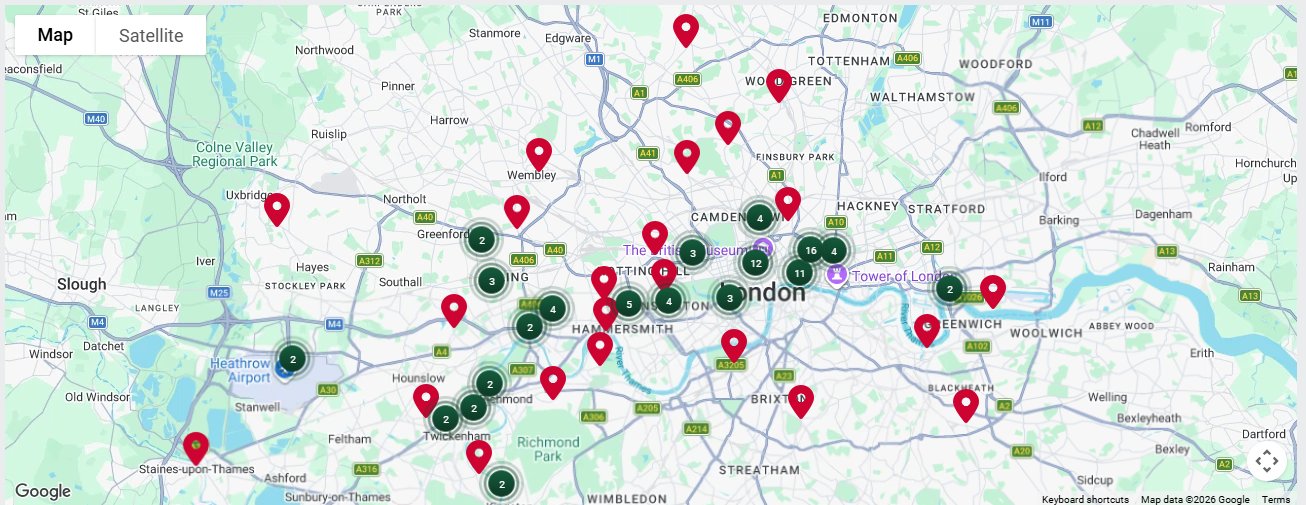
We’ve started keeping track of the Fuller’s pubs in London we’ve visited. Naturally, the goal is to hit them all. Here’s how we’re doing so far, with many pints ahead of us. The history is summarized using Google AI that I’ll fill in and confirm over time.
| Pub | Nearest Tube or Overground Station | History | Visited |
| The Admiralty, Trafalgar Square | Charing Cross | Built in 1871, as a bank. The pub was launched in 2014, a tribute to British naval history. An “Ale & Pie” House. We have visited this pub several times. It’s kind of match-day tradition when we’re staying in the neighborhood. | Yes |
| The Harp, Covent Garden | Charing Cross or Leicester Square | Built in 1785. Includes portraits of actors, opera stars, and singers who frequented the bar. Also known for its beautiful stained glass. This pub doesn’t have a kitchen and serves only snacks. We had a drink here and went elsewhere for lunch. | Yes |
| The Round House, Covent Garden | Covent Garden | Built in 1868. Popular with tradespeople and theatre goers. It has a kitchen but we happened to be there during limited operation. Toasties for us! They hit the spot. | Yes |
| The Lamb & Flag, Covent Garden | Covent Garden or Leicester Square Station | Building origins to 1623, pub established 1772, exterior rebuilt 1958. Charles Dickens was a famous patron. Known for bare-knuckle fighting that took place upstairs during the early 1800s. | Yes |
| The Red Lion, Westminster | Westminster | Built in 1899 but a pub has been on site since 1434. Charles Dickens frequented a pub on this site. Winston Churchill was a regular patron. The pub has a bell that historically informed members of Parliament they had eight minutes to get back for a vote. | |
| The Red Lion, Mayfair | Piccadilly Circus or Green Park | Built in 1821, but a pub has been on this site since 1788. Preserved Victorian “gin palace” interior. | |
| The Coach And Horses, Soho | Covent Garden or Leicester Square | The current building was built in1840, but a pub has been on site since 1724. A haunt for the columnist Jeffrey Barnard (“Low Life” in The Spectator, starting 1978). Also patronized by The Beatles. | Yes |
| The Sun & 13 Cantons, Soho | Piccadilly Circus | The current building was built in 1882, with a pub on this site since 1756. The “13 cantons” name comes from the popularity of the pub with Swiss migrants who jokingly called it the 13th canton of Switzerland. Popular with icons of cinema and a birthplace of 90s electronic music. Food: Features a rotating residency for emerging chefs. | |
| The Ship, Soho | Oxford Circus or Tottenham Court Road | Built 1887, pub on site since 1780. Tidbit: Popular with artists like David Bowie, Jimi Hendrix, John Lennon. Stone’s Keith Moon was banned from this pub. | |
| The Sanctuary House Hotel, Westminster | St. James Park Station | Site of a Medieval monastery. Current building, late 1800s, was originally an office space. Opened as a pub in 1998. An “Ale & Pie” House. | |
| The Wellington Hotel, Waterloo | Waterloo | Original tavern dates from 1851, rebuilt in 1918. Known for its ceiling mural of the Battle of Waterloo. It was the site of a series of late 1800s poisonings of young female patrons and was patronized by other famous criminals. It served as a temporary infirmary during the World Wars and hosted early concerts by The Who and The Rolling Stones in the 60s. | Yes |
| The Jack Horner, Bloomsbury | Goodge Street or Warren Street | A tavern/hotel existed on this site from 1776 -1941 at which time it served as a bank. It was converted back to a hotel and pub in the 1990s. An “Ale & Pie” House. | Yes |
| The Duke of Sussex, Waterloo | Waterloo | The current structure was opened as a pub in 1924, designed by A.E. Sewell and is known for its exterior tile. It’s also known for some drama surrounding its sign that reflected images of Prince Harry and Meghan that had to be removed when they stepped down from public service. | |
| The Iron Duke, Mayfair | Bond Street | The only surviving “mews” pub in Mayfair. (Off the main drag, typically frequented by the servant class.) A pub has stood on this site since the 1700s. The current building was built in1866. The pub honors Arthur Wellesley (the first duke of Wellington), who led the successful fight against Napoleon at Waterloo. Wellington boots are a key element of decor throughout the pub, including on its sign. | |
| The Windmill, Lambeth | Lambeth North, Vauxhall | Previously the site of a mill, and a prior pub since 1822, the current pub was built by Fuller’s in the 1930s. Known for decor that includes portraits of stage actors who worked nearby. | Yes |
| The Hercules, Lambeth | Lambeth North | Original site of a pub opened in 1805, it was restored by Fullers in 2019. The pub is close to an old circus and is named after a circus strongman. William Blake was a patron of the old pub and Charles Dickens mentions it in A Tale of Two Cities. | Yes |
| The Mad Hatter Hotel, Southbank | Southwark or Waterloo | On the old site of a manufacturing hub for hats, the present building was bought by Fuller’s in 1998. The property has been sold but the pub is still owned and operated by Fuller’s. | |
| The Jugged Hare, Victoria | Victoria | Originally built as a bank in the 1800s. Restored and turned into a pub in 1996. A Fuller’s “Ale & Pie” house, specializing in meat pies. | |
| The White Hart, Southwark | Borough | A famous pub by this name stood a half mile away. That pub had been established in the early 1400s, was destroyed by a fire, rebuilt in the late 1600s, and demolished in the late 1800s. That pub had been where Jack Cade headquartered during an uprising against Henry VI and was featured in Shakespeare’s play about Henry VI. It was also a setting used in Dicken’s Pickwick Papers. The current pub named The White Hart was built shortly before the original was demolished. The “new” pub is known for exterior glazed tiling with “FRIARS MEUX” (a centuries-old brewery) advertising still visible in the tiles. | |
| The Ye Olde Mitre, Holborn | Chancery Lane or Farringdon | Pub on this site since 1546. Supposedly Queen Elizabeth I danced around a cherry tree on this site, May pole style, the trunk of which is preserved in the corner of the bar. The pub’s land belonged to the Bishop of Ely and was considered outside the jurisdiction of the City of London. Therefore, legend had it that criminals could escape arrest by London police by running into the pub. This pub has no kitchen. We were served intentionally cold, gelatinous pies we tried but could not finish. The beer was suitably cold. | Yes |
| The Shaws Booksellers, St. Andrew’s Hill | Blackfriars or St Paul’s | The office building the pub is currently housed in was built in the late 1800s and was used as a paper warehouse and mill. An iron loading hoist used to lift the product remains in front of the building. The building was used in filming the 1997 movie, The Wings of the Dove, some of which took place around a fictional book shop named “Shaw’s Booksellers.” Fuller’s bought space for the pub shortly after the movie was filmed and decided to name the pub for the bookstore name that had been painted on the building. | |
| The Conductor, Farringdon | St. Paul’s or Farringdon | This pub is located above the historic River Fleet, first a Roman-era river that was later built over and served as a sewage canal. The pub’s current name is based on the proximity to a major transport station, the City Thameslink Station. | |
| The Viaduct Tavern, Newgate | St Paul’s | The building, built in the late 1800s, is considered London’s most famous example of a Victorian “Gin Palace.” It is also the site of a disproven myth that posits holding cells for the original, notorious, Newgate Prison are in the building’s basement. It’s known for its beautiful wall murals, ornate ceiling, etched mirrors, and cashier’s “token booth. Like any proper pub, it is supposedly frequented by a ghost named “Fred.” | |
| The Star Tavern, Belgravia | Knightsbridge or Hyde Park Corner | First pub on this site started in 1848, patrons primarily being domestic workers for wealthy families nearby. Paddy Kennedy, a gambler, owned the pub in the 1950s, and the pub was frequented by famous actors and criminals. The Great Train Robbery (1963) was allegedly planned in an upstairs room. | |
| The Fence, Farringdon | Farringdon | The building was originally a butcher’s cold storage warehouse, close to railway lines. In the early 1990s, parts of the building were updated to serve as a center for LGBTQ+. It was repurposed as a pub in the late 1990s and Fuller’s bought it around 2008. | |
| The City Pride, Farringdon | Farringdon | Tavern on this site since 1839, renamed in 1983. It sits near the historical site of The Clerk’s Well and functioned as a beer garden for people coming to the wells to watch biblical mystery plays. They serve pizza, and it’s very very delicious. This was the tavern with the cool London Pride glasses that the barkeep invited us to steal. (We did not.) | Yes |
| St. Barts, Smithfield | Barbican or Farringdon | The building was originally a “banking hall” in the late 1800s and is known for its Victorian architecture. It was named after the historic St. Bartholomew’s Hospital nearby which has been in place since the 1100s. | |
| The Butchers Hook and Cleaver, Farringdon | Barbican or Farringdon | Fuller’s built a pub in 1999 on the site of a bank and a butcher shop near the famous Smithfield meat market. The pub is opposite the site where Scottsman William Wallace (of Braveheart fame) was hung in 1305. An “Ale & Pie” house. | Yes |
| The Doric Arch, Euston | Euston Square | Situated inside Euston train station, the pub is named in honor of a lost monument called the Euston Arch that formerly stood at the entrance of the station and had been controversially destroyed during a modernization project. A piece of the Arch is displayed in the pub. The pub dates to the early 1960s, although a pub has stood on the site since the early 1800s. | |
| The Signal Box, Euston | Euston | This pub is actually inside Euston Station and opened in 2018. It’s named for the signal box inside Euston station which was once the largest mechanical signal box in the world. The pub features displays of railway memorabilia. We visited this pub as waited for a friend to arrive on the train. | Yes |
| The Euston Flyer, Euston | Euston or King’s Cross St. Pancras | The building originally held a sewing machine shop. The pub was established when a large youth hostel located nearby. The name of the pub reflects the nickname of a steam locomotive that formerly ran between Euston Station and Scotland. | |
| The Pavilion End, St. Paul’s | Mansion House or Cannon Street | The building was originally a shoe factory in the 1800s on a road that has been in use in various iterations as far back as Roman occupation. The current pub is dedicated to sports and, particularly, cricket. | |
| The Trinity, Borough | Borough | A pub has been on this site since the 1800s, originally named St. George’s Tavern. The current pub has an area called “The St. George’s Room” in homage to the original pub. A funny history is that the building also housed a Museum of Curiosities downstairs from the tavern. The pub’s current name reflects the Trinity House Estate nearby, and is close to Trinity Street, Trinity Church Square, and the Holy Trinity Church. | |
| The Antelope, Belgravia | Sloane Square | Pubs appeared on this site since the 1700s. The current building was built in the early 1800s to serve domestic servants of wealthy families. It was retrofitted to serve the wealthy themselves, taking care to separate the classes. Two front doors remain, one for each. The pub contains a wall of memorabilia in support of a sponsored cricket club, “The Antelopians.” | |
| The Saint, Bow Lane | Mansion House | A relatively new pub, it’s located next to St. Mary-le-Bow, one of many churches rebuilt by Sir Christopher Wren following the Great Fire (1666) but heavily damaged during WWII. It sits on Bow Lane, one of London’s oldest streets, housing a shoe-making district in medieval times. The pub’s outdoor patio is in the churchyard and a good vantage point for hearing the church’s Bow Bells. The current bells were replaced following WWII, but the sound of bells have featured in the neighborhood across centuries. | |
| The Banker, Cannon Street | Cannon Street | A newer pub (1970s or 80s), its brick ceilings are the original structure supporting tracks and platforms at the Cannon Street Station. It’s one of few pubs at the edge of the Thames and it sits on the site of a medieval steelyard. | |
| The Sutton Arms, Barbican | Barbican or Farringdon | A pub has stood on this site for at least 200 years and under the name The Sutton Arms at least since 1825. It was named for the very wealthy Sir Thomas Sutton, who died in 1611. His fortune was used to establish a famous school for boys on the land near the pub. Well before Sir Thomas Sutton’s influence, the area near the pub was home of the Carthusian Monastery, a hotbed of resistance to King Henry VIII’s plan to dissolve monasteries in the 1500s. He did destroy the monastery and brutally dealt with leaders of the resistance, including nailing the arm from the murdered Prior to the gatehouse as a warning to others. The pub also sits near a large mass grave for victims of the 1300s Black Death. The pub has a distinctive, barrel-shaped window that was added in the late 1800s during a redesign that also created separate doors and rooms to serve different social classes. It has a red-haired ghost named Charlie. | |
| The Barrowboy and Banker, London Bridge | London Bridge | A Fuller’s “Ale & Pie” House. Situated in an old palazzo-style Victorian banking hall, which was built in the late 1870s. It was a working bank until Fuller’s bought it in the late 1990s. The “barrowboy” reference in the name of the pub pays homage to street traders who pushed barrow loaded with goods in the streets. Safety deposit boxes of the Bank are visible on the upper floor and the bank vaults in the basement now secure the cask barrels. | |
| The Vintry, Cannon Street | Bank or Cannon Street | This pub is located near the “Vintry Ward,” the district known in the 1100s and 1200s for wine trade. The land beneath the pub originally housed the “Worshipful Company of Vinters.” The current building is relatively new, built in the 1990s. The pub’s outside garden is on the site of a former Medieval graveyard belonging to the St. Mary Abchurch next door. The pub includes a huge wine tasting room. | |
| The Tokenhouse, Moorgate | Moorgate or Bank | The name reflects businesses that sprung up in the 1600s to help people be able to break gold or silver coins issued by the Royal Mint into smaller units to be able to buy necessities. The tokens were created using brass and lead and offered via “Tokenhouses.” Tokenhouses were eliminated during the 1600s. The pub is situated in a former Edwardian Palladian-style bank building established in 1915. It became a pub in 2008 and was bought by Fuller’s in 2012. | |
| The Parcel Yard, King’s Cross Station | King’s Cross St. Pancras | The largest railway pub in Great Britain, it was built in a section of King’s Cross Station that was completed in 1852 as a parcel office and depot. Fuller’s opened its pub in 2012. The areas that once were used to store packages are now used to retain cask ale barrels. The pub is adjacent to mythical Harry Potter Platform 9-3/4 and also, as legend has it, the burial site for Queen Bodica, a Celtic queen who fought the Romans during their occupation. | |
| The Telegraph, Moorgate | Moorgate | The pub is located on street hosting the global headquarters for the Electric and International Telegraph Company. A pub stood on the site since the 1800s and was demolished in 2002 to make way for an office building. Fuller’s opened the current pub on the ground floor in 2003. | Yes |
| The Hydrant, Monument | Monument | Located near The Monument to the Great Fire of 1666 and opened in 1999. We’ve visited here a few times. Great people-watching as they pose outside the window to be photographed in front of The Monument. | Yes |
| The Counting House, Cornhill | Bank or Monument | An “Ale & Pie” House. | |
| The Swan Tavern, Leadenhall | Bank or Monument | ||
| The Victoria, Paddington | Lancaster Gate or Paddington | ||
| The Artillery Arms, Old Street | Old Street | ||
| The Hung, Drawn and Quartered, Tower Hill | Tower Hill | The pub is near the Tower of London which housed many a person destined for execution, including by means described in the name. The site has previously housed a school and a bank. Fuller’s converted it to a pub in the late 1990s. An “Ale & Pie” House. | Yes |
| The Swan, Hyde Park | Lancaster Gate | ||
| The Trinity Bell, Aldgate | Aldgate | ||
| The Bull & Hide | Liverpool Street | ||
| The Crown, Islington | Angel | The pub is on the site of the land of a wealthy tax collector, Richard Cloudesley, which was left to a charitable trust. The pub was built around 1820 and rebuilt in the late 1800s. The interior features Victorian “snob screens, designed to keep the wealthy patrons from having to see or interact with working-class people. They are beautiful. I think this pub might be one of my favorites. It was especially cozy. We were definitely seated in the “working class” section. | Yes |
| The Astronomer, Liverpool Street | Liverpool Street | Built on the site of a building called the “Astral House,” which offered assistance to Jewish immigrants. The Astral house was built in 1896 and the first-floor pub was converted by Fuller’s in 2016 and then refurbished, including its space-themed decor, in 2016. At that time, its name was changed to “The Astronomer.” This is the pub at which a drunk who wanted us to buy him a beer intimated that he believed I was my husband’s mother. My husband corrected him quickly, announcing that I was in fact his grandmother. | Yes |
| The Chamberlain Hotel, Tower Hill | Tower Hill or Aldgate | ||
| The Mad Bishop & Bear, Paddington Station | Paddington | ||
| The Masons Arms, Clapham | Battersea Park (rail) or Battersea Power Station (Northern) | ||
| The Hereford Arms, Kensington | Gloucester Road | The site of a pub since 1857 and rebuilt in 1865. Sir Conan Doyle and Sir J.M. Barrie were frequent patrons. Rumor has it, also Jack the Ripper! (keeping in mind his true identity has never been reliably determined.) We’ve been to this pub a few times, including for Sunday Roast once. It’s as charming as can be. | Yes |
| The Churchill Arms, Kensington | Notting Hill Gate; High Street Kensington | ||
| The King’s Head, Earl’s Court | Earl’s Court | ||
| The Blackbird, Earl’s Court | Earl’s Court | An “Ale & Pie” House. | |
| The Scarsdale Tavern, Kensington | High Street Kensington | ||
| The Union Tavern, Maida Vale | Westbourne Park Station | ||
| The Hand and Flower, Hammersmith | West Kensington | ||
| The Latymers, Hammersmith | Hammersmith | ||
| The Queen’s Head, Hammersmith | Hammersmith | ||
| The Holly Bush, Hampstead | Hampstead | Originally built in the late 1700s as a stable for the house next door, it evolved into a pub by the mid 1800s. It was acquired by Fuller’s in 2010 and refurbished in 2026. Lots of famous patrons over the years including now. We’ve been to this pub twice, including once for Sunday Roast. It’s beautiful, inside and out. And the food is notably delicious. | Yes |
| The Distillers, Hammersmith | Hammersmith | ||
| The Flask, Highgate | Highgate | The main building was built in the early 1700s. The pub is said to be haunted by an 18th or 19th century barmaid and by a 17th century cavalier. Famous visitors included Karl Marx poets Lord Byron, Percy Bysshe Shelley, and John Keats, and a notorious Outlaw highwayman, Dick Turpin. | |
| The Blue Boat, Hammersmith | Hammersmith, Baron’s Court | ||
| The Crown and Sceptre, Shepherds Bush | Goldhawk Road or Shepherd’s Bush Market | ||
| The Dove, Hammersmith | Ravenscourt Park or Hammersmith | ||
| The Sail Loft, Greenwich | Greenwich or Cutty Sark (DLR) | ||
| The Gun, Docklands | Canary Wharf; Blackwall (DLR) | ||
| The Red Lion, Barnes | Piccadilly Circus or Green Park | ||
| The Great Northern Railway Tavern, Hornsey | Hornsey (Overground), Turnpike Lane Station | ||
| The George IV, Chiswick | Turnham Green | ||
| The Pilot, Greenwich | North Greenwich | ||
| The Old Pack Horse, Chiswick | Turnham Green | ||
| The Pilot, Chiswick | Gunnersbury, Turnham Green | ||
| The Bell and Crown, Chiswick | Gunnersbury (District, Overground) | ||
| The Windjammer, Silvertown | Custom House Station (Elizabeth, DLR), Canning Town Station | ||
| The Plough, East Sheen | Richmond Station | ||
| The Lord Northbrook, Lee | Hither Green or Lee (rail) | ||
| The Fox and Goose, Ealing | Park Royal, Ealing Broadway | ||
| The Elephant Inn, North Finchley | Woodside Park or Finchley Central | ||
| The Rose and Crown, Ealing | Ealing Broadway | ||
| The Plough Inn, Ealing | Northfields | ||
| The Drayton Court, Ealing | Ealing Broadway; West Ealing (Elizabeth line) | ||
| The Duke of Kent, Ealing | Ealing Common or Ealing Broadway | ||
| The London’s Pride, Heathrow Terminal 2 | Heathrow | ||
| The Queen’s Arms, Heathrow Terminal 2 | Heathrow |

